
Contents
- 1. How to Brief a Clothing Manufacturer [Template]
- 1.1. Why a Poorly Written Brief Costs More Than the Sample
- 1.2. The 7 Essential Sections of a Manufacturer Brief
- 1.2.1. Section 1 — Brand and Project Overview
- 1.2.2. Section 2 — Garment Description and Style Reference
- 1.2.3. Section 3 — Fabric and Material Requirements
- 1.2.4. Section 4 — Quantity, Sizes, and Colourways
- 1.2.5. Section 5 — Sampling Requirements and Timeline
- 1.2.6. Section 6 — Quality and Construction Standards
- 1.2.7. Section 7 — Delivery Requirements and Deadlines
- 1.3. How to Send Your Brief — Email Template
- 1.4. What Happens After You Send the Brief
- 1.5. Common Briefing Mistakes That Cause Production Problems
- 1.6. FAQ
- 1.6.1. What should be included in a clothing manufacturer brief?
- 1.6.2. Do I need an NDA before briefing a manufacturer?
- 1.6.3. How detailed does my brief need to be if I don’t have a finished tech pack yet?
- 1.6.4. What happens if my brief doesn’t get a response?
- 1.6.5. Can I send the same brief to multiple manufacturers at once?
How to Brief a Clothing Manufacturer [Template]
A vague brief costs more than a bad sample. If a manufacturer has to guess at fabric weight, quantity, or your deadline, they’ll quote based on their best assumption — and that assumption often doesn’t match what you actually need.
This guide covers how to brief a clothing manufacturer UK startups and established brands can use to get an accurate quote and a smoother production process from day one.
In this article:
- Why a poorly written brief costs more than the sample itself
- The 7 essential sections every manufacturer brief needs
- A ready-to-use email template for first contact
- What happens after you send your brief
- The mistakes that cause production problems down the line
Why a Poorly Written Brief Costs More Than the Sample
A manufacturer can only quote and produce based on what you tell them. Leave out fabric weight, and they’ll assume one. Leave out your target price point, and they’ll quote without knowing whether you need budget or premium construction.
Every gap in your brief becomes a guess on the factory’s side — and guesses are where fit issues, wrong fabric orders, and missed deadlines start.
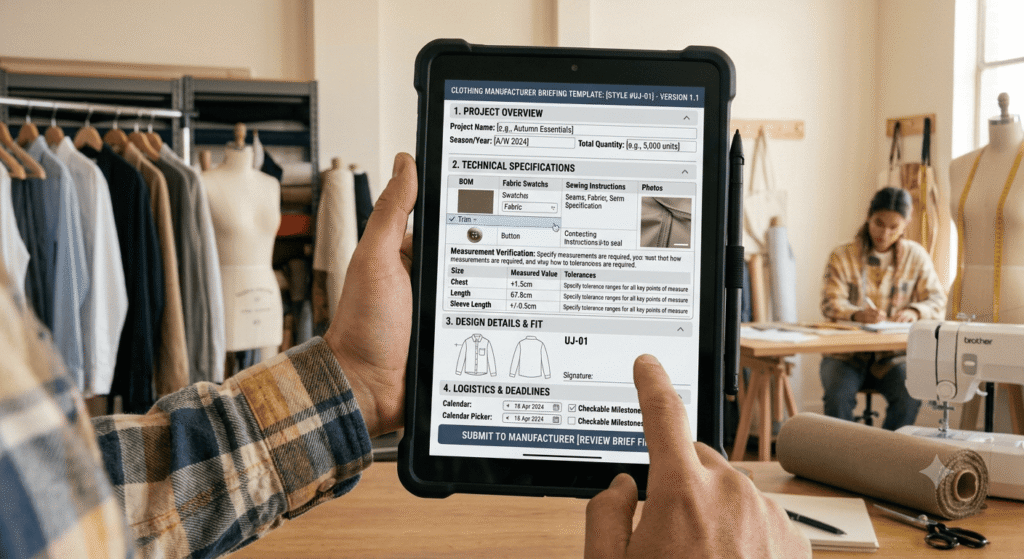
The 7 Essential Sections of a Manufacturer Brief
| # | Section | What It Covers |
|---|---|---|
| 1 | Brand and Project Overview | Who you are, what the project is |
| 2 | Garment Description and Style Reference | What you’re making, with visual reference |
| 3 | Fabric and Material Requirements | Fabric type, weight, composition, trims |
| 4 | Quantity, Sizes, and Colourways | Order volume, size range, colour options |
| 5 | Sampling Requirements and Timeline | What samples you need and by when |
| 6 | Quality and Construction Standards | Tolerances, finishing expectations |
| 7 | Delivery Requirements and Deadlines | Ship date, destination, packaging needs |
Section 1 — Brand and Project Overview
Introduce your brand briefly and explain what this specific project is — a new core range, a one-off capsule collection, a reorder. This context helps a manufacturer understand whether you’re likely to be a repeat customer or a one-time order, which can affect how they prioritise and price your enquiry.
Section 2 — Garment Description and Style Reference
Describe the garment clearly, and include reference images or a rough sketch even if you don’t have a full tech pack yet. A manufacturer working from “a casual dress, similar to X brand” needs the reference image, not just the brand name — style interpretation varies enormously between people.
Section 3 — Fabric and Material Requirements
Specify fabric type, weight (in GSM if you know it), composition, and any required certifications like OEKO-TEX. If you don’t have a fabric locked in yet, say so clearly and ask whether the manufacturer can recommend options — leaving this section blank without explanation reads as an oversight, not an open question.
Section 4 — Quantity, Sizes, and Colourways
State your minimum order quantity expectations, size range, and how many colourways you need. This section directly affects pricing, since MOQs and colourway count both influence cost per unit — vague quantity ranges make it hard for a factory to quote accurately.
Section 5 — Sampling Requirements and Timeline
Specify whether you need a proto sample, straight to pre-production sample, or a full sampling process with revisions. State your target dates, and be realistic — a rushed sampling timeline is one of the most common causes of quality issues later.
Section 6 — Quality and Construction Standards
Note any specific construction requirements, measurement tolerances, or finishing standards that matter to your brand. If you have a tech pack, reference it here; if not, describe your quality expectations in as much concrete detail as possible.
Section 7 — Delivery Requirements and Deadlines
State your required delivery date, destination, and any packaging or labelling specifications tied to delivery. Build in buffer time — production delays are common, and a brief with zero flexibility around the deadline puts unnecessary pressure on both sides from the start.
How to Send Your Brief — Email Template
Keep your first email concise, with the full brief attached as a document rather than written out in the email body.
Subject: Production Enquiry — [Your Brand Name] — [Garment Type]
Hi [Manufacturer Name],
I’m reaching out from [Brand Name] regarding a potential production run of [garment type, e.g. “women’s midweight cotton dresses”]. I’ve attached a full brief covering fabric requirements, quantities, sizing, and timeline.
In short: we’re looking at an initial order of approximately [quantity] units across [number] colourways, with a target delivery of [month/year]. I’d appreciate a quote and an indication of your current lead times.
Happy to share reference images, fabric swatches, or further detail on request.
Best regards, [Your Name]
Consider whether an NDA is appropriate before sharing detailed designs or proprietary information — a signed confidentiality agreement is standard practice before disclosing ideas you want to keep protected (GOV.UK).
What Happens After You Send the Brief
Expect a manufacturer to come back with clarifying questions before quoting, especially on a first enquiry — this is a good sign, not a delay. A factory that quotes instantly without asking anything may be quoting on assumptions rather than your actual requirements.
If you’re preparing your first brief and want it reviewed before sending, our clothing manufacturing services team can look over your brief and flag any gaps before it goes to quote.
Common Briefing Mistakes That Cause Production Problems
Leaving fabric specification vague. “Cotton” without weight or composition leaves too much room for interpretation. Fix: specify fabric weight in GSM and composition percentage wherever you have it.
Not stating a realistic timeline. An unrealistic deadline set in the brief often gets missed anyway, just later and with more frustration. Fix: build in buffer time and communicate your true deadline, not an artificially compressed one.
Omitting your target price point. Manufacturers quote differently depending on whether you need budget or premium construction — leaving this out means a mismatched quote either way. Fix: give a rough target cost range, even if it’s approximate.
Sending reference images without explaining what you actually want changed. “Similar to this” without noting what should differ leads to a sample copying details you didn’t intend to keep. Fix: annotate reference images with specific notes on what to match and what to change.
Skipping quantity and colourway detail until later. Both directly affect pricing, and leaving them vague delays getting an accurate quote. Fix: include your best estimate for quantity and colourway count in the initial brief, even if it may shift slightly later.
FAQ
What should be included in a clothing manufacturer brief?
A complete brief should cover brand overview, garment description with visual reference, fabric requirements, quantity and colourways, sampling needs, quality standards, and delivery deadlines. Missing any of these sections usually means the manufacturer has to guess or come back with follow-up questions before quoting.
Do I need an NDA before briefing a manufacturer?
An NDA is worth considering if you’re sharing detailed proprietary designs or unique product information you want to keep confidential. For a general enquiry with standard garment types, it’s less commonly required, but it’s a reasonable request if you’re uncertain.
How detailed does my brief need to be if I don’t have a finished tech pack yet?
Provide as much detail as you have — reference images, rough measurements, fabric preferences — and clearly flag which sections are still undecided. A manufacturer can often work with a partial brief as long as gaps are marked, rather than left blank without explanation.
What happens if my brief doesn’t get a response?
Follow up after a reasonable window, typically a few business days, since manufacturers often handle multiple enquiries and yours may need to be prioritised in their queue. If there’s still no response, it may be worth checking whether your brief reached the right contact or trying an alternative manufacturer.
Can I send the same brief to multiple manufacturers at once?
Yes, sending your brief to several manufacturers for comparison is standard practice and often recommended for a first production run. Just be transparent that you’re gathering multiple quotes, since this can affect how manufacturers prioritise responding to you.