
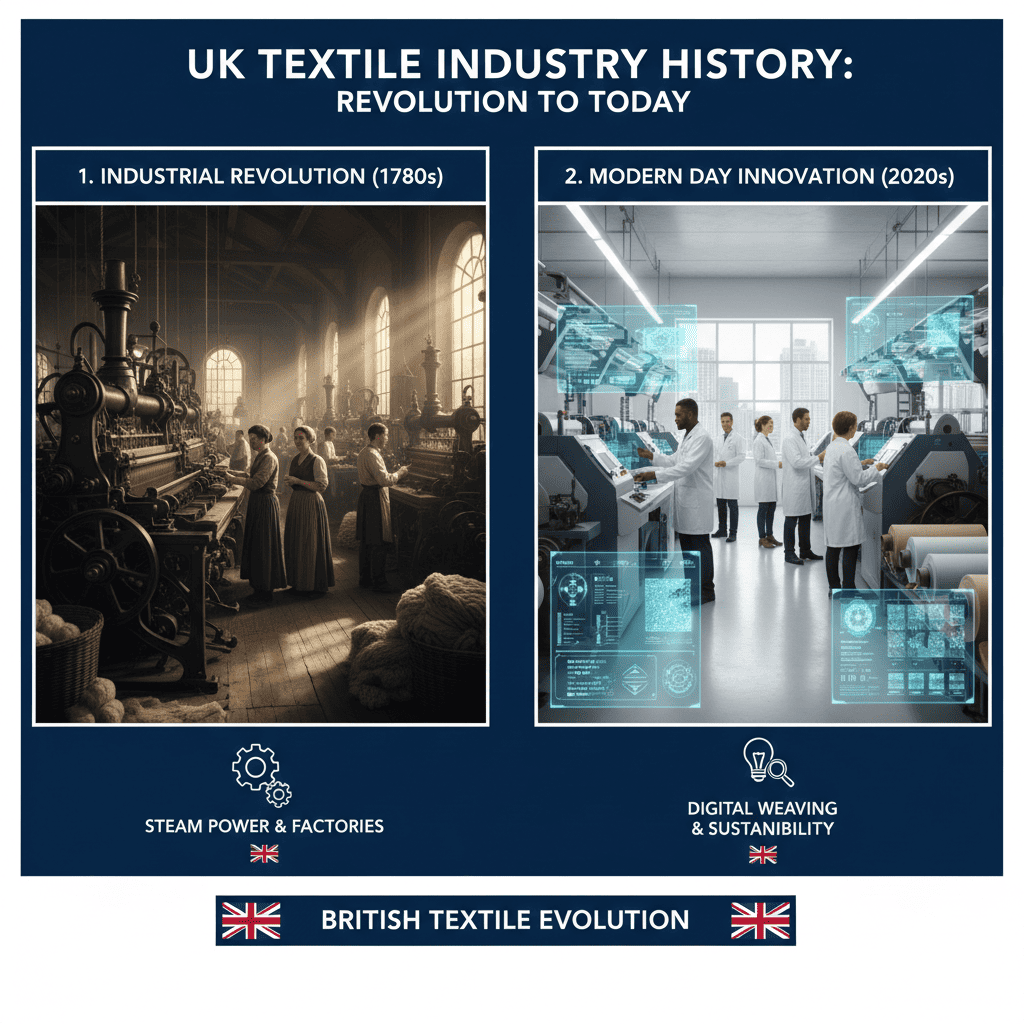
In 1764, a weaver named James Hargreaves sat in his cottage in Oswaldtwistle, Lancashire, and watched his daughter Jenny accidentally knock over the family spinning wheel.
The spindle kept turning — vertically now, instead of horizontally.
Hargreaves spent the next two years building a machine that could spin eight threads simultaneously using that vertical principle. He called it the Spinning Jenny. It did not transform the textile industry immediately. But it started a sequence of invention, investment, and industrial reorganisation that would make Britain the most powerful manufacturing nation on earth within three generations.
That story does not end in Lancashire. It ends in a Derbyshire mill, a Yorkshire valley, a Leicester factory floor, and — in ways that matter practically for brands sourcing UK production today — in the mills that are still running in 2026.
For the complete picture of how UK clothing manufacturing operates today, see the Complete Guide to Clothing Manufacturers in UK.
Post Summary
- How Britain went from cottage wool spinners to the world’s dominant textile power in under a century — and the specific inventions that made it happen
- Lancashire cotton and Yorkshire wool at Victorian peak — the scale, the geography, and what it actually looked like on the ground
- The post-war collapse: how offshoring, synthetic fibres, and trade liberalisation dismantled 200 years of manufacturing dominance between 1950 and 2000
- What survives in 2026 — the heritage mills, the reshoring movement, and the categories where British manufacturing still holds a competitive position
- Why understanding this history matters for every brand making sourcing decisions today
Contents
- 1. UK Textile Industry History: Industrial Revolution to Today
- 1.1. The Industrial Revolution — How Britain Became the World’s Textile Powerhouse
- 1.2. The Victorian Peak — Lancashire Cotton and Yorkshire Wool
- 1.3. What Was the Textile Industry During the Industrial Revolution?
- 1.4. The Post-War Collapse — Offshoring and the Contraction of UK Manufacturing
- 1.5. The 21st Century Revival — Reshoring and Made in Britain
- 1.6. What Remains of the UK Textile Industry in 2026
- 1.7. Frequently Asked Questions
- 1.7.1. When Did the UK Textile Industry Reach Its Peak?
- 1.7.2. Why Did UK Textile Manufacturing Decline So Rapidly After 1970?
- 1.7.3. What Was the Textile Industry During the Industrial Revolution?
- 1.7.4. Which Parts of the UK Textile Industry Have Survived Best?
- 1.7.5. Is UK Textile Manufacturing Actually Growing in 2026?
The UK Textile Industry Before Industrialisation
Before the late 18th century, British textile production was domestic and dispersed.
Wool was the dominant material. Britain’s sheep population and the quality of its fleece had made English wool the most prized raw material in European trade since the medieval period. Merchants exported raw wool to Flemish weavers who produced finished cloth, sold it back to English markets at a premium, and kept the value-added manufacturing on the continent.
The shift began when English merchants grew tired of exporting margin. By the 16th century, domestic wool weaving had expanded significantly — the West Country, East Anglia, and Yorkshire all developed regional cloth-making traditions. But production remained cottage-based: spinning and weaving done by hand, in homes, by families supplementing agricultural income.
Cotton was a minor material — imported, expensive, and processed in small quantities. It would not become the industry’s dominant fibre until machines made it competitive. The machines were coming.
Silk Routes IT Team · Interactive History Guide
UK Textile Industry History: Industrial Revolution to Today
From the Spinning Jenny of 1764 to 80,000 workers in premium UK manufacturing today — the complete data story.
The inventions that built an empire
Between 1764 and 1785, four inventions transformed British textile production from cottage to factory — and made Britain the world's dominant manufacturing power within a generation.
1764
Spinning Jenny
James Hargreaves, Lancashire
Enabled one operator to spin 8 threads simultaneously — the first mechanical multiplier of textile output.
1769
Water Frame
Richard Arkwright, Derbyshire
Water-powered spinning frame producing stronger thread suitable for cotton warp — enabled the first true textile factories.
1779
Spinning Mule
Samuel Crompton, Bolton
Combined Jenny and Water Frame principles to produce fine, consistent cotton yarn at volume. Named for being a hybrid.
1785
Power Loom
Edmund Cartwright, Kent
Mechanised weaving itself — completing the factory system by automating the final hand-skill bottleneck in cotton production.
Source: Science Museum Group — Industrial Revolution Textile Machinery Collection and Historical Records.
Victorian peak — Lancashire cotton output multiplier
Relative output multipliers are illustrative of direction and scale; absolute figures from ONS Historical Data and British Fashion Council 2024 industry review.
Key dates in UK textile history
From the first mechanical spinning to the reshoring revival — the events that shaped British manufacturing across three centuries.
Pre-1760
Cottage industry era
Spinning and weaving done by hand in homes. Britain exports raw wool; Flemish weavers add the value. English wool is Europe's most prized raw material.
1764–1785
The four inventions
Spinning Jenny, Water Frame, Spinning Mule, and Power Loom mechanise the entire production chain within 21 years. The factory system is born.
1811–1816
The Luddite movement
Handloom weavers — displaced by power looms — break machinery across the Midlands and North. A specific economic response to a specific catastrophe, not anti-technology sentiment in the abstract.
1850–1900
Victorian peak
Britain produces more cotton cloth than the rest of the world combined. Lancashire employs 440,000 in 2,500+ mills. Yorkshire wool dominates global tailoring markets. Manchester's Royal Exchange sets world cotton prices.
1912
Lancashire employment peaks — and never recovers
India develops domestic cotton production, displacing Lancashire exports. Cotton employment in Lancashire peaks in 1912. The long decline begins.
1929–1945
Depression and wartime
The Great Depression collapses export markets. Decades-old mills close within months. WWII provides a reprieve through military textile demand — but it is the last phase before structural collapse.
1970s–2000
Offshoring and collapse
Employment falls from 300,000 (1980) to under 30,000 (2010). UK clothing imports triple after the Multi-Fibre Arrangement phase-out (1995–2005). Entire mill towns are restructured within a single working generation.
2011–present
Made in Britain revival
Made in Britain organisation founded 2011; membership grows steadily. Supply chain disruptions of 2020–22 accelerate reshoring. Premium and sustainable categories grow. Employment recovers modestly to ~80,000 by 2026 (Source: ONS).
The employment collapse — and partial recovery
UK clothing manufacturing employment fell by over 90% between 1980 and 2010 — the fastest sectoral contraction in British industrial history.
UK clothing manufacturing employment by decade
Source: ONS UK Manufacturing Employment Historical Series; ONS Business Register and Employment Survey (BRES) 2024; UKFT industry data.
Three causes of the collapse
The Multi-Fibre Arrangement (international quota system protecting UK producers) was phased out 1995–2005. UK clothing imports tripled in the following decade. Source: UKFT 2024.
What survives in 2026
UK textile manufacturing in 2026 is smaller, more specialised, and more resilient than the industry of 1980 — concentrated in categories where British production holds a defensible quality position.
| Category | UK Strength (2026) | Key Locations | Status |
|---|---|---|---|
| Heritage wool & worsted | International luxury reputation | Yorkshire, Scottish Borders | Strong |
| Cashmere & luxury knitwear | Premium positioning, global export | Scotland (Johnstons of Elgin, Pringle) | Strong |
| Bespoke tailoring | World-class — Savile Row tradition | London, Leeds, Edinburgh | World-class |
| Technical & workwear | Industrial heritage base | Midlands, North West | Solid |
| Lace & hosiery | Specialist — reduced but active | Nottingham, East Midlands | Specialist |
| Sustainable & ethical | Reshoring-driven growth | Distributed nationally | Growing |
| Performance & activewear | New facility investment | Yorkshire, South East | Emerging |
Sources: ONS BRES 2024; IBISWorld UK Clothing Manufacturing January 2026; Made in Britain Buying British Survey 2024; Barclays Brand Britain Research.
The Industrial Revolution — How Britain Became the World’s Textile Powerhouse
Between 1760 and 1840, British textile production was mechanised faster than any industry in history.
The sequence of inventions came rapidly and built on each other. Hargreaves’ Spinning Jenny (1764) allowed one operator to spin multiple threads simultaneously. Richard Arkwright’s Water Frame (1769) produced stronger thread suitable for cotton warp. Samuel Crompton’s Spinning Mule (1779) combined both principles into a machine capable of producing fine, consistent cotton yarn at volume. Edmund Cartwright’s Power Loom (1785) mechanised weaving itself. Source: Science Museum Group.
Each invention multiplied output. Each multiplication drove down the cost of cotton cloth. Each cost reduction expanded the market. Each market expansion justified further investment in machinery and factory construction.
By 1800, cotton spinning in Britain had shifted almost entirely from cottage to factory. Lancashire — with its damp climate that reduced thread breakage, its river valleys that provided waterpower, and its proximity to Liverpool’s cotton import docks — became the centre of the global cotton trade.
The human consequences of this shift were severe and well-documented. Handloom weavers who had earned a living wage in 1800 were earning subsistence wages by 1820, competing against power looms that produced cloth at a fraction of the labour cost. The Luddite movement — the machine-breaking protests of 1811–1816 — was not anti-technology sentiment in the abstract. It was a specific response to a specific economic catastrophe affecting specific working communities.
The factories kept running.
The Victorian Peak — Lancashire Cotton and Yorkshire Wool
By the mid-19th century, Britain produced more cotton cloth than the rest of the world combined (Source: British Fashion Council, 2024).
Lancashire’s cotton towns — Manchester, Bolton, Blackburn, Preston, Burnley — were the industrial centre of the global economy in a way that no single region has matched before or since. Manchester’s Royal Exchange was where cotton prices were set for international markets. The city’s merchant warehouses held cloth destined for India, America, Australia, and across the British Empire.
By 1860, Lancashire employed approximately 440,000 people directly in cotton production. The region contained over 2,500 mills. Britain exported £47 million worth of cotton cloth annually — equivalent in scale to a dominant industry by any modern measure (Source: ONS Historical Data).
Yorkshire ran a parallel story in wool. The West Riding — Huddersfield, Bradford, Leeds, Halifax — developed the world’s most sophisticated worsted and woollen cloth industry. Huddersfield textile mills produced fine worsteds for international tailoring markets. Bradford became the wool capital of the world, with a commodity exchange setting fleece prices for global trade.
The two industries were distinct in character. Lancashire cotton was high-volume, lower-margin, and heavily mechanised from early in its development. Yorkshire wool retained more artisanal elements — the quality gradations in woollen cloth required human judgment at stages that cotton could automate — while achieving scale through specialisation by town and valley.
Leicester added a third strand: hosiery and knitwear, producing knitted goods from the late 18th century onwards using frames that mechanised stocking production. Nottingham developed parallel capability in lace. The East Midlands became the UK’s knitwear heartland — a position that surviving manufacturers still hold in attenuated form today.
What Was the Textile Industry During the Industrial Revolution?
At its peak in the Industrial Revolution, the UK textile industry was the first fully mechanised mass-production system in history. It transformed cotton and wool from hand-processed materials into industrially produced commodities, employed hundreds of thousands in purpose-built factory towns, and made Britain the world’s largest exporter of cloth. The sector was the engine of the British economy — its growth drove demand for coal, iron, engineering, and shipping, and its export revenues financed British imperial expansion. The factory system it pioneered became the organisational template for industrial manufacturing worldwide.
The Post-War Collapse — Offshoring and the Contraction of UK Manufacturing
The first serious blow to Lancashire cotton came not from a competitor but from a customer.
India — Britain’s largest export market for cotton cloth — began developing its own domestic textile industry in the late 19th century. By the 1920s, Indian cotton production had displaced significant volumes of Lancashire exports to the subcontinent. Lancashire cotton employment peaked in 1912 and never recovered (Source: UKFT, 2024).
The interwar period brought further contraction. The Great Depression collapsed export markets. Mills that had operated continuously for decades closed within months.
The post-war period initially suggested recovery. It was not recovery. It was the last phase before structural collapse.
The liberalisation of global textile trade, combined with the economic development of lower-wage manufacturing countries, made UK domestic clothing production increasingly uncompetitive on cost from the 1970s onwards. A garment that cost £12 to produce in a Lancashire factory in 1975 could be produced in Hong Kong for £3, in Bangladesh for £1.50 by 1990. UK retailers shifted sourcing offshore. UK manufacturers who could not compete on price closed.
The numbers are stark. UK clothing manufacturing employment stood at approximately 300,000 in 1980. By 2000 it had fallen to 100,000. By 2010 it was below 30,000 (Source: ONS). The mills that had employed entire towns were demolished, converted to apartments, or left derelict.
The trade policy context mattered. The Multi-Fibre Arrangement — an international quota system that had limited developing country textile exports to protect developed country producers — was phased out between 1995 and 2005. Its removal accelerated offshoring by removing the regulatory constraint on import volumes. UK clothing imports tripled in the decade following full MFA phase-out (Source: UKFT, 2024).
The 21st Century Revival — Reshoring and Made in Britain
The offshoring narrative, dominant from 1980 to 2010, has partially reversed in the years since.
The reversal is not a return to Victorian scale — nothing close. But it is a genuine structural shift driven by factors that were not present in the period of maximum offshoring.
Supply chain resilience became a visible commercial priority after the disruptions of 2020–2022. Brands that had concentrated production in single offshore locations discovered the cost of that concentration when shipping costs rose sharply and lead times extended dramatically. Domestic and nearshore production became commercially attractive in a way that pure unit cost comparison had previously obscured.
Consumer demand for provenance has grown measurably. Retail research consistently shows that Made in Britain labelling commands a price premium among consumers who prioritise domestic production (Source: British Fashion Council, 2024). For brands positioned at the premium end of the market, UK manufacturing is a brand asset, not just a production decision.
Sustainability credentials have moved from niche to mainstream. UK domestic production offers shorter supply chains, lower transport emissions, and greater visibility of labour conditions — all credentials that increasingly influence both consumer purchasing and retail buyer procurement criteria.
The Made in Britain organisation, whose membership has grown steadily since 2011, provides a verified mark for UK-manufactured products. UKFT membership has stabilised following decades of contraction. The mills that have survived — Abraham Moon in Yorkshire, Johnstons of Elgin in Scotland, Fox Brothers in Somerset — are not operating as museums. They are producing fabric that sells into international luxury markets at price points that offshore production cannot match on quality.
What Remains of the UK Textile Industry in 2026
| Category | UK Strength in 2026 | Key Locations |
|---|---|---|
| Heritage wool and worsted | Strong — international reputation | Yorkshire, Scottish Borders |
| Cashmere and luxury knitwear | Strong — premium positioning | Scotland |
| Technical and workwear | Solid — industrial heritage base | Midlands, North West |
| Bespoke tailoring | World-class — Savile Row tradition | London, Leeds |
| Lace and hosiery | Specialist — reduced but active | Nottingham, East Midlands |
| Sustainable and ethical garments | Growing — reshoring-driven | Distributed nationally |
| Performance and activewear | Emerging — new facility investment | Yorkshire, South East |
UK clothing manufacturing employment in 2026 stands at approximately 80,000 — down from 300,000 in 1980 but up from the low point of the mid-2010s (Source: ONS). The growth since 2015 has been concentrated in premium, technical, and sustainable categories where domestic production is commercially competitive rather than simply nationally sentimental.
For brands making sourcing decisions today, the practical implication of this history is clear. UK manufacturing is not available for everything, and it is not the cheapest option for anything. But in specific categories — heritage materials, premium construction, certified ethical production, short-run responsiveness — it offers something that offshore production structurally cannot.
Understanding where that capability exists and what it costs to access it is the starting point for any honest UK sourcing conversation. Find out more about Silk Routes and what British manufacturing looks like in practice today.
Frequently Asked Questions
When Did the UK Textile Industry Reach Its Peak?
Lancashire cotton peaked in employment in 1912, though output remained high until the 1920s. Yorkshire wool peaked slightly later. By any measure, the Victorian era from 1850 to 1900 represents the period of maximum scale, international dominance, and economic significance for British textile manufacturing — the period when Britain produced more cotton cloth than the rest of the world combined.
Why Did UK Textile Manufacturing Decline So Rapidly After 1970?
Three factors combined: the removal of trade barriers that had protected domestic producers from lower-cost imports; the economic development of manufacturing nations — particularly in South and Southeast Asia — that could produce comparable garments at a fraction of UK labour costs; and the strategic decisions of UK retailers to prioritise price competition over domestic supply chains. No single factor was sufficient alone. Together they produced a contraction in domestic employment of over 90% in three decades.
What Was the Textile Industry During the Industrial Revolution?
At its peak in the Industrial Revolution, the UK textile industry was the first fully mechanised mass-production system in history. It transformed cotton and wool from hand-processed materials into industrially produced commodities, employed hundreds of thousands in purpose-built factory towns, and made Britain the world’s largest exporter of cloth. The factory system it pioneered became the organisational template for industrial manufacturing worldwide.
Which Parts of the UK Textile Industry Have Survived Best?
Heritage wool and worsted production in Yorkshire and Scotland has survived best, supported by international reputation and premium market positioning that cannot be replicated offshore. Bespoke tailoring in London retains world-class status. Technical and workwear manufacturing in the Midlands and North West has maintained a viable base. Volume commodity production — basic knitwear, standard woven garments, hosiery — has not returned and is unlikely to.
Is UK Textile Manufacturing Actually Growing in 2026?
In employment terms, yes — modestly, from the low point of the mid-2010s. The growth is concentrated in premium, technical, and sustainable categories. The sector that is growing is fundamentally different in character from the sector that declined: smaller scale, higher value per unit, more specialised, and more dependent on brand narrative and sustainability credentials than the Victorian industry was.