
![Exit Strategy for Clothing Brands UK [Complete Guide 2026]](https://silkroutes.co.uk/wp-content/uploads/2026/06/Exit-Strategy-for-Clothing-Brands.png)
Most clothing brand founders spend years building their brand and about three weeks thinking about how to exit it. That imbalance is expensive.
Whether you plan to sell in two years or twenty, the decisions you make today, about brand structure, customer data, supplier contracts, and financial records, directly determine what your brand is worth when you’re ready to leave. An exit strategy isn’t an end-of-journey document. It’s a framework that shapes how you build.
This guide covers the four exit options available to UK clothing brand owners, how brands are valued for sale, what buyers look for in an acquisition, and the 12-month preparation process that maximises your exit outcome.
- The four main exit options for UK clothing brands and when each makes sense
- How clothing brand valuation works and what multiple to expect
- What strategic buyers and acquirers specifically look for
- The 12-month preparation plan that improves your sale outcome
- How to find buyers without a broker
- The most common exit mistakes and how to avoid them
Contents
- 1. Why Every Clothing Brand Needs an Exit Strategy
- 2. The Four Main Exit Options for UK Clothing Brands
- 3. How to Value a Clothing Brand for Sale
- 4. What Buyers Look for in a Clothing Brand Acquisition
- 5. How to Prepare Your Brand for Sale — 12-Month Plan
- 6. How to Find Buyers for Your Clothing Brand
- 7. Common Exit Mistakes Clothing Brand Owners Make
- 8. FAQ
- 8.1. How much is a UK clothing brand typically worth when sold?
- 8.2. Do I need a business broker to sell my clothing brand?
- 8.3. How long does it take to sell a clothing brand in the UK?
- 8.4. What makes a clothing brand difficult to sell?
- 8.5. Is licensing a realistic exit option for a small clothing brand?
- 9. Building Toward an Exit Worth Taking
Why Every Clothing Brand Needs an Exit Strategy
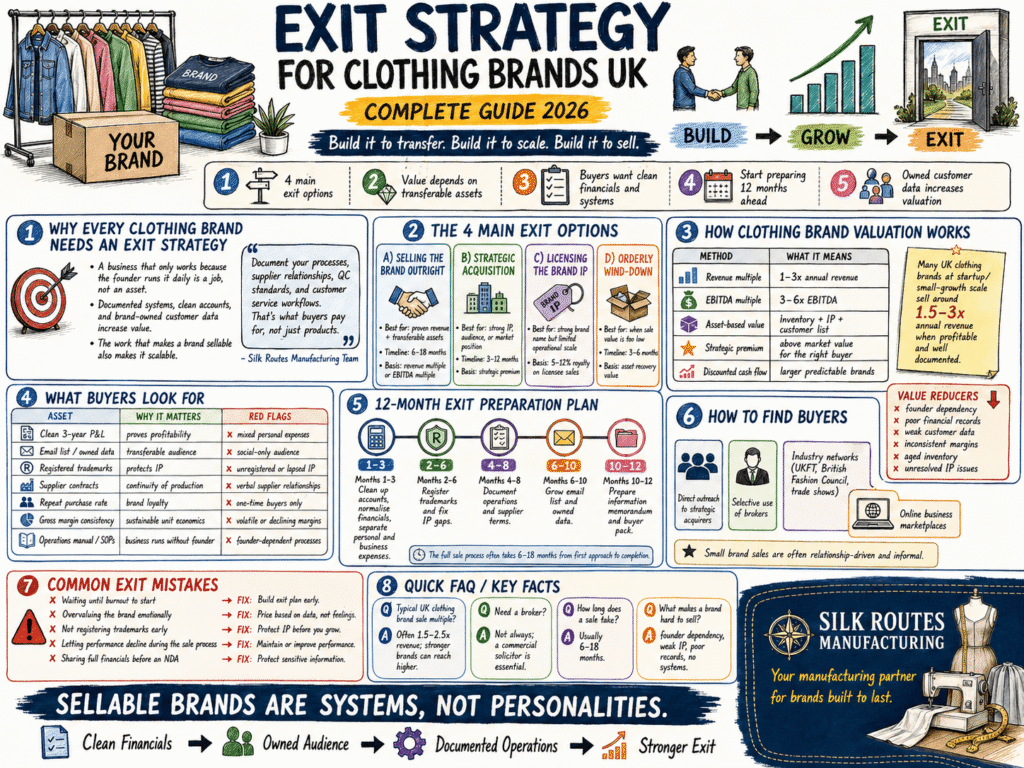
An exit strategy doesn’t mean you’re planning to leave soon. It means you’re building something that could be transferred, which is the same thing as building something valuable.
A clothing brand that only works because the founder runs it every day isn’t an asset. It’s a job. Buyers purchase assets.
“Document your processes before you think you need to. Supplier relationships, production schedules, quality control procedures, customer service flows, if these exist only in your head, they disappear when you do. Written systems increase clothing brand valuation significantly because they demonstrate the business can operate without you.” — Silk Routes Manufacturing Team
Build your customer data asset deliberately. An email list of 10,000 engaged subscribers is a quantifiable, transferable asset. A social following is not, it follows the person, not the brand.
Keep your financials clean from year one. Buyers and their accountants will scrutinise 3 years of accounts during due diligence. Mixing personal and business expenses, inconsistent revenue recognition, or undocumented director loans create problems that delay or kill transactions.
Separate the brand from your personal identity where possible. A brand whose marketing centres entirely on a named founder is harder to sell because buyers worry the audience won’t transfer. Build brand equity in the name, not the face.
The counterintuitive insight: the work required to make a clothing brand sellable is the same work required to make it scalable. A brand with documented systems, clean financials, and transferable customer relationships grows faster and exits better. These aren’t competing goals.
The Four Main Exit Options for UK Clothing Brands
| Exit Option | Best For | Typical Timeline | Valuation Basis |
|---|---|---|---|
| Selling the brand outright | Brands with proven revenue and transferable assets | 6–18 months | Revenue multiple or EBITDA multiple |
| Strategic acquisition | Brands with IP, audience, or market position a larger player wants | 3–12 months | Strategic premium above market value |
| Licensing the brand IP | Brands with strong name recognition but limited operational scale | Ongoing | Royalty rate on licensee revenue |
| Orderly wind-down | Brands that cannot be sold at an acceptable value | 3–6 months | Asset recovery value |
Selling the Brand Outright
An outright sale transfers ownership of all brand assets, trademarks, domain, customer data, supplier relationships, inventory, and goodwill, to a buyer in exchange for a lump sum or structured payment.
This is the most common exit for UK clothing brands with annual revenues of £200,000–£5 million. The buyer is typically another entrepreneur, a small brand consolidator, or a strategic acquirer looking to add a complementary label to their portfolio.
In our experience, a profitable clothing brand with strong repeat purchase rates and clean financials typically sells at somewhere in the range of 1.5–3x annual revenue at this scale, though the exact multiple depends heavily on documentation quality and buyer fit.
Strategic Acquisition
A strategic acquisition occurs when a larger brand, retailer, or group acquires your brand specifically for what it brings to their existing business: your customer demographic, your IP, your manufacturing relationships, or your market position.
Strategic buyers will pay a premium above market value if your brand solves a specific problem for them. This route typically involves larger brands, retail groups, or private equity-backed consolidators.
The critical difference from an outright sale: in a strategic acquisition, your leverage comes from being specifically valuable to that buyer, not just generally marketable. Identifying the right strategic acquirer and approaching them directly often produces better outcomes than a broad market process.
Licensing the Brand IP
Licensing means retaining ownership of your brand while allowing a third party to manufacture and sell products under your name in exchange for a royalty, typically 5–12% of net sales.
This is appropriate when the brand has genuine name recognition and consumer trust, but the owner lacks the capital or operational capacity to scale manufacturing and distribution independently.
This route generates passive income without requiring a full exit. The risk is brand dilution if the licensee’s product quality or brand presentation doesn’t match what customers expect.
Orderly Wind-Down
A wind-down isn’t a failure, it’s a managed closure that maximises recovery from remaining assets. It’s the correct choice when a brand cannot be sold at a value that reflects the time and capital invested.
This involves liquidating inventory at the best achievable price, terminating supplier and lease agreements, recovering any deposits, and formally closing the legal entity. Done in an orderly way, it protects your credit position and preserves your ability to start again.
How to Value a Clothing Brand for Sale
Valuation methods differ depending on the brand’s scale, profitability, and asset base. Understanding which method applies to your brand sets realistic expectations before you approach buyers.
| Valuation Method | How It Works | When It Applies |
|---|---|---|
| Revenue multiple | 1–3x annual revenue | Profitable brands with consistent sales |
| EBITDA multiple | 3–6x EBITDA | Brands with documented, normalised profitability |
| Asset-based | Inventory + IP + customer list value | Brands with assets but limited profitability |
| Strategic premium | Negotiated above market value | Brands with specific value to a named acquirer |
| Discounted cash flow | Present value of projected future earnings | Larger brands with predictable growth trajectory |
For most UK clothing startups exiting in the £100,000–£1,000,000 range, a revenue multiple is the most common valuation method. A brand with solid repeat purchase rates, transferable customer data, and clean accounts is generally seen at the lower-to-mid end (around 1.5–2.5x), while a brand with demonstrable growth trajectory, strong gross margins, and documented systems can push toward 2.5–3x.
Sale price is reduced by: high founder dependency, undocumented supplier relationships, inconsistent gross margins, poor customer data, significant aged inventory, or unresolved IP issues (an unregistered trademark, for example, creates due diligence risk that buyers price in as a discount).
Goodwill value, the intangible value above and beyond physical assets, is driven primarily by brand recognition, customer loyalty metrics (repeat purchase rate, NPS), and the strength of your owned audience.
What Buyers Look for in a Clothing Brand Acquisition
Buyers aren’t buying your product. They’re buying your revenue, your customers, and your ability to continue generating both without you.
| Asset | Why Buyers Value It | Red Flag |
|---|---|---|
| Clean 3-year P&L | Demonstrates true profitability | Mixed personal/business expenses |
| Email list (owned data) | Transferable customer relationship | Social-only audience |
| Registered trademarks | Protects brand IP post-acquisition | Unregistered name or logo |
| Documented supplier contracts | Continuity of production | Informal verbal-only relationships |
| Repeat purchase rate | Indicates genuine brand loyalty | High one-time purchase rate |
| Gross margin consistency | Sustainable unit economics | Wide margin variance between seasons |
| Operational documentation | Business runs without founder | Founder-dependent processes |
The asset most buyers undervalue going in and overvalue in due diligence: the supplier relationship. A buyer who cannot replicate your manufacturing relationship, because it existed only through your personal connection to the factory, faces an immediate operational risk. Formalised supplier contracts with documented terms, pricing, and lead times are a material asset.
Strategic acquirers assess whether your brand’s positioning, customer demographic, and aesthetic fit their portfolio, and whether the acquisition creates more value inside their business than it would as a standalone operation.
If you’re considering a sale and want your manufacturing relationships properly documented and contractually formalised before going to market, see our clothing manufacturing services for how supplier agreements and production terms should be structured.
How to Prepare Your Brand for Sale — 12-Month Plan
Rushing a sale without preparation consistently produces lower valuations and higher transaction failure rates. A 12-month runway allows you to address the gaps that buyers discount most aggressively.
Months 1–3: Financial clean-up. Separate any personal expenses that have run through the business. Prepare a normalised P&L that shows true business profitability with any one-off costs added back. Commission an accountant to prepare a 3-year summary in a format suitable for due diligence.
Months 3–6: IP registration. If your brand name and logo aren’t registered as UK trademarks, start the process immediately. UK trademark registration takes 4–6 months and costs £205 for the first class (the UKIPO fee increased from £170 on 1 April 2026), plus £60 per additional class. An unregistered brand name is a due diligence problem that experienced buyers will price as a discount or use to delay completion.
Months 4–8: Document your operations. Write down every process that currently exists in your head, supplier contacts and terms, production schedules, customer service procedures, returns handling, social media workflows. The goal is an operations manual a new owner can run from on day one.
Months 6–10: Grow your owned data. An email list that has grown consistently in the 12 months before a sale is a demonstrable, transferable asset. A declining or stagnant list raises questions about brand health. Run a deliberate list growth campaign before going to market.
Months 10–12: Prepare your information memorandum. A concise document covering brand history, financials, customer metrics, supplier relationships, and growth opportunities. This is what buyers read before they sign an NDA. Quality of presentation signals quality of operation.
The full sale process typically takes 6–18 months from first approach to completion. Factor that timeline into when you begin preparation.
How to Find Buyers for Your Clothing Brand
Most UK clothing brand sales at startup scale happen through direct outreach, not through brokers or formal auction processes.
Identify strategic acquirers before you go to market. Make a list of brands, retailers, or consolidators for whom your brand would have specific value. Approach them directly with a brief introduction, not an unsolicited full information pack. A warm conversation is a better starting point than a cold information dump.
Use business brokers selectively. Brokers add value when your brand is large enough to justify their fees (typically 5–10% of sale price) and when you need access to a buyer network you cannot reach independently. For brands under £500,000 in sale value, broker fees often consume a disproportionate share of proceeds.
Consider industry networks and trade associations. UKFT and the British Fashion Council have member networks that include potential acquirers. Industry trade shows are where strategic buyers and their representatives are present in a context that makes initial conversations natural.
Online business marketplaces (Flippa, BusinessesForSale.com, Rightbiz) reach a wider pool of financial buyers, entrepreneurs looking for an acquisition rather than strategic operators. This route suits brands where the primary value is revenue and systems rather than strategic fit.
The honest assessment: exit processes at small brand scale are informal, relationship-driven, and slow. The founder who has spent three years building relationships in the industry has a meaningfully better exit outcome than the one who goes to market cold with no prior conversations started.
Common Exit Mistakes Clothing Brand Owners Make
Waiting until they’re burned out to start the process. Founders don’t think about exit until they’re ready to leave immediately.
Fix: start exit preparation 18–24 months before your target exit date. A rushed sale, driven by founder fatigue rather than brand performance, consistently produces lower valuations and attracts opportunistic buyers who know you need to sell quickly.
Overvaluing the brand based on emotional investment. Founders value years of effort and personal meaning. Buyers value revenue, assets, and transferable relationships.
Fix: commission an independent brand valuation before going to market. An objective figure, even if lower than expected, creates a realistic starting point for negotiation.
Not registering trademarks before going to market. Founders assume trading under a name establishes sufficient ownership.
Fix: register your brand name and logo as UK trademarks before approaching buyers. An unregistered trademark is a negotiating discount that experienced buyers exploit systematically. Registration costs £205 for the first class and takes 4–6 months, start early.
Allowing the business to decline during the sale process. Founders mentally check out once the decision to sell is made, and operational performance drops.
Fix: treat the period of sale preparation as your most important operating period. Declining revenue during a sale process is the fastest way to reduce your valuation or lose a buyer mid-transaction.
Sharing full financial information before an NDA is signed. Founders are eager to demonstrate the business’s value and share detailed financials in early conversations.
Fix: share only a high-level summary, revenue, growth rate, and a brief description of assets, before an NDA is signed. Full financials, customer data, and supplier contacts go to credible buyers under NDA only.
FAQ
How much is a UK clothing brand typically worth when sold?
Most UK clothing brands with revenues of £200,000–£1,000,000 sell at 1.5–2.5x annual revenue if profitable and well-documented. Brands with strong repeat purchase rates, registered trademarks, clean financials, and documented operational systems achieve the higher end of that range.
Do I need a business broker to sell my clothing brand?
Not necessarily. For brands under £500,000 in expected sale value, broker fees of 5–10% consume a significant share of proceeds. Direct outreach to strategic acquirers, use of industry networks, and listing on business sale marketplaces are viable alternatives. A commercial solicitor is essential for the legal side of any transaction, a broker is optional.
How long does it take to sell a clothing brand in the UK?
From first approach to completion, expect 6–18 months for most clothing brand transactions. Finding the right buyer takes longer than founders typically anticipate, and due diligence adds a further 2–4 months once a buyer is identified.
What makes a clothing brand difficult to sell?
The most common barriers are: unregistered trademarks, high founder dependency, no documented operational processes, an audience that follows the founder personally rather than the brand, inconsistent financial records, and aged inventory that inflates the asset base without generating returns. Most of these are fixable with 12 months of preparation.
Is licensing a realistic exit option for a small clothing brand?
Licensing works when the brand has genuine consumer recognition, the name means something to customers independently of the products currently under it. For most early-stage clothing brands, that threshold hasn’t been reached. Licensing at too early a stage typically produces low royalty volumes and risks brand dilution if the licensee’s quality doesn’t match customer expectations.
Building Toward an Exit Worth Taking
An exit strategy is not a plan for leaving. It’s a framework for building something transferable, which is the same as building something valuable.
The clothing brands that exit well are not the ones that got lucky with a strategic buyer. They’re the ones that spent years building clean financials, documented systems, registered IP, and owned customer data, the assets that make a business worth acquiring at a price worth accepting.
The manufacturing relationships that underpin all of this, reliable production, formalised supplier contracts, consistent quality, are foundational to brand value in any acquisition process. Our complete guide to low MOQ and private label clothing manufacturers in the UK covers how to structure those relationships from the start.
To discuss how Silk Routes supports brands at different stages of growth and how we structure our manufacturing agreements, visit our about page.
People also ask
Is it a good idea to start a clothing brand in 2026? It can be, but success depends more on execution than timing — UK online fashion remains a large, active market, and a founder with a validated product, a confirmed low-MOQ manufacturing relationship, and a realistic launch budget (see our minimum viable collection guide) is in a reasonable position. The category is competitive, so a clear point of differentiation matters more than ever.
How to make your clothing brand stand out? Focus on a specific, well-defined customer and a coherent brand identity rather than a broad product range — a strong lookbook, a distinctive niche, and consistent quality across a small number of styles typically differentiate a startup brand more effectively than trying to compete on breadth or price with established players.
Do you need a license to sell clothes online in the UK? No specific “licence” is required to sell clothing in the UK, but you do need to register your business (sole trader or limited company at Companies House), comply with product safety and labelling regulations, and hold appropriate insurance. See our guides on clothing line insurance and product liability for the specifics.
What clothing brands are in demand? Demand shifts by season and trend cycle, but consistently strong areas for UK startups include sustainable and ethically produced basics, athleisure and activewear, and niche or size-inclusive positioning that larger fast-fashion players underserve. Rather than chasing a trend directly, most successful startups identify an underserved segment within a category they understand well.