
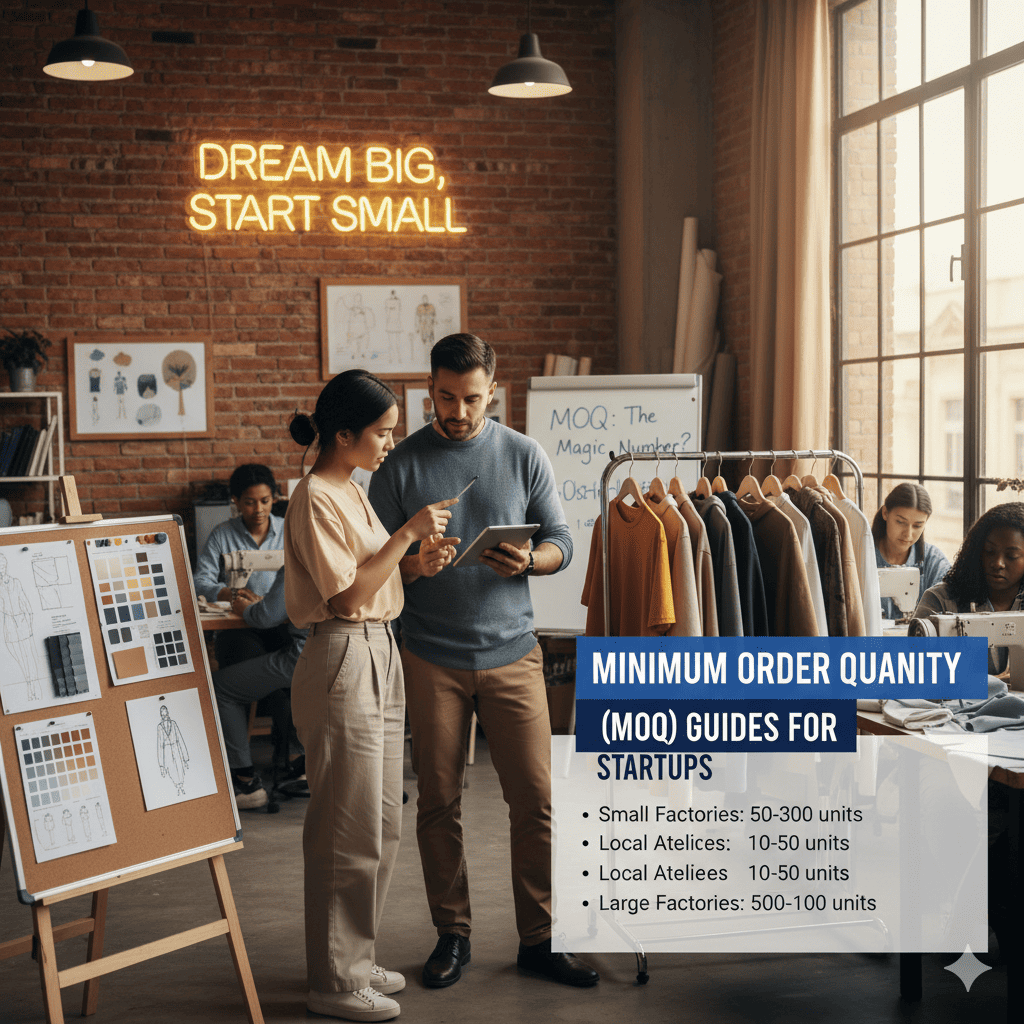
Most founders treat a low MOQ as the goal. It isn’t — a low MOQ is usually the reason your unit cost makes retail pricing impossible.
The real question isn’t how low you can push a factory’s minimum. It’s what MOQ makes your specific product profitable at the volume you can actually sell.
This guide breaks down realistic MOQ for clothing startups by manufacturer type, what those numbers do to your margin, and when accepting a higher MOQ is the smarter commercial call.
In this guide:
- Typical MOQ ranges by manufacturer type (CMT, full-service, knitwear, woven)
- Why MOQ exists and who actually sets it
- The real cost trade-off between low and high MOQ orders
- Five proven ways to negotiate a lower minimum
- When accepting a higher MOQ protects your margin instead of hurting it
- Four MOQ mistakes that quietly cost startups money
Contents
- 1. Why MOQ Isn’t the Enemy You Think It Is
- 2. Typical MOQ Ranges Across UK Manufacturer Types
- 3. The Real Cost of Chasing the Lowest MOQ
- 4. How to Negotiate Your MOQ Down — Five Levers That Work
- 5. When a Higher MOQ Is Actually the Smarter Call
- 6. Four MOQ Mistakes That Cost Startups Money
- 7. FAQ
- 8. Setting Your MOQ Number Before You Talk to Any Factory
Why MOQ Isn’t the Enemy You Think It Is
Minimum order quantity is the smallest number of units a factory will produce per style, per colourway, in one run. It exists because sampling, pattern cutting, and machine setup cost the same whether you order 30 units or 300.
Below a certain volume, a factory can’t spread those fixed costs thinly enough to make the run worthwhile. That’s the honest reason MOQs exist — not a barrier factories put up to filter out small brands.
UKFT has tracked renewed momentum behind reshoring UK apparel production, with more domestic factories exploring smaller, more agile production models. That shift helps startups, but it hasn’t erased the underlying cost math.

Typical MOQ Ranges Across UK Manufacturer Types
MOQ varies sharply by manufacturer type and who carries the fabric risk. These are the ranges we see most often across the UK factories we work with.
| Manufacturer Type | Typical MOQ Range | Who Sources Fabric |
|---|---|---|
| CMT (Cut, Make, Trim) | 30–100 units | Brand supplies fabric |
| Full-Service | 100–300 units | Factory sources fabric |
| Specialist Knitwear | 50–150 units per colourway | Factory, machine-dependent |
| Specialist Woven | 100–250 units | Often set by mill minimums |
CMT factories carry less risk because you supply the fabric. That’s why their floor sits lower — often 30–50 units for simple jersey styles.
Full-service factories absorb more of the process, so their MOQ climbs to 100–300 units. You get a simpler supply chain in exchange for a bigger first commitment.
Woven fabric MOQs are frequently set by the mill, not the factory. Ask early whether your MOQ is capacity-driven or fabric-driven — the answer changes how you negotiate.
The Real Cost of Chasing the Lowest MOQ
Unit cost drops steeply between a small first run and a mid-sized one, then flattens out. That’s because fixed costs — sampling, grading, setup — get spread across more pieces as volume rises.
A startup ordering 30–50 units will typically pay well above the per-unit cost of the same garment at 200 units. That gap eats directly into your margin and your retail pricing room.
“A 30-unit MOQ sounds great until you realise your unit cost means you need to sell at £90 to hit a 60% margin. Chasing the lowest number on the page isn’t a strategy.” — Silk Routes Manufacturing Team
McKinsey’s 2026 State of Fashion analysis found that 45% of fashion executives now cite sourcing costs as the area of their economic model under the most pressure — more than pricing or inventory. Startups feel that pressure fastest, because they have the least room to absorb it.
What’s a Realistic First-Order MOQ?
For most UK startups, 50–100 units per style is the workable sweet spot on a first run. Below 50, unit cost usually makes sustainable retail pricing very hard.
A direct-to-consumer brand can often test at 50 units with a pre-order model and limited stock risk. A brand supplying wholesale accounts needs enough volume to avoid running out mid-season.
“Set your unit cost target first. Then find the MOQ that lands inside the volume you need to hit it — not the other way round.” — Silk Routes Manufacturing Team
How to Negotiate Your MOQ Down — Five Levers That Work
Negotiating MOQ means giving a factory something in exchange for the risk they’re absorbing. Five approaches consistently move the number.
Arrive with a finished tech pack. A factory quoting from a rough brief carries more risk and takes longer. The British Fashion Council’s Positive Fashion initiative has run sessions specifically helping smaller brands engage manufacturers more effectively, and preparation is consistently the difference-maker.
Offer faster payment. Standard terms are 30–50% deposit, balance on completion. Offering 70% upfront reduces the factory’s working capital exposure — many will drop the MOQ floor in return.
Consolidate colourways. Two colourways at 50 units each is 100 units of changeover cost. One colourway at 100 units is a single setup.
Commit to a written reorder. A confirmed reorder at 90 days lets the factory treat your first order as a trial rather than a one-off gamble.
Start with one SKU. A focused single-product launch consistently negotiates better terms than a five-style range on day one.
If you want a realistic read on which of these levers fits your product, Silk Routes can talk through the cost structure with you before you commit to a factory.
When a Higher MOQ Is Actually the Smarter Call
Most startup guides treat a high MOQ as a red flag by default. That’s backwards for a meaningful share of products.
A 200-unit factory with better construction quality and a structured reorder process can deliver more long-term value than a 50-unit factory with inconsistent QC. Manufacturers with ISO-certified or WRAP-accredited quality management systems tend to carry higher fixed overhead — which shows up as a higher MOQ, not a worse deal.
Three situations where a higher MOQ makes sense:
- Your product has a long shelf life. A core-range piece staying in your collection for two or three seasons carries far less stock risk than a trend piece.
- Your pipeline is already confirmed. Purchase orders or pre-orders covering 60%+ of the run turn a high MOQ into a cash-flow calculation, not a gamble.
- The quality gap is real. If the 200-unit factory’s construction is materially better, the higher MOQ can protect your brand on a first impression.
For a broader view of how to weigh MOQ against everything else in a manufacturer decision, our framework for choosing a UK clothing manufacturer walks through the full checklist.
Four MOQ Mistakes That Cost Startups Money
Treating MOQ as the only selection factor. Founders chase the lowest number and end up with inconsistent quality. Fix: set your unit cost target first, then filter factories against it.
Ordering too many styles on the first run. Five styles at 50 units each ties up thousands in untested stock. Fix: launch with one or two styles and prove sell-through first.
Missing that MOQ applies per colourway. A 50-unit MOQ across three colourways is really 150 units, not 50. Fix: confirm per-style vs per-colourway in writing before quoting retail prices.
Confusing sampling minimums with production minimums. A low sample MOQ says nothing about the production floor. Fix: ask directly, “What’s your minimum for a production run?” — don’t infer it from sampling.
FAQ
What’s the lowest MOQ I can realistically get from a UK manufacturer?
Some UK CMT factories will produce from 30 units per style on simple jersey constructions where you supply the fabric. Below that, you’re usually looking at print-on-demand rather than genuine cut-and-sew production.
Does MOQ apply per style or across my whole order?
MOQ almost always applies per style, per colourway. Three styles at a 100-unit MOQ means a 300-unit minimum across the order, not 100 total.
How much more does a low MOQ run cost per unit?
Expect to pay significantly more per unit at 50 units than at 200, since fixed setup costs are spread across far fewer pieces. The exact gap depends on construction complexity and fabric sourcing.
Can I negotiate MOQ down after my first order?
It’s possible, but your strongest leverage is before the first order — factories that have already produced for you at their standard MOQ have less incentive to lower it later.
Is a 50-unit MOQ viable if I’m supplying wholesale accounts?
It’s tight. Split across three or four stockists it leaves little buffer for reorders, so 100 units per style is a more workable floor if wholesale is part of your launch.
Setting Your MOQ Number Before You Talk to Any Factory
MOQ isn’t a number to minimise — it’s a variable to optimise against your unit cost, your sales model, and how much stock risk you can carry. The brands that get this right know their target volume before the first factory call, not after.
If you want help working out what MOQ makes sense for your specific product, find out more about how Silk Routes works with startup brands — or start with our complete guide to low MOQ and private label manufacturing in the UK for the full picture.