
![UK vs Turkey Clothing Manufacturing: Honest Comparison [2026]](https://silkroutes.co.uk/wp-content/uploads/2026/04/UK-vs-Turkey-Clothing-Manufacturing-Honest-Comparison.png)
Turkey isn’t the cheap, easy alternative most guides make it sound. For UK brands that have done the maths properly, the decision is a lot closer than the nearshoring conversation suggests.
This post gives you the real comparison — unit costs, lead times, MOQ realities, import duties, and sustainability credentials — so you can make a sourcing decision based on numbers, not assumptions. For the broader framework on UK versus offshore production, see our Complete Guide to Clothing Manufacturers in UK.
Post Summary
- Turkish unit costs are 35–50% lower than UK at factory gate, but total landed cost is significantly closer once freight, QC, and origin documentation are factored in
- Genuinely Turkish-made garments can qualify for 0% UK import duty under the UK-Turkey Free Trade Agreement — but only if they meet specific rules of origin, which many real supply chains using imported fabric do not meet
- Full order cycle from a Turkish factory to a UK warehouse runs 11–18 weeks, versus 5–9 weeks for UK domestic production
- Turkish factories typically require 300–500 units MOQ per style; UK manufacturers commonly work to 50–150 units
- OEKO-TEX and GOTS certification are available in Turkey but coverage is uneven — always verify directly through the issuing body’s database, never from a supplied PDF
- Turkey suits brands with consistent volume, time, and in-country oversight; the UK suits brands needing speed, flexibility, and Made in Britain credentials
Contents
- 1. Why UK Brands Look to Turkey for Production
- 2. Cost Comparison: UK vs Turkey Per Garment
- 3. Lead Times: Istanbul Factory to UK Warehouse
- 4. Quality Standards: What Turkey’s Industry Offers in 2026
- 5. Import Duties and Post-Brexit Logistics
- 6. MOQ Differences: UK Manufacturers vs Turkish Factories
- 7. Sustainability Credentials in Turkish Manufacturing
- 8. When to Choose Turkey Over UK, and Vice Versa
- 9. Common Mistakes UK Brands Make With Turkish Manufacturers
- 10. UK vs Turkey: Questions Brands Ask Us
- 11. The Right Call Depends on Your Numbers, Not the Trend
Why UK Brands Look to Turkey for Production
Turkey has been the default nearshore option for UK fashion brands for over a decade. Lower labour costs than the UK, faster turnaround than Asia, and strong denim and jersey manufacturing capability made it an attractive middle ground.
The logic held up when sterling was stronger and pre-Brexit trade arrangements were in place. In 2026, both of those conditions have changed, and the Turkey proposition deserves a harder look.
What guides consistently get wrong: they treat Turkey as a single manufacturing market. Istanbul, Izmir, and Bursa have distinct factory ecosystems, pricing structures, and quality tiers. Treating “Turkish manufacturing” as one thing produces bad sourcing decisions.
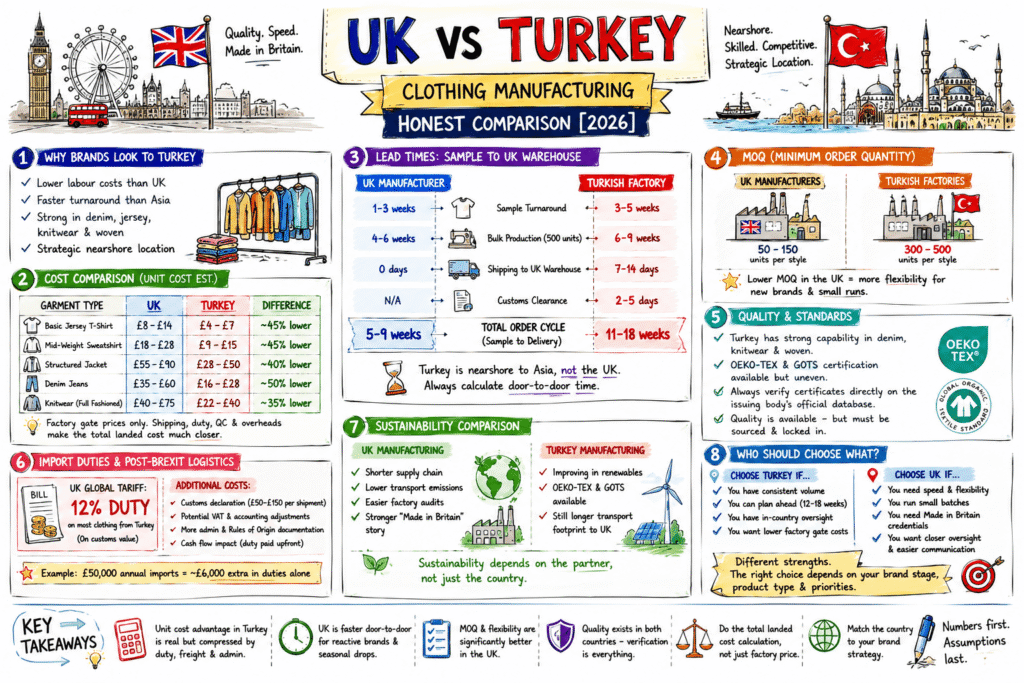
Cost Comparison: UK vs Turkey Per Garment
Labour costs in Turkey remain below UK levels, but the gap has narrowed in recent years as Turkey has responded to domestic inflation with repeated minimum wage increases.
| Garment Type | UK Unit Cost (est.) | Turkey Unit Cost (est.) | Cost Difference |
|---|---|---|---|
| Basic jersey T-shirt | £8–£14 | £4–£7 | Turkey ~45% lower |
| Mid-weight sweatshirt | £18–£28 | £9–£15 | Turkey ~45% lower |
| Structured jacket | £55–£90 | £28–£50 | Turkey ~40% lower |
| Denim jeans | £35–£60 | £16–£28 | Turkey ~50% lower |
| Knitwear (full fashioned) | £40–£75 | £22–£40 | Turkey ~35% lower |
These are factory gate prices. They don’t include shipping, import duties, quality control travel, or the cost of managing a supplier relationship from a distance. Once those are added, the Turkey advantage compresses significantly on smaller runs.
If you want to understand how UK unit costs are structured at source, our UK manufacturing cost breakdown covers the specific 2026 price ranges for each cost component.
Lead Times: Istanbul Factory to UK Warehouse
The nearshore argument for Turkey rests heavily on lead time. Against Bangladesh or China, it holds. Against UK domestic production, the picture is different.
| Production Stage | UK Manufacturer | Turkish Factory |
|---|---|---|
| Sample turnaround | 1–3 weeks | 3–5 weeks |
| Bulk production (500 units) | 4–6 weeks | 6–9 weeks |
| Shipping to UK warehouse | 0 days | 7–14 days (road freight) |
| Customs clearance | N/A | 2–5 days |
| Total order cycle (sample to delivery) | 5–9 weeks | 11–18 weeks |
The shipping and customs buffer is where Turkey’s lead time advantage disappears for urgent or reactive orders. UK brands running seasonal drops or responding to demand signals in-season will find Turkish lead times too long to be useful.
What guides get wrong: they quote factory production time only, not the full cycle from order placement to warehouse receipt. Always measure door to door.
Quality Standards: What Turkey’s Industry Offers in 2026
Turkey’s garment industry has genuine quality capability, particularly in denim, knitwear, and woven cotton. Factories in the Bursa region have long-standing relationships with European luxury and high street brands.
The quality variance is, however, significant. An OEKO-TEX certified factory in Izmir and an uncertified CMT operation in Istanbul’s suburban belt aren’t comparable. Both are “Turkish manufacturers.” Only one has independently verified standards.
OEKO-TEX STANDARD 100 certification is the credible baseline for UK brands buying from Turkey — it tests for harmful substances across the full supply chain, from yarn to finished garment. Without it, you’re relying entirely on factory self-reporting for fabric safety and production standards. Always check a certificate’s validity directly through OEKO-TEX’s own Label Check tool rather than trusting a PDF a factory sends you.
Our view: quality in Turkey is available, but it has to be specifically sourced and contractually locked in. Don’t assume a Turkish factory is quality-compliant because it supplies a brand you recognise.
Import Duties and Post-Brexit Logistics
This is where most guides get the Turkey cost calculation wrong, and where it matters most.
Before 2021, clothing manufactured in Turkey and entering the EU, then the UK under single market rules, carried no import tariff. That arrangement no longer applies automatically.
The honest picture is more nuanced than a single number. The UK-Turkey Free Trade Agreement, in force since 1 January 2021, allows genuinely Turkish-made clothing to enter the UK at 0% duty — but only if it meets the agreement’s rules of origin. Broadly, this means the garment must have undergone substantial transformation in Turkey: yarn woven into fabric in Turkey, or a garment manufactured from fabric in Turkey, rather than simply assembled there from materials imported from elsewhere.
If your Turkish factory uses fabric sourced from China or another non-qualifying country, your order is likely to fail the rules of origin test and fall back to the standard Most Favoured Nation rate, which for most clothing categories sits at around 8–12%. Claiming the 0% preferential rate isn’t automatic either: it requires a declaration of origin on the commercial invoice from the exporter, which the UK importer must hold and be able to produce if HMRC asks.
In practice, this means two brands sourcing what looks like an identical garment from Turkey can face completely different duty bills, depending entirely on where the fabric came from and whether the right paperwork exists. On top of duty (where it applies), brands also face customs declaration costs, typically £50–£150 per shipment via a freight forwarder, potential VAT import accounting adjustments, and added administrative burden on Rules of Origin documentation.
For a brand importing £50,000 of garments annually from Turkey on goods that genuinely qualify for the FTA rate, the duty bill could be close to zero. For the same brand sourcing through a factory that imports its fabric, a 10% effective duty rate would add roughly £5,000 a year — a fixed overhead with no UK domestic equivalent. The only way to know which position you’re in is to ask your factory directly where the fabric comes from, before you commit to an order.
MOQ Differences: UK Manufacturers vs Turkish Factories
Minimum order quantities are one of the most practically important differences between the two options, and one of the least honestly discussed.
Turkish factories, particularly mid-tier and export-focused operations, typically work to higher MOQs than UK manufacturers. A standard Turkish CMT factory may require 300–500 units per style per colourway. Some denim specialists require 1,000 units minimum.
UK manufacturers, especially those serving the independent brand market, are more accustomed to smaller run sizes. MOQs of 50–150 units per style are achievable with the right UK partner — our how to choose a UK clothing manufacturer guide covers how to vet for this specifically.
For early-stage brands or those testing new styles, this MOQ gap is significant. The lower Turkish unit cost can be entirely offset by having to produce more units than the market actually needs.
Sustainability Credentials in Turkish Manufacturing
Turkey’s garment manufacturing sector has made real progress on sustainability certifications, particularly OEKO-TEX STANDARD 100 and GOTS (Global Organic Textile Standard).
The honest caveat: certification coverage is uneven. Larger, export-oriented factories are more likely to be certified. Smaller operations, where lower prices are found, often aren’t.
UK manufacturing, by comparison, operates under domestic employment law, HMRC oversight, and in many cases Made in Britain certification. The audit burden on UK factories is higher by default. That transparency has commercial value for brands with sustainability claims to substantiate.
“If a brand is making environmental claims about their product, they need their manufacturing chain to be independently verified, not self-declared. In Turkey, you can find certified factories, but you have to specifically look for them and pay for them.” — Silk Routes Manufacturing Team
When to Choose Turkey Over UK, and Vice Versa
The sourcing decision isn’t about which country is “better.” It’s about which model fits your brand’s current position.
Turkey makes commercial sense when:
Your volumes exceed 300 units per style consistently. Your product category is denim, jersey, or volume woven — categories where Turkish expertise is deep. You have time to absorb 11–18 week total order cycles. You have an in-country quality control resource or are willing to travel for approvals. Your price architecture can absorb the duty outcome either way, since you may not know your final rate until your factory confirms its fabric sourcing.
UK manufacturing makes more commercial sense when:
You’re running under 200 units per style. You need sample-to-delivery cycles under 10 weeks. You’re building a Made in Britain brand story. You want to eliminate import duty uncertainty, customs complexity, and long-haul logistics entirely. You need a manufacturing partner who can communicate directly and respond quickly.
“The brands that struggle most are those who choose Turkey on unit price alone without modelling total landed cost. When you add duty, freight, QC visits, and the cost of one failed run, the saving often disappears.” — Silk Routes Manufacturing Team
Common Mistakes UK Brands Make With Turkish Manufacturers
Mistake 1 — Comparing factory gate prices without calculating total landed cost. Brands see the Turkish unit price and compare it directly to a UK quote, without adding duty, freight, insurance, and QC costs. Fix: build a landed cost model before making any sourcing decision. Confirm your factory’s fabric origin first, since that determines whether duty applies at all, then add realistic freight (£200–£400 per shipment) and a QC visit (£500–£1,500). Then compare.
Mistake 2 — Not verifying factory certifications independently. Factories send certificate PDFs that look legitimate but may be expired, transferred, or not applicable to the factory floor producing your order. Fix: verify all certifications directly through the issuing body’s online database — OEKO-TEX has a public certificate search through its Label Check tool. Never accept a PDF alone.
Mistake 3 — Underestimating communication and time zone friction. Brands assume WhatsApp and email bridge the gap. In practice, a two-hour time difference plus language barriers slows every approval cycle. Fix: build an additional week into every approval milestone. Assign one named contact at the factory. Confirm all decisions in writing, not voice messages.
Mistake 4 — Locking in a Turkish supplier without a written contract covering IP and pattern ownership. The relationship starts informally, and brands assume goodwill protects them. Fix: use a written manufacturing agreement that explicitly assigns pattern, sample, and tech pack ownership to the brand. This applies regardless of country, but enforcement is harder cross-border.
Mistake 5 — Assuming Turkish-made automatically means duty-free. Brands that started sourcing from Turkey pre-2021 sometimes assume nothing has changed, or assume the FTA covers them automatically. Fix: confirm with your factory exactly where their fabric originates, and check HMRC’s current Rules of Origin guidance for clothing imports from Turkey. If your factory uses fabric from outside Turkey, your duty liability may be very different from what you expect. Confirm with a customs broker before placing orders.
UK vs Turkey: Questions Brands Ask Us
Which country is best for clothing manufacturing?
There’s no single best country — it depends on your volume, timeline, and budget for oversight. The UK suits brands running under 200 units per style who need fast turnaround and want to eliminate import duty and customs complexity. Turkey suits brands with consistent volumes above 300 units in categories like denim or jersey, who have the time to absorb longer lead times and the resource to verify fabric origin and certifications properly. Asian manufacturing hubs typically beat both on unit price at very high volumes, but with longer lead times and a bigger oversight gap again.
Is Turkey a good place to manufacture clothing?
Yes, with conditions. Turkey has genuine, deep expertise in denim, knitwear, and woven cotton, and factories in regions like Bursa have decades of experience supplying European brands. The risk isn’t capability, it’s variance: an export-focused, certified factory and a small uncertified CMT operation are both “Turkish manufacturers” but very different propositions. It works well for brands with the volume to meet Turkish MOQs, the time to absorb an 11–18 week order cycle, and the diligence to verify fabric origin (for duty purposes) and certifications (for quality and sustainability claims) independently rather than taking a factory’s word for it.
Is manufacturing in Turkey cheaper than the UK in 2026?
At factory gate level, yes — Turkish unit costs are typically 35–50% lower depending on garment type. However, once freight, customs clearance, and quality control costs are added, and depending on whether your goods qualify for 0% duty under the UK-Turkey FTA or fall back to the 8–12% MFN rate, the total landed cost gap narrows significantly, particularly on runs below 300 units per style.
Do I pay import duty on clothing made in Turkey?
It depends on where the fabric came from. Genuinely Turkish-made clothing, where the fabric itself was woven or knitted in Turkey, can qualify for 0% duty under the UK-Turkey Free Trade Agreement, provided the exporter declares the origin on the commercial invoice. If the fabric was imported into Turkey from a non-qualifying country and simply cut and sewn there, the garment is likely to fail the rules of origin test and attract the standard 8–12% Most Favoured Nation duty instead. Always ask your factory directly where their fabric comes from before assuming either rate applies.
What MOQ should I expect from a Turkish manufacturer?
Most mid-tier Turkish export factories require 300–500 units per style per colourway as a minimum. Denim specialists often require 1,000 units. UK manufacturers serving independent brands typically work to MOQs of 50–150 units per style, a meaningful difference for brands in early growth stages.
The Right Call Depends on Your Numbers, Not the Trend
Turkey is a legitimate production option for UK brands, but only when the full cost picture is modelled honestly and the operational realities of cross-border production are factored in.
The nearshoring conversation has made Turkey sound simpler and cheaper than it often is in practice. For brands with the volume, the time, and the in-country oversight capability, it can work well. For brands that don’t have all three, UK domestic production is frequently the more commercially rational choice.
For a full picture of how UK manufacturing compares across all offshore options, our Complete Guide to Clothing Manufacturers in UK covers the broader sourcing landscape. To discuss UK production directly, visit our clothing manufacturing services page.