
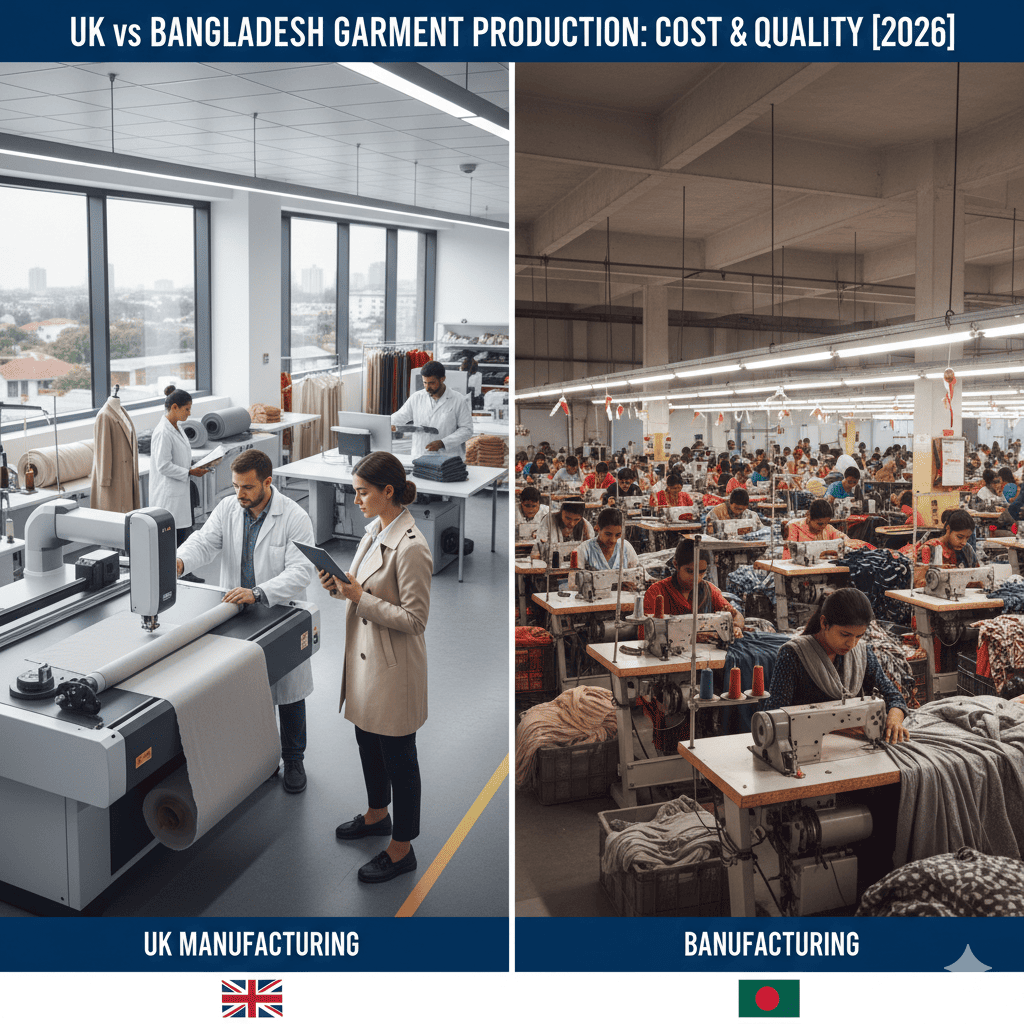
Bangladesh is the world’s second largest garment exporter, with annual exports that have run somewhere between $38 billion and over $50 billion in recent reporting depending on the year and source. Yet UK brands using Bangladeshi factories are still routinely surprised by costs they didn’t model and quality gaps they didn’t anticipate.
This post gives you an honest, numbers-first comparison of UK versus Bangladesh garment manufacturing across unit costs, lead times, quality standards, import duties, and sustainability credentials. For the broader sourcing framework, see our Complete Guide to Clothing Manufacturers in UK.
Post Summary
- Bangladesh remains the lowest-cost large-scale garment producer available to UK brands, but the total landed cost gap with UK manufacturing is narrower than factory gate prices suggest
- Import duties on clothing from Bangladesh to the UK stand at 0% under the UK’s Developing Countries Trading Scheme (DCTS) — and Bangladesh keeps duty-free access for 98% of its exports even after its scheduled 2026 graduation from Least Developed Country status
- Full order cycles from Bangladesh to a UK warehouse run 16–24 weeks, more than double the domestic equivalent
- Quality standards have improved substantially since 2013, but certification levels vary significantly across factory tiers
- The International Accord’s safety reforms have raised the floor on building and fire safety, but coverage isn’t universal
- Bangladesh suits high-volume, low-complexity products where price is the primary driver; the UK suits speed, flexibility, and brand story
Contents
- 1. Bangladesh’s Position in Global Garment Manufacturing in 2026
- 2. Cost Comparison: UK vs Bangladesh Per Garment Type
- 3. Lead Times and Logistics: The Full Picture
- 4. Quality Standards: What Has Changed Since 2013
- 5. Import Duties and Trade Terms in 2026
- 6. Sustainability and Ethical Sourcing in Bangladesh
- 7. When Bangladesh Still Makes Commercial Sense for UK Brands
- 8. Hidden Costs UK Brands Underestimate
- 9. UK vs Bangladesh: Questions Brands Ask Us
- 9.1. What is the import duty on clothing from Bangladesh to the UK in 2026?
- 9.2. What is a realistic lead time for Bangladesh garment production in 2026?
- 9.3. Has Bangladesh garment quality improved since Rana Plaza?
- 9.4. What is the minimum order quantity for Bangladesh garment factories?
- 9.5. Is Bangladesh garment manufacturing sustainable?
- 10. Making the Bangladesh Decision on Full Numbers, Not Headlines
Bangladesh’s Position in Global Garment Manufacturing in 2026
Bangladesh is the world’s second largest apparel exporter behind China, a position it has held for over a decade. Recent annual export figures for the sector have been reported anywhere from the high $30 billions to over $50 billion depending on the year and the reporting body, with the trend clearly upward.
The country’s garment sector employs around 4 million workers, with the industry historically representing roughly 80% or more of Bangladesh’s total export earnings. Those figures explain why Bangladesh has been the default volume production destination for UK high street and mid-market brands for over two decades.
What most sourcing guides get wrong: they treat Bangladesh’s cost advantage as fixed. It isn’t. Minimum wage increases, currency fluctuations, and rising energy costs have all compressed margins since 2021. The gap between Bangladesh and competitor countries like Vietnam has narrowed.
Cost Comparison: UK vs Bangladesh Per Garment Type
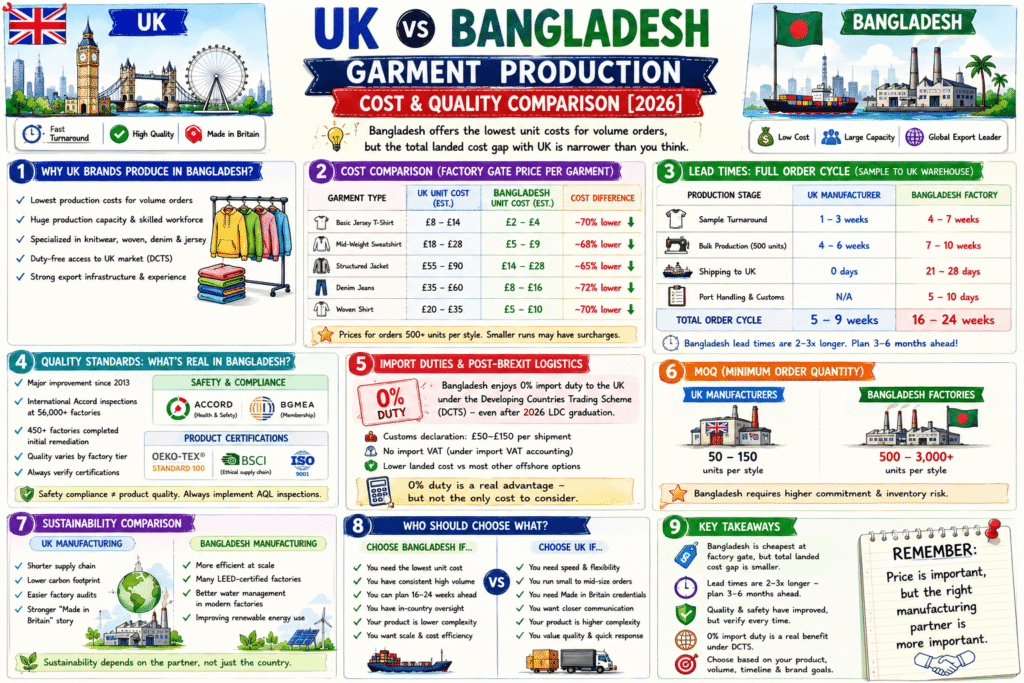
Factory gate prices in Bangladesh remain substantially below equivalent UK production costs for volume orders, though the precise gap varies by garment type and order size.
| Garment Type | UK Unit Cost (est.) | Bangladesh Unit Cost (est.) | Cost Difference |
|---|---|---|---|
| Basic jersey T-shirt | £8–£14 | £2–£4 | Bangladesh ~70% lower |
| Mid-weight sweatshirt | £18–£28 | £5–£9 | Bangladesh ~68% lower |
| Structured jacket | £55–£90 | £14–£28 | Bangladesh ~65% lower |
| Denim jeans | £35–£60 | £8–£16 | Bangladesh ~72% lower |
| Woven shirt | £20–£35 | £5–£10 | Bangladesh ~70% lower |
These are factory gate prices for volume orders, typically 500 units and above per style. Below that threshold, Bangladesh factories frequently decline orders or apply surcharges that erode the unit price advantage.
For UK production costs by garment type and run size, our UK manufacturing cost breakdown covers how we structure pricing across different volume bands.
Lead Times and Logistics: The Full Picture
The lead time data for Bangladesh production is consistently understated in brand sourcing decisions.
Most factories quote production lead time only, typically 45–60 days. The full cycle, from order confirmation to UK warehouse receipt, is a different number entirely.
| Production Stage | UK Manufacturer | Bangladesh Factory |
|---|---|---|
| Sample turnaround | 1–3 weeks | 4–7 weeks |
| Bulk production (500 units) | 4–6 weeks | 7–10 weeks |
| Shipping to UK (sea freight) | 0 days | 21–28 days |
| Port handling and customs | N/A | 5–10 days |
| Total order cycle (sample to delivery) | 5–9 weeks | 16–24 weeks |
The 16–24 week full cycle means brands must commit to orders three to six months ahead of the selling season. For brands reacting to trends, running test quantities, or operating without a large forward-buying budget, this is a structural constraint that unit cost savings can’t offset.
Quality Standards: What Has Changed Since 2013
The Rana Plaza collapse in 2013 killed over 1,100 garment workers and triggered a fundamental restructuring of factory safety and compliance standards in Bangladesh.
The International Accord for Health and Safety in the Textile and Garment Industry (the successor to the original ACCORD on Fire and Building Safety) is a legally binding agreement between garment brands and trade unions. It has now carried out over 56,000 inspections at covered factories and supported more than 450 factories through completed initial remediation of identified hazards. This is a genuine and measurable improvement in safety compliance at the factories that participate.
What guides consistently get wrong: they conflate factory safety compliance with product quality consistency. They aren’t the same thing. A factory can be Accord-compliant and still produce variable quality garments if it lacks adequate inline quality control systems.
The practical quality picture in Bangladesh is tiered. Tier 1 factories, those supplying major international brands, operate to high and consistent standards, with dedicated QC teams, inline inspection, and AQL-tested final inspection. Tier 2 and Tier 3 factories have improved but remain variable.
BGMEA membership is the minimum credible baseline, confirming a factory is a registered, recognised exporter. Beyond that, brands should look for International Accord registration, ISO 9001 quality management certification, and evidence of active third-party social auditing such as BSCI or SMETA.
Import Duties and Trade Terms in 2026
Bangladesh currently benefits from 0% import duty on clothing exported to the UK under the Developing Countries Trading Scheme (DCTS), which replaced the EU’s Generalised System of Preferences post-Brexit.
This is Bangladesh’s single most important trade advantage over competitor sourcing countries. For a brand importing £100,000 of garments from Bangladesh annually, the zero-duty position saves roughly £12,000 compared to sourcing from a non-preferential country at the standard 12% clothing tariff.
Here’s the update most guides haven’t caught up with: Bangladesh is scheduled to graduate from Least Developed Country status in 2026, and earlier guidance treated this as a looming risk to the duty-free arrangement. The UK government has since confirmed that changes made to the DCTS mean Bangladesh will retain duty-free access for 98% of its exports, including ready-made garments, even after graduation. This is more generous than the EU scheme the UK previously operated under. The DCTS also makes it easier for Bangladesh to use raw materials sourced from a wide range of other countries without losing duty-free status, provided certain requirements are met.
This doesn’t make the position permanent or risk-free. Preferential trade terms remain subject to periodic government review, and retention of DCTS preferences is explicitly tied to ongoing compliance with human and labour rights commitments. But the specific “LDC graduation equals automatic duty loss” framing that circulated for several years is no longer accurate, and brands building long-term sourcing strategies around Bangladesh should work from the current confirmed position rather than the older assumption.
Sustainability and Ethical Sourcing in Bangladesh
Long-haul sea freight from Bangladesh to UK ports carries a real, measurable carbon cost that simply doesn’t exist for domestic UK production. The exact per-garment figure varies by vessel, route, and product weight, but the principle holds regardless of the specific number: shipping distance is a genuine sustainability liability that UK manufacturing doesn’t carry.
Set against that, the Bangladesh garment sector has made real progress on factory-level sustainability. Bangladesh has more LEED-certified green garment factories than any other country, with figures from recent years putting the total above 200 and continuing to grow.
“Bangladesh’s green factory programme is genuinely impressive at the top end. But it applies to a fraction of the country’s thousands of active export factories. The sustainability story has real depth for the right supplier, and very little substance for the wrong one.” — Silk Routes Manufacturing Team
Bangladesh is also a significant processor of organic and recycled cotton textiles, though raw cotton itself is almost entirely imported, primarily from India and the United States.
When Bangladesh Still Makes Commercial Sense for UK Brands
Bangladesh isn’t the right choice for every brand. But for specific brand profiles and product categories, it remains the most commercially rational option available.
“Bangladesh works when volume is high, lead times are long enough to plan around, and the product is standardised enough that quality consistency can be managed by specification rather than proximity.” — Silk Routes Manufacturing Team
Bangladesh is the right call when:
Your order volumes consistently exceed 500 units per style per colourway. Your product is a core staple — jersey basics, woven shirts, denim — rather than a complex or technical garment. You have 16–24 weeks of lead time built into your seasonal buying calendar. You have in-country QC resource, or are using a third-party inspection service with Bangladesh presence. Your brand doesn’t make UK origin or short supply chain claims.
Bangladesh is the wrong call when:
You’re running under 300 units per style. You need to react to trend or replenish in-season. Your brand story depends on UK, European, or nearshore manufacturing credentials. You can’t absorb the risk of a quality failure at 10,000 units.
For the full picture of how UK domestic production compares across all offshore options, our Complete Guide to Clothing Manufacturers in UK covers sourcing decisions across every major manufacturing destination.
Hidden Costs UK Brands Underestimate
Mistake 1 — Calculating Bangladesh savings on factory gate price alone. Brands compare the Bangladesh unit price directly to a UK quote without building a full landed cost model. Fix: add sea freight (typically £0.80–£1.50 per unit depending on garment weight and volume), port handling, customs broker fees (£150–£300 per shipment), third-party inspection costs (£300–£600 per visit), and any currency hedging costs. Run the total before making a sourcing decision.
Mistake 2 — Not accounting for minimum order surcharges on smaller runs. Brands see headline MOQ figures of 300–500 units and assume that applies across all styles and colourways. Many Bangladeshi factories apply per-colourway minimums, not per-style. Fix: confirm MOQ terms per colourway in writing before finalising your range plan. A 6-style, 3-colourway range may require 18 separate MOQ commitments, not 6.
Mistake 3 — Using a Bangladesh factory without a third-party pre-shipment inspection. Brands rely on factory self-reporting or a single final inspection photo. Distance makes in-person checks expensive and infrequent. Fix: budget for a third-party AQL inspection on every bulk production run. Services like SGS or Bureau Veritas operate in Bangladesh and typically charge £300–£600 per inspection, a fraction of the cost of receiving a rejected shipment.
Mistake 4 — Assuming LDC graduation means an automatic duty increase. Brands either ignore the LDC graduation timeline entirely, or overcorrect and assume it will trigger a sudden 12% duty uplift. Fix: work from the confirmed current position — the UK has committed to retaining duty-free access for 98% of Bangladesh’s exports post-graduation — while still building light contingency into long-term cost models, since trade preferences remain subject to periodic review.
Mistake 5 — Treating all Bangladesh factories as equivalent because they’re BGMEA members. BGMEA membership is used as a shorthand for compliance. In practice, BGMEA membership confirms registration, not quality or ethical standards. Fix: verify factory audits independently. Look for International Accord registration, BSCI or SMETA audit results, and where relevant, GOTS or OEKO-TEX certification. Never rely on membership alone.
UK vs Bangladesh: Questions Brands Ask Us
What is the import duty on clothing from Bangladesh to the UK in 2026?
Currently 0% under the UK’s Developing Countries Trading Scheme (DCTS), which replaced the EU’s GSP framework after Brexit. This preferential rate applies because of Bangladesh’s trade status, and the UK has confirmed that 98% of Bangladesh’s exports, including ready-made garments, will keep duty-free access even after Bangladesh’s scheduled 2026 graduation from Least Developed Country status.
What is a realistic lead time for Bangladesh garment production in 2026?
The full order cycle, from order confirmation to UK warehouse receipt, runs 16–24 weeks. This includes 7–10 weeks of factory production, 21–28 days of sea freight, and 5–10 days of port handling and customs clearance. Brands quoting only factory production time are understating the true cycle by 4–6 weeks.
Has Bangladesh garment quality improved since Rana Plaza?
Yes, meaningfully, but unevenly. The International Accord has carried out over 56,000 factory inspections and supported more than 450 factories through completed remediation of structural, fire, and electrical hazards. Tier 1 factories supplying major brands operate to consistently high standards. Tier 2 and 3 factories have improved but remain variable. Always verify factory certification independently rather than relying on self-reporting.
What is the minimum order quantity for Bangladesh garment factories?
Most mid-tier export factories require 300–500 units per style as a baseline MOQ. However, many apply this per colourway, not per style, meaning a 4-colour range effectively requires 4 separate MOQ commitments. Specialist or complex garment factories often set higher minimums of 1,000 units or above.
Is Bangladesh garment manufacturing sustainable?
It depends entirely on the factory. Bangladesh has more LEED-certified green factories than any other country, with figures from recent years putting the total above 200. However, the carbon cost of long-haul sea freight remains a real liability for brands with verified environmental claims, and certification coverage is concentrated at the top tier — at mid-tier and below, sustainability claims require independent verification rather than assumption.
Making the Bangladesh Decision on Full Numbers, Not Headlines
Bangladesh offers the lowest factory gate prices of any major garment-producing country accessible to UK brands. That headline figure is real. What surrounds it — lead time constraints, QC overhead, and genuine sustainability trade-offs — requires honest modelling before it becomes a strategy.
For brands that have the volume, the calendar, and the QC infrastructure, Bangladesh remains a commercially rational choice for specific product categories. For brands that don’t have all three, the apparent savings frequently disappear on closer inspection.
To understand how UK domestic production sits within a full sourcing strategy, see our Complete Guide to Clothing Manufacturers in UK. To discuss what UK manufacturing could look like for your brand, visit our clothing manufacturing services page.