
Brands come to us every week without a tech pack.
They have a sketch, a reference garment, sometimes a detailed mood board. What they do not have is the one document that tells a factory exactly what to make.
Without it, the first four to six weeks of the manufacturing relationship are spent filling in information gaps that should have been resolved before the first conversation.
That time costs money. It delays your season. It is entirely avoidable.
The clothing manufacturing process has eight distinct stages, from design development through to finishing and dispatch. Each stage has inputs it needs and outputs it must deliver before the next stage can begin.
A break in that chain — an incomplete tech pack, an unapproved sample, an untested fabric — creates a knock-on delay that compounds at every subsequent stage.
This guide walks through every stage in the order it actually happens, with the decisions, trade-offs, and specific mistakes that cause brands to lose weeks and money at each point.
Contents
- 0.1. Post Summary
- 0.2. Quick Answer
- 0.3. Stage 1: Design Development
- 0.4. Stage 2: Tech Pack Creation
- 0.5. Stage 3: Pattern Making & Grading
- 0.6. Stage 4: Fabric Sourcing & Testing
- 0.7. Stage 5: Sample Development — Proto to Production
- 0.8. Stage 6: Production Run
- 0.9. Stage 7: Quality Control & Inspection
- 0.10. Stage 8: Finishing Services — Embroidery, Printing & Packaging
- 0.11. Timeline: Concept to Delivery
- 0.12. Cost Breakdown by Production Stage
- 1. Tech Pack to Production: Complete Process Visual Guide [2026]
- 1.1. Common Production Mistakes
- 1.2. Case Study: The Tech Pack That Saved Four Weeks
- 1.3. Case Study: The Inline QC That Prevented a Full Re-Make
- 1.4. The Silk Routes Approach to Production Management
- 1.5. Frequently Asked Questions
- 1.5.1. How long does the full clothing manufacturing process take from concept to delivery?
- 1.5.2. What is the minimum information a factory needs to start sampling?
- 1.5.3. How much should I budget for sample development on a new style?
- 1.5.4. What is AQL inspection and do I need it for every order?
- 1.5.5. What is the difference between inline QC and final inspection?
- 1.5.6. Can I visit the factory during production?
- 1.6. Citations and Sources
Post Summary
- The clothing manufacturing process runs across 8 distinct stages, from design development to finishing and dispatch.
- A complete, accurate tech pack is the single highest-return investment a brand can make before approaching any manufacturer.
- UK manufacturing typically takes 8-14 weeks from an approved PP sample to bulk delivery, depending on complexity.
- Grading to a brand’s fit standard requires the brand’s own grading rules — a factory will not infer this correctly without being told.
- Sample approval sequence matters: proto is for construction, fit samples are for fit, PP is for fabric and colour — confirming things out of order triggers expensive repeat rounds.
- Inline QC at three production checkpoints catches errors when they affect a handful of units, not hundreds.
- AQL 2.5 is standard for fashion garments; AQL 1.0 applies to higher-risk categories like childrenswear and technical workwear.
- One case in this guide shows a four-week timeline difference between two styles in the same order, caused entirely by a missing grading brief.
Quick Answer
The clothing manufacturing process runs across 8 stages: design development, tech pack creation, pattern making and grading, fabric sourcing and testing, sample development, production run, quality control, and finishing. From an approved tech pack to finished bulk goods, UK manufacturing typically takes 8-14 weeks depending on product complexity. A complete, accurate tech pack significantly reduces sampling rounds and cuts overall development time compared with an incomplete brief. Getting the pre-production documentation right is the single highest-return investment a brand can make before approaching any manufacturer.
Stage 1: Design Development
The UK fashion and textile industry contributes £62 billion to GDP and supports 1.3 million jobs — yet the single most common failure point we see at production stage originates here, in design development (Source: UKFT and Oxford Economics, Fashion & Textile Industry Footprint Report, 2023).
Design development is not drawing. It is the process of translating a creative concept into a manufacturable specification.
Those are different things. A concept can ignore construction reality — a spec cannot.
We see two categories of brief arrive at Silk Routes. The first is a concept: visuals, references, a general aesthetic direction.
The second is a specification: construction method, fabric weight, seam type, finish. The first requires a development conversation before sampling can begin.
The second can go to pattern directly. The difference in timeline between the two is typically three to four weeks.
If you are at concept stage, the most valuable thing you can do before approaching a manufacturer is answer four questions in writing. What is the garment’s primary end use?
What fabric type and weight does the construction require? What is the target retail price point, and does the specification support the margin at your likely MOQ?
What certifications or compliance standards does the product need to meet?
What Good Design Development Produces
A completed design development stage should produce a finalised silhouette with construction notes, a fabric brief, a trim and hardware list, a colourway plan, and a target cost range.
It should not produce a finished product. That comes through sampling. Design development is the foundation; sampling is the refinement.
Stage 2: Tech Pack Creation
The tech pack is the legal and operational document of clothing manufacturing. Every factory that has ever produced a consistent garment has worked from one.
A tech pack is not optional. It cannot be replaced by a sample garment, a Pinterest board, or a detailed email.
It is the single source of truth for the manufacturer — and the single point of reference if a production run comes back wrong.
| Section | What It Includes | Why It Matters |
|---|---|---|
| Technical flat sketches | Front, back, side views with measurement callouts | Removes ambiguity about silhouette and proportion |
| Measurement specification | Size chart with graded measurements for all sizes | Defines fit across the range — not just the sample size |
| Construction details | Seam type, stitch type, stitch density per inch | Determines structural integrity and finish quality |
| Fabric specification | Fabric type, weight (gsm), composition, supplier preference | Ensures the right fabric is sourced before cutting begins |
| Trim and hardware spec | Zips, buttons, labels, thread colour, interlining | Brand identity sits in the details — these must be specified |
| Colourway plan | Pantone or LAB references for all colours | Prevents colour interpretation errors in bulk |
| Care label requirements | Washing instructions, fibre content, country of origin | Legal requirement under UK textile labelling regulations |
| Packaging specification | Fold type, poly bag size, hangtag position | Determines dispatch-ready presentation standard |
The most common tech pack failure we see is incomplete measurement specifications. A brand provides measurements for the sample size only and assumes the factory will grade the range.
Grading to a brand’s fit standard requires the brand’s grading rules. Assumptions made by the factory will produce a size run that fits inconsistently.
Provide a full graded spec for every size in your range, or brief the factory explicitly to grade and submit the graded spec for approval before cutting.
How to Create a Tech Pack If You Do Not Have One
You do not need specialist software. Adobe Illustrator is industry standard for technical flats.
If you are not a trained technical designer, your options are: commission a freelance technical designer (expect £150-£400 per style), use a manufacturer offering tech pack development as a paid service, or use a validated template with support from your pattern maker.
Do not guess. An incomplete tech pack produces an inaccurate sample, which produces a repeat sample round.
Working with Silk Routes on your tech pack? Our team reviews every brief before sampling begins. See our full manufacturing services to understand how we approach pre-production documentation.
Stage 3: Pattern Making & Grading
Pattern making translates the tech pack specification into the physical cutting templates used to produce the garment. It is a skilled trade, and in the UK, one of the most acute skills shortage areas in clothing manufacturing.
UKFT’s industry reporting identifies pattern cutting and grading among the top skills gaps in UK garment manufacturing, alongside machinist skills and technical design (Source: UKFT, Industry Reports and Statistics).
Pattern making has a direct relationship with sample quality. A pattern made by an experienced cutter who has worked extensively in your product category produces a first sample far closer to the approved spec than one made by a generalist encountering your construction for the first time.
When we take on a new product category at Silk Routes, we assign the pattern to the cutter with the most relevant category experience — not simply the next available person.
Grading: What It Is and Why It Is Not Automatic
Grading is the process of scaling a base-size pattern up and down to produce the full size range. It is not a simple multiplication.
Grading rules vary by garment type, brand fit standard, and target customer. Applying incorrect grading rules produces a size run that fits well at the sample size and poorly at every other size.
For brands launching with a limited size range, the grading brief should be explicit about the increment between sizes at each measurement point, whether the grade distributes proportionally or applies a flat increment, and whether the brand has a specific fit model to check against.
Grading that has not been explicitly briefed will default to the factory’s standard increments. Those increments may or may not match your customer’s body.
Stage 4: Fabric Sourcing & Testing
Fabric sourcing is not buying fabric. It is identifying, qualifying, and securing the right material at the right specification before production begins.
The most common sourcing mistake — choosing a fabric based on a small swatch — produces a garment in bulk that behaves differently to the development sample.
Fabric weight, hand feel, and drape at a 20cm swatch are not the same as fabric behaviour at a full garment cut and washed.
| Sourcing Route | Lead Time | MOQ | Cost | Risk |
|---|---|---|---|---|
| UK fabric merchant (stock) | 1-5 days | No minimum | Higher per metre | Low — available immediately |
| UK fabric merchant (indent) | 3-6 weeks | 50-100m | Moderate | Medium — spec must be confirmed |
| European mill | 4-8 weeks | 50-300m | Variable by mill | Medium — quality high, lead time a factor |
| Far East mill (direct) | 8-14 weeks | 300-500m | Lowest per metre | High at low volume — MOQ and lead time challenging |
| Deadstock / end-of-roll | 1-5 days | As available | Low-moderate | Medium — limited availability, no repeat guarantee |
For brands producing under 200 units per style, stock fabric from UK merchants is frequently the right sourcing route — not because it is cheapest, but because the lead time and MOQ flexibility allow development and bulk production to run closer together.
The per-metre cost premium over direct mill sourcing is often offset by the reduction in working capital tied up in minimum quantities you may not need.
Fabric Testing: What Must Be Done Before Cutting
Testing is not optional for compliant categories, and not optional for any brand intending to reorder the same fabric in future seasons.
Minimum required tests before bulk cutting: wash shrinkage, colourfastness, and pilling resistance, particularly for knitwear and jersey fabrics.
For GOTS-certified organic fabric claims, the certification must be verified through the GOTS public database before the claim is used in brand communications.
For OEKO-TEX Standard 100 fabric, the certificate must be current — certificates are valid for one year and must be renewed by the mill.
Stage 5: Sample Development — Proto to Production
| Sample Type | Purpose | Who Approves | Typical Round Count |
|---|---|---|---|
| Proto sample | Concept verification — silhouette, proportion, basic construction | Brand creative lead | 1-2 rounds |
| Fit sample (SMS) | Fit verification — measurements checked against spec | Brand + technical designer | 1-2 rounds |
| Counter sample | Brand’s approved sample replicated by production factory | Brand technical lead | 1 round if PP correct |
| Pre-production (PP) sample | Final approval before bulk cutting | Brand director/buyer | 1 round (ideally) |
| TOP sample | First unit off the production line | Brand QC lead | Inspection only |
The sample development stage is where most development budget is spent and most time is lost.
The most expensive sampling mistake we see consistently is brands approving a proto sample on construction and proportion, then requesting fabric and colour changes at PP stage.
Proto is for construction. SMS is for fit. PP is for fabric, colour, and trim confirmation in the production fabric.
Requesting a fabric change after PP approval triggers a new PP round — adding 2-4 weeks and a full additional sample cost. Follow the approval sequence.
How Many Sample Rounds Should You Budget For?
Based on our own production data, brands without a complete tech pack typically need an average of 3-4 sample rounds across all sample types for a new style.
With a complete tech pack and clear approval criteria at each stage, we typically bring this down to 1-2 rounds for our clients (Source: Silk Routes production data, 2026).
The variables that most affect round count: completeness of the original tech pack, clarity of feedback at each approval stage, and whether the brand has worked with the factory on a similar construction before.
Stage 6: Production Run
The production run begins only when the PP sample has been approved in writing. Not verbally. Not by email with caveats.
In writing, unambiguously, by the authorised person on the brand side.
An unambiguous PP approval is the factory’s authority to cut bulk fabric. Any change requested after bulk cutting begins creates waste, cost, and delay.
What Happens During Production
A production run has three phases: cut, make, trim (CMT), often performed by different teams within the same factory.
Cut: the approved pattern is used to cut fabric from the roll. Lay planning is performed before cutting to minimise waste, directly affecting cost per unit.
Make: cut pieces are assembled by machinists. Stitch type, stitch density, seam allowance, and pressing are performed to the tech pack spec. Inline QC checks happen during make, not only at end of line.
Trim: finishing operations — thread trimming, pressing, attaching labels, hangtags, packaging. This stage determines how the finished garment is presented to the end customer.
Inline QC during make is non-negotiable at Silk Routes. Catching a construction error at stitch stage costs the time to re-stitch one seam.
Catching the same error at end-of-line QC means a full inspection and potential re-make of multiple units.
We run inline checks at three points: after main seaming, after pocket and trim attachment, and before pressing. This structure is named in our client SLAs.
Stage 7: Quality Control & Inspection
Quality control failures account for a meaningful share of avoidable production cost in UK garment manufacturing when rework, returns, and replacements are included — a cost that drops sharply once inline QC checkpoints are built into the production process rather than relying on end-of-line inspection alone (Source: Silk Routes production data, 2026).
QC is not a final check. It is a system built into every stage of production.
| QC Stage | When | What Is Checked | Who Conducts |
|---|---|---|---|
| Pre-production QC | Before bulk cut | Fabric quality, trim delivery, PP sample match | Factory QC lead |
| Inline QC | During make (3 points) | Construction, stitch quality, seam integrity | Factory floor QC |
| End-of-line QC | After make, before trim | Measurements, construction defects, pressing | Factory QC team |
| Final inspection | Before packing | AQL sampling, measurements, presentation | Brand QC or third-party inspector |
AQL Sampling: What the Numbers Mean
AQL (Acceptable Quality Level) is the standard method for statistically sampling a production batch without inspecting every unit. The most commonly used levels are AQL 2.5 (general fashion quality) and AQL 1.0 (tighter standard for technical or compliance-driven categories).
At AQL 2.5, a batch of 500 units requires inspection of 50 units. If 3 or fewer major defects are found, the batch passes. If 4 or more, the full batch is subject to 100% inspection or re-make.
We use AQL 2.5 as our standard level for fashion garments. For uniform programmes and childrenswear, we apply AQL 1.0.
The decision is made at pre-production stage and written into the production brief. We do not apply a uniform QC standard regardless of category — a children’s garment and a fashion tote bag do not carry the same risk profile if a defect is missed.
Stage 8: Finishing Services — Embroidery, Printing & Packaging
Finishing is the stage that most directly affects the brand experience of the finished garment. It is also the stage most frequently under-briefed.
| Method | Best For | MOQ | Detail Capability | Durability |
|---|---|---|---|---|
| Embroidery | Logos, crests, wordmarks on structured garments | 12-50 units | High | Excellent — does not fade or crack |
| Screen printing | Bold graphics, large colour blocks, T-shirts | 24-50 units/colour | Medium | Good — correct cure essential |
| DTG | Photographic prints, low volume | 1 unit (no MOQ) | Very high | Moderate |
| Heat transfer / vinyl | Small runs, names/numbers | 1 unit | Medium | Good on smooth fabric only |
| Woven labels | Brand identity — neck/size labels | 100-500 units | High | Excellent — permanent |
| Sublimation printing | All-over print on polyester | 24-50 units | Very high | Excellent on synthetic only |
The most common finishing brief failure is not specifying embroidery placement precisely. “Left chest” is not a placement brief.
The distance from centre front, the distance from the shoulder seam, and the orientation of the design must all be specified.
We require a placement diagram in the tech pack for every embroidered or printed garment. A placement diagram takes ten minutes to produce and prevents a decoration that cannot be unpicked.
Timeline: Concept to Delivery
| Stage | Typical Duration | Variable Factors |
|---|---|---|
| Design development | 1-3 weeks | Completeness of brief on arrival |
| Tech pack creation | 1-2 weeks | Construction complexity |
| Pattern making | 1-2 weeks | Category; fully-fashioned knitwear adds time |
| Fabric sourcing & testing | 1-5 weeks | Sourcing route |
| Sample development | 4-10 weeks | Number of rounds; approval speed |
| Production run | 4-8 weeks | Volume; complexity; factory capacity |
| QC & inspection | 1-2 weeks | Inspection method; AQL level |
| Finishing & dispatch | 1-2 weeks | Decoration complexity |
| Total (minimum) | 8-12 weeks | From approved PP sample to dispatch |
| Total (full development) | 14-22 weeks | From concept brief to finished bulk delivery |
Cost Breakdown by Production Stage
| Stage | Typical Cost Range | Notes |
|---|---|---|
| Tech pack development | £0 (brand-supplied) to £400/style | Freelance or manufacturer service |
| Pattern making | £80-£250/style | Knitwear and tailoring at top of range |
| Grading (full size run) | £40-£120/style | Fully-fashioned knitwear higher |
| Proto sample | £80-£250/unit | Complexity-dependent |
| Fit sample (SMS) | £80-£200/unit | |
| PP sample | £100-£300/unit | Production fabric; reflects bulk spec |
| Fabric (per metre, UK merchant) | £4-£35/m | By fibre and construction |
| CMT (cut, make, trim) | £8-£45/unit | T-shirt at lower end; tailored outerwear at top |
| Embroidery | £1.50-£6/placement | Stitch count determines price |
| Screen print | £1-£4/colour/unit | Setup fee for first run |
| Final inspection (third party) | £200-£400/day | Covers 500-800 units typically |
These figures represent UK market ranges in 2026. They are starting benchmarks — actual quotes vary by manufacturer, volume, and specification.
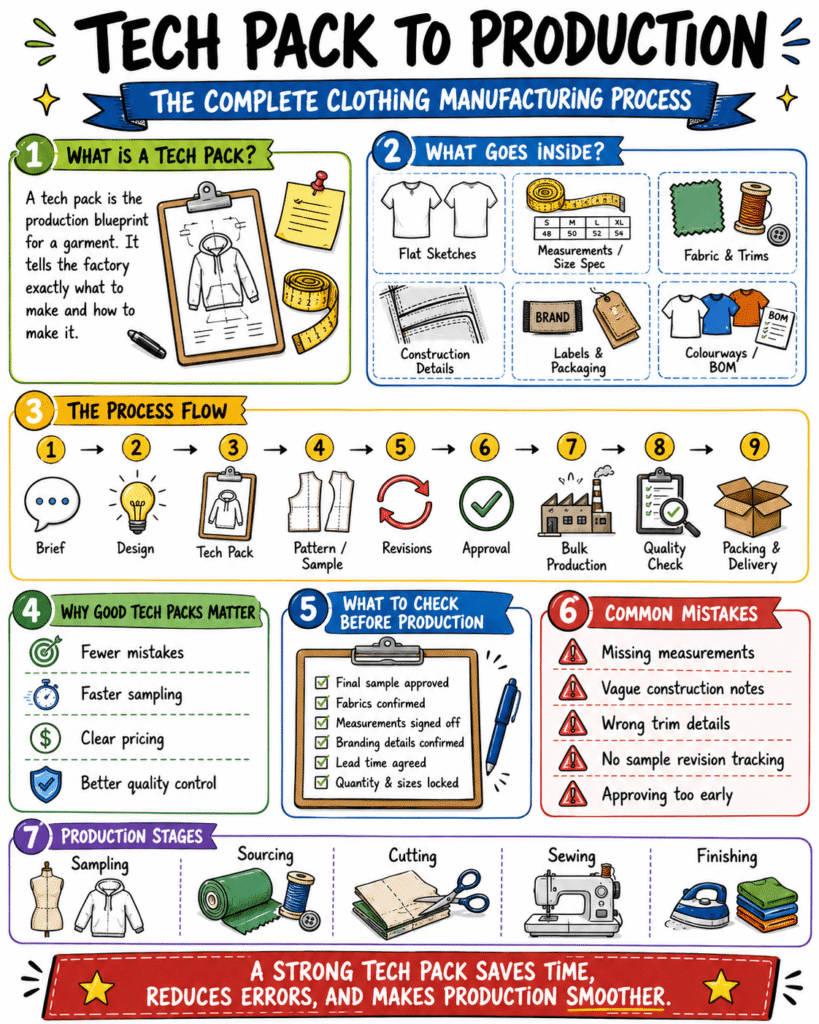
Tech Pack to Production: Complete Process Visual Guide [2026]
Eight production stages, verified cost benchmarks, AQL inspection standards, lead time timelines by category, and the six mistakes brands repeat most. All data from publicly verified UK industry sources.
AQL 2.5 (fashion): batch passes if major defects ≤ 3 per 50 units inspected. AQL 1.0 (workwear / childrenswear): tighter — 1 major defect triggers full batch re-inspection. Brand holds product liability regardless of factory QC pass.
Data: UKFT/Oxford Economics · IBISWorld · WRAP · ISO 2859-1 · OPSS Gov.uk · Make It Britain
Common Production Mistakes
Mistake 1 — Starting sampling without an approved tech pack. Why it happens: brands are eager to see a physical sample and believe the factory can interpret intent from a reference garment. Exact fix: do not submit a sampling brief without a complete tech pack. The cost of one extra sample round exceeds the cost of producing a basic tech pack.
Mistake 2 — Approving samples without written sign-off. Why it happens: brand teams communicate approval verbally or via message without a formal record. Exact fix: use a sample approval form for every stage, recording sample type, date, decision, amendments, authorising person, and sign-off date.
Mistake 3 — Changing fabric at PP stage. Why it happens: the brand sees the PP sample in production fabric and decides a different fabric would look better — a decision that should have been made at fit stage. Exact fix: confirm fabric selection definitively at SMS stage. Fabric changes after PP require a new PP round.
Mistake 4 — Sending vague correction notes. Why it happens: stakeholders describe problems aesthetically rather than technically. Exact fix: measure before you describe. Express the difference in millimetres or centimetres, not aesthetic language.
Mistake 5 — Not building PP approval time into the season calendar. Why it happens: brands assume one sample round and immediate PP approval. Exact fix: add three weeks of buffer to every pre-production stage — one for courier transit, one for internal review, one contingency for a correction round.
Mistake 6 — Skipping third-party final inspection. Why it happens: brands trust the factory’s own QC to save £200-£400. Exact fix: commission an independent AQL inspection for every bulk order over 200 units. The cost of a single recall or retailer deduction exceeds the inspection cost many times over.
Case Study: The Tech Pack That Saved Four Weeks
A London-based accessories and jersey brand came to us with a new range — five styles, all jersey construction, targeting a spring launch with a confirmed retail listing.
Their timeline required PP approval within eight weeks of brief submission. The first two styles arrived with complete tech packs — construction drawings, full graded specs, Pantone references, care label text.
Proto samples on both styles were approved after one round. Pattern was confirmed. PP was ordered immediately.
The remaining three styles arrived without graded specs. The brand had provided sample size measurements only and noted “please grade to standard.”
Our pattern cutter flagged this before sampling began and requested the grading instructions. The brand needed two weeks to confirm their grading standard with their technical designer.
Result: the two fully-specified styles completed PP approval in seven weeks. The three under-specified styles completed PP approval in eleven weeks — four weeks longer, entirely attributable to the missing grading brief.
The brand has since adopted a pre-submission tech pack checklist for every style.
Case Study: The Inline QC That Prevented a Full Re-Make
A Manchester-based workwear brand — 800-unit production run, a corporate jacket with embroidered chest logo and reflective tape panels.
At the second inline QC checkpoint, our floor QC identified that the reflective tape on 34 units had been applied 8mm outside the specified placement — a positioning error introduced when the trim team changed shift midway through the run.
At that point, 34 units were affected. The correction — removing and re-applying the tape — took half a day.
Without inline QC, the error would not have been caught until end-of-line inspection, by which point 200+ units would have been affected before the shift change was identified.
The re-make cost on 200 units at the garment’s CMT rate would have been approximately £4,200, against a QC intervention cost of under £200.
The client received their full 800-unit run on schedule. The inline QC checkpoint is standard practice in our production process, not an add-on.
The Silk Routes Approach to Production Management
We manage the full eight-stage process described in this guide — from tech pack review through to final inspection and dispatch. Our clients are not handed off to a production team after the initial conversation.
Our pre-production process starts with a brief assessment before any costs are committed. We review your tech pack against our production checklist — 24 specification points across construction, fabric, trim, and compliance — and return a written brief assessment within three working days.
If your brief has gaps, we tell you specifically what is missing and what it will take to resolve them. We do not start the clock on sampling until we are confident the brief is complete enough to produce an accurate first sample.
For brands that need tech pack development support, we offer this as a paid pre-production service. We do not charge a development fee for brands providing a complete tech pack.
What we can guarantee: a written brief assessment before sampling begins, inline QC at three production checkpoints, and a final inspection report before dispatch. What we cannot guarantee: a specific number of sample rounds — that depends on the accuracy of the original brief and the speed of the brand’s approval process.
For brands at the start of their manufacturing journey, our clothing manufacturing services page covers what we produce and how the process works in practice.
This guide pairs directly with our Complete Guide to Clothing Manufacturers UK and our Low MOQ & Private Label guide for brands at startup stage.
You can read more about how we work on our about page.
Frequently Asked Questions
How long does the full clothing manufacturing process take from concept to delivery?
From an initial concept brief to finished bulk delivery, the realistic timeline is 14-22 weeks for a new style with a new manufacturer. From an approved PP sample, bulk production and dispatch typically runs 8-12 weeks depending on complexity and volume.
What is the minimum information a factory needs to start sampling?
The minimum viable brief for a first proto sample is a technical flat sketch with construction notes, a measurement specification for the base sample size, a fabric brief, a colourway specification, and a trim list. Without all five, the factory will make assumptions requiring correction.
How much should I budget for sample development on a new style?
Budget £400-£900 per style for full sample development from proto through PP, assuming two rounds per sample type at the higher end. A realistic all-in pre-production budget for a new style with no existing patterns is £600-£1,500 before bulk fabric and CMT costs.
What is AQL inspection and do I need it for every order?
AQL is a statistical sampling method that assesses a batch for defect rate without inspecting every unit. AQL 2.5 is standard for fashion garments; AQL 1.0 applies to higher-risk categories including childrenswear and technical workwear. For orders of 200 units or more, an independent AQL inspection is increasingly required by retail buyers as part of supplier compliance documentation.
What is the difference between inline QC and final inspection?
Inline QC is conducted during production at specific checkpoints to catch construction errors early, when they affect a small number of units. Final inspection happens after production is complete, using AQL sampling against the approved PP sample. Both are necessary.
Can I visit the factory during production?
Yes — for orders over 500 units or first orders with a new manufacturer, we encourage a factory visit during pattern and pre-production stage and again during bulk production at an inline QC checkpoint. Remote video inspection is also available for clients who cannot travel.
Citations and Sources
- UKFT and Oxford Economics — The Fashion and Textile Industry’s Footprint in the UK
- UKFT — Industry Reports and Statistics
- OPSS / GOV.UK — Product Safety Advice for Businesses
- WRAP — Textiles 2030 Annual Progress Update
- Textile Exchange — Materials Market Report 2024
- Make It British — UK Clothing Manufacturers Directory 2025