
Contents
- 1.
- 2. Marker efficiency and fabric waste
- 2.1. What Is Lay Planning and How Does It Relate to Marker Making?
- 2.2. How Marker Efficiency Is Calculated
- 2.3. CAD Marker Making Software — Options and Benefits
- 2.4. Nap and Directional Fabrics — How They Affect Marker Efficiency
- 2.5. How to Improve Marker Efficiency and Reduce Fabric Waste
- 2.6. What Brands Can Do to Influence Marker Efficiency
- 2.7. Common Marker Making Mistakes That Cost Brands Money
- 2.8. How Silk Routes Approaches Fabric Efficiency
- 2.9. FAQ
- 2.9.1. Does marker efficiency matter for small production runs?
- 2.9.2. Can marker efficiency be improved without changing the design?
- 2.9.3. Who is typically responsible for marker making in a factory?
- 2.9.4. Does higher marker efficiency always mean lower fabric cost?
- 2.9.5. How often should marker efficiency be reviewed for a repeat style?
Fabric is usually the single largest cost in a garment’s bill of materials — often larger than labour. A one or two percentage point improvement in marker efficiency sounds small, but multiplied across a bulk order, it’s real money left on the cutting room floor or saved from it. This guide covers what marker making and lay planning actually are, how efficiency gets calculated, and what both factories and brands can do to reduce fabric waste.
In this article:
- What marker making and lay planning are, and how they relate
- How marker efficiency is calculated and what affects it
- CAD marker making software options and what they offer
- How nap and directional fabrics change the calculation
- Practical steps to improve efficiency and cut fabric waste
- Common marker making mistakes that quietly cost brands money
What Is Marker Making in Clothing Production?
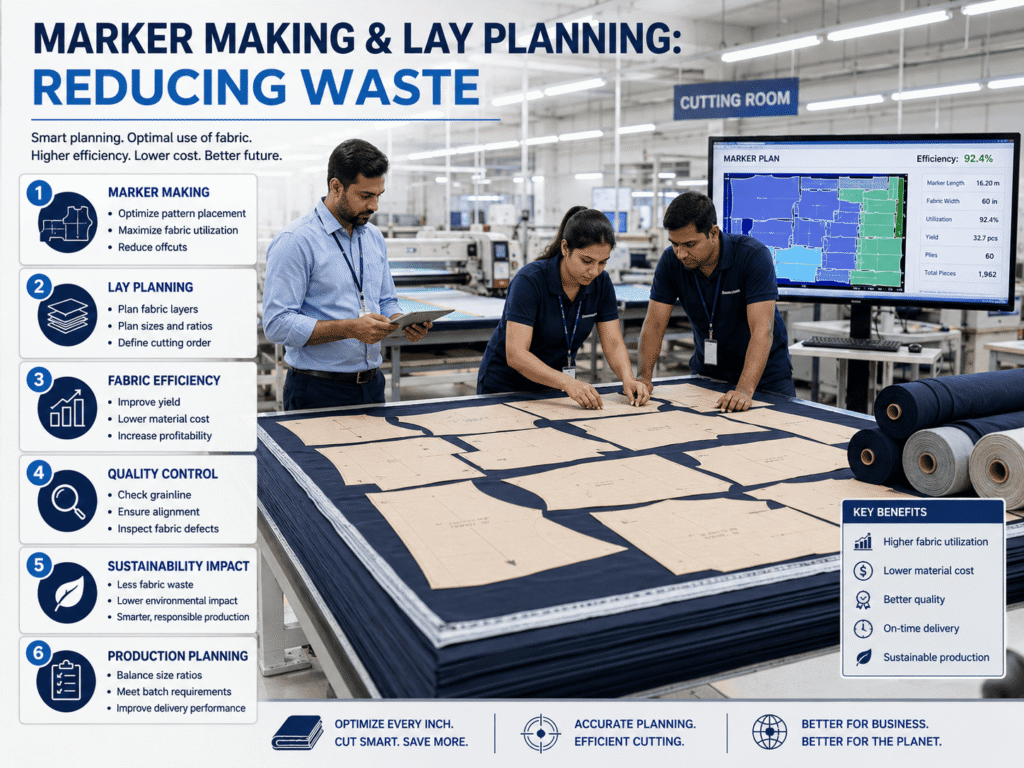
Marker making is the process of arranging every pattern piece for a garment onto a layout that matches the fabric’s width, with the goal of using as little fabric as possible. The finished layout — the marker — is what gets placed on top of the fabric before cutting.
A good marker isn’t just about squeezing pieces together. It also has to respect fabric grain, pattern matching, and any directional print or nap in the material.
Marker efficiency and fabric waste
An interactive companion to "Marker Making & Lay Planning" — calculate marker efficiency live, compare CAD software, and see where nap fabrics change the numbers.
Gerber AccuMark
Widely used suite for pattern design, grading, and marker making, with automated nesting via AccuNest.
Lectra Modaris / Diamino
Pattern design and automated marker nesting, now part of the same company as Gerber.
Optitex
2D and 3D pattern and marker software with garment simulation built in.
Non-directional fabric
Pieces can face any direction, giving the nesting software the most options to tighten the layout.
Nap / directional fabric
Every piece must face the same way, which typically reduces achievable marker efficiency versus a free-rotation fabric.
Design & pattern draft
Grading across sizes
Marker making & nesting
Lay planning
Spreading & cutting
What Is Lay Planning and How Does It Relate to Marker Making?
Lay planning and marker making work together but solve different problems.
| Term | What It Covers |
|---|---|
| Marker Making | Arranging pattern pieces efficiently within a single fabric width |
| Lay Planning | Deciding how many fabric layers (plies) to stack and cut at once |
Marker making determines how efficiently one layer of fabric is used. Lay planning determines how many layers get cut simultaneously, and in what order sizes are distributed through the stack — this affects cutting speed and labour cost as much as fabric usage.
How Marker Efficiency Is Calculated
Marker efficiency measures how much of the fabric in a marker actually becomes garment, versus how much is wasted as offcuts between pieces.
| Metric | Formula |
|---|---|
| Marker Efficiency % | (Total area of all pattern pieces ÷ Total marker area) × 100 |
| Fabric Consumption | Marker length × fabric width, divided by units produced |
| Efficiency Range | What It Typically Indicates |
|---|---|
| Below 75% | Poor marker planning, or highly irregular pattern shapes |
| 75–85% | Typical range for many standard garment styles |
| 85%+ | Strong efficiency, usually achieved through CAD nesting on simple silhouettes |
Higher marker efficiency isn’t only about smarter arrangement — it also depends on the pattern shapes themselves. Curved, irregular pieces waste more fabric between them than straight-edged pieces, regardless of how well the marker is planned.
CAD Marker Making Software — Options and Benefits
Manual marker making — physically arranging paper patterns on fabric — has largely been replaced by CAD software in factories producing at any real scale.
| Software | What It’s Known For |
|---|---|
| Gerber AccuMark | Widely used pattern design, grading, and marker making suite |
| Lectra Modaris/Diamino | Pattern design and automated marker nesting, now part of the same company as Gerber |
| Optitex | 2D/3D pattern and marker software with garment simulation |
Gerber and Lectra are now part of the same company, and both remain widely used industry-standard platforms for pattern design, grading, and automated marker nesting. Automated nesting tools within these platforms can test multiple pattern arrangements and select the most fabric-efficient option, something that would take far longer to test manually.
Brands sourcing production through Silk Routes’ clothing manufacturing services benefit from factories using CAD-based marker making as standard, since it removes a significant source of avoidable fabric cost before cutting even begins.
Nap and Directional Fabrics — How They Affect Marker Efficiency
“Always confirm whether a fabric has nap or directional print before marker planning starts — it changes the achievable efficiency, not just the layout.” — Silk Routes Manufacturing Team
Nap fabrics — velvet, corduroy, and similar pile fabrics — reflect light differently depending on direction, so every pattern piece must face the same way. This restriction typically reduces achievable marker efficiency compared with a non-directional fabric, since pieces can no longer be rotated freely to interlock more tightly.
“Confirm directional requirements with the factory before sampling, not after the bulk marker has already been planned.” — Silk Routes Manufacturing Team
Striped and plaid fabrics carry a similar constraint, since pattern matching across seams limits how pieces can be positioned relative to each other.
How to Improve Marker Efficiency and Reduce Fabric Waste
“Combine multiple sizes into a single marker wherever the order allows it — a size-mixed marker almost always nests tighter than single-size markers run separately.” — Silk Routes Manufacturing Team
Running a marker across a full size range, rather than one size at a time, gives the nesting software more piece-shape combinations to work with, which typically improves overall efficiency.
“Review marker efficiency reports from your factory, not just the final fabric invoice — a dropping efficiency percentage is an early warning sign worth investigating.” — Silk Routes Manufacturing Team
Fabric width also matters more than many brands realise — a marker that fits awkwardly on a narrow fabric roll can sometimes nest significantly better on a wider roll of the same material, if that width option exists from the mill.
What Brands Can Do to Influence Marker Efficiency
“Simplify pattern shapes where design allows — a slightly squarer hemline or sleeve can meaningfully change how tightly pieces nest together.” — Silk Routes Manufacturing Team
Design decisions made long before cutting — curved hems, angled seams, asymmetric details — directly affect achievable marker efficiency. This doesn’t mean simplifying every design, but it’s worth knowing which design choices carry a real fabric cost.
“Ask your factory for the marker efficiency percentage on every bulk production run, not just the sample stage.” — Silk Routes Manufacturing Team
Brands that never ask for this figure rarely find out how much fabric cost is quietly being lost to poor marker planning, since it’s not a number factories volunteer unprompted.
Common Marker Making Mistakes That Cost Brands Money
Mistake 1: Not confirming nap or directional requirements before marker planning. Why it happens: brands assume the factory will catch it, and factories sometimes assume the brand has already specified it. Fix: state nap and directional requirements explicitly in the tech pack, not verbally.
Mistake 2: Running single-size markers when a combined size marker was possible. Why it happens: order quantities per size are decided separately from marker planning. Fix: share full size breakdowns with the factory before marker planning begins, not after.
Mistake 3: Never reviewing marker efficiency reports. Why it happens: fabric cost is treated as fixed once the tech pack is approved. Fix: request the marker efficiency percentage as a standard line item on every production cost sheet.
Mistake 4: Approving pattern changes late without checking the fabric impact. Why it happens: last-minute design tweaks feel minor from a design perspective. Fix: ask the factory to re-run the marker efficiency check after any late-stage pattern change, since even small shape changes can shift the percentage.
How Silk Routes Approaches Fabric Efficiency
We treat marker efficiency as a cost-control checkpoint, not a factory-side detail brands don’t need visibility into. Efficiency percentages get reviewed alongside fabric consumption figures before a bulk order is confirmed, not after fabric has already been ordered.
This same discipline around cost checkpoints runs through the complete tech pack to production process, where fabric planning sits alongside costing and sourcing as a reviewed production stage. Read more about Silk Routes and how fabric efficiency fits into our wider approach to production cost control.
FAQ
Does marker efficiency matter for small production runs?
Yes, though the absolute fabric savings are smaller in cash terms than on a bulk run. Even at low volume, poor marker efficiency increases the fabric quantity needed per unit, which affects unit cost on every future reorder using the same pattern.
Can marker efficiency be improved without changing the design?
Yes, to a point — better nesting software, combining sizes into one marker, and using wider fabric rolls can all improve efficiency without touching the pattern. Beyond a certain point, further improvement usually requires adjusting pattern shapes themselves.
Who is typically responsible for marker making in a factory?
Marker making is usually handled by pattern cutters or graders who have progressed into CAD-based marker and nesting work, often building on skills first developed in pattern cutting and grading roles. Larger factories may have a dedicated marker planning team separate from the pattern room.
Does higher marker efficiency always mean lower fabric cost?
Generally yes, since less fabric is wasted per unit produced, but it isn’t the only factor in fabric cost. Fabric price per metre, minimum order quantities from the mill, and wastage from fabric flaws also affect the final cost independently of marker efficiency.
How often should marker efficiency be reviewed for a repeat style?
It’s worth reviewing marker efficiency whenever a repeat style changes fabric supplier, fabric width, or size ratio, since any of these can shift the achievable efficiency. A style that hasn’t changed at all rarely needs re-checking beyond an occasional audit.