
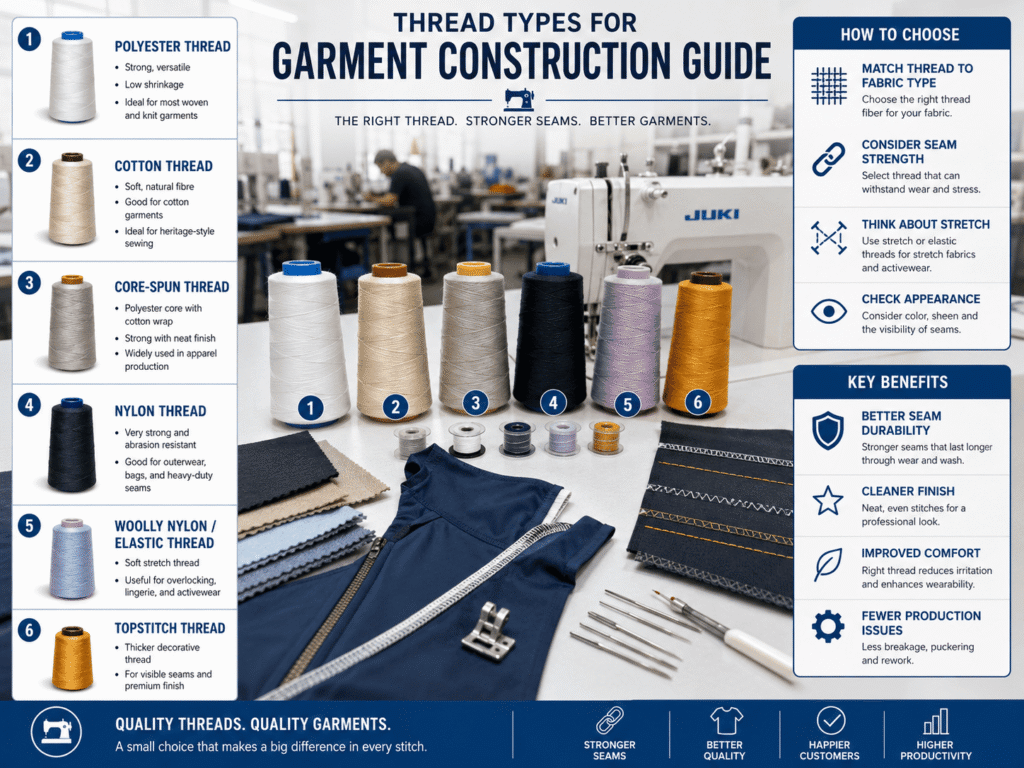
A brand once had an entire batch of activewear returned after seams split at the first proper stretch test — the fabric was fine, the stitching was fine, but the thread itself simply couldn’t stretch with the fabric. Thread is one of the cheapest line items in a garment’s cost sheet and one of the most consequential when it’s wrong. This guide covers the main thread types, how to read ticket numbers, colour matching, and thread selection by garment and fabric type.
In this article:
- Why thread selection affects garment quality and durability
- The five main thread types used in garment construction
- How to read and specify thread ticket numbers
- Thread selection by garment type and special fabric
- Common thread specification mistakes and how to avoid them
Contents
- 1. Why Thread Selection Affects Garment Quality and Durability
- 2. The Main Thread Types Used in Garment Construction
- 3. Thread Ticket Numbers — How to Read and Specify Them
- 4. Thread Selection by Garment Type
- 5. Thread Colour Matching — How to Specify Correctly
- 6. Thread for Special Fabrics — Activewear, Denim, and Knitwear
- 7. Specifying Thread Correctly in Your Tech Pack
- 8. Common Thread Specification Mistakes
- 9. FAQ
- 9.1. Can the same thread be used for both needle and bobbin?
- 9.2. Does thread colour need to match exactly, or is close enough acceptable?
- 9.3. What’s the difference between core spun and filament thread?
- 9.4. Why do some threads snap during high-speed sewing even though they seemed strong enough?
- 9.5. Is thread specification something a small brand needs to worry about, or only larger manufacturers?
Why Thread Selection Affects Garment Quality and Durability
Thread carries the seam, but it also has to move with the fabric it’s sewn into. A stretch fabric sewn with a rigid thread will look fine on the rack and fail the first time it’s actually worn and stretched.
“Never leave thread type unspecified in a tech pack and assume the factory will pick something sensible — thread choice belongs in the spec, not in the factory’s default.” — Silk Routes Manufacturing Team
Thread strength, elasticity, and heat tolerance all vary significantly between types, and the wrong choice shows up as seam failure, puckering, or thread breakage during high-speed sewing.
The Main Thread Types Used in Garment Construction
Each thread type is built differently and behaves differently under stress, heat, and repeated washing.
| Thread Type | Best For | Key Property |
|---|---|---|
| Spun Polyester | General woven and knit garments | Strong, low-cost, moderate stretch |
| Spun Cotton | Denim, natural fibre garments | Matches cotton fabric, lower stretch recovery |
| Core Spun | Higher-stress seams, denim topstitching | Polyester core wrapped in cotton for strength and heat resistance |
| Filament (Nylon/Polyester) | Overlocking, activewear seams | High strength, smooth finish, good stretch recovery |
| Textured Polyester | Overlocking, knitwear seams | Bulkier, covers seams well, good stretch |
Spun Polyester Thread
Spun polyester is the most commonly used thread across general garment construction, offering a good balance of strength, cost, and colour range. It handles most woven and light knit applications without needing anything more specialised.
Spun Cotton Thread
Spun cotton thread is chosen specifically to match cotton fabric — denim being the most common example — since it shrinks and ages in a similar way to the fabric itself. It has lower stretch recovery than polyester, which matters less on rigid wovens than on stretch fabrics.
Core Spun Thread
Core spun thread wraps a cotton or polyester fibre sheath around a polyester filament core, combining the strength of filament with the sewability of a spun thread. It’s a common choice for denim topstitching and other high-stress seams that need both strength and heat resistance during high-speed sewing.
Filament Thread
Filament thread is made from continuous strands rather than spun staple fibres, giving it higher strength and smoother stitch formation than spun thread. This makes it a strong choice for overlocking seams on activewear, where stretch recovery under repeated movement matters.
Textured Polyester Thread
Textured polyester thread is bulked or crimped to add volume, which helps it cover a seam edge fully on overlocked knit seams. It’s commonly used as the looper thread in overlock machines rather than as the main construction stitch.
Thread Ticket Numbers — How to Read and Specify Them
Thread size is communicated through numbering systems that relate a thread’s weight to its length, and Tex and Ticket are the two most commonly seen on spec sheets.
| System | How It Works | Direction |
|---|---|---|
| Tex | Weight in grams per 1,000 metres of thread | Higher Tex = thicker thread |
| Ticket Number | Manufacturer reference derived from Tex | Higher Ticket = finer thread |
To convert Tex to Ticket, thread manufacturer Coats’ own conversion guidance sets out the formula: divide 1,000 by the Tex number, then multiply by 3. The two systems run in opposite directions, so it’s worth double-checking which one a factory or supplier is quoting before assuming a “higher number” means a thicker thread.
Thread Selection by Garment Type
Different garment categories favour different thread types by default, though fabric and construction detail can shift the choice.
| Garment Type | Typical Thread Choice |
|---|---|
| Wovens (shirts, trousers) | Spun polyester |
| Denim | Spun cotton or core spun (topstitching) |
| Knitwear | Textured polyester (overlock), spun polyester (main seams) |
| Activewear | Filament polyester or nylon |
| Outerwear | Core spun or bonded nylon for high-stress seams |
Thread Colour Matching — How to Specify Correctly
“Match thread colour against the actual fabric lot, not a swatch card colour reference — dye lots vary enough to make a card-matched thread look slightly off.” — Silk Routes Manufacturing Team
Thread that matches perfectly under one lighting condition can look mismatched under another, particularly with fluorescent factory lighting versus daylight. Specify colour matching under natural daylight wherever possible, and confirm the match against a physical fabric swatch from the actual production lot.
“For topstitching on visible seams, request a physical thread sample stitched onto the actual fabric before bulk approval — a colour reference alone isn’t enough for a detail this visible.” — Silk Routes Manufacturing Team
Thread for Special Fabrics — Activewear, Denim, and Knitwear
| Fabric Type | Recommended Thread | Why |
|---|---|---|
| Activewear (4-way stretch) | Filament polyester or nylon | High stretch recovery, won’t snap under repeated stretch |
| Denim | Spun cotton (body seams), core spun (topstitching) | Matches fabric behaviour, withstands heavy topstitching |
| Knitwear | Textured polyester | Bulks to cover overlock seam edges cleanly |
| Waterproof outerwear | Bonded nylon | Resists moisture absorption and seam seepage |
Fabric with high stretch content is the category most likely to expose the wrong thread choice, since a rigid thread simply cannot recover the way a stretch fabric does. This is one of the more common causes of seam failure specifically on activewear returns.
Specifying Thread Correctly in Your Tech Pack
Thread specification belongs in the same level of detail as fabric and trim specification — thread type, ticket number, and colour match method should all be documented, not left to factory discretion. Brands sourcing production through Silk Routes’ clothing manufacturing services can request thread specification as a standard tech pack field rather than raising it only after a quality issue appears.
This same level of documentation runs through the complete tech pack to production process, where every construction detail — including thread — is specified before bulk production begins. Read more about Silk Routes and how thread specification fits into our wider quality approach.
Common Thread Specification Mistakes
Mistake 1: Leaving thread type unspecified in the tech pack. Why it happens: brands assume thread is a minor detail the factory will handle sensibly. Fix: specify thread type and ticket number explicitly for every seam category, not just fabric and trims.
Mistake 2: Using spun cotton thread on a stretch fabric. Why it happens: cotton thread feels like the “natural” match for cotton-blend stretch fabrics. Fix: use filament polyester or nylon on any fabric with meaningful stretch, regardless of fibre content.
Mistake 3: Approving thread colour from a swatch card instead of the actual fabric lot. Why it happens: swatch cards are convenient and available before bulk fabric arrives. Fix: request a physical thread-on-fabric sample from the actual production lot before final colour approval.
Mistake 4: Not specifying thread for overlock/looper stitches separately from main seams. Why it happens: brands assume one thread type covers the whole garment. Fix: specify looper thread (often textured polyester) separately from needle thread in the tech pack.
FAQ
Can the same thread be used for both needle and bobbin?
Yes, and it’s common practice to use matching needle and bobbin thread of a similar Tex size, though some machines and stitch types allow a different bobbin thread. Mixing drastically different thread weights between needle and bobbin can cause tension problems and uneven stitching.
Does thread colour need to match exactly, or is close enough acceptable?
For most seams, a close match is acceptable, but visible topstitching and edge stitching warrant an exact match confirmed against the actual fabric. A near-miss on a hidden inseam is far less noticeable than the same mismatch on a visible chest pocket.
What’s the difference between core spun and filament thread?
Core spun thread wraps a spun fibre sheath around a filament core, combining strength with a more matte, traditional stitch appearance. Filament thread is entirely continuous strand, giving higher strength and a smoother, slightly shinier finish.
Why do some threads snap during high-speed sewing even though they seemed strong enough?
High-speed sewing generates heat at the needle, and thread with poor heat resistance can weaken or fray before it even reaches the fabric. This is a common issue when a lower-quality thread is substituted for cost reasons on a high-speed production line.
Is thread specification something a small brand needs to worry about, or only larger manufacturers?
It matters at any order volume — a single seam failure on a small run is still a returned or damaged garment, and the cost of specifying the wrong thread doesn’t scale down with order size. Getting thread type and ticket number right from the first sample avoids costly rework regardless of brand size.