

A shirt that fits perfectly on delivery and then no longer fits after the customer’s first wash isn’t a fluke — it’s a shrinkage problem that should have been caught before bulk production ever started. Fabric shrinkage is one of the most common, and most preventable, quality issues in clothing manufacturing.
This guide covers fabric shrinkage testing prevention UK brands need to build into their production process, from testing methods to pattern allowances.
In this article:
- Why fabric shrinkage is one of the costliest problems in production
- What actually causes fabric to shrink
- How to test fabric for shrinkage, and which standards to use
- Acceptable shrinkage tolerances by fabric type
- How to build shrinkage allowance into your pattern
- Pre-shrinking methods, including sanforizing
- How to specify shrinkage requirements in your tech pack
- The shrinkage mistakes that cause returns
Contents
- 1. Why Fabric Shrinkage Is One of the Most Costly Problems in Clothing Production
- 2. What Causes Fabric to Shrink?
- 3. How to Test Fabric for Shrinkage — Methods and Standards
- 4. Acceptable Shrinkage Tolerances by Fabric Type
- 5. How to Build Shrinkage Allowance into Your Pattern
- 6. Pre-Shrinking Methods — Sanforizing and Washing
- 7. How to Specify Shrinkage Requirements in Your Tech Pack
- 8. Common Shrinkage Mistakes Clothing Brands Make
- 9. FAQ
Why Fabric Shrinkage Is One of the Most Costly Problems in Clothing Production
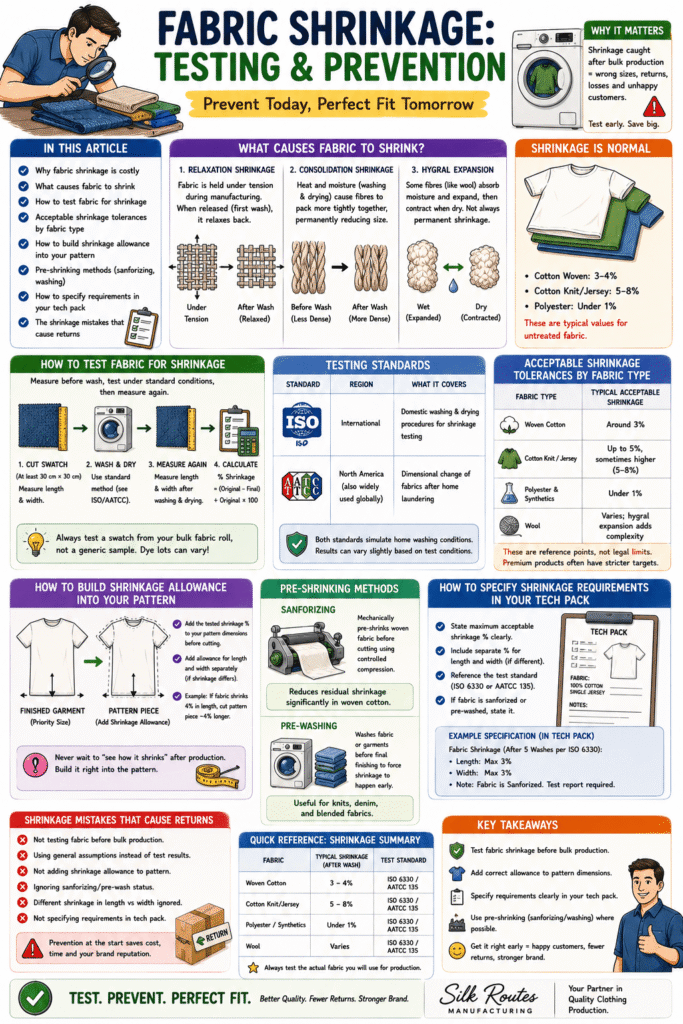
Shrinkage that’s caught after bulk production means an entire run of garments no longer matches its labelled size — there’s no fixing that after the fact. Catching it at the fabric testing stage costs a swatch and a few days; catching it after delivery costs the whole order plus returns and reputation damage.
Shrinkage isn’t rare or unpredictable, either. Cotton wovens commonly shrink 3–4% after a single wash, cotton knits and jersey can shrink considerably more — often in the 5–8% range — while polyester typically shrinks under 1%. These aren’t edge cases; they’re the normal behaviour of untreated fabric.
What Causes Fabric to Shrink?
| Cause | What Happens |
|---|---|
| Relaxation Shrinkage | Fabric relaxes back to its natural, unstretched state after the tension applied during weaving or knitting is released |
| Consolidation Shrinkage | Fibres pack more tightly together under heat and moisture, permanently reducing fabric dimensions |
| Hygral Expansion | Fibres like wool absorb and release moisture, causing dimensional change that isn’t always permanent |
Relaxation Shrinkage
Fabric is held under tension during manufacturing, and once that tension is released — typically during the first wash — it relaxes back toward its natural dimensions. This is largely unavoidable unless the fabric has already been relaxed before cutting.
Consolidation Shrinkage
Heat and moisture, especially from washing and tumble drying, cause fibres to pack more densely together, permanently reducing the fabric’s size. Unlike relaxation shrinkage, this type compounds with repeated washing rather than happening mostly on the first wash.
Hygral Expansion
Some fibres, particularly wool, expand when they absorb moisture and contract again as they dry — this isn’t always permanent shrinkage, but it affects how a garment measures at any given moment. It’s a different mechanism from the other two and matters most for wool and wool-blend garments.
How to Test Fabric for Shrinkage — Methods and Standards
| Standard | Region | What It Covers |
|---|---|---|
| ISO 6330 | International | Domestic washing and drying procedures for shrinkage testing |
| AATCC 135 | North America (also widely used globally) | Dimensional change of fabrics after home laundering |
Both standards work on the same basic principle: measure the fabric precisely before washing, wash and dry it under controlled, specified conditions, then measure again. The percentage change in length and width is your shrinkage figure.
Test an actual swatch from your bulk fabric roll, not a generic reference sample — dye lots and finishing can vary between batches even for the “same” fabric spec, and shrinkage behaviour can shift along with them.
Acceptable Shrinkage Tolerances by Fabric Type
| Fabric Type | Typical Acceptable Shrinkage |
|---|---|
| Woven Cotton | Around 3% |
| Cotton Knit / Jersey | Up to 5%, sometimes higher (5–8%) |
| Polyester and Synthetics | Under 1% |
| Wool | Varies; hygral expansion adds complexity beyond simple shrinkage |
These figures are industry-standard reference points rather than fixed legal limits — many brands set stricter tolerances for premium products, and some fabric types simply behave less predictably regardless of standard.
How to Build Shrinkage Allowance into Your Pattern
Add your fabric’s tested shrinkage percentage directly into your pattern dimensions before cutting, not as an afterthought once garments come back the wrong size. If your fabric shrinks 4% in length, a pattern piece needs to be cut roughly 4% longer than the finished garment measurement to compensate.
Apply the allowance separately for length and width where shrinkage rates differ between the two directions — many fabrics shrink more in one direction than the other, and a single blanket percentage across both dimensions can still produce a distorted fit.
Pre-Shrinking Methods — Sanforizing and Washing
| Method | What It Does |
|---|---|
| Sanforizing | Mechanically pre-shrinks woven fabric before cutting, using controlled compression |
| Pre-Washing | Washes fabric or garments before final finishing to force shrinkage to happen early |
Sanforized fabric is pre-treated specifically to minimise residual shrinkage after the garment is made — it’s a standard finishing process for many cotton wovens and significantly reduces the shrinkage allowance needed in your pattern. Confirm with your fabric supplier whether a fabric has been sanforized, since it directly changes how much allowance your pattern actually needs.
How to Specify Shrinkage Requirements in Your Tech Pack
State your maximum acceptable shrinkage percentage explicitly in the tech pack, rather than assuming the factory will apply an appropriate default. Include separate figures for length and width if your testing shows they differ.
Reference which test standard the shrinkage figure should be measured against — ISO 6330 or AATCC 135 — since results can vary slightly depending on test conditions. If you’re finalising a tech pack and want shrinkage requirements reviewed before it goes to a factory, our clothing manufacturing services team can check this alongside your other specifications.
Common Shrinkage Mistakes Clothing Brands Make
Not testing the actual bulk fabric batch. A shrinkage result from a previous order or a generic reference doesn’t guarantee the same result on a new fabric roll. Fix: test a swatch from the specific bulk fabric batch you’re about to cut.
Applying a single shrinkage allowance to both length and width. Many fabrics shrink at different rates in each direction, and a blanket percentage distorts fit. Fix: measure and apply shrinkage allowance separately for length and width.
Assuming all cotton behaves the same way. Woven cotton and cotton knits shrink very differently, and treating them identically in your pattern leads to fit errors. Fix: test and allow for shrinkage based on the specific fabric construction, not just fibre content.
Skipping pre-shrinking to save time. Untreated fabric requires a much larger pattern allowance and carries more risk of unpredictable results. Fix: use sanforized or pre-washed fabric where shrinkage risk is high, especially on fitted garments.
Not specifying a test standard in the tech pack. Without a named standard, different labs or factories may test shrinkage under different conditions, producing inconsistent results. Fix: name ISO 6330 or AATCC 135 explicitly in your shrinkage specification.
FAQ
What causes fabric to shrink?
Fabric shrinks mainly through relaxation shrinkage, where tension from manufacturing releases during washing, and consolidation shrinkage, where heat and moisture pack fibres more tightly together permanently. Wool and similar fibres also experience hygral expansion, a separate moisture-related dimensional change.
What is an acceptable shrinkage tolerance for clothing fabric?
Woven cotton typically has an acceptable shrinkage tolerance of around 3%, while cotton knits and jersey can shrink up to 5% or more. Polyester and other synthetics usually shrink under 1%, making fibre content and fabric construction key factors in setting the right tolerance.
What is the difference between ISO 6330 and AATCC 135?
ISO 6330 is the international standard for domestic washing and drying procedures used in shrinkage testing, while AATCC 135 is the equivalent standard widely used in North America. Both measure dimensional change after laundering, though exact test conditions can differ slightly between them.
What does sanforized fabric mean?
Sanforized fabric has been mechanically pre-shrunk using controlled compression before it’s cut and sewn, significantly reducing how much it will shrink further after the garment is made. It’s a standard finishing process for many woven cottons and reduces the shrinkage allowance needed in the pattern.
How do I calculate shrinkage allowance for my pattern?
Test your fabric’s actual shrinkage percentage using ISO 6330 or AATCC 135, then increase your pattern dimensions by that percentage before cutting. Apply the allowance separately for length and width, since many fabrics shrink at different rates in each direction.