
Choosing the wrong dyeing method doesn’t show up as a defect on day one — it shows up three washes later as a colour-faded, oddly-fitting garment that customers return. Garment dyeing and piece dyeing solve different problems, and picking based on cost alone often backfires.
This guide compares garment dyeing vs piece dyeing UK brands need to choose between, covering the technical differences, cost, and when each method actually makes sense.
In this article:
- What garment dyeing is and how it works
- What piece dyeing is and how it differs
- A side-by-side comparison of both methods
- Colour consistency and dye lot variation risk
- Shrinkage and dimensional stability differences
- Cost comparison between the two methods
- Which method suits your brand
- The dyeing mistakes that cause returns
Contents
- 1. What Is Garment Dyeing?
- 2. What Is Piece Dyeing?
- 3. Side-by-Side Comparison: Garment Dyeing vs Piece Dyeing
- 4. Colour Consistency and Dye Lot Variation — Key Risk
- 5. Shrinkage and Dimensional Stability Differences
- 6. Cost Comparison: Garment vs Piece Dyeing
- 7. Which Dyeing Method Is Right for Your Brand?
- 8. Common Dyeing Mistakes Clothing Brands Make
- 9. FAQ
- 9.1. What is the difference between garment dyeing and piece dyeing?
- 9.2. Which is cheaper, garment dyeing or piece dyeing?
- 9.3. Does garment dyeing cause more shrinkage than piece dyeing?
- 9.4. Can any trim be used with garment dyeing?
- 9.5. Why do two garments in the same colour sometimes look different?
What Is Garment Dyeing?
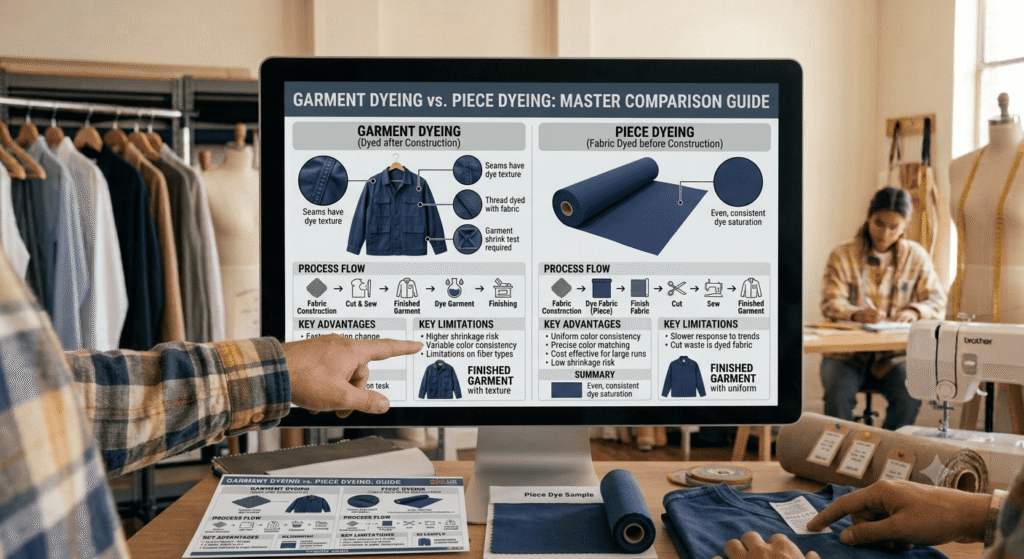
Garment dyeing means constructing the garment first, in undyed (greige) fabric, then dyeing the finished piece as a whole unit. The entire garment — seams, trims where compatible, and all — goes into the dye bath together.
This method is common for casualwear brands wanting a soft, washed-in look, and for smaller production runs where dyeing after construction avoids committing to large fabric dye lots upfront.
What Is Piece Dyeing?
Piece dyeing means dyeing the fabric in bulk rolls before it’s ever cut or sewn. The factory receives pre-dyed fabric and constructs the garment from material that’s already at its final colour.
This is the standard approach for most mainstream clothing production, since it allows precise colour matching against a target shade before any cutting begins.
Side-by-Side Comparison: Garment Dyeing vs Piece Dyeing
| Factor | Garment Dyeing | Piece Dyeing |
|---|---|---|
| When Dyeing Happens | After construction | Before cutting and sewing |
| Colour Precision | Softer, more variable | Precise, matched to swatch |
| Best For | Casualwear, washed looks, smaller runs | Mainstream production, exact colour matching |
| Trim Compatibility | Limited — trims must survive the dye bath | No constraint — trims added after dyeing |
| Typical Look | Slightly faded, lived-in aesthetic | Clean, consistent, saturated colour |
Neither method is objectively better — they produce genuinely different aesthetic and commercial outcomes, and the right choice depends on what look and consistency your brand actually needs.
Colour Consistency and Dye Lot Variation — Key Risk
| Risk Factor | Garment Dyeing | Piece Dyeing |
|---|---|---|
| Dye Lot Variation Between Batches | Higher — each garment batch dyed separately | Lower — fabric dyed in larger, controlled rolls |
| Colour Match to Approved Swatch | Harder to guarantee exactly | Easier to match precisely |
| Consistency Across a Size Run | Can vary between garments in the same batch | Consistent, since fabric is dyed before cutting |
Dye lot variation is the biggest practical risk with garment dyeing — two production runs of the “same” colour can come out visibly different if dye bath conditions aren’t tightly controlled. Piece dyeing reduces this risk because the fabric is dyed in bulk before any garment-specific variation can creep in.
Shrinkage and Dimensional Stability Differences
| Consideration | Garment Dyeing | Piece Dyeing |
|---|---|---|
| Shrinkage Timing | Happens after construction — can distort fit | Happens before cutting — pattern can account for it |
| Fit Predictability | Less predictable, since shrinkage occurs post-assembly | More predictable, since fabric is pre-shrunk before cutting |
| Risk to Seams and Trims | Higher — dye bath heat affects finished construction | Lower — trims and seams unaffected by the dye process |
Garment dyeing genuinely risks fit distortion, because any shrinkage happens after the garment is already fully constructed — a seam that was straight before dyeing can pull or pucker afterward. Piece dyeing avoids this because shrinkage is accounted for in the pattern before the garment is ever cut.
Cost Comparison: Garment vs Piece Dyeing
| Cost Factor | Garment Dyeing | Piece Dyeing |
|---|---|---|
| Small Runs | Often more cost-effective | Can require higher minimums for dye lots |
| Large Runs | Less efficient at scale | More cost-efficient at volume |
| Colour Change Flexibility | Easier to dye small batches in different colours | Requires committing to fabric dye lots per colour |
Garment dyeing tends to suit brands testing multiple colourways on smaller quantities, since you can dye undyed garments in small batches without committing to a large piece-dyed fabric run per colour. Piece dyeing becomes more cost-efficient once you’re producing at volume in a smaller number of confirmed colourways.
Which Dyeing Method Is Right for Your Brand?
Choose garment dyeing if your brand’s aesthetic depends on a soft, washed-in look, if you’re producing smaller batches, or if you want flexibility to test multiple colours without large fabric commitments.
Choose piece dyeing if precise, repeatable colour matching matters more than a washed aesthetic, if you’re producing at volume, or if your garment includes trims or construction elements that wouldn’t survive a garment dye bath.
If you’re unsure which approach fits your specific garment and production volume, our clothing manufacturing services team can advise based on your design and order size.
Common Dyeing Mistakes Clothing Brands Make
Garment dyeing a style with incompatible trims. Metal zips, certain plastics, or heat-sensitive components can be damaged or discoloured in a garment dye bath. Fix: confirm every trim and component can survive the specific dyeing process before committing to garment dyeing.
Approving a garment-dyed sample without checking batch-to-batch consistency. One well-dyed sample doesn’t guarantee the next production batch matches exactly. Fix: request a second dye lot sample before signing off on garment dyeing for a full run.
Not accounting for post-dye shrinkage in garment dyeing. Fit that looked correct in the greige (undyed) stage can shift after dyeing. Fix: build a shrinkage allowance into your pattern specifically for the dyeing process being used.
Assuming piece dyeing guarantees a perfect colour match every time. Even piece-dyed fabric carries some dye lot variation between production runs. Fix: request a physical lab dip or strike-off sample matched against your reference before bulk dyeing.
Choosing a dyeing method based on cost alone. The cheaper option per unit isn’t always the right fit if it compromises the aesthetic or consistency your brand needs. Fix: weigh dyeing method against your brand’s actual quality and colour consistency requirements, not just unit cost.
FAQ
What is the difference between garment dyeing and piece dyeing?
Garment dyeing colours the fully constructed garment after sewing, while piece dyeing colours the fabric in bulk before it’s cut and sewn. This timing difference affects colour consistency, shrinkage risk, and which trims can be used.
Which is cheaper, garment dyeing or piece dyeing?
Garment dyeing tends to be more cost-effective for smaller runs and multiple colourway testing, while piece dyeing becomes more cost-efficient at higher production volumes with fewer confirmed colours. The right choice depends on your order size and colour strategy, not just unit price.
Does garment dyeing cause more shrinkage than piece dyeing?
Garment dyeing risks shrinkage happening after the garment is already constructed, which can distort fit and seams. Piece dyeing allows shrinkage to be accounted for in the pattern before cutting, making fit more predictable.
Can any trim be used with garment dyeing?
No, garment dyeing requires trims and components that can survive the dye bath’s heat and chemicals without damage or discolouration. Piece dyeing avoids this constraint entirely, since trims are added after the fabric is already dyed.
Why do two garments in the same colour sometimes look different?
This is usually dye lot variation, where different dye batches produce slightly different shades even when targeting the same colour. Garment dyeing is more prone to this than piece dyeing, since each garment batch is dyed separately rather than as one larger, controlled fabric roll.