
Contents
- 1.
- 1.1. What Is Garment Finishing and Why Does It Affect Brand Perception?
- 1.2. Garment Washing Methods and Their Effects
- 1.3. Pressing and Steaming — How UK Factories Process Finished Garments
- 1.4. Hand Feel Treatments and Final Finishing
- 1.5. Garment Folding, Tagging, and Quality Inspection at Finishing
- 1.6. Packaging Options for Clothing Brands
- 1.7. How Finishing Instructions Should Be Communicated to the Factory
- 1.8. Common Finishing Mistakes That Damage Brand Perception
- 1.9. FAQ
- 1.9.1. Does every garment need to be washed after sewing?
- 1.9.2. How long does garment pressing add to a production timeline?
- 1.9.3. Can I request recycled poly bags for my packaging?
- 1.9.4. What’s the difference between hand ironing and form finishing?
- 1.9.5. Is enzyme washing more expensive than stone washing?
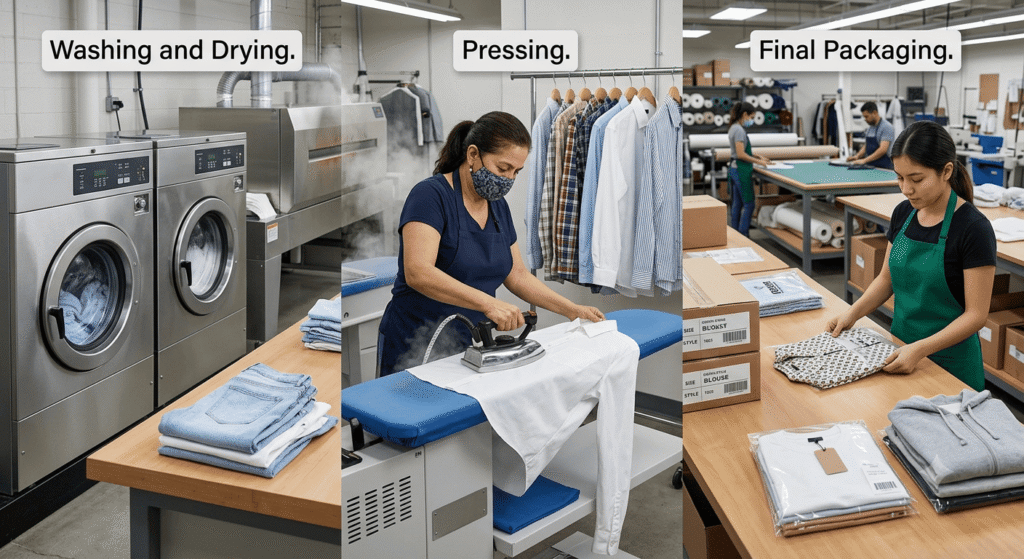
A brand owner once sent us a bulk order that looked flawless on the cutting table and came out of the box looking cheap — the stitching was fine, the fabric was right, but nobody had accounted for how it would look after washing, pressing, and packing. That gap between “well-made” and “well-finished” is where a lot of brands lose the perceived quality they paid for. This guide walks through what actually happens to a garment after sewing — washing, pressing, hand feel, folding, and packaging — and where finishing choices most often go wrong.
In this article:
- The four main garment washing methods and how each changes the finished look
- How pressing and steaming affect perceived quality before a garment ever reaches a customer
- Hand feel treatments, and the chemical safety considerations behind them
- Folding, tagging, and QC checkpoints at the finishing stage
- Packaging options and how UK plastic packaging rules affect your choice
- Common finishing mistakes that quietly damage brand perception
What Is Garment Finishing and Why Does It Affect Brand Perception?
Garment finishing covers everything that happens between a garment leaving the sewing line and it arriving at a customer’s door. That includes washing treatments, pressing, hand feel finishing, folding, tagging, and packaging.
Two garments can use identical fabric and identical construction and still feel completely different in the hand — finishing is usually why. A customer notices a stiff hand feel, a wrinkled fold line, or loose threads long before they notice anything about the stitching underneath.
Garment Washing Methods and Their Effects
Not every garment needs washing after sewing — it’s typically requested for a specific look or hand feel rather than applied by default.
| Method | Effect | Best For |
|---|---|---|
| Stone Washing | Softens fabric, creates a faded, worn look | Denim, casual workwear |
| Enzyme Washing | Softens fibres without abrasive stones, gentler on fabric | Cotton, delicate blends |
| Acid Washing | Creates high-contrast, mottled bleaching effect | Fashion denim, statement pieces |
| Garment Dyeing Wash | Dyes and softens the garment simultaneously after construction | Casualwear needing a lived-in colour |
Stone Washing
Stone washing tumbles garments with pumice stones to physically abrade the fabric surface. It’s still the standard method for achieving a genuinely worn, faded denim look at scale.
Enzyme Washing
Enzyme washing uses cellulase enzymes instead of stones to break down surface fibres. We tend to recommend it over stone washing for anything with delicate seams, since it’s gentler and produces less fabric loss.
Acid Washing
Acid washing uses chlorine-based bleach applied unevenly, often with pumice stones soaked in the bleach solution first. It’s a strong, dated aesthetic — brief the factory precisely, because “acid wash” means different intensities to different suppliers.
Garment Dyeing Wash
Garment dyeing wash dyes the finished garment rather than the fabric, which gives a distinctive soft hand feel and slight colour variation between pieces. It’s popular for casual basics that are meant to look intentionally lived-in from day one.
Pressing and Steaming — How UK Factories Process Finished Garments
Pressing removes the creases that accumulate throughout cutting, sewing, and washing, and it’s one of the last chances to catch a construction flaw before a garment ships.
| Method | How It Works | Common Use |
|---|---|---|
| Steam Pressing | Steam relaxes fibres before a heated press flattens the garment | Structured garments, tailoring |
| Hand Ironing | Manual iron used for detail areas a press can’t reach | Collars, cuffs, pocket edges |
| Form Finishing | Garment is placed on an inflatable dummy and steamed into shape | Shirts, jackets, structured knitwear |
Pressing is also where a factory does its final visual check — seam alignment, symmetry, and any pulled threads tend to show up clearly under a press. This is a stage worth confirming directly with your manufacturing partner rather than assuming it happens by default; it’s one of the checkpoints we build into every clothing manufacturing services production run, precisely because it’s easy for a factory to skip under deadline pressure.
Hand Feel Treatments and Final Finishing
Hand feel treatments change how a fabric feels against skin without necessarily changing how it looks — softening agents, anti-wrinkle resin treatments, and water-repellent coatings all fall into this category.
“Ask your factory exactly which finishing chemicals are used on hand feel treatments — don’t assume ‘soft finish’ means the same formulation across every supplier.” — Silk Routes Manufacturing Team
Anti-wrinkle and crease-resistant finishes are frequently based on formaldehyde resin, and the HSE notes this is the most common irritant chemical behind fabric-related skin problems, particularly once the fabric surface has been abraded through wear. Brands sourcing hand-feel-treated fabric for direct-skin-contact garments should ask for OEKO-TEX STANDARD 100 certification, which independently tests finished textiles for formaldehyde and other substances that could be harmful to health.
Garment Folding, Tagging, and Quality Inspection at Finishing
Finishing-stage QC happens in two passes — once before pressing, and once after — and it’s where most stitching, stain, and thread defects get caught before shipment.
| Check | What’s Inspected |
|---|---|
| Pre-Press Inspection | Stitching defects, fabric flaws, stains |
| Thread Trimming | Loose threads removed with thread-sucking machines or manually |
| Post-Press Inspection | Measurement against tech pack spec, final visual check |
| Tagging | Price tags, care labels, brand labels attached per spec |
Stubborn stains at this stage are usually treated with spotting solvents, which the HSE flags as requiring careful handling since some solvent types are classified as substances of very high concern under REACH. Ask your factory which spotting solvents they use if stain removal is a regular part of your finishing process — it’s a fair supplier question, not an unusual one.
Packaging Options for Clothing Brands
Packaging choice affects unit cost, shelf presentation, and — since April 2022 — UK tax exposure if you’re manufacturing or importing plastic packaging at volume.
| Packaging | Best For | Consideration |
|---|---|---|
| Poly Bag Folded | Bulk basics, e-commerce | Lowest cost, least visual presentation |
| Hanger and Polybag | Retail-ready garments | Higher cost, ready for shop floor |
| Box Packaging | Premium or gifted items | Highest cost, strongest unboxing experience |
Poly Bag Folded
The garment is folded to spec and sealed in a single poly bag, usually with a barcode sticker. This is the standard choice for high-volume, price-sensitive product.
Hanger and Polybag
The garment ships on a hanger inside a polybag, ready to go straight onto a shop floor rail without repackaging. It costs more per unit but saves in-store labour for wholesale retail clients.
Box Packaging
Box packaging is used for premium positioning or direct-to-consumer gifting, where unboxing itself is part of the brand experience. It’s the most expensive option per unit but has the strongest impact on perceived value.
Brands manufacturing or importing 10 tonnes or more of plastic packaging annually need to be aware of the UK’s Plastic Packaging Tax, which from April 2026 charges £228.82 per tonne on packaging containing less than 30% recycled plastic. This is worth raising with your factory or packaging supplier early — UK Plastics Pact members, who account for the majority of plastic packaging sold through UK supermarkets, have already been shifting toward higher recycled content, so recycled poly bags are increasingly available at comparable cost to virgin plastic.
How Finishing Instructions Should Be Communicated to the Factory
“Never leave finishing instructions verbal or vague — ‘soft wash’ and ‘lightly pressed’ mean different things to every factory floor manager.” — Silk Routes Manufacturing Team
Finishing instructions belong in the tech pack alongside construction details, not as a separate afterthought communicated over email. Specify wash type, press method, hand feel treatment, and packaging format explicitly, with reference photos wherever possible — this removes ambiguity that otherwise gets resolved by guesswork on the factory floor.
Getting finishing specification right from the start is part of the same discipline covered across the complete tech pack to production process, where every production stage — including finishing — is documented before bulk cut begins rather than decided reactively. Read more about Silk Routes and how we build finishing checkpoints into every production run.
Common Finishing Mistakes That Damage Brand Perception
Mistake 1: Leaving wash type undefined in the tech pack. Why it happens: brands assume “washed” is specific enough instruction. Fix: specify the exact wash method (stone, enzyme, acid, or garment dye) along with a reference sample or photo.
Mistake 2: Skipping a physical pressing check before bulk shipment. Why it happens: brands trust that pressing happens correctly by default once a PO is placed. Fix: request photos or a physical sample of the final pressed garment before the full shipment leaves the factory.
Mistake 3: Choosing packaging without checking Plastic Packaging Tax exposure. Why it happens: packaging decisions get made late, often by a different team than the one handling compliance. Fix: confirm recycled plastic content with your packaging supplier before committing to poly bag volume, especially above the 10-tonne registration threshold.
Mistake 4: Not specifying hand feel treatment chemistry for skin-contact garments. Why it happens: “soft finish” sounds harmless, so it isn’t interrogated further. Fix: request OEKO-TEX STANDARD 100 certification for any hand feel treatment applied to garments with prolonged skin contact.
FAQ
Does every garment need to be washed after sewing?
No — washing after sewing is a stylistic or hand feel choice, not a universal step, and many garments go straight from sewing to pressing and packing. Only around a portion of production runs use post-sewing washing, typically for denim, casualwear, or garment-dyed pieces.
How long does garment pressing add to a production timeline?
Pressing typically adds a small number of days to a production schedule, though this varies with order volume and whether form finishing equipment is used versus manual pressing. For a standard bulk run, factor pressing and final QC as roughly the last stage before packing, usually within the final week before shipment.
Can I request recycled poly bags for my packaging?
Yes — recycled poly bags with 30% or more recycled plastic content are increasingly standard, partly driven by the UK’s Plastic Packaging Tax threshold that exempts packaging above that recycled content level. Confirm the exact percentage with your supplier, since the tax exemption requires documented evidence, not just a general recycled claim.
What’s the difference between hand ironing and form finishing?
Hand ironing uses a manual iron for detail areas like collars and cuffs that a press can’t easily reach, while form finishing places the whole garment on an inflatable dummy that’s steamed into shape in one pass. Structured garments like shirts and jackets typically use form finishing for the main body, then hand ironing for one or two detail areas.
Is enzyme washing more expensive than stone washing?
Enzyme washing typically costs more per unit than stone washing, since the enzymes themselves are a chemical input rather than reusable stones. Many brands accept the extra cost because enzyme washing causes less mechanical fabric damage, extending garment lifespan.