
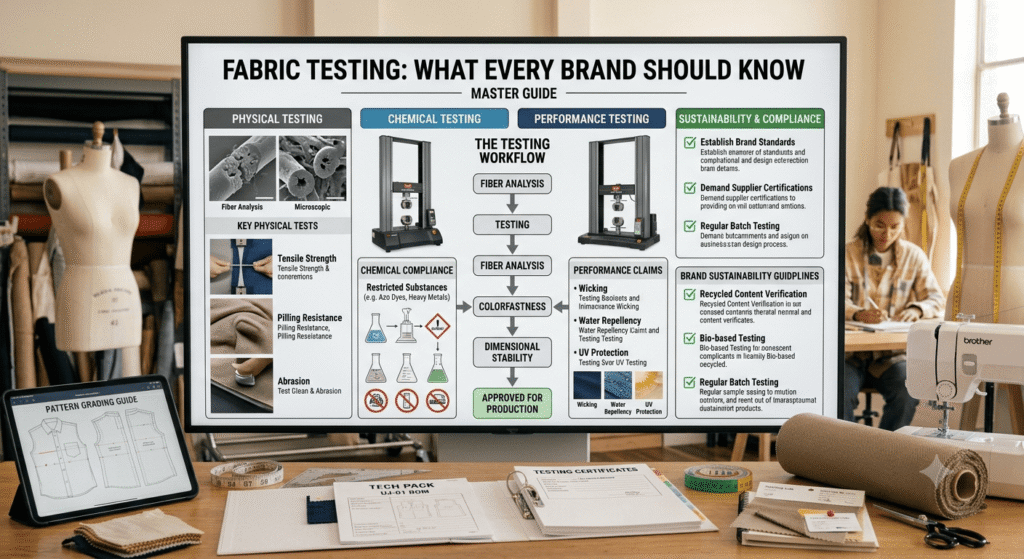
A fabric that looks and feels perfect in the showroom can still fail a customer’s washing machine, an allergy test, or a legal compliance check. Fabric testing exists to catch exactly that gap before bulk production — not after a customer complaint.
This guide covers fabric testing clothing UK brands need to understand: which tests matter, when to commission them, which labs to use, and how to read the results.
In this article:
- Why fabric testing isn’t optional, even for small production runs
- The 8 essential fabric tests every clothing brand should know
- When to commission tests — before or after bulk production
- UK accredited testing laboratories and how they differ
- What fabric testing typically costs
- How to actually read a fabric test report
- The mistakes that let untested fabric reach bulk production
Contents
- 1. Why Fabric Testing Is Not Optional for UK Clothing Brands
- 2. The 8 Essential Fabric Tests for Clothing Brands
- 3. When to Commission Fabric Tests — Before or After Bulk?
- 4. UK Fabric Testing Laboratories — Accredited Options
- 5. Cost of Fabric Testing in the UK
- 6. How to Read a Fabric Test Report
- 7. Common Fabric Testing Mistakes
- 8. FAQ
- 8.1. What fabric tests does a clothing brand need before bulk production?
- 8.2. How much does fabric testing cost in the UK?
- 8.3. What is the difference between OEKO-TEX and SGS testing?
- 8.4. Do I need a UKAS accredited lab for fabric testing?
- 8.5. What happens if my fabric fails a REACH chemical safety test?
Why Fabric Testing Is Not Optional for UK Clothing Brands
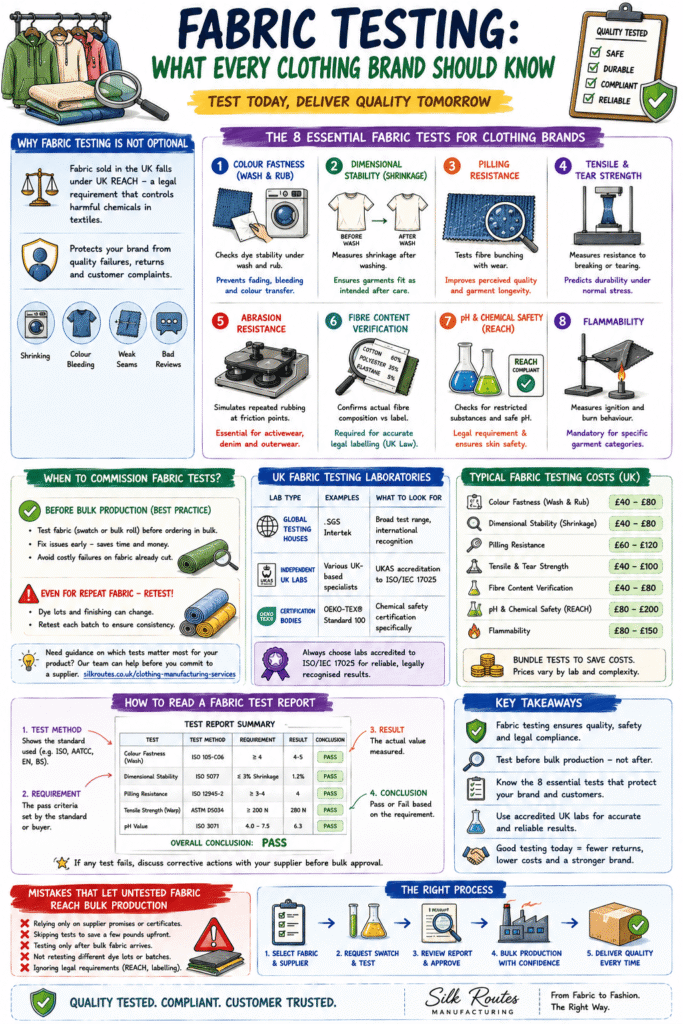
Fabric sold in the UK falls under UK REACH, the regulation controlling harmful chemicals in consumer products, including textiles (HSE). This isn’t a voluntary quality step — it’s a legal requirement that applies regardless of your order size or where the fabric was sourced.
Beyond legal compliance, fabric testing protects your brand from the kind of quality failure that generates returns and damages trust — shrinking after one wash, colour bleeding, or seams failing under normal wear.
The 8 Essential Fabric Tests for Clothing Brands
| Test | What It Checks | Why It Matters |
|---|---|---|
| Colour Fastness | Dye stability under wash and rub | Prevents fading, bleeding, and colour transfer |
| Dimensional Stability | Shrinkage after washing | Ensures garments fit as intended after care |
| Pilling Resistance | Fibre bunching with wear | Affects perceived quality and longevity |
| Tensile & Tear Strength | Fabric’s resistance to breaking | Predicts durability under normal stress |
| Abrasion Resistance | Wear resistance at friction points | Relevant for activewear, denim, workwear |
| Fibre Content Verification | Actual fibre composition vs label | Required for accurate legal labelling |
| pH & Chemical Safety (REACH) | Presence of restricted substances | Legal requirement, skin safety |
| Flammability | Ignition and burn behaviour | Mandatory for certain garment categories |
Colour Fastness (Wash and Rub)
Colour fastness testing checks whether dye stays put through washing and rubbing against other fabrics. A fabric that fails wash fastness will bleed onto other garments in the same laundry load — a common and entirely avoidable customer complaint.
Dimensional Stability (Shrinkage)
This test measures how much a fabric shrinks after washing, which directly affects whether a garment still fits its labelled size afterward. Natural fibres like cotton typically shrink more than synthetic blends, making this test especially important for those fabrics.
Pilling Resistance
Pilling is the small fibre balls that form on fabric surface with wear and washing. Knitwear and brushed fabrics are particularly prone to this, and a pilling failure often shows up in customer reviews faster than almost any other defect.
Tensile and Tear Strength
This measures how much force a fabric can withstand before breaking or tearing, which matters most for garments under regular physical stress — workwear, activewear, and childrenswear.
Abrasion Resistance
Abrasion testing simulates repeated rubbing to predict how a fabric holds up at friction points — elbows, inner thighs on trousers, and seat areas. It’s particularly relevant for denim and outerwear.
Fibre Content Verification
This test confirms the fabric actually contains what the label claims. UK law requires accurate fibre content labelling on all textile products (GOV.UK), and a mismatch between label and actual content is a compliance failure, not just a quality issue.
pH and Chemical Safety (REACH)
Chemical safety testing checks for restricted substances covered under UK REACH — certain azo dyes, heavy metals, and other regulated chemicals. Fabrics carrying an OEKO-TEX Standard 100 certification have already been tested against more than 1,000 potentially harmful substances, which can simplify this step considerably.
Flammability
Flammability testing is a legal requirement for specific garment categories, most notably children’s nightwear and certain protective clothing. Requirements vary by garment type, so this isn’t a test to assume is optional based on fabric type alone.
When to Commission Fabric Tests — Before or After Bulk?
Test fabric before committing to a bulk order wherever possible, not after goods have already been cut. A failed test on bulk fabric that’s already been purchased is a far more expensive problem than a failed test on a swatch.
For repeat fabric from a supplier you’ve used before, retesting each batch is still worth doing — dye lots and chemical treatments can vary between production runs even when the fabric specification hasn’t changed.
If you’re building fabric testing into your production timeline, our clothing manufacturing services team can advise on which tests matter most for your specific garment category before you commit to a supplier.
UK Fabric Testing Laboratories — Accredited Options
| Lab Type | Examples | What to Look For |
|---|---|---|
| Global testing houses | SGS, Intertek | Broad test range, international recognition |
| Independent UK labs | Various UK-based specialists | UKAS accreditation to ISO/IEC 17025 |
| Certification bodies | OEKO-TEX | Chemical safety certification specifically |
Whichever lab you choose, confirm the specific tests you need are within their UKAS-accredited scope — accreditation is typically granted per test method, not as a blanket certification covering everything a lab offers.
Cost of Fabric Testing in the UK
Fabric testing is typically priced per individual test rather than as one flat fee, and costs vary significantly by lab, test complexity, and turnaround time requested. A single colour fastness or shrinkage test costs meaningfully less than a full chemical safety panel covering multiple restricted substances.
Request an itemised quote from your chosen lab before committing, specifying exactly which tests you need — bundling unnecessary tests into a “standard package” is a common way costs run higher than expected.
How to Read a Fabric Test Report
Check the pass/fail result against the specific standard referenced, not just a general “pass” statement — a report should name the exact test method (such as an ISO or BS EN standard) used. If a standard isn’t named, ask the lab which one applied.
Pay attention to graded results, not just binary pass/fail. Colour fastness, for example, is usually reported on a numbered grey-scale rating rather than a simple pass or fail, and a low-but-technically-passing grade may still be worth addressing before bulk production.
Common Fabric Testing Mistakes
Relying on a supplier’s certificate without independent verification. A certificate from months ago may not reflect the current dye lot or batch. Fix: request current test results or commission your own test for each new fabric batch.
Testing only for quality, not chemical safety. A fabric can pass every physical test and still contain a restricted substance under UK REACH. Fix: always include a chemical safety check alongside physical performance tests.
Skipping flammability testing because “it’s not nightwear.” Flammability requirements can apply more broadly than brands expect, depending on garment category. Fix: check flammability requirements for your specific product type before assuming it doesn’t apply.
Testing the swatch but not the bulk fabric roll. Dye lots can vary between a supplier’s sample swatch and the actual bulk delivery. Fix: retest a sample from the actual bulk fabric shipment, not just the original swatch.
Treating fabric testing as a one-time step. A fabric that passed testing last season isn’t guaranteed to pass again if the supplier’s process has changed. Fix: retest on a reasonable cycle, especially when reordering from the same supplier after a gap.
FAQ
What fabric tests does a clothing brand need before bulk production?
At minimum, most UK clothing brands need colour fastness, dimensional stability (shrinkage), and chemical safety testing under REACH. Additional tests like pilling resistance, tensile strength, and flammability depend on the specific garment category and fabric type.
How much does fabric testing cost in the UK?
Fabric testing is typically priced per individual test rather than a single flat fee, with costs varying by lab and test complexity. It’s best to request an itemised quote specifying exactly which tests you need rather than assuming a standard package price.
What is the difference between OEKO-TEX and SGS testing?
OEKO-TEX Standard 100 is a specific certification focused on chemical safety, testing for more than 1,000 potentially harmful substances. SGS is a global testing house offering a much broader range of tests, including physical performance, chemical safety, and compliance testing across many standards.
Do I need a UKAS accredited lab for fabric testing?
A UKAS-accredited lab provides independently verified test results to the ISO/IEC 17025 standard, which carries more weight with retailers, buyers, and regulators. It’s not always a strict legal requirement, but it’s strongly recommended for any test result you may need to defend later.
What happens if my fabric fails a REACH chemical safety test?
A fabric that fails a REACH test cannot legally be sold in the UK market in that form, and continuing to sell it can result in enforcement action. The supplier will typically need to reformulate the dye or treatment process and resupply fabric that passes retesting before production can proceed.