
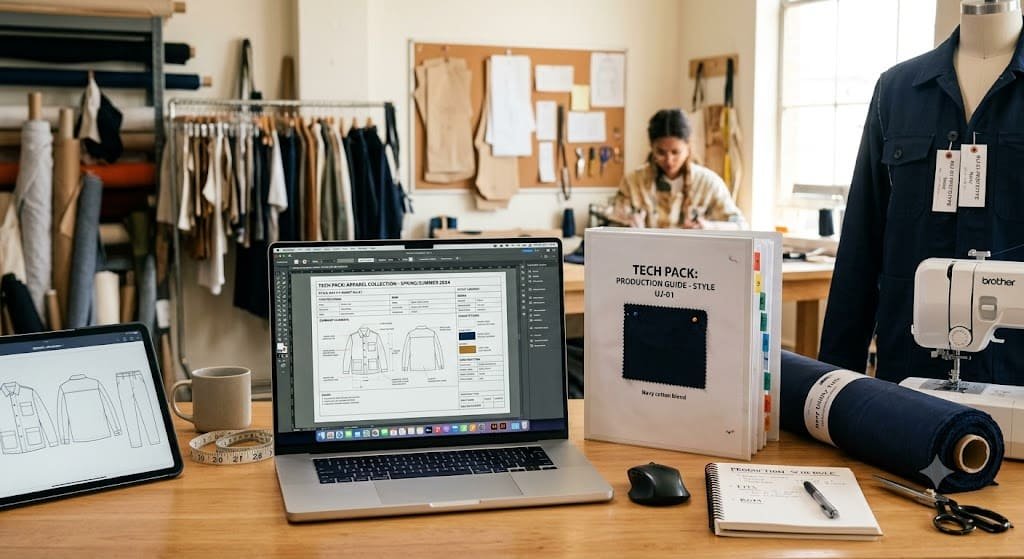
Most guides tell you to start a tech pack with a nice technical sketch. Start there and you’ll spend hours perfecting a drawing before you’ve even decided what fabric you’re using — the sketch is the easy part, not the starting point.
This guide walks through how to create a clothing tech pack UK manufacturers can actually quote and produce from, in the order that actually saves you time.
In this article:
- What a tech pack is and why factories won’t quote without one
- The 8 sections every clothing tech pack needs, in the right order
- Software options for building one, from free to professional
- The mistakes that get tech packs bounced back for revisions
- How to send a tech pack so a UK manufacturer takes it seriously
Contents
- 1. What Is a Clothing Tech Pack and Why Does Every Manufacturer Need One?
- 2. Why Build Your Tech Pack With Manufacturer Input
- 3. The 8 Essential Sections of a Clothing Tech Pack
- 3.1. Section 1 — Cover Page and Style Information
- 3.2. Section 2 — Technical Flat Sketch (Front and Back)
- 3.3. Section 3 — Bill of Materials (BOM)
- 3.4. Section 4 — Construction and Stitch Details
- 3.5. Section 5 — Measurement Chart and Size Spec
- 3.6. Section 6 — Trim and Label Details
- 3.7. Section 7 — Colourways and Pantone References
- 3.8. Section 8 — Packaging and Care Label Instructions
- 4. Tools for Creating a Tech Pack — Software Options
- 5. Common Tech Pack Mistakes That Delay Production
- 6. How to Send a Tech Pack to a UK Manufacturer
- 7. From Tech Pack to Your First Production Run
- 8. FAQ
What Is a Clothing Tech Pack and Why Does Every Manufacturer Need One?
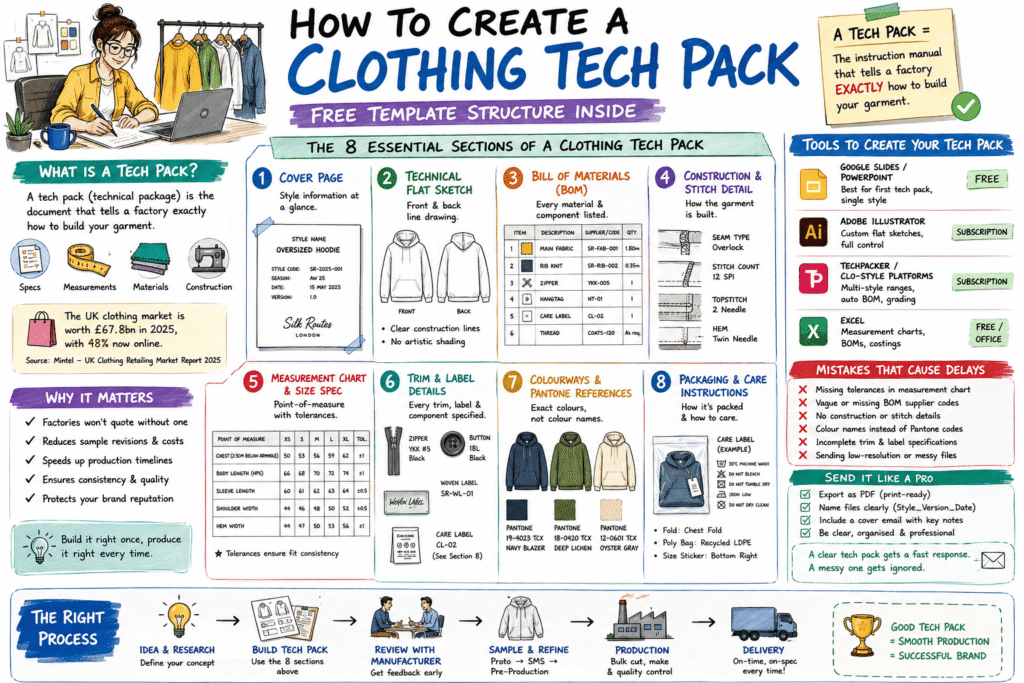
A tech pack (short for technical package) is the document that tells a factory exactly how to build your garment. It’s not a mood board or a single sketch — it’s specs, measurements, materials, and construction detail in one place.
The UK clothing market reached an estimated £67.8bn in 2025, with online sales now making up 48% of all clothing spend (Mintel). Every brand competing in that market is relying on a factory somewhere getting the product right the first time — and that starts with the tech pack.
Without one, a manufacturer is guessing at fit, fabric weight, and finish. Guessing costs you money in sample revisions.
Why Build Your Tech Pack With Manufacturer Input
Most first-time founders build a tech pack in isolation, then send it out for quotes. The problem: a section that looks complete to you can still be unusable to a pattern maker if it’s missing tolerances or supplier codes.
We review tech packs before quoting, not after. If yours is missing a critical section, we’ll tell you before you’ve committed to fabric or paid a deposit — you can start that process through our clothing manufacturing services page.
The 8 Essential Sections of a Clothing Tech Pack
Here’s what a complete, factory-ready tech pack contains, and the order that makes sense to build it in.
| # | Section | What It Does |
|---|---|---|
| 1 | Cover Page | Style name, code, season, version, date |
| 2 | Technical Flat Sketch | Front and back line drawing, no artistic shading |
| 3 | Bill of Materials | Every fabric, trim, and component listed |
| 4 | Construction & Stitch Detail | Seam types, stitch counts, finishing method |
| 5 | Measurement Chart | Point-of-measure spec with tolerances, by size |
| 6 | Trim & Label Detail | Zips, buttons, labels, hangtags specified |
| 7 | Colourways & Pantone | Exact colour references, not colour names |
| 8 | Packaging & Care Instructions | Fold method, poly bag, care label wording |
Section 1 — Cover Page and Style Information
This is the smallest section and the easiest to skip properly. Include the style name, a unique style code, the season, and a version number — factories handle dozens of styles at once and need to know which version they’re looking at.
Section 2 — Technical Flat Sketch (Front and Back)
A flat sketch is a simple black-and-white line drawing, not a fashion illustration. It needs to show construction lines — seams, darts, pocket placement — clearly enough that a pattern maker can read it without asking questions.
Section 3 — Bill of Materials (BOM)
The Bill of Materials lists every physical component in the garment: main fabric, lining, thread, zips, buttons, labels. Each line should include a supplier name or code where you have one, not just a generic description like “cotton.”
Section 4 — Construction and Stitch Details
This section tells the factory how the garment goes together — seam allowances, stitch type per seam, and any reinforcement or topstitching. A garment with no construction detail specified gets built to the factory’s default standard, which may not match what you want.
Section 5 — Measurement Chart and Size Spec
The measurement chart lists every point of measure — chest, waist, sleeve length — for every size in your range, plus an acceptable tolerance for each. No tolerance means the factory decides how much variation is acceptable, and that decision usually favours their convenience over your fit consistency.
Section 6 — Trim and Label Details
Every zip, button, drawstring, and label goes here, with supplier codes where available. UK law requires clothing to carry a label showing full fibre content, and it’s the brand’s or importer’s responsibility to get this right, not the factory’s (GOV.UK).
Section 7 — Colourways and Pantone References
Never describe a colour by name alone — “navy” can mean five different shades to five different factories. Use Pantone TCX codes so the factory can match dye lots precisely.
Section 8 — Packaging and Care Label Instructions
Specify fold method, poly bag type, and exact care label wording here. If any fabric or trim in the garment carries an OEKO-TEX Standard 100 certification, note it here too, since it’s a claim a manufacturer needs supporting documentation for before use.
Tools for Creating a Tech Pack — Software Options
You don’t need professional design software to start, but it helps once you’re producing more than one or two styles a season.
| Tool | Best For | Cost |
|---|---|---|
| Google Slides / PowerPoint | First tech pack, single style | Free |
| Adobe Illustrator | Custom flat sketches, full control | Subscription |
| Techpacker / CLO-style platforms | Multi-style ranges, auto-grading | Subscription |
| Excel / Google Sheets | Measurement charts and BOM tables | Free |
A pattern maker’s day rate reflects the same specialism this software is trying to replace — UK pattern cutters typically start on £18,000–£26,000 a year, rising to £35,000–£40,000 with experience (UKFT). That’s the skill a clear tech pack is trying to get the most out of, whichever tool you use to build it.
Common Tech Pack Mistakes That Delay Production
No tolerances on the measurement chart. Most guides don’t flag this until it’s already caused a fit problem. Fix: add a plus-or-minus range to every measurement, not just the finished garment size.
Colours described by name, not Pantone code. “Sage green” means something different to every supplier. Fix: reference a Pantone TCX number for every colourway before sending the tech pack out.
BOM left incomplete. Fabric named, trims marked “TBC.” Fix: finalise every component before requesting a quote — a partial BOM gets you a partial, unreliable price.
Skipping construction detail because “it’s standard.” There is no universal standard seam allowance or stitch count across factories. Fix: specify it, even if it feels obvious to you.
Sending a tech pack with no version control. Revisions get made, but the old file keeps circulating. Fix: date and version every export, and confirm which version the factory is quoting against.
How to Send a Tech Pack to a UK Manufacturer
“A tech pack that answers questions before we ask them gets quoted faster and sampled with fewer rounds of corrections.” — Silk Routes Manufacturing Team
Send the tech pack as a single PDF, not a scattered set of images and spreadsheets. Include fabric swatches or trim samples by post where possible — a photo of a colour is never as reliable as the physical material.
Be upfront about your target price point and order quantity in the same email. A factory quoting blind, without knowing your MOQ expectations, will often quote for a volume that doesn’t match what you actually need.
From Tech Pack to Your First Production Run
A tech pack is only as useful as the questions it answers before production starts, not after. Get the measurement chart and BOM right, and everything downstream — pattern making, sampling, bulk cut — moves faster.
If you’re weighing up manufacturers for your first run, you can read more about how we work and what we check before a single sample gets cut.
FAQ
What is a clothing tech pack?
A clothing tech pack is the technical document — sketches, measurements, Bill of Materials, and construction detail — that tells a manufacturer exactly how to build a garment. Factories use it to quote, pattern, and sample your design accurately.
How long does it take to make a tech pack?
A single, well-prepared tech pack typically takes several hours to a full day to complete, depending on how detailed the construction and BOM sections need to be. Complex garments with multiple fabrics or trims take longer than a simple T-shirt or basic tee.
What software do I need to create a tech pack?
You can build a basic tech pack in free tools like Google Slides and Google Sheets for your first style. Dedicated platforms with auto-grading and flat sketch libraries become worthwhile once you’re managing several styles per season.
What’s the difference between a tech pack and a spec sheet?
A spec sheet is one section within a tech pack, usually referring specifically to the measurement chart. The tech pack is the complete document — sketches, BOM, construction, measurements, and packaging instructions together.
Do I need a tech pack before contacting a manufacturer?
Most UK manufacturers, including Silk Routes, need at least a draft tech pack before providing an accurate quote. A rough sketch and description can get a conversation started, but pricing and sampling timelines depend on a properly specified document.