
Most clothing brands lose money in one of three ways during sampling: approving too early, confusing what each sample is actually for, or skipping the one round that actually matters. Get sampling right, and bulk production runs smoothly. Get it wrong, and the same mistake repeats hundreds of times over.
This guide breaks down proto vs SMS vs production sample — what each one is for, what to check at every stage, and how many rounds are normal before you’re ready for bulk.
In this article:
- Why sampling is the highest-leverage stage in the entire production process
- The three sample types and exactly what each one proves
- What to check — and what not to worry about — at each stage
- How many sampling rounds are typical before bulk approval
- A full sampling checklist across all three sample types
- The mistakes that turn into bulk production problems
Contents
- 1. Garment Sampling: Proto vs SMS vs Production Sample
- 1.1. The Three Sampling Stages
- 1.2. How Many Rounds Are Normal?
- 1.3. Sampling Checklist by Category
- 1.4. Common Sampling Mistakes
- 1.5. The Three Types of Garment Samples — Overview
- 1.6. Stage 1 — Proto Sample: What It Is and What to Check
- 1.7. Stage 2 — Salesman Sample (SMS): What It Is and What to Check
- 1.8. Stage 3 — Pre-Production Sample: The Final Gate
- 1.9. How Many Rounds of Each Sample Type Are Normal?
- 1.10. Sampling Checklist — Key Points Across All Sample Types
- 1.11. Common Sampling Mistakes That Lead to Bulk Problems
- 1.12. The Silk Routes Sampling Process
- 1.13. FAQ
Why Garment Sampling Is the Most Important Stage of Production
Every fabric order, every grading decision, and every factory booking downstream depends on what gets approved at the sampling stage. A mistake caught in a proto sample costs almost nothing to fix. The same mistake caught after bulk cutting costs the entire run.
Treat each sample type as a distinct checkpoint with its own job, not a single blurry “sample stage.” Approving a proto sample as if it were a pre-production sample is how avoidable problems make it all the way to bulk.
Garment Sampling: Proto vs SMS vs Production Sample
An interactive breakdown of the three sampling checkpoints — what each one proves, what to check, and where brands typically go wrong.
The Three Sampling Stages
Tap a stage to see its purpose, fabric used, and who signs off.
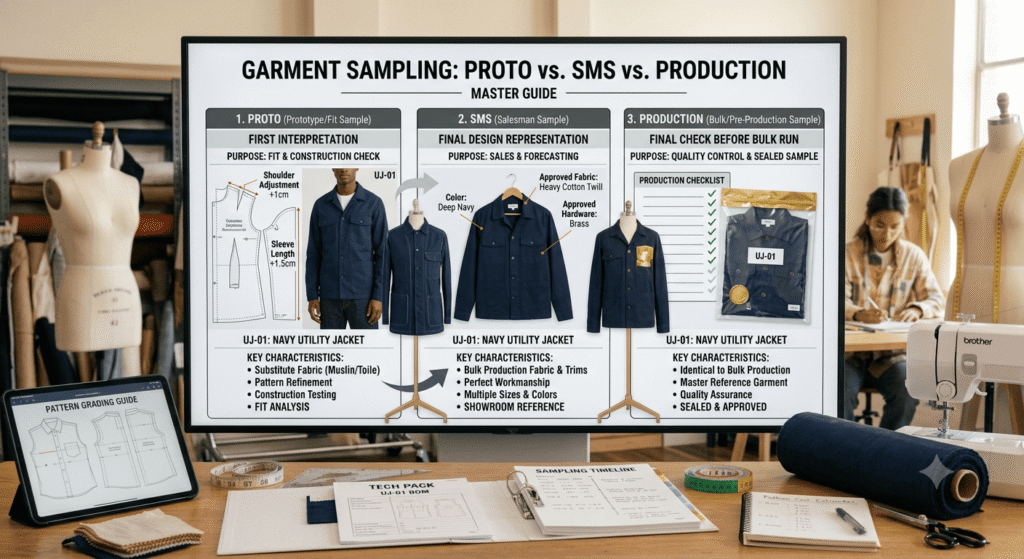
The proto sample tests whether the design translates from sketch into a physical, wearable garment. It's usually made in substitute fabric, so colour and exact fabric behaviour aren't confirmed yet — only construction, rough fit, and proportions.
The Salesman Sample (SMS) is built to look final for buyer meetings and trade shows. It's a step closer to production but isn't yet locked — colour or finish tweaks are still common at this stage.
The Pre-Production Sample (PPS) must match bulk output exactly and becomes the factory's benchmark for the entire run. Signing off with an unresolved fit issue here is the single biggest predictor of bulk production problems.
How Many Rounds Are Normal?
A clean first attempt is the exception at every stage — this is the typical pattern brands should expect.
Proto Sample
Salesman Sample
Pre-Production
Sampling Checklist by Category
Tap each category to see exactly what to check at every sample stage.
- Overall silhouette matches design intent
- Shoulder placement and sleeve length
- Ease at chest, waist, and hip
- Garment length against spec
- Seam allowance matches tech pack
- Correct stitch type and topstitching
- Reinforcement at stress points
- Closures (zips, buttons) function correctly
- Fabric weight matches specification
- Colour matches the approved swatch
- Print or pattern placement is correct
- Hand-feel matches intended fabric
- Trims match the Bill of Materials
- Labels correctly placed and worded
- Care label content is accurate
- Packaging matches final specification
Common Sampling Mistakes
Want your samples reviewed against the right checkpoint, every time?
Talk to Silk Routes
The Three Types of Garment Samples — Overview
| Sample Type | Main Purpose | Fabric Used | Who Approves |
|---|---|---|---|
| Proto Sample | Test design, construction, and initial fit | Substitute or similar-weight fabric | Brand (internal) |
| Salesman Sample (SMS) | Sales, trade shows, buyer presentations | Bulk or close-to-bulk fabric | Brand/Buyer |
| Pre-Production Sample (PPS) | Final gate before bulk cutting | Exact bulk fabric and trims | Brand |
Each stage exists because the one before it can’t answer every question. A proto sample can’t confirm bulk fabric colour. An SMS isn’t tested against your final tolerances. Only the PPS proves all of it together.
Stage 1 — Proto Sample: What It Is and What to Check
| Check | Why It Matters |
|---|---|
| Overall silhouette | Confirms the design translates from sketch to garment |
| Construction method | Verifies seams and finishing match the tech pack |
| Rough fit | Identifies major fit issues early, cheaply |
| Proportions | Catches sizing or scale problems before they compound |
Purpose of the Proto Sample
The proto sample exists to answer one question: does this design work as a physical garment? It’s usually made in a substitute fabric, which means colour, drape, and exact fabric behaviour aren’t reliable indicators yet.
What You Are Approving (and What You Are Not)
You’re approving the concept, construction approach, and rough fit — not the final fabric, not the exact colour, and not the finished tolerance range. Treating a proto sample approval as final sign-off is one of the most common sampling mistakes brands make.
Stage 2 — Salesman Sample (SMS): What It Is and What to Check
| Check | Why It Matters |
|---|---|
| Bulk or close-to-bulk fabric | Needed for accurate buyer presentation |
| Finished look and finish | Represents what buyers or retailers will see |
| Colourway accuracy | Sales decisions depend on colour matching |
| Overall presentation quality | SMS often photographed or displayed at trade shows |
Purpose of the SMS
The SMS is built to look final for sales purposes — trade shows, buyer meetings, wholesale presentations — but it isn’t yet locked for bulk cutting. Fit corrections identified after the proto stage should already be reflected here.
Showroom and Wholesale Use
Brands doing wholesale often rely on the SMS to secure pre-orders before bulk production even begins. That makes SMS quality important commercially, even though it’s still one step away from the final production benchmark.
Stage 3 — Pre-Production Sample: The Final Gate
| Check | Why It Matters |
|---|---|
| Exact bulk fabric and trims | Must match what bulk production will actually use |
| Full measurement spec, within tolerance | Last chance to catch fit deviation before cutting |
| Construction and finishing detail | Confirms the factory can replicate it at volume |
| Labelling and packaging | Should match final delivery specification |
What Must Be Perfect Before You Sign Off
The pre-production sample must match bulk output exactly — same fabric lot, same trims, same construction — because it becomes the reference the factory checks bulk production against. Signing off with an unresolved fit issue here is the single biggest predictor of bulk problems.
Consequences of Skipping PPS Approval
Skipping straight from SMS to bulk cutting removes the last checkpoint before hundreds of units are committed. Any gap between SMS fabric and true bulk fabric — weight, stretch, colour — goes uncaught until it’s already been cut into every size in the run.
How Many Rounds of Each Sample Type Are Normal?
A clean first proto is the exception, not the rule — most styles need at least one round of proto revisions before moving forward. SMS typically needs fewer revisions if the proto stage caught fit issues properly, though colour or finish tweaks are common.
The pre-production sample should ideally need zero revisions if the proto and SMS stages did their job. If a PPS comes back with a fit problem, that’s usually a sign an earlier stage was approved too quickly.
Sampling Checklist — Key Points Across All Sample Types
| Category | What to Check |
|---|---|
| Fit | Overall silhouette, shoulder placement, ease at chest/waist/hip, sleeve length, garment length |
| Construction | Seam allowance, stitch type, topstitching, reinforcement points, closures function correctly |
| Fabric & Colour | Fabric weight matches spec, colour matches approved swatch, print/pattern placement, hand-feel |
| Finishing | Trims match BOM, labels correctly placed, care label wording accurate, packaging matches spec |
Run through all four categories at every sample stage, adjusting expectations for what each stage can realistically confirm — a proto sample won’t pass the fabric and colour checks the way a PPS should.
Common Sampling Mistakes That Lead to Bulk Problems
Treating the proto sample as final approval. Fit and construction may look right, but fabric and colour haven’t been confirmed yet. Fix: keep proto approval limited to concept, construction, and rough fit only.
Skipping the SMS to save time. Going straight from proto to PPS removes a useful checkpoint for sales-facing quality and colour accuracy. Fix: only skip SMS if your bulk fabric and colour are already fully confirmed elsewhere.
Approving a pre-production sample with a known fit issue. “We’ll fix it in bulk” almost never happens — the PPS becomes the factory’s benchmark exactly as approved. Fix: never sign off a PPS until every measurement is within tolerance.
Losing track of which sample round is which. Without version control, brands sometimes compare bulk output against an outdated sample. Fix: label and date every sample round clearly, and keep the approved PPS as your single reference.
Not checking labelling and packaging until the final sample. Packaging and label errors caught this late can delay shipment even after the garment itself is approved. Fix: check labelling and packaging specification from the SMS stage onward, not just at PPS.
The Silk Routes Sampling Process
We treat each sample round as answering a specific question, not as a general “does this look right” check. A proto sample gets reviewed against construction and fit intent; a pre-production sample gets reviewed against your exact bulk fabric and full tolerance range, with nothing signed off until it matches.
If you’re preparing to move from tech pack into your first sampling round, our clothing manufacturing services team can walk you through what to expect at each stage before you commit to a factory.
FAQ
What are the three types of garment samples?
The three main garment sample types are the proto sample, the salesman sample (SMS), and the pre-production sample (PPS). Each serves a distinct purpose, moving from design validation through sales presentation to final bulk-ready approval.
What’s the difference between a proto sample and an SMS?
A proto sample tests design, construction, and rough fit, usually in a substitute fabric. An SMS is built in bulk or close-to-bulk fabric specifically for sales and buyer presentations, one step closer to final production.
What is a pre-production sample (PPS)?
A pre-production sample is the final sample made in the exact bulk fabric and trims, used as the reference the factory checks bulk output against. It’s the last checkpoint before cutting begins on the full production run.
How many rounds of sampling are normal before bulk production?
Most styles need at least one round of proto revisions, with fewer revisions typically needed at SMS and pre-production stage if earlier rounds were handled properly. A pre-production sample needing zero revisions is the target, not the norm on a first style.
What happens if you skip the pre-production sample?
Skipping the pre-production sample removes the last checkpoint before bulk cutting, meaning any gap between your SMS and true bulk fabric goes uncaught until it’s already been cut into every unit. It’s one of the most common causes of bulk runs coming back with fit or fabric problems.