
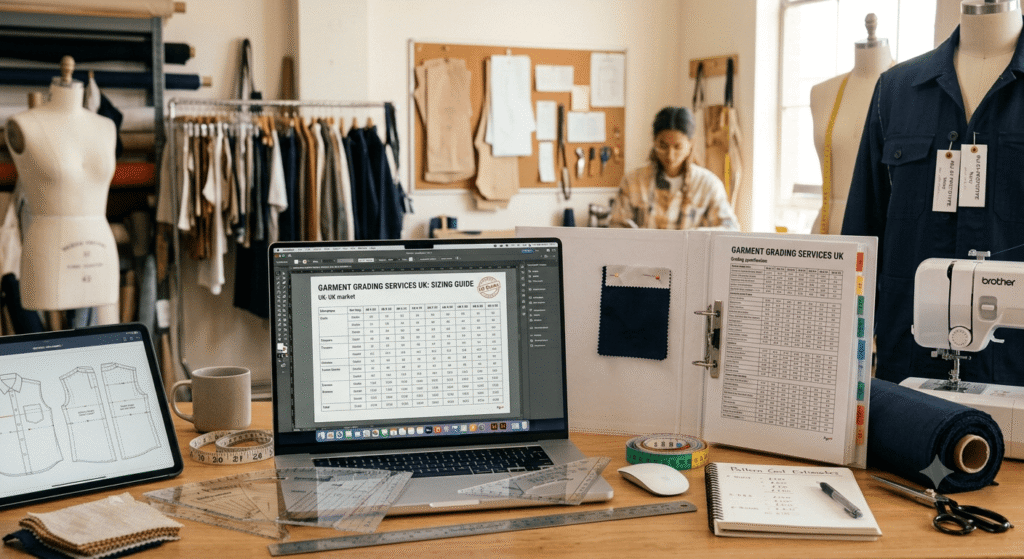
A pattern that fits perfectly in a sample size 12 can fall apart completely once it’s scaled up to a size 20 — not because the grading was rushed, but because bodies don’t grow proportionally in every direction.
This guide covers garment grading services UK brands rely on to take one approved pattern and turn it into a full, sellable size range.
In this article:
- What garment grading is and why it can’t be skipped
- How the grading process actually works, step by step
- Standard UK grading increments for womenswear, menswear, and childrenswear
- CAD versus manual grading — cost and accuracy differences
- What grading services typically cost in the UK
- The mistakes that cause fit problems across a size run
Contents
- 1. Garment Grading Services UK — Sizing Guide
- 1.1. How Garment Grading Works
- 1.2. Standard UK Grading Increments
- 1.3. CAD Grading vs Manual Grading
- 1.4. Cost of Garment Grading in the UK
- 1.5. Common Grading Mistakes
- 1.6. Standard UK Clothing Grading Increments
- 1.7. CAD Grading vs Manual Grading — Cost and Accuracy Comparison
- 1.8. Cost of Garment Grading Services in the UK
- 1.9. How to Prepare Your Base Pattern for Grading
- 1.10. Common Grading Mistakes That Cause Fit Problems Across Sizes
- 1.11. FAQ
How Garment Grading Works — The Technical Process
Grading takes your approved sample-size pattern and mathematically scales it to create every other size in your range, without changing the design or proportions.
| Step | What Happens | Who’s Involved |
|---|---|---|
| 1. Base pattern approval | Sample size pattern signed off after fitting | Brand + pattern maker |
| 2. Grade rules set | Increment amounts defined per measurement point | Grader |
| 3. Pattern graded | Each size scaled using the grade rules | Grader (manual or CAD) |
| 4. Nest check | Graded sizes checked against each other for consistency | Grader |
| 5. Sample size verified | One or two graded sizes sample-checked physically | Brand |
The body doesn’t grow the same amount everywhere as size increases — shoulder width and hip circumference change at different rates. A proper grade accounts for that; simply scaling the whole pattern up or down by a percentage doesn’t.
Garment Grading Services UK — Sizing Guide
An interactive visual breakdown of the grading process, standard UK increments, CAD vs manual costs, and where fit problems come from.
How Garment Grading Works
Five stages from an approved base pattern to a fully graded, production-ready size range.
Base Pattern Approval
Sample size pattern signed off after fitting.Grade Rules Set
Increment amounts defined per measurement point.Pattern Graded
Each size scaled — manually or via CAD.Nest Check
Graded sizes checked against each other.Sample Verified
One or two graded sizes physically checked.Standard UK Grading Increments
Increments vary by category — tap a tab to see the typical UK grade rule for each.
Bust / Waist / Hip
Womenswear typically grades in increments of around 4cm per size at the bust, waist and hip — with wider gaps sometimes used between the S–L and L–XXL bands. Grade rules are applied differently at each point rather than uniformly across the whole pattern.
Chest / Waist
Menswear commonly uses larger increments than womenswear — around 6cm per size — and grading is often less linear across the full range. Tailored and casualwear typically need different grade rules.
Heightbased
Not Fixed Centimetres
Childrenswear doesn't follow fixed cm grades the way adult sizing does — children's proportions shift faster between ages. Extreme sizes are usually checked individually rather than relying purely on a formula.
CAD Grading vs Manual Grading
Both methods produce a correct grade — the difference is consistency at scale and cost per additional size.
✂️ Manual Grading
- Lower cost for one or two sizes
- Cut-and-spread or shift method
- More prone to human error at scale
- Best for simple, low-volume styles
💻 CAD Grading
- Higher setup, cheaper per extra size
- Mathematically consistent across sizes
- Integrates directly with cutting software
- Best for multi-size, repeat production
Cost of Garment Grading in the UK
Typical price per size, based on current UK grading service rate cards. Bars show the upper end of each range.
Common Grading Mistakes
Need your pattern reviewed and graded correctly before bulk production?
Talk to Silk Routes
Standard UK Clothing Grading Increments
Grading increments vary by garment category and by which part of the body is being measured, and they’re rarely identical between menswear and womenswear.
| Category | Typical Grade Between Sizes | Notes |
|---|---|---|
| Womenswear (bust/waist/hip) | Around 4cm per size | Wider gaps sometimes used between S–L and L–XXL bands |
| Menswear (chest/waist) | Around 6cm per size | Increments can be less linear than womenswear |
| Childrenswear | Based on age/height bands, not fixed cm | Grading interpretation varies more between sizes |
Womenswear Grading Standards
Womenswear typically grades in smaller, more frequent increments than menswear, reflecting a narrower range of body variation between adjacent sizes. Grade rules are usually applied differently at the bust, waist, and hip rather than uniformly across the whole pattern.
Menswear Grading Standards
Menswear increments tend to run slightly larger than womenswear, and grading is often less linear across the full size range. A grader experienced in menswear will apply different rules for tailored versus casualwear.
Childrenswear Grading Standards
Childrenswear doesn’t follow fixed centimetre grades in the way adult sizing does, since children’s proportions shift more dramatically between ages than adult bodies do between sizes. Most graders check extreme sizes individually rather than relying purely on formal size charts.
CAD Grading vs Manual Grading — Cost and Accuracy Comparison
| Method | Cost | Accuracy | Best For |
|---|---|---|---|
| Manual (cut and spread) | Lower for very small runs | Prone to human error at scale | One or two sizes, simple styles |
| CAD (Lectra, Gerber AccuMark) | Higher setup, cheaper per additional size | Mathematically consistent across all sizes | Multi-size ranges, repeat production |
With experience, a pattern cutter can progress into grading specialism and eventually a senior grader role (National Careers Service) — reflecting how distinct a skill grading is from pattern cutting itself, even though the two are closely related.
Cost of Garment Grading Services in the UK
Grading is typically priced per size, per pattern piece, or as a flat rate per style — not as one fixed fee regardless of complexity.
| Garment Type | Typical Cost Per Size | Notes |
|---|---|---|
| Simple top/trouser (1–4 pieces) | £10–£20 | Most common structure for basics |
| Dress (moderate pieces) | £15–£25 | Slightly higher due to shaping |
| Tailored jacket (lined, structured) | £50–£70+ | Reflects pattern piece count and complexity |
| Digital digitising (any style) | £20–£100 | One-off cost to convert paper pattern to CAD file |
Most UK grading services charge by pattern piece count rather than by time, which is worth knowing — it means a technically complex garment with few large pieces can sometimes cost less than a simple garment with many small components.
How to Prepare Your Base Pattern for Grading
Confirm your base pattern is fully approved and fit-tested before sending it for grading — any change after grading starts usually means re-grading from scratch. If you’re finalising your tech pack alongside this stage, our clothing manufacturing services team can review both together before committing to a grading service.
Provide a complete size chart with your target range, not just a sample size and a vague size span. Vague scope is one of the most common reasons a grading quote comes back higher than expected.
Specify which measurement points matter most for your garment’s fit. A grader working blind will apply standard assumptions that may not match your actual customer.
Common Grading Mistakes That Cause Fit Problems Across Sizes
Grading from an unapproved base pattern. Any fit issue in the sample size gets multiplied across every graded size. Fix: only send a pattern for grading once it’s fully fit-approved.
Applying uniform scaling instead of proper grade rules. Bodies don’t grow at the same rate everywhere, so blanket scaling distorts fit at the extreme sizes. Fix: use grade rules specific to each measurement point, not one flat percentage.
Grading too many sizes from a single base in one step. Stretching a pattern too far from its original size in one grade can distort proportions. Fix: for a wide size range, consider grading in stages from more than one base size.
Treating childrenswear like scaled-down adult grading. Children’s proportions change faster than adult bodies do, so adult-style fixed increments don’t translate well. Fix: check extreme child sizes individually rather than relying purely on a formula.
Skipping a physical check on graded extremes. A pattern that looks correct on screen can still fail as a physical sample at the smallest or largest size. Fix: sample-check at least the smallest and largest sizes in your range before bulk cutting.
FAQ
What is garment grading in clothing manufacturing?
Garment grading is the process of taking an approved sample-size pattern and scaling it mathematically to create every other size in a brand’s range, while keeping proportions and fit consistent. It’s a distinct skill from pattern making, usually handled by a specialist grader.
How much does garment grading cost in the UK?
UK grading services typically charge £10–£25 per size for simple styles like tops and trousers, rising to £50–£70 or more per size for complex, tailored garments. Pricing is usually based on the number of pattern pieces rather than time spent.
What is a standard UK clothing grading increment?
Womenswear typically grades in increments of around 4cm per size at the bust, waist, and hip, while menswear commonly uses larger increments of around 6cm. Childrenswear doesn’t follow fixed centimetre increments in the same way, since children’s proportions change unevenly with age.
Is CAD grading more accurate than manual grading?
CAD grading applies grade rules mathematically and consistently across every size, which reduces the human error risk that comes with manual cutting and spreading at scale. Manual grading can still be cost-effective for a very small number of sizes on a simple style.
How many sizes can you grade from one base pattern?
Most graders recommend not grading more than two or three sizes in either direction from the original base pattern before proportions start to distort. For a wide size range, it’s often better to grade in stages from more than one base size rather than stretching a single pattern too far.