
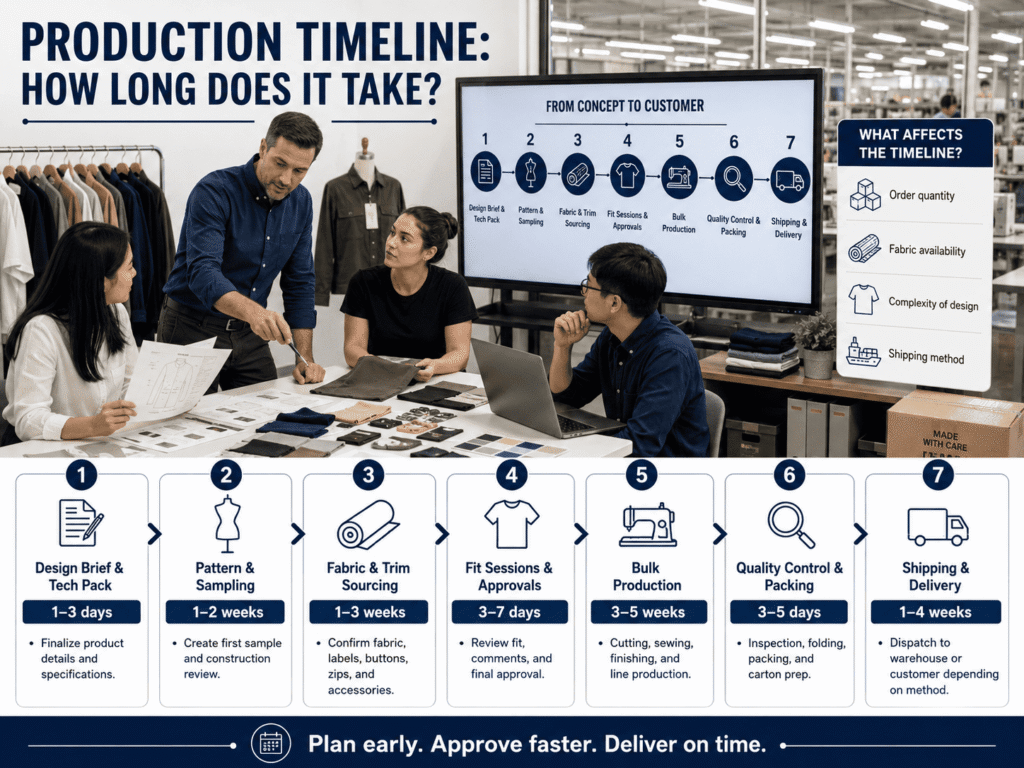
A realistic clothing production timeline runs 12 to 16 weeks from an approved tech pack to delivery, and that’s for a straightforward style with no major hold-ups. Brands that plan against a shorter window almost always end up compressing quality checks or air-freighting at the last minute to hit a deadline. This guide gives a week-by-week breakdown, compares timelines by garment type and sourcing location, and covers what actually causes schedules to slip.
In this article:
- A realistic week-by-week production timeline breakdown
- How timelines vary by garment type
- UK domestic versus offshore production timeline comparison
- How to plan around seasonal retail deadlines
- What causes production timelines to slip, and how to build a proper critical path
Contents
- 1. Production timeline planner
- 1.1. Production Timeline — Week-by-Week Breakdown
- 1.2. Production Timeline by Garment Type
- 1.3. UK Domestic vs Offshore Timeline Comparison
- 1.4. How Seasonal Deadlines Should Drive Your Timeline Planning
- 1.5. What Causes Production Timelines to Slip
- 1.6. How to Build a Critical Path for Your Collection
- 1.7. Building Your Production Timeline With Silk Routes
- 1.8. FAQ
- 1.8.1. Can a production timeline be compressed for an urgent order?
- 1.8.2. Does reordering an existing style follow the same timeline as a new style?
- 1.8.3. How much of the timeline is actually shipping versus production?
- 1.8.4. What’s the biggest single cause of timeline slippage?
- 1.8.5. Should a brand build the same timeline buffer for every collection?
What Is a Realistic Clothing Production Timeline for UK Brands?
For a standard style with no major complications, 12 to 16 weeks from approved tech pack to delivered stock is a realistic baseline. Complex garments — tailoring, outerwear, multi-component styles — regularly run longer.
That 12 to 16 week window assumes fabric is either in stock or on a standard mill lead time, and that no more than the usual two to three sample rounds are needed. Any of those assumptions breaking down extends the timeline, sometimes significantly.
Production timeline planner
An interactive companion to "Production Timeline: How Long Does It Take?" — work backward from your delivery date and see the full week-by-week critical path.
UK domestic
- Shipping: same day to a few days
- No customs clearance needed
- Minimal communication lag, same time zone
Offshore
- Shipping: 2–6 weeks by sea freight
- Customs clearance: typically hours once documentation is correct
- Turkey benefits from preferential tariffs under the UK-Turkey FTA
Production Timeline — Week-by-Week Breakdown
Each phase of production has its own typical duration, though these can compress or extend depending on style complexity and supplier responsiveness.
| Phase | Typical Duration | What Happens |
|---|---|---|
| Tech Pack, Pattern, Sample Prep | Weeks 1–4 | Pattern drafted, fabric sourced, first proto sample made |
| Sampling and Approvals | Weeks 5–8 | Fit sessions, SMS sample, size set approval |
| Pre-Production and Bulk Cut | Weeks 9–12 | PP sample approved, bulk fabric ordered, marker planning and cutting |
| Make, QC, Finish, and Deliver | Weeks 13–16 | Sewing, QC inspection, finishing, packing, shipping |
Weeks 1–4: Tech Pack, Pattern, and Sample Prep
This phase covers pattern drafting, initial fabric sourcing, and the first proto sample. Delays here are usually caused by an incomplete tech pack going back and forth for clarification before pattern work can even start.
Weeks 5–8: Sampling and Approvals
Fit sessions, salesman sample approval, and size set fitting all happen in this window. This is typically the phase most likely to extend, since fit issues often need more than one additional round to resolve properly.
Weeks 9–12: Pre-Production and Bulk Cut
Once the PP sample is approved, bulk fabric gets ordered, marker planning happens, and cutting begins. Fabric lead time is the most common bottleneck here, particularly for any fabric not already held in stock by the mill.
Weeks 13–16: Make, QC, Finish, and Deliver
Sewing, QC inspection, finishing, packing, and shipping happen in this final phase. Shipping method chosen at this stage — sea versus air — has a direct impact on how much buffer remains before a retail deadline.
Production Timeline by Garment Type
Garment complexity directly affects how long each phase takes, particularly sampling and make time.
| Garment Type | Typical Total Timeline |
|---|---|
| Basic T-shirts, simple knitwear | 8–12 weeks |
| Shirts, trousers, standard wovens | 12–16 weeks |
| Outerwear, tailoring | 16–20 weeks |
| Multi-fabric, multi-component styles | 18–24 weeks |
Brands sourcing production through Silk Routes’ clothing manufacturing services get a garment-specific timeline estimate at the tech pack stage, rather than working from a generic industry average that may not reflect their actual style complexity.
UK Domestic vs Offshore Timeline Comparison
Sourcing location changes the timeline mainly through shipping and customs, not through the core production phases themselves.
| Factor | UK Domestic | Offshore |
|---|---|---|
| Shipping Time | Same day to a few days | 2–6 weeks (sea freight) |
| Customs Clearance | Not applicable | Typically cleared within hours once documentation is submitted correctly, though delays occur if paperwork is incomplete |
| Communication Lag | Minimal, same time zone | Time zone and language can add turnaround delay |
| Tariffs | Not applicable | Depends on country — Turkey, for example, benefits from preferential tariffs under the UK-Turkey Free Trade Agreement |
Well-prepared shipments with correct documentation submitted to HMRC’s National Clearance Hub in advance can clear within hours, but any documentation issue can extend that to days. This makes accurate paperwork, not just shipping speed, a meaningful factor in offshore timeline planning.
How Seasonal Deadlines Should Drive Your Timeline Planning
“Work backwards from your retail delivery date, not forwards from when you’re ready to start — this exposes exactly how much buffer you actually have.” — Silk Routes Manufacturing Team
Retail calendars are unforgiving about delivery windows, and a collection arriving even two weeks late can mean missing peak selling weeks entirely. Build in buffer time specifically around fabric lead times and sampling rounds, since these are the two phases most likely to run over.
“Trade shows and buyer deadlines should be treated as hard stops when planning backwards — not as the date you start planning.” — Silk Routes Manufacturing Team
What Causes Production Timelines to Slip
Mistake 1: Starting the timeline from an incomplete tech pack. Why it happens: brands want to start production moving before every detail is finalised. Fix: treat tech pack approval as the actual start date of the timeline, not the date it was first sent.
Mistake 2: Underestimating fit session rounds needed. Why it happens: brands assume proto-to-approval will happen in one or two rounds. Fix: budget for one extra fit round on any new pattern or new fabric, and treat it as a pleasant surprise if it isn’t needed.
Mistake 3: Ordering fabric before the pattern is finalised. Why it happens: brands want to save time by getting fabric moving early. Fix: confirm fabric consumption from an approved pattern before placing the bulk fabric order, to avoid ordering the wrong quantity.
Mistake 4: Choosing sea freight without checking the actual delivery deadline. Why it happens: sea freight is cheaper, and cost gets prioritised over timeline risk. Fix: confirm the retail delivery date against realistic sea freight transit time, with buffer for customs, before confirming shipping method.
How to Build a Critical Path for Your Collection
“List every phase with its own start and end date, not just a single overall deadline — a critical path only works if every phase is dated individually.” — Silk Routes Manufacturing Team
A critical path maps every phase — tech pack, sampling, fabric ordering, cutting, sewing, QC, shipping — against dependencies, so it’s clear which delays are recoverable and which directly threaten the final delivery date.
“Identify which phases have zero slack — usually fabric lead time and final shipping — and monitor those more closely than phases with natural buffer built in.” — Silk Routes Manufacturing Team
Building Your Production Timeline With Silk Routes
We build a realistic, garment-specific timeline at the tech pack stage rather than relying on a generic estimate, so brands know exactly where the tight points are before committing to a retail delivery date. This same planning discipline runs through the complete tech pack to production process, where timeline planning sits alongside sourcing and sampling as a reviewed production stage.
Read more about Silk Routes and how we build production timelines around real retail deadlines.
FAQ
Can a production timeline be compressed for an urgent order?
Yes, to a point — rush production is possible by running sampling and bulk cutting in parallel where the risk is acceptable, and by switching to air freight instead of sea. This typically increases cost significantly and reduces the buffer available if anything goes wrong.
Does reordering an existing style follow the same timeline as a new style?
No, reordering an already-approved style is usually much faster, since pattern, grading, and fit approval are already done. The main remaining variables are fabric lead time and factory capacity availability.
How much of the timeline is actually shipping versus production?
For offshore sourcing, shipping and customs can account for a meaningful portion of the total timeline, particularly with sea freight. For UK domestic production, this portion shrinks to a few days at most, which is one reason UK-based timelines are often shorter overall despite similar production phase durations.
What’s the biggest single cause of timeline slippage?
Fabric lead time is one of the most common causes, particularly for any fabric not already held in stock by the mill and needing to be woven or dyed to order. This is why confirming fabric availability early in the timeline, not after the pattern is finalised, matters so much.
Should a brand build the same timeline buffer for every collection?
No — buffer should scale with garment complexity and how new the fabric, pattern, or factory relationship is. A repeat style with an established supplier needs far less buffer than a new style using an unfamiliar fabric or a first-time factory partner.