
Contents
- 1. 3D Garment Design: CLO3D & Browzwear Guide
- 1.1. What Is 3D Garment Design and Why Is It Growing in UK Fashion?
- 1.2. CLO3D vs Browzwear — Platform Comparison
- 1.3. The 3D Garment Design Workflow — From Sketch to Virtual Sample
- 1.4. How Much Does 3D Garment Design Software Cost?
- 1.5. How 3D Design Reduces Physical Sampling Costs
- 1.6. Limitations of 3D Design — What It Cannot Replace
- 1.7. Is 3D Garment Design Right for Your Brand Stage?
- 1.8. Common Mistakes When Adopting 3D Design
- 1.9. Bringing 3D Design Into Your Production Process
- 1.10. FAQ
- 1.10.1. Can 3D garment design completely replace physical samples?
- 1.10.2. Is CLO3D or Browzwear better for a small independent brand?
- 1.10.3. Do I need pattern-making experience to use 3D garment design software?
- 1.10.4. How accurate is virtual fabric simulation compared to a real fabric?
- 1.10.5. Does adopting 3D design require new software on every device, or is it cloud-based?
3D Garment Design: CLO3D & Browzwear Guide
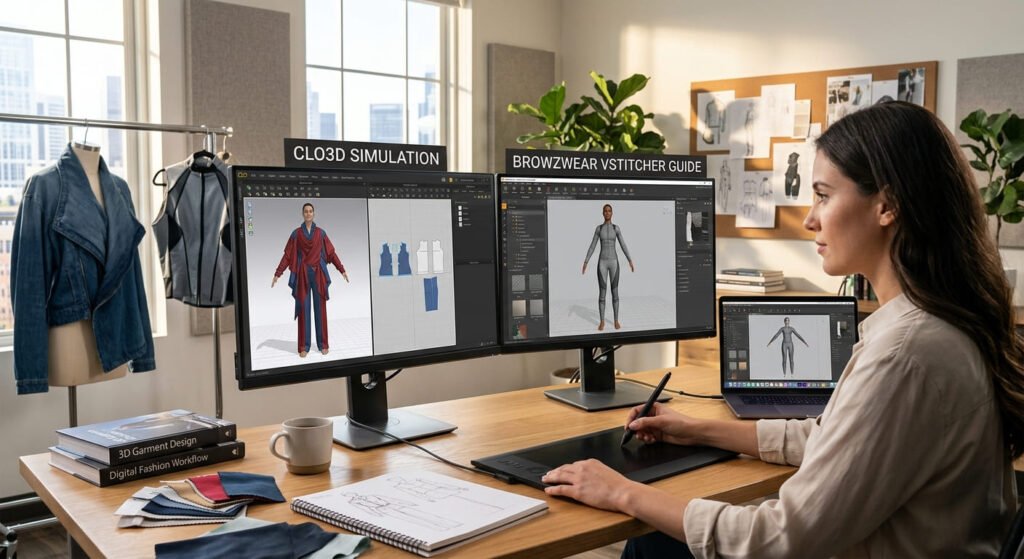
3D garment design has moved from a novelty to a standard part of product development for many UK fashion brands, driven largely by how much physical sampling it can eliminate. Oxana Razdoldki, Director of Technical Design at Thinx, described the shift plainly: 3D technology let her team refine fit, artwork, and colourways “with ease” and get a genuine sense of the final product before ever making a physical sample. This guide covers the two leading platforms, the workflow from sketch to virtual sample, realistic cost expectations, and where 3D design still can’t replace a physical garment.
In this article:
- Why 3D garment design is growing across UK fashion
- CLO3D versus Browzwear — how the two platforms compare
- The 3D workflow from pattern import to virtual sign-off
- Realistic software cost expectations
- Where 3D design genuinely cuts sampling cost, and where it can’t replace a physical sample
What Is 3D Garment Design and Why Is It Growing in UK Fashion?
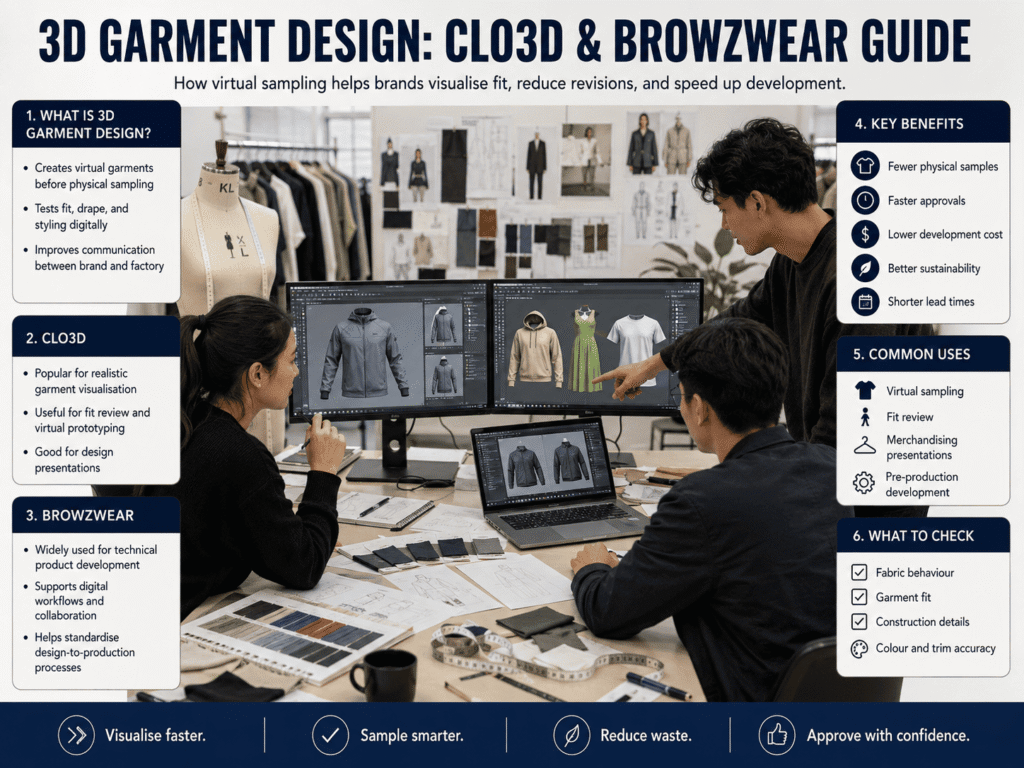
3D garment design software simulates how a garment will look, drape, and fit using digital patterns and virtual fabric physics, rather than requiring a physical sample at every stage. Brands adopting it report meaningfully faster development cycles — Browzwear’s own client data points to development timelines cutting from three to four months down to around two, largely by removing repeated physical sample rounds.
The technology has matured enough that, for simpler product groups, some brands now move to production with confidence and no physical sample at all. That’s a genuine shift from a few years ago, when 3D was mostly used for early-stage visualisation rather than production sign-off.
CLO3D vs Browzwear — Platform Comparison
Both platforms simulate garments in 3D, but they’ve built slightly different strengths.
| Factor | CLO3D | Browzwear (VStitcher) |
|---|---|---|
| Core Strength | Realistic rendering, widely used across independent designers and brands | Physics-based fabric simulation tied to real fabric data via Fabric Analyzer |
| Collaboration | CLO-SET platform for asset management and sharing | Stylezone platform for buyer, designer, and vendor collaboration |
| Typical User | Independent designers through to enterprise brands | Larger fashion and apparel companies, including major global retailers |
| File Support | DXF, OBJ, Alembic, OpenCollada, and more | DXF, FBX, OBJ, PLM integration |
The 3D Garment Design Workflow — From Sketch to Virtual Sample
The workflow moves from a 2D pattern through to a fully simulated, presentation-ready virtual garment.
| Step | What Happens |
|---|---|
| 1. Pattern Import or Creation | Existing 2D pattern imported, or a new pattern drafted directly in the software |
| 2. Virtual Fabric Application | Real fabric properties — weight, stretch, stiffness — applied to the digital pattern |
| 3. 3D Simulation and Fit Check | Pattern simulated on a virtual avatar to check drape, fit, and movement |
| 4. Virtual Presentation and Sign-Off | Finished virtual garment shared for buyer or internal approval |
Step 1 — Pattern Import or Creation
Most brands import an existing 2D pattern from their CAD system rather than building a new pattern from scratch inside the 3D software. This keeps the pattern data consistent with what the factory will eventually receive.
Step 2 — Virtual Fabric Application
Accurate fabric simulation depends on real physical properties — weight, stretch, drape, and stiffness — being measured and applied to the digital fabric, not just a visual texture. Browzwear’s Fabric Analyzer is built specifically to digitise these physical properties from a real fabric swatch for this purpose.
Step 3 — 3D Simulation and Fit Check
The pattern is simulated on a virtual avatar to check drape, fit, and how the garment behaves under movement. This is the stage most likely to reveal a pattern flaw that would otherwise only surface once a physical sample was cut and sewn.
Step 4 — Virtual Presentation and Sign-Off
The finished virtual garment is shared with buyers or internal stakeholders for review and approval, often through a dedicated collaboration platform. For simpler styles, this sign-off can happen entirely without a physical sample ever being made.
How Much Does 3D Garment Design Software Cost?
Both platforms follow a subscription-based licensing model rather than a one-off purchase, with pricing tiers for individual designers through to enterprise teams.
| Tier | Typical Structure |
|---|---|
| Individual / Freelance | Monthly or annual subscription plans |
| Enterprise / Brand | Custom pricing, typically quote-based |
| Free Trial | Both platforms commonly offer a time-limited free trial |
Enterprise pricing for either platform is generally negotiated directly with sales, since cost scales with team size and the level of PLM or factory integration required, rather than following a fixed public rate card.
How 3D Design Reduces Physical Sampling Costs
The clearest cost benefit comes from removing sample rounds that would otherwise involve fabric, courier shipping, and factory time for a garment that may still need revision. Brands report being able to test fit, colourways, and artwork placement entirely virtually before committing to a single physical cut.
Confirm real fabric properties are digitised — through a fabric analyser tool or manual measurement — before relying on virtual fit checks for sign-off, since an inaccurate fabric simulation undermines the accuracy of the entire fit check. Treat the first few virtual-to-physical comparisons on any new fabric as a calibration exercise, not a guarantee, until the simulation has proven reliable against a real sample.
Limitations of 3D Design — What It Cannot Replace
3D simulation is highly accurate for drape and general fit, but it still cannot fully replicate every physical sensation — hand feel, exact garment weight on the body, and some construction details only reveal themselves on a physical sample. Complex constructions involving multiple fabric layers, structured tailoring, or unusual trims often still need at least one physical sample before final approval.
Brands should treat 3D as a tool for reducing sample rounds, not eliminating physical sampling altogether, particularly for a brand’s first order with a new factory or fabric.
Is 3D Garment Design Right for Your Brand Stage?
Brands producing simple, repeat styles with an established factory relationship often see the fastest return from adopting 3D design, since the fabric properties and factory execution are already well understood. Brands still establishing a new factory relationship or working with unfamiliar fabrics may get less immediate benefit, since physical validation still matters more at that early stage of trust-building.
Brands sourcing production through Silk Routes’ clothing manufacturing services can discuss whether a specific style and fabric combination is a good early candidate for 3D-first development, rather than assuming every style is equally suited to it.
Common Mistakes When Adopting 3D Design
Mistake 1: Skipping fabric digitisation and using a generic virtual fabric preset. Why it happens: digitising real fabric properties takes extra time upfront. Fix: measure or scan actual fabric properties before relying on the simulation for fit sign-off.
Mistake 2: Approving a garment virtually without any physical sample at all on a first order. Why it happens: 3D confidence can outpace the actual proven accuracy of a new fabric-factory combination. Fix: request at least one physical sample on any new fabric or new factory relationship before going fully virtual.
Mistake 3: Treating 3D design as a total replacement for pattern expertise. Why it happens: the software’s realistic rendering can create false confidence in an inexperienced pattern. Fix: pair 3D design tools with genuine pattern-making knowledge, not as a substitute for it.
Bringing 3D Design Into Your Production Process
3D garment design works best as part of an established tech pack and sampling process, not as a separate tool bolted on afterward. This same integration runs through the complete tech pack to production process, where digital and physical sampling decisions are planned together rather than treated as competing approaches.
Read more about Silk Routes and how we help brands decide where 3D design genuinely earns its place in a production timeline.
FAQ
Can 3D garment design completely replace physical samples?
For simpler, well-understood styles with digitised fabric data and an established factory relationship, yes, some brands do move to production without a physical sample. For complex constructions or new fabric-factory combinations, at least one physical sample is still commonly used to validate the simulation.
Is CLO3D or Browzwear better for a small independent brand?
CLO3D is widely used by independent designers and smaller brands due to its accessible pricing tiers and strong rendering quality. Browzwear tends to suit brands needing tighter integration with PLM systems and multi-stakeholder collaboration, which matters more at larger scale.
Do I need pattern-making experience to use 3D garment design software?
Some background in pattern making and garment construction produces the best results, but both platforms are accessible enough that beginners can produce convincing virtual garments with practice. It isn’t a substitute for pattern expertise on complex or technical styles.
How accurate is virtual fabric simulation compared to a real fabric?
Accuracy depends heavily on how the fabric’s physical properties were measured and applied — tools like Browzwear’s Fabric Analyzer aim to closely match real fabric behaviour. Even with accurate digitisation, some hand-feel and construction details are still best confirmed on a physical sample.
Does adopting 3D design require new software on every device, or is it cloud-based?
Both CLO3D and Browzwear offer collaboration platforms (CLO-SET and Stylezone respectively) that allow cloud-based sharing and review, though the core design software itself is typically installed locally for the simulation work. This means teams can collaborate remotely on virtual assets without every stakeholder needing the full design software installed.