
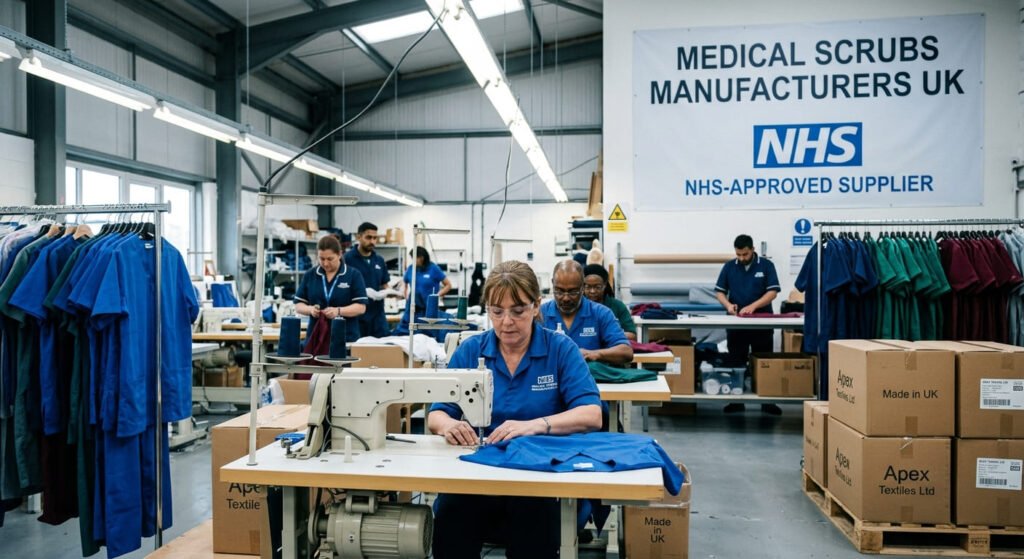
Medical scrubs look simple until a buyer starts specifying them.
Fabric weight, colour consistency, repeated industrial washing, pocket construction, seam strength, sizing and replenishment all affect whether a scrub range works in daily healthcare use.
For brands, clinics and healthcare uniform suppliers searching for medical scrubs manufacturers UK, the real task is finding a manufacturer that can control these details repeatedly across production runs.
Silk Routes manufactures specialist garments for UK brands and organisations. Medical uniforms sit within the wider field of specialist clothing manufacturing in the UK, where product performance matters as much as appearance.
A useful distinction also needs making at the start: “NHS-approved scrubs” is not a universal product certification covering every medical scrub garment. Buyers supplying NHS organisations normally need to work to the relevant procurement specification, contract requirements, fabric standards and supplier conditions applying to that particular order.
Contents
- 1. Post Summary
- 2. What Should a UK Medical Scrubs Manufacturer Be Able to Produce?
- 3. Are Medical Scrubs Really “NHS-Approved”?
- 4. Which Fabrics Work Best for Medical Scrubs?
- 5. How Should Medical Scrubs Be Constructed?
- 6. Medical Scrub Sizing Needs More Than S, M and L
- 7. Why Colour Consistency Matters in Healthcare Uniforms
- 8. Embroidery and Branding on Medical Scrubs
- 9. What Happens During Medical Scrub Sampling?
- 10. What Medical Scrub Buyers Often Get Wrong
- 11. Medical Scrubs for Private Clinics and Healthcare Brands
- 12. Can Medical Scrubs Be Manufactured at Low MOQ?
- 13. Medical Scrub Manufacturing and Sustainability
- 14. UK Manufacturing vs Overseas Medical Scrub Production
- 15. What Should You Send a Medical Scrubs Manufacturer?
- 16. FAQs About Medical Scrubs Manufacturing in the UK
- 17. Building a Medical Scrub Range That Can Be Reordered
Post Summary
Medical scrubs need repeatable fit, fabric and colour control
“NHS-approved” should not be treated as a blanket garment certification
Fabric selection affects comfort, durability and laundering performance
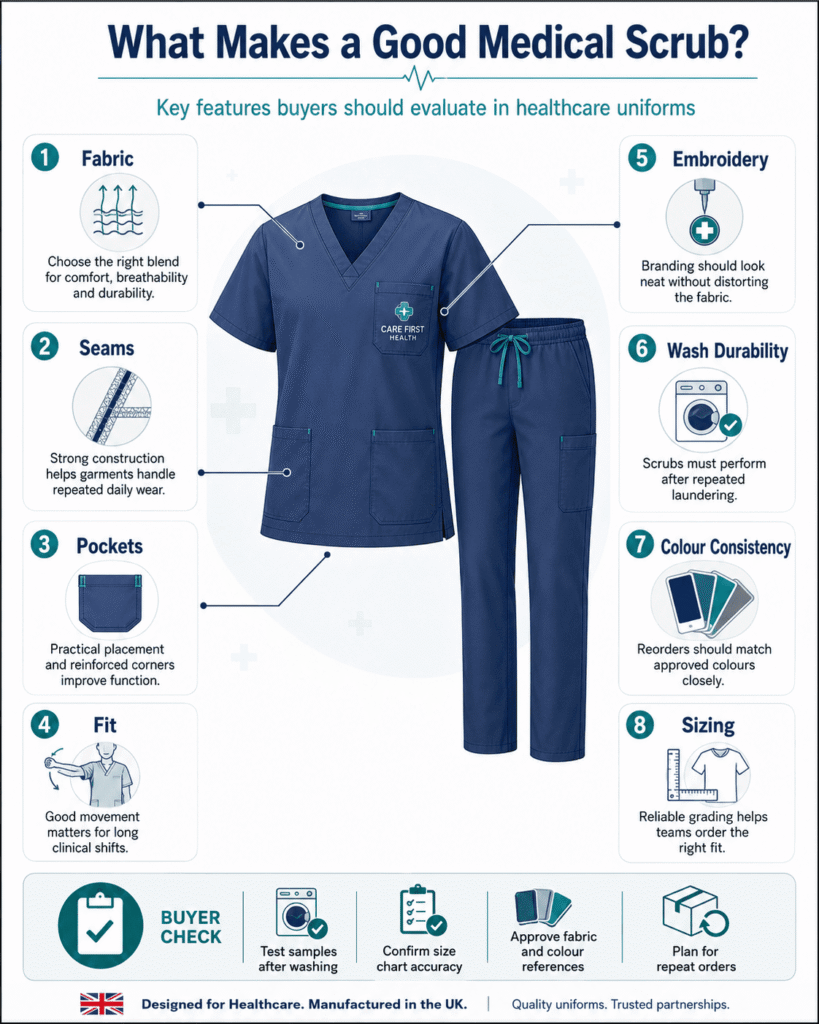
Reinforced seams and functional pockets matter in healthcare use
Sampling should test movement, laundering and shrinkage before bulk production
Colour consistency becomes critical when ranges are reordered
Low and medium MOQs can support clinics, uniform brands and specialist suppliers
Production planning should include future replenishment from the first order
What Should a UK Medical Scrubs Manufacturer Be Able to Produce?
A medical scrubs manufacturer should be able to produce more than a basic V-neck top and drawstring trousers.
Typical ranges can include:
V-neck scrub tops
Round-neck scrub tops
Unisex scrubs
Women’s fitted scrubs
Men’s scrub sets
Cargo scrub trousers
Jogger-style scrub trousers
Tunics
Healthcare dresses
Laboratory coats
Theatre clothing
Dental uniforms
Veterinary scrubs
Maternity healthcare uniforms
Embroidered staff uniforms
The production method changes according to the end user.
A private dental chain may prioritise a polished fitted silhouette and embroidered branding. A healthcare supplier dealing with institutional contracts may place greater weight on wash durability, consistent sizing and repeat ordering.
That is why medical workwear belongs within specialist clothing manufacturing rather than ordinary fashion production.
Our view is straightforward: a factory that produces attractive casualwear is not automatically equipped to manufacture reliable healthcare uniforms.
Are Medical Scrubs Really “NHS-Approved”?
The phrase is used loosely in the uniform market.
There is no single universal badge that turns any scrub garment into an “NHS-approved scrub.” Approval can relate instead to a supplier framework, procurement contract, product specification or individual NHS organisation’s requirements.
Buyers should therefore ask a manufacturer a more useful question:
Can you manufacture the garment consistently to the specification required by the healthcare buyer?
That specification might cover:
Fabric composition
Fabric weight
Colour
Garment dimensions
Pocket configuration
Embroidery
Care labelling
Wash temperature
Shrinkage tolerance
Seam construction
Packaging
Traceability
Calling a product NHS-approved without identifying what has actually been approved creates unnecessary procurement risk.
A manufacturer should be able to work from a technical specification rather than rely on marketing terminology.
Which Fabrics Work Best for Medical Scrubs?
Fabric choice determines much of the garment’s performance.
Three common options are cotton-rich blends, polyester-rich blends and stretch fabrics containing elastane.
| Fabric type | Typical advantage | Main consideration | Suitable use |
|---|---|---|---|
| Polyester/cotton | Durable and practical | Less stretch than performance blends | General healthcare uniforms |
| Cotton-rich blend | Softer hand feel | Can require greater shrinkage control | Clinics and private healthcare |
| Polyester/viscose | Smooth appearance | Fabric specification must suit laundering | Tunics and structured uniforms |
| Stretch blend | Greater movement | Elastane performance must be tested | Modern fitted scrubs |
Polyester-Cotton Scrubs
Polyester-cotton remains practical because the two fibres bring different characteristics.
Polyester helps with dimensional stability and durability. Cotton contributes softness and moisture absorption.
The exact ratio should be selected around the intended laundering process rather than copied from another scrub range.
Stretch Medical Scrubs
Stretch scrubs have become common in private healthcare, dentistry, veterinary businesses and premium uniform ranges.
Adding elastane can improve freedom of movement, particularly in fitted trousers and shaped tops.
The risk comes from treating stretch percentage as the whole specification.
Fabric recovery matters too. A trouser that stretches comfortably but loses shape after repeated wear will create complaints quickly.
Fabric Certification
Buyers concerned about substances used in textiles can specify independently tested materials.
The OEKO-TEX STANDARD 100, for example, applies testing criteria to textile products for harmful substances.
A certificate should be checked against the actual fabric or product scope being supplied rather than treated as a generic factory claim.
How Should Medical Scrubs Be Constructed?
Healthcare uniforms face a different pattern of wear from ordinary clothing.
Staff bend, reach, sit, lift and move throughout long shifts. Pockets may repeatedly carry phones, pens, scissors, keys or medical accessories.
That changes where reinforcement matters.
Shoulder and Side Seams
Main structural seams need clean, repeatable construction.
A poorly balanced scrub top can twist after laundering even when the fabric itself performs well.
Pocket Reinforcement
Pocket corners are frequent stress points.
Bartacks or other reinforcement methods can reduce tearing where pocket openings receive repeated load.
Trouser Seams
The crotch and seat areas deserve particular attention.
Fashion-style construction that is acceptable for occasional wear may not perform well in garments worn through long clinical shifts.
Necklines
V-neck scrub tops need stable neckline construction.
A neckline that stretches out of shape can make an otherwise usable garment look worn very quickly.
This is the sort of product-specific engineering covered in our wider Specialist Clothing Manufacturers UK guide.
Medical Scrub Sizing Needs More Than S, M and L
Sizing becomes difficult when one uniform range serves many body shapes.
A nominal medium does not tell the manufacturer enough.
A proper specification should include garment measurements such as:
Chest
Waist
Hip
Shoulder width
Garment length
Sleeve opening
Trouser rise
Thigh
Inside leg
Hem opening
Women’s, men’s and unisex blocks may also require different grading logic.
We would rather establish the block correctly during development than compensate for poor sizing after bulk production.
That matters even more for repeat contracts because an incorrect block can affect thousands of garments over time.
Why Colour Consistency Matters in Healthcare Uniforms
Colour often identifies staff role, department or organisation.
A scrub supplier might need navy, royal blue, bottle green, burgundy, ceil blue and several additional shades across one programme.
The first order is only part of the challenge.
Reorders six months later need to remain visually consistent with uniforms already in circulation.
Several variables can affect this:
Fabric mill
Dye lot
Fibre composition
Finishing
Wash treatment
Supplier substitution
A manufacturer should record approved fabric and colour references during development.
Buying an approximately similar navy fabric later is not good enough for a uniform programme.
Embroidery and Branding on Medical Scrubs
Healthcare uniforms often carry embroidered branding.
Typical applications include:
Clinic name
NHS organisation or department identity where authorised
Staff role
Employee name
Dental practice logo
Veterinary practice logo
Private hospital branding
Embroidery should be tested against the garment fabric before bulk production.
Dense embroidery on lightweight fabric can cause puckering. Poor stabilisation can distort the garment around the logo.
Logo position also needs to account for pockets.
A left-chest logo that collides visually with a chest pocket can make an otherwise professional scrub top look poorly planned.
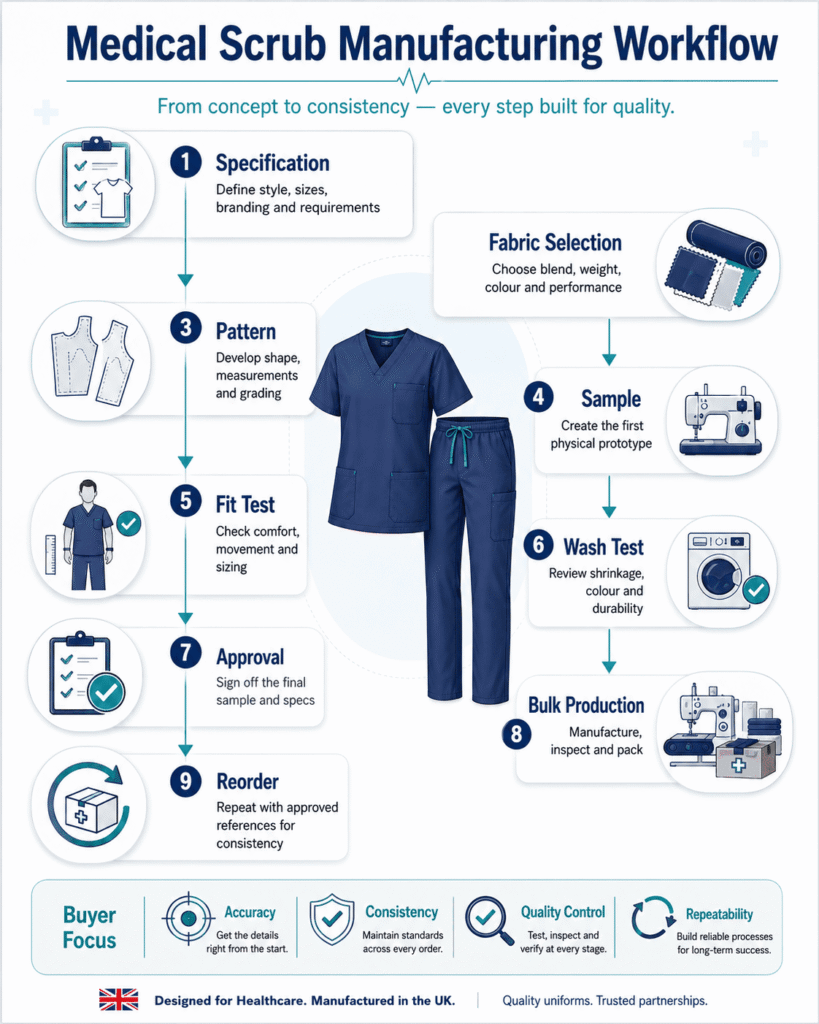
What Happens During Medical Scrub Sampling?
A good sample should answer production questions, not simply show the buyer what the garment looks like.
We would normally expect the development process to test:
Pattern and silhouette
Garment measurements
Fabric behaviour
Pocket position
Neckline construction
Trouser rise and movement
Branding placement
Wash performance
Shrinkage
Final specification
The fitting stage should involve movement.
Standing straight in front of a mirror does not replicate the way a nurse, dentist or veterinary professional uses the garment.
Squatting, reaching and sitting often reveal problems that remain invisible during a static fitting.
Silk Routes Manufacturing Team: Test the scrub sample after laundering, not only before it. A garment that looks correct straight from production can behave differently after repeated wash cycles.
For brands developing a healthcare uniform programme, our clothing manufacturing services can cover the route from specification and sampling through production.
What Medical Scrub Buyers Often Get Wrong
1. Choosing Fabric by Feel Alone
A soft fabric can perform poorly after repeated laundering.
Fix: approve the fabric against the expected care process, shrinkage requirement and end use.
2. Ignoring Reorder Availability
The first batch looks correct, but the same fabric cannot be sourced six months later.
Fix: discuss continuity and replenishment before approving bulk production.
3. Using Fashion Sizing for Healthcare Uniforms
A fashion block may be too restrictive during physical work.
Fix: develop the fit around movement and occupational use.
4. Adding Too Many Pockets Without Testing Them
More pockets do not automatically create a better scrub.
Poorly positioned pockets can interfere with movement or become uncomfortable when loaded.
Fix: prototype the actual pocket arrangement and test garments while carrying typical items.
5. Treating Embroidery as an Afterthought
Large logos can distort lightweight scrub fabric.
Fix: approve an embroidered sample before bulk production.
6. Assuming “NHS-Approved” Is a Complete Specification
The phrase can hide important unanswered questions.
Fix: identify the actual procurement requirements, garment specification and approval route applying to the order.
Medical Scrubs for Private Clinics and Healthcare Brands
Not every medical scrub order is an institutional contract.
Private healthcare has created demand for more branded and design-conscious uniforms.
Typical buyers include:
Dental practices
Cosmetic clinics
Private hospitals
Physiotherapy centres
Veterinary practices
Care providers
Aesthetic businesses
Healthcare uniform brands
These buyers often require smaller production runs and more variation.
They may want different fits, custom colours, logo embroidery and seasonal replenishment without ordering institutional volumes.
That creates a different manufacturing problem from mass uniform supply.
The factory needs enough production discipline for workwear while retaining enough flexibility for smaller branded programmes.
Can Medical Scrubs Be Manufactured at Low MOQ?
Yes, depending on fabric availability, colour, construction and customisation.
MOQ means minimum order quantity.
Low-volume production works most easily when the buyer uses readily available fabrics and limits unnecessary variation.
For example, splitting a small order across:
5 colours
8 sizes
2 fits
3 embroidery variations
can create a large number of individual production combinations.
A nominal order of 300 garments can quickly become dozens of very small manufacturing batches.
Our preference is to simplify the first production run, collect real sizing and demand data, then broaden the range.
This approach reduces inventory risk without compromising the product.
Medical Scrub Manufacturing and Sustainability
Durability deserves more attention than sustainability slogans.
A garment that survives repeated wear and laundering can reduce the frequency at which uniforms need replacement.
Material choice also matters.
Organisations such as Textile Exchange publish resources around preferred fibres and materials, while WRAP works on resource efficiency and circularity across textiles and other sectors.
Healthcare uniforms create their own constraints because hygiene, performance, laundering and longevity cannot simply be sacrificed to improve a sustainability claim.
For many programmes, the useful question is:
Which material delivers the required performance with the lowest practical environmental burden over its usable life?
That is a better manufacturing discussion than selecting fabric from a sustainability label alone.
UK Manufacturing vs Overseas Medical Scrub Production
Both models can work.
UK production can offer advantages where the buyer needs:
Faster development
Smaller runs
Easier communication
Quicker sampling
More frequent replenishment
Overseas production can become attractive at larger volumes where unit cost carries more weight.
The right choice depends on order size, product complexity and replenishment strategy.
Hybrid sourcing can also work.
Development and initial smaller runs might be handled closer to the buyer, while established high-volume lines move to another production route later.
Medical uniforms should be treated as a supply programme rather than a single purchase order.
What Should You Send a Medical Scrubs Manufacturer?
A detailed enquiry speeds up costing and sampling.
Send:
Product drawings or reference images
Tech pack if available
Fabric composition
Fabric weight
Colour references
Size range
Measurement chart
Quantity per size
Pocket requirements
Branding requirements
Wash requirements
Packaging requirements
Target delivery date
A specification does not need to be perfect before the first discussion.
It does need to be specific enough for the manufacturer to identify what remains unresolved.
FAQs About Medical Scrubs Manufacturing in the UK
What is a typical MOQ for custom medical scrubs?
MOQ varies by fabric, colour and factory setup, but custom programmes often become easier to manufacture from roughly 100–300 pieces per style or production grouping. More colours and size variations can push the practical MOQ higher.
How long does medical scrub production take?
A straightforward repeat order may take around 4–8 weeks once fabric, trims and specifications are confirmed. New development requires additional time for patterns, samples, fitting and approval.
Can a UK manufacturer make embroidered medical scrubs?
Yes. Embroidery can normally be added during production, but at least 1 approved embroidered sample should be reviewed before bulk manufacture.
Can medical scrubs be made in custom colours?
Yes, although custom-dyed fabric may require a higher minimum than stock colours. Buyers should also approve 1 physical colour standard rather than relying only on screen colours.
How many samples should be made before bulk production?
The number depends on complexity, but a new scrub range may require 2–3 development rounds before the fit, fabric and construction are ready for production.
Building a Medical Scrub Range That Can Be Reordered
The strongest medical uniform programmes are designed for the second and third orders from the beginning.
Patterns, fabric references, trims, embroidery files, measurements and approved colours should all be recorded.
That turns replenishment into controlled production rather than product redevelopment.
Silk Routes works across medical uniforms and other technically specific garment categories. You can see how these products fit into the wider manufacturing landscape in our Specialist Clothing Manufacturers UK: The Complete Product Guide.
For information about our manufacturing background and production approach, visit About Silk Routes.