
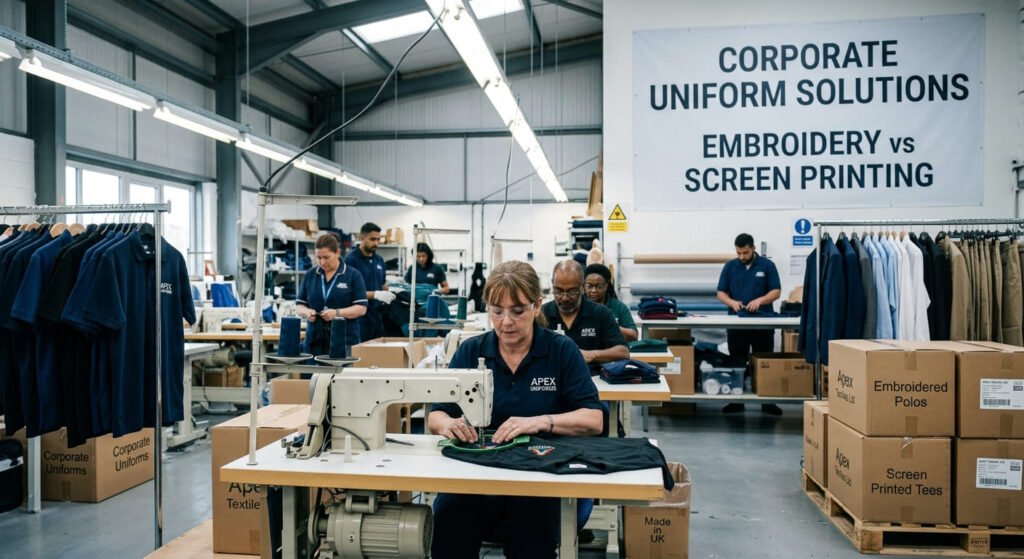
A logo can make a corporate uniform look considered or cheap.
The difference often comes down to choosing the right decoration method for the garment, fabric and working environment.
For UK businesses developing branded workwear, the usual decision is embroidery vs screen printing. Both methods can produce professional results, but they solve different problems.
Embroidery works particularly well for polos, jackets, shirts and heavier uniforms. Screen printing suits larger artwork, lightweight garments and higher-volume runs.
Corporate uniforms sit within the wider field of specialist clothing manufacturing in the UK, where branding has to work alongside fit, durability and garment performance.
Contents
- 1. Post Summary
- 2. Embroidery vs Screen Printing: What Is the Main Difference?
- 3. When Does Embroidery Work Best on Corporate Uniforms?
- 4. Where Does Screen Printing Work Better?
- 5. Is Embroidery Better Than Screen Printing?
- 6. Which Looks More Professional?
- 7. Embroidery vs Screen Printing Comparison
- 8. Which Is More Expensive: Screen Printing or Embroidery?
- 9. What Is Better, Embroidery or Print?
- 10. Fabric Weight Changes the Decision
- 11. Does Embroidery Last Longer Than Screen Printing?
- 12. Why Should Branding Be Tested Before Bulk Production?
- 13. Logo Placement on Corporate Uniforms
- 14. Thread Colour vs Printed Colour
- 15. Can Detailed Logos Be Embroidered?
- 16. Corporate Uniforms With Multiple Garment Types
- 17. Common Branding Mistakes in Corporate Uniform Production
- 18. Should You Use Embroidery for Workwear?
- 19. Does Screen Printing Work on Polyester Uniforms?
- 20. Embroidery and Screen Printing for Sustainable Uniform Programmes
- 21. What Information Should You Send the Manufacturer?
- 22. FAQs About Embroidery vs Screen Printing
- 23. Choosing the Branding Method for a Repeatable Uniform Programme
Post Summary
Embroidery gives corporate uniforms a textured, premium appearance
Screen printing works better for larger, flatter artwork
Embroidery usually costs more for complex or large designs
Screen printing can become economical at higher quantities
Lightweight fabrics may distort under dense embroidery
Detailed gradients are usually easier to reproduce through print
Logo placement should be approved on an actual garment sample
The best method depends on fabric, artwork, quantity and end use
Embroidery vs Screen Printing: What Is the Main Difference?
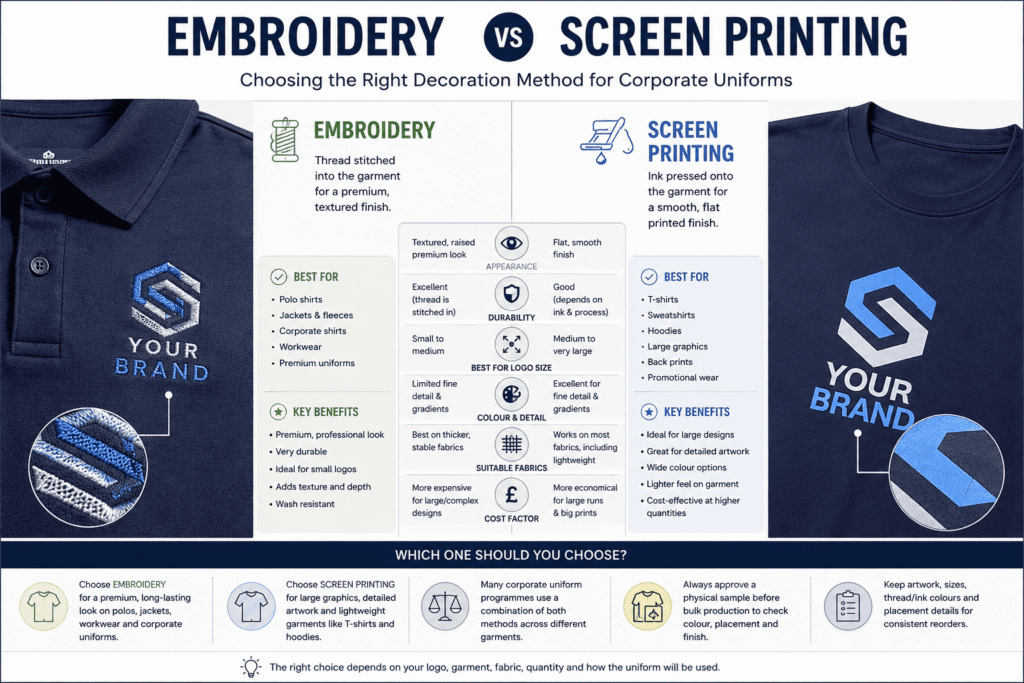
Embroidery creates a design using thread stitched directly into the garment.
Screen printing pushes ink through a prepared screen onto the surface of the fabric.
That difference affects nearly everything else.
Embroidery becomes part of the garment structure. Screen printing sits primarily on the surface.
For corporate uniforms, this means embroidery tends to feel more formal, while screen printing often gives more freedom with size and graphic detail.
Neither method is automatically superior.
The right choice depends on what the uniform needs to achieve.
When Does Embroidery Work Best on Corporate Uniforms?
Embroidery works particularly well when the logo needs to look structured and long-lasting.
Typical garments include:
Polo shirts
Corporate shirts
Fleeces
Jackets
Gilets
Workwear
Healthcare uniforms
Hospitality uniforms
Premium staff uniforms
A small embroidered logo on the left chest remains one of the most common corporate uniform treatments because it looks deliberate without dominating the garment.
Embroidery Gives Logos Physical Depth
Thread creates texture.
That raised finish can make a simple company logo feel more substantial than a flat print.
This is particularly useful for customer-facing teams where the uniform forms part of the organisation’s visual identity.
Hotels, estate agents, hospitality businesses, clinics and professional service firms often benefit from this more restrained appearance.
Embroidery Handles Small Logos Well
A compact chest logo is often a strong embroidery application.
The design can remain readable without taking over the garment.
The mistake is assuming that every small detail from a digital logo should be reproduced exactly in thread.
Very fine text, thin lines and tiny negative spaces may need simplifying.
An embroidery file should be digitised specifically for stitching rather than treated like an image sent directly to a printer.
Where Does Screen Printing Work Better?
Screen printing becomes attractive when branding is larger, flatter or more graphic.
It is common on:
T-shirts
Sweatshirts
Hoodies
Promotional garments
Event uniforms
Casual staff clothing
Branded workwear
Back prints
Large chest designs
A large logo across the back of a staff T-shirt would normally make more sense as a print than dense embroidery.
The embroidery could become heavy, expensive and uncomfortable.
Screen printing handles this type of coverage more naturally.
Is Embroidery Better Than Screen Printing?
This is one of the most common questions buyers ask.
Embroidery is better when the priority is a premium, textured finish on suitable garments. Screen printing is better when the design is large, graphic or needs to remain lightweight.
A corporate polo with a small left-chest logo is a strong embroidery candidate.
A promotional T-shirt with a large full-back graphic is usually a stronger screen-printing candidate.
The garment decides much of the answer.
Trying to force one decoration method across every item in a uniform collection can create unnecessary compromises.
Which Looks More Professional?
For traditional corporate clothing, embroidery often has the advantage.
Thread gives the branding dimension and can complement structured garments such as polos, shirts, jackets and gilets.
Screen printing can still look highly professional.
Its strength is different.
A clean one-colour print on a well-made T-shirt can look more appropriate than embroidery if the brand has a contemporary, casual identity.
The choice should reflect the garment rather than a general rule that embroidery always looks more expensive.
Embroidery vs Screen Printing Comparison
| Factor | Embroidery | Screen Printing | Better suited to |
|---|---|---|---|
| Finish | Raised and textured | Flat and smooth | Depends on brand style |
| Small chest logos | Excellent | Good | Embroidery |
| Large graphics | Can become heavy | Very suitable | Screen printing |
| Fine gradients | Limited | Better potential | Screen printing |
| Heavy garments | Very suitable | Suitable | Embroidery |
| Lightweight garments | Requires care | Often suitable | Screen printing |
| Small quantities | Often practical | Setup can affect cost | Embroidery |
| High quantities | Consistent | Can become economical | Screen printing |
| Premium appearance | Strong | Depends on artwork | Embroidery |
| Large back branding | Usually inefficient | Strong application | Screen printing |
Which Is More Expensive: Screen Printing or Embroidery?
Embroidery is often more expensive for large or stitch-heavy artwork.
Pricing can depend on:
Stitch count
Logo dimensions
Number of embroidery positions
Thread changes
Garment construction
Quantity
A simple 8 cm chest logo can remain economical.
The same logo enlarged across the back of a jacket might require a very high stitch count.
Screen-printing costs behave differently.
Pricing can depend on:
Number of colours
Number of screens
Artwork complexity
Print size
Garment fabric
Quantity
Number of print positions
The setup cost means screen printing can become more attractive as quantities increase.
For a small order with one compact logo, embroidery may remain competitive.
For hundreds of T-shirts carrying the same large graphic, screen printing can make considerably more sense.
What Is Better, Embroidery or Print?
The better method is the one that suits the garment and the intended use.
A uniform collection may use both.
For example:
Polo shirt: embroidered chest logo
T-shirt: screen-printed chest or back design
Jacket: embroidered chest logo
Sweatshirt: embroidery or print depending on artwork
Apron: embroidery for a restrained brand mark
Event shirt: screen print for larger campaign artwork
This mixed approach gives the designer more control.
Corporate uniform programmes should not be built around decoration technology alone.
The garment, fabric, logo and workplace should determine the decoration.
Fabric Weight Changes the Decision
Fabric is one of the most important factors.
Embroidery places thousands of stitches into a concentrated area.
A heavier polo or jacket can support this well.
A very lightweight fabric may not.
Dense embroidery on a thin material can cause:
Puckering
Distortion
Rippling
Fabric pulling
Poor drape
Backing and stabilisation can help, but they cannot make every design suitable for every fabric.
Screen printing adds far less structural weight.
That makes it useful for lightweight T-shirts and similar garments.
The print chemistry and curing process still need to suit the fabric.
Does Embroidery Last Longer Than Screen Printing?
Good embroidery can be extremely durable.
The thread is physically stitched through the garment rather than bonded only to the surface.
That gives embroidery an advantage for uniforms that experience frequent use.
Screen printing can also last well when the correct ink system, curing process and wash instructions are used.
Poorly applied print may:
Crack
Peel
Fade
Lose sharpness
Poor embroidery creates different failures.
These can include:
Loose threads
Distorted fabric
Broken stitching
Fraying
Poorly secured backing
Durability therefore depends on production quality, not only decoration type.
Why Should Branding Be Tested Before Bulk Production?
A logo that looks good on a computer screen may behave differently on fabric.
This is especially common with embroidery.
The buyer might approve a digital artwork file without seeing:
Thread thickness
Fabric distortion
Logo density
Finished dimensions
Actual thread colours
Placement
That creates avoidable risk.
At Silk Routes, we consider the physical branded sample more useful than a digital mock-up alone.
The sample should be inspected before the bulk run.
For businesses developing a full branded range, our clothing manufacturing services can cover development, sampling and production.
Logo Placement on Corporate Uniforms
Decoration method is only half the decision.
Placement matters just as much.
Common positions include:
Left chest
Right chest
Sleeve
Upper back
Full back
Trouser pocket
Apron chest
Jacket front
Collar area
Left-Chest Branding
This remains a reliable position for corporate polos, shirts and jackets.
It works particularly well with embroidery because the area is compact.
Sleeve Branding
Sleeves can carry secondary branding, department names or partner logos.
The available area is smaller, so artwork normally needs simplifying.
Large Back Branding
Large artwork across the back is usually better suited to print.
It provides visibility without adding the weight associated with large embroidery.
Thread Colour vs Printed Colour
Corporate identity often depends on specific brand colours.
Embroidery thread and printing ink reproduce colour differently.
Thread catches light.
The same nominal colour can look lighter or darker depending on the angle and stitch direction.
Printed ink creates a flatter surface.
This may make colour matching easier for some brand applications.
Neither method should be approved solely from a computer monitor.
Physical thread cards, swatches or strike-offs are more reliable references.
For textile buyers concerned about material testing and substances used in textile products, OEKO-TEX STANDARD 100 provides an independent textile-testing framework.
Can Detailed Logos Be Embroidered?
Yes, but there are limits.
Embroidery works best when the logo has clear shapes.
Problems can appear with:
Very small lettering
Thin outlines
Tiny gaps
Complex gradients
Photographic detail
Fine shadows
The solution is sometimes to simplify the embroidery version.
Many brands maintain multiple approved logo variations for this reason.
A digital logo designed for a website does not always make a good embroidery file.
Screen printing offers greater freedom for many detailed graphics, although artwork preparation and print method still matter.
Corporate Uniforms With Multiple Garment Types
A complete corporate uniform range often contains several fabrics.
For example:
Cotton polo
Polyester performance T-shirt
Softshell jacket
Sweatshirt
Work trousers
Apron
Applying exactly the same branding method to all six garments may not produce the best result.
The polo and softshell may suit embroidery.
The performance T-shirt might work better with print.
The trousers may need a small embroidered mark or no visible decoration.
The apron could go either way depending on fabric weight.
This is why corporate uniforms sit naturally within specialist clothing manufacturing.
The garment system matters more than any single item.
Common Branding Mistakes in Corporate Uniform Production
1. Making an Embroidered Logo Too Large
A large stitched design can become heavy and rigid.
Fix: reduce the embroidery size or use print for large artwork.
2. Using Extremely Small Text
Small lettering can lose definition in thread.
Fix: simplify the artwork and increase critical text size.
3. Approving Only a Digital Mock-Up
Digital artwork does not show how thread or ink interacts with fabric.
Fix: approve a physical decorated sample.
4. Ignoring Fabric Stretch
Stretch fabrics move underneath decoration.
Dense embroidery can restrict that movement.
Fix: test the exact fabric and decoration together.
5. Using the Same Branding Method on Every Garment
A jacket and a lightweight T-shirt do not have the same construction requirements.
Fix: choose decoration by garment type.
6. Forgetting Reorders
Changing thread shade, print colour or logo dimensions during later production can make uniforms look inconsistent.
Fix: retain approved artwork, embroidery files, colour references and placement measurements.
Should You Use Embroidery for Workwear?
Often, yes.
Workwear such as jackets, polos, fleeces and heavier tops generally provides a stable base for embroidery.
Small embroidered logos also handle frequent use well.
That does not mean every workwear item should be embroidered.
High-visibility clothing, lightweight technical garments or garments requiring large identification marks may need another decoration method.
The work environment should guide the decision.
Does Screen Printing Work on Polyester Uniforms?
It can.
The print system needs to be suitable for the fabric.
Polyester introduces its own considerations because heat and dye migration can affect some printing processes.
Testing the actual garment fabric before bulk production is therefore sensible.
A printer should know the fibre composition before choosing inks and curing settings.
The broader material choice also affects garment durability and environmental performance. Organisations such as Textile Exchange publish textile-material resources that can help buyers understand fibre choices beyond decoration alone.
Embroidery and Screen Printing for Sustainable Uniform Programmes
Decoration can influence garment lifespan.
A strong uniform does little good if the branding fails early.
Likewise, durable branding cannot rescue a garment with poor construction.
Buyers planning uniforms for repeated use should think about the complete product:
fabric + construction + decoration + laundering + repair + replacement
WRAP has published extensively on textile resource efficiency and extending clothing use.
For uniforms, durability is often one of the most practical sustainability decisions.
A garment that remains usable and presentable for longer needs replacement less frequently.
What Information Should You Send the Manufacturer?
A branding enquiry should include more than the logo file.
Send:
Vector artwork where possible
Preferred decoration method
Logo dimensions
Garment type
Fabric composition
Fabric weight
Branding position
Quantity
Colour references
Size breakdown
Wash requirements
Delivery deadline
For embroidery, the factory may also need to create a digitised stitch file.
For screen printing, artwork may need colour separation or preparation for the chosen print process.
FAQs About Embroidery vs Screen Printing
Is embroidery better than screen printing?
Embroidery is usually better for small logos on polos, jackets and structured corporate uniforms. Screen printing tends to work better for larger graphics and lightweight garments, so the garment should be assessed before choosing 1 decoration method.
What is better, embroidery or print?
Neither is universally better. A mixed uniform range may use embroidery on 2–3 structured garments while using print on T-shirts or large back graphics.
Which is more expensive, screen printing or embroidery?
Embroidery can cost more as stitch count and design size increase, while screen printing carries setup costs for screens and colours. Once an order reaches larger quantities, even 1 repeated screen design can become economical across the run.
How large should an embroidered company logo be?
A left-chest logo often works within roughly 6–10 cm depending on the artwork and garment. The exact size should be approved on a physical sample because dense designs behave differently from simple logos.
Should I approve a sample before branded uniform production?
Yes. Approve at least 1 physical decorated sample showing final size, colour, placement and garment behaviour before the bulk order begins.
Choosing the Branding Method for a Repeatable Uniform Programme
The best corporate uniform branding survives beyond the first photograph.
It should remain consistent through laundering, everyday wear and future reorders.
Use embroidery where the garment can support the stitching and the logo benefits from a premium textured finish.
Use screen printing where artwork size, garment weight or production quantity makes print the stronger choice.
Keep the approved logo dimensions, thread or ink references, placement measurements and production files for every repeat order.
For more product categories where fabric, construction and end use determine how garments should be manufactured, see our Specialist Clothing Manufacturers UK: The Complete Product Guide.
You can also learn more about the factory background and production approach on About Silk Routes.