
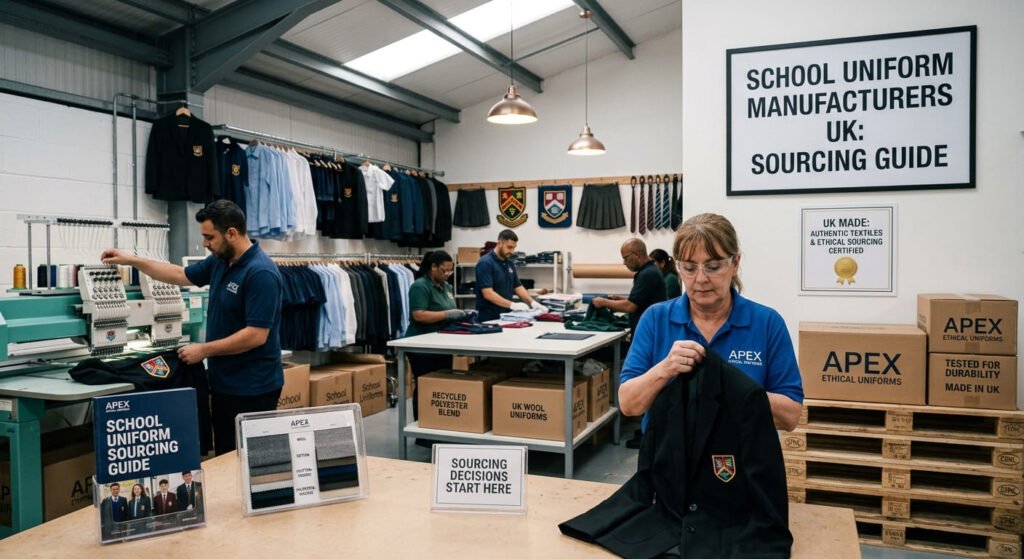
A school uniform order looks straightforward until it has to work across hundreds of pupils, multiple sizes, several garments and repeated reorders.
The manufacturer has to keep colours consistent, logos accurate, sizing predictable and replacement stock available long after the first production run.
For schools, multi-academy trusts and educational uniform suppliers searching for school uniform manufacturers UK, the manufacturing decision should therefore focus on repeatability rather than the cheapest first order.
School uniforms are part of the wider specialist clothing manufacturing sector in the UK, where garments are built around a defined environment and repeated functional use.
Contents
- 0.1. Post Summary
- 0.2. Why Do Schools Use Specialist Uniform Manufacturers?
- 0.3. What Should School Uniform Manufacturers Be Able to Produce?
- 0.4. Blazers and Jackets Need Structured Manufacturing
- 0.5. Shirts, Blouses and Polo Shirts
- 0.6. Trousers, Skirts and Shorts
- 0.7. PE Kits Require a Different Approach
- 0.8. What School Uniform Standards Should Buyers Check?
- 0.9. Build a School Uniform Specification Before Requesting Quotes
- 0.10. School Logo Embroidery Needs Physical Approval
- 0.11. Colour Consistency Is Critical for School Uniform Reorders
- 0.12. How Should School Uniform Sizing Work?
- 0.13. School Uniform Manufacturing for Multi-Academy Trusts
- 0.14. MOQ for Custom School Uniforms
- 0.15. How Long Does School Uniform Manufacturing Take?
- 0.16. Plan Around the Academic Calendar
- 0.17. UK vs Overseas School Uniform Manufacturing
- 0.18. Common Mistakes When Sourcing School Uniforms
- 0.19. How to Brief a School Uniform Manufacturer
- 0.20. Should Schools Buy Finished Stock or Manufacture Bespoke Uniforms?
- 0.21. How Can School Uniform Programmes Reduce Waste?
- 1. School Uniform Manufacturers UK: Sourcing Guide
- 1.1. Fast Sourcing Snapshot
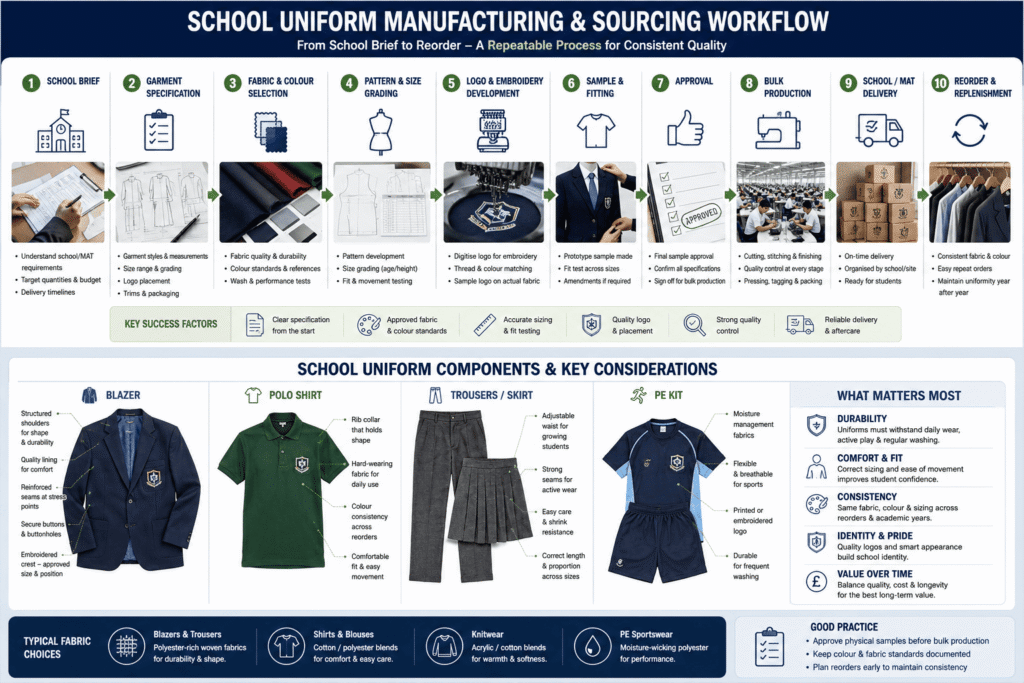
- 1.2. School Uniform Manufacturing Workflow
- 1.3. Interactive Garment Requirements
- 1.4. What Matters Most
- 1.5. School / MAT Procurement Checklist
- 1.6. Manufacturer Comparison Dashboard
- 1.7. Source & Accuracy Note
- 1.8. FAQs About School Uniform Manufacturers UK
- 1.8.1. How do I find a school uniform manufacturer in the UK?
- 1.8.2. Can school uniforms be manufactured with a custom logo?
- 1.8.3. What is the typical MOQ for bespoke school uniforms?
- 1.8.4. How long does bespoke school uniform production take?
- 1.8.5. How many sizes should a school uniform range include?
- 1.9. Build the Uniform Programme for the Next Order, Not Just the First
Post Summary
School uniform production requires consistent sizing across a broad age range
Fabric durability matters because garments face frequent wear and laundering
Blazers, shirts, knitwear and PE kits require different manufacturing methods
Embroidery should be approved on the actual garment before bulk production
Colour standards need documenting for future reorders
Multi-academy trusts benefit from consolidated specifications across schools
Smaller initial orders can reduce inventory risk when launching a new uniform range
Replenishment planning should begin before the first bulk order
Why Do Schools Use Specialist Uniform Manufacturers?
School uniforms are not ordinary children’s fashion.
The garments need to survive repeated washing, playground activity, classroom use, sports, travel and frequent wear across an academic year.
They also need to remain recognisable as part of one uniform programme.
That places unusual pressure on:
Fabric durability
Colour consistency
Seam strength
Sizing
Logo positioning
Trims
Reordering
Stock management
A school blazer ordered this year should not look noticeably different from the same blazer supplied next year.
The same applies to knitwear, polo shirts, skirts, trousers and PE clothing.
That repeatability is one reason school uniforms sit naturally within specialist garment manufacturing rather than standard seasonal clothing production.
What Should School Uniform Manufacturers Be Able to Produce?
A complete school uniform programme can include many garment categories.
Common products include:
Blazers
Jackets
Shirts
Blouses
Polo shirts
Jumpers
Cardigans
Sweatshirts
Trousers
Shorts
Skirts
Pinafores
Dresses
PE T-shirts
Sports shorts
Jogging bottoms
Tracksuits
Sports tops
Ties
Aprons
Coats
Staff clothing
Producing all of these consistently requires more than sewing capacity.
Each garment behaves differently during cutting, construction, finishing and wear.
Blazers and Jackets Need Structured Manufacturing
A school blazer is one of the more technically demanding garments in a uniform range.
It may include:
Structured shoulder construction
Lining
Lapels
Welt or patch pockets
Internal pockets
Buttons
Embroidered badge
Reinforced seams
Vent construction
The pattern needs enough room for movement while maintaining a formal silhouette.
Children also grow quickly.
An overly fitted blazer may look sharp during the first fitting but become impractical within months.
Our preference is to build enough functional ease into the pattern without making the garment look oversized.
Fabric Choice for School Blazers
Durability and appearance need balancing.
Polyester-rich woven fabrics are common because they can provide:
Dimensional stability
Colour retention
Abrasion resistance
Easier care
Wool-rich fabrics may create a more traditional appearance, but they can change cost and care requirements.
The specification should reflect how the school expects pupils and parents to maintain the garment.
Shirts, Blouses and Polo Shirts
These garments tend to be ordered in higher quantities than blazers.
They also receive frequent laundering.
That makes consistency important.
A manufacturer should control:
Collar shape
Button position
Sleeve length
Chest width
Garment length
Shrinkage
Fabric weight
Colour
Polo shirts may appear simpler than woven shirts, but collar quality can expose weak production quickly.
Poor rib collars can curl, lose shape or discolour differently from the main body fabric.
The collar and garment body therefore need to be specified as one product rather than sourced independently without testing.
Trousers, Skirts and Shorts
Lower-body school garments need enough durability for daily movement.
Important construction points can include:
Reinforced pocket openings
Secure waistbands
Strong crotch seams
Reliable zips
Adjustable waist systems
Consistent hem allowance
Adjustable waists are particularly useful across younger age groups.
They can extend the useful fitting range without changing the external appearance of the garment.
Skirts also require attention to pleat construction.
A pleated skirt may look correct after pressing but behave differently after repeated laundering if fabric and construction are poorly matched.
PE Kits Require a Different Approach
PE garments should not simply be treated as school uniform in sportswear fabric.
Movement changes the specification.
A PE kit may include:
Performance T-shirts
Shorts
Tracksuits
Leggings
Rugby shirts
Training tops
Sports socks
Hoodies
Fabric needs to suit physical activity.
Moisture management, stretch, weight and recovery can become more important than the characteristics used for classroom clothing.
The range may also require larger printed branding than formal uniform pieces.
A school blazer and PE top might carry the same crest, but the best decoration method may be different.
What School Uniform Standards Should Buyers Check?
There is no single standard covering every school uniform garment.
Requirements depend on garment type, material, trims, age group and intended use.
Buyers should establish whether any relevant product-safety or flammability requirements apply to the garments in their programme.
Children’s products require particular care around components and construction.
A supplier should be able to identify materials, trims and manufacturing details accurately.
Avoid vague claims such as “fully compliant” unless the manufacturer can explain exactly what the product has been tested or assessed against.
For school procurement teams, written specifications are far more useful than broad assurances.
Build a School Uniform Specification Before Requesting Quotes
One of the easiest ways to receive inconsistent quotes is to give manufacturers inconsistent information.
A useful uniform specification should define:
| Requirement | Example detail | Why it matters |
|---|---|---|
| Garment | Navy school blazer | Defines construction |
| Fabric | Polyester-rich woven | Controls performance |
| Colour | Approved navy reference | Helps future matching |
| Sizes | Age and chest range | Determines grading |
| Logo | Embroidered school crest | Controls decoration |
| Position | Left chest | Keeps branding consistent |
| Quantity | Units per size | Determines production planning |
| Packaging | Individual polybag or bulk | Changes finishing requirements |
The more specific the enquiry, the more meaningful the quotation becomes.
Two factories may quote different prices because they have interpreted an incomplete brief differently.
That is not a true price comparison.
School Logo Embroidery Needs Physical Approval
Embroidery is widely used on:
Blazers
Polo shirts
Jumpers
Cardigans
Sweatshirts
Sports tops
Jackets
It works well because school crests are usually compact and need to remain recognisable over repeated use.
The embroidery file still needs preparing specifically for stitching.
Very fine text, tiny shield details and thin lines may need adjustment.
Why Digital Approval Is Not Enough
A logo can look perfect on screen but poorly stitched.
Potential problems include:
Small text closing up
Colours appearing different in thread
Excessive stitch density
Fabric puckering
Poor placement
Distortion around pockets
A physical sample reveals these issues.
Silk Routes Manufacturing Team: Approve the school crest on the actual uniform fabric. Embroidery behaves differently on a blazer, polo shirt and knitted jumper.
Schools developing a new programme can use our clothing manufacturing services for product development, sampling and production.
Colour Consistency Is Critical for School Uniform Reorders
A school may use the same uniform design for many years.
That makes colour management different from seasonal fashion production.
Consider a navy blazer.
If one production batch appears deep navy and the next appears noticeably brighter, pupils wearing garments from different years will not look uniform.
Colour references should therefore be recorded during development.
Useful controls can include:
Approved fabric swatch
Supplier reference
Dye-lot approval
Pantone reference where applicable
Trim colour reference
Thread colour code
Physical references are particularly useful because screen colours vary between devices.
How Should School Uniform Sizing Work?
School uniforms need to cover considerable variation in height and body shape.
Age labels alone are not enough for manufacturing.
A specification should include actual garment measurements.
For example:
Chest
Waist
Hip
Shoulder
Sleeve length
Garment length
Inside leg
Rise
Hem width
The manufacturer then grades between sizes.
Do Not Assume Children Grow Uniformly
Two pupils of the same age can require very different garment dimensions.
That makes broader size availability useful.
Some ranges may benefit from:
Regular fit
Short fit
Long fit
Different waist options
Not every school needs all of these.
Adding too many variants without sufficient demand can create unnecessary inventory.
School Uniform Manufacturing for Multi-Academy Trusts
Multi-academy trusts create a different sourcing challenge.
A MAT may be responsible for several schools, each with its own:
Crest
Colours
Uniform policy
Size demand
PE kit
Replenishment needs
Central procurement can create efficiencies, but only when the specification is organised.
One useful approach is to standardise the garment base while allowing controlled branding variation.
For example, several schools might use the same:
Blazer construction
Trouser block
Polo fabric
PE T-shirt pattern
while changing crest and colour details.
That reduces unnecessary product fragmentation.
It can also make stock planning easier.
MOQ for Custom School Uniforms
MOQ means minimum order quantity.
The practical MOQ depends on:
Garment type
Fabric availability
Custom colour
Number of sizes
Embroidery
Trim requirements
Packaging
Production method
A simple polo shirt in a stock colour can usually be produced more flexibly than a fully bespoke blazer using custom fabric and buttons.
The problem is often not the total quantity.
It is how that quantity is divided.
Suppose a school orders 300 garments across:
10 sizes
3 colours
2 styles
That creates 60 possible combinations.
Many combinations may contain only a handful of garments.
Reducing unnecessary variation can make smaller programmes much easier to manufacture.
How Long Does School Uniform Manufacturing Take?
Lead time depends on whether the product already exists.
A repeat production order is usually simpler because:
Pattern approved
Fabric approved
Logo digitised
Sizing confirmed
Trims recorded
A new programme requires development first.
The process may include:
Specification
Fabric sourcing
Pattern development
Prototype
Fitting
Logo sample
Revised sample
Size set
Approval
Bulk production
Allow development time before the school needs stock.
Starting a completely new uniform programme shortly before the academic year creates avoidable pressure.
Plan Around the Academic Calendar
School uniform demand is highly seasonal.
The largest purchasing period often occurs before the start of the school year.
Production planning should therefore work backwards from the required delivery date.
A useful programme separates:
Development period
from
Bulk production period
from
Distribution period
Trying to complete all three at the same time increases the chance of mistakes.
The manufacturer also needs to know whether stock will be delivered:
Directly to the school
To a uniform retailer
To a fulfilment warehouse
To multiple academy locations
Packaging requirements may change accordingly.
UK vs Overseas School Uniform Manufacturing
Both sourcing models can work.
UK manufacturing can be attractive when buyers value:
Easier sampling
Faster communication
Lower logistics complexity
Smaller production runs
Quicker replenishment
Closer development control
Overseas production can become economical at higher volumes.
However, the unit price is only one part of the sourcing decision.
Buyers should also consider:
Freight
Import costs
Production lead time
Inventory commitment
Quality control
Reorder speed
A school uniform programme that frequently needs small top-up orders may value replenishment flexibility more than the lowest initial unit price.
The wider Specialist Clothing Manufacturers UK guide explains why specialist products often need a different sourcing model from general clothing.
Common Mistakes When Sourcing School Uniforms
1. Choosing the Cheapest Fabric
A lower fabric price can increase replacement frequency.
Fix: assess durability, wash behaviour and colour stability alongside cost.
2. Approving the Logo Only on Screen
Digital artwork cannot show thread behaviour.
Fix: approve one physical embroidery sample on the intended garment fabric.
3. Creating Too Many Product Variants
Every additional colour, fit and style increases production complexity.
Fix: standardise the core range and add variations only where demand supports them.
4. Failing to Plan Reorders
A successful first delivery does not guarantee future consistency.
Fix: document patterns, fabrics, colours, trims and embroidery files.
5. Ordering Too Close to the New School Year
Development problems become urgent because there is no time to correct them.
Fix: work backwards from the required delivery date and allow a separate sampling stage.
6. Treating Every School in a MAT as a Separate Product Programme
This can duplicate patterns and fabrics unnecessarily.
Fix: identify which garments can use common base specifications before customising branding.
How to Brief a School Uniform Manufacturer
The first enquiry should give the factory enough information to estimate the project accurately.
Include:
School or trust name
Garments required
Reference images
Existing samples if available
Fabric requirements
Colours
Size range
Quantity per garment
Quantity per size
Logo artwork
Decoration method
Packaging
Required delivery date
Reorder expectations
If an existing uniform is being replaced, sending the current garment can be useful.
The manufacturer can assess fit, construction and material before recommending changes.
Should Schools Buy Finished Stock or Manufacture Bespoke Uniforms?
Finished stock works well when the school can use standard garments with limited branding.
Bespoke manufacturing makes more sense when the programme requires:
Unique colours
Custom fabric
Specific fit
Special trims
Distinctive styling
Custom sportswear
Consistent multi-school specifications
Neither approach is automatically better.
The decision depends on quantity, budget and how distinctive the uniform needs to be.
A hybrid programme can also work.
A school might manufacture the blazer and PE kit specifically while sourcing standard shirts and trousers.
How Can School Uniform Programmes Reduce Waste?
Over-ordering creates more waste than many buyers expect.
The risk increases when a new programme launches without historical size data.
One practical approach is to keep the first order controlled and use actual demand to plan later production.
Durability matters too.
A stronger garment that stays presentable for longer can reduce replacement demand.
Design choices also affect reuse.
Removing unnecessary year-specific decoration, for example, can make garments easier to pass between pupils.
School Uniform Manufacturers UK: Sourcing Guide
An interactive sourcing dashboard for schools, multi-academy trusts and uniform buyers — focused on specification, fit, branding, production control and repeat orders.
Fast Sourcing Snapshot
These figures are structural counts taken directly from this sourcing framework, not market estimates.
School Uniform Manufacturing Workflow
A repeatable process matters because school uniform programmes are usually multi-size, multi-garment and reorder-driven.
School Brief
Quantities, budget, delivery date, school/MAT requirements.
Specification
Garment styles, measurements, trims, packaging and branding.
Fabric & Colour
Performance, durability, approved colour references and wash behaviour.
Pattern & Grading
Base pattern plus a controlled size range for growing pupils.
Logo Development
Embroidery file, thread colours, position and garment-specific test.
Sample & Fitting
Physical prototype, fit test and movement check.
Approval
Final specification, colour, logo and construction sign-off.
Bulk Production
Cutting, sewing, branding, finishing, inspection and packing.
School / MAT Delivery
Single-site, multi-site or retail/fulfilment distribution.
Reorder
Repeat against approved fabrics, patterns, colours and logo files.
Interactive Garment Requirements
Construction
Structured shoulder, stable lapels, secure pockets, lining and reinforced stress points.
Branding
Embroidered crest normally suits the left chest; approve it on the real blazer fabric.
Reorder Risk
Navy shade, buttons, lining and embroidery thread should be documented for future matching.
Construction
Collar quality, placket shape, shrinkage and garment length need consistency across sizes.
Branding
Small chest embroidery works well when stitch density suits the knit fabric.
Reorder Risk
Body fabric and rib collar must remain visually consistent across production batches.
Construction
Strong crotch and pocket seams, adjustable waist systems and controlled pleat construction.
Fit
Age labels alone are not enough; use a documented garment measurement chart.
Reorder Risk
Fabric shade, waistband components and fit block should remain fixed once approved.
Performance
Movement, breathability, stretch, recovery and wash performance matter more than formal structure.
Branding
Printing may suit larger graphics, while embroidery suits compact crests on stable areas.
Reorder Risk
Performance fabric, panel colours and print/embroidery specifications need stable references.
What Matters Most
This chart is a sourcing-priority visual, not a market statistic. It shows the five control areas emphasised in the guide.
School / MAT Procurement Checklist
Use the same reference when requesting quotations from different manufacturers.
Do not rely only on screen colours for long-term uniform matching.
Control chest, waist, length, sleeve and other key garment dimensions.
Check thread colour, stitch density, scale and garment position.
Keep patterns, trims, fabric references, logo files and approved samples.
Separate development, production and distribution windows.
Manufacturer Comparison Dashboard
| Factor | Strong Supplier Evidence | Warning Sign |
|---|---|---|
| Specification control | Written measurements, fabrics, trims and branding references | Vague “same as sample” instructions only |
| Sampling | Physical prototype and revision process | Bulk order requested before fit/branding approval |
| Colour consistency | Approved swatch/reference retained for reorder | Approximate colour matching by description |
| Embroidery | Digitised file + physical sew-out/sample | Logo approved only on screen |
| Size grading | Documented measurements across the size range | Age label treated as the full sizing specification |
| Replenishment | Reorder process based on retained specifications | Every repeat order treated as a fresh development job |
Source & Accuracy Note
FAQs About School Uniform Manufacturers UK
How do I find a school uniform manufacturer in the UK?
Start with manufacturers that already understand uniforms or other specialist clothing categories. Give each factory the same specification so quotations can be compared properly.
Can school uniforms be manufactured with a custom logo?
Yes. School crests can be embroidered or printed depending on the garment, and at least 1 physical branded sample should be approved before bulk production.
What is the typical MOQ for bespoke school uniforms?
MOQ varies by garment and fabric. A relatively simple programme may begin around 100–300 pieces, while custom fabrics or numerous size and colour combinations can require more.
How long does bespoke school uniform production take?
Once samples and materials are approved, a straightforward order may require around 4–8 weeks of production time. New development should be started earlier because pattern, sample and approval stages come first.
How many sizes should a school uniform range include?
There is no fixed number. A school should build its range from actual pupil measurements and demand, but every approved style should have 1 documented size chart controlling future production.
Build the Uniform Programme for the Next Order, Not Just the First
School uniform sourcing succeeds when the second order looks and fits like the first.
Patterns, fabric references, logo files, approved colours, measurement charts and trim specifications should stay controlled throughout the programme.
That gives schools and uniform suppliers a reliable basis for replenishment instead of recreating products each year.
Silk Routes works with specialist garments where product consistency and repeat production are central to the brief. Our Specialist Clothing Manufacturers UK: The Complete Product Guide covers the wider range of specialist products and sourcing considerations.
You can also learn more about our manufacturing background through About Silk Routes.