
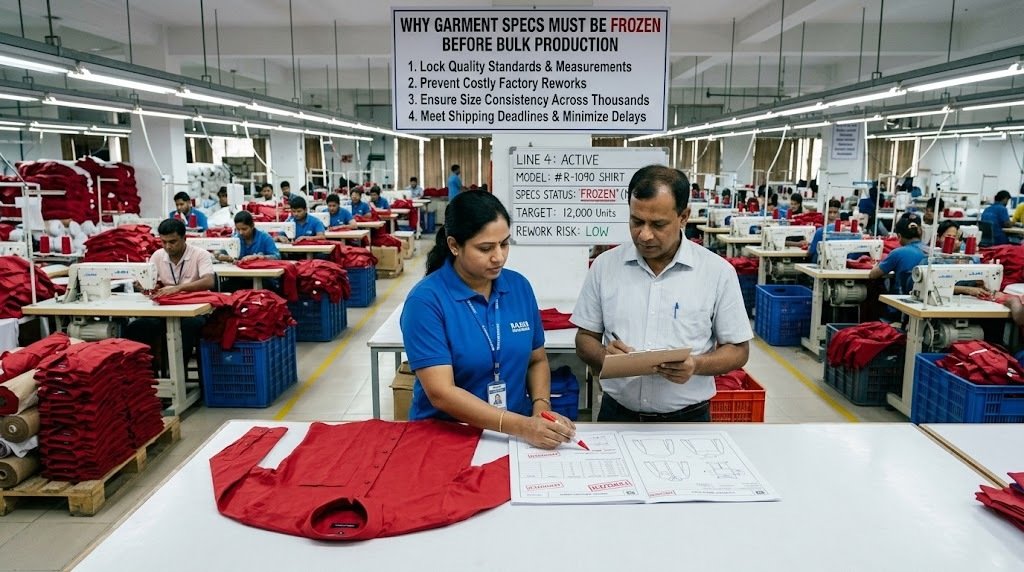
The period between sample approval and bulk cutting is one of the most dangerous windows in garment production. It is also the most misunderstood. Many fashion founders believe that once a sample looks right, the hard work is done. In reality, the sample is only a proof of concept. The specifications that produced it — fabric reference, measurement points, construction methods, trim sources — must be locked into a definitive, documented standard before bulk production begins. Without that freeze, what leaves the factory may bear only a passing resemblance to what you approved.
Freezing garment specifications before bulk production means that every material, measurement, construction detail, and trim is documented and agreed between brand and factory as the fixed production standard. No further changes are permitted without a formal revision process, additional sampling, and additional cost. This article explains why this freeze is non-negotiable, what happens when it is skipped, and how to protect your brand through a rigorous specification-lock process.
What Freezing Specifications Actually Means
A frozen specification is not a strong suggestion. It is a binding reference standard. The tech pack, the Bill of Materials (BOM), the measurement chart, and the sealed pre-production sample collectively form the contractual baseline for production. Any deviation — a different zip, a changed pocket placement, a fabric substitution — is a departure from that baseline.
Factories interpret incomplete or ambiguous specifications to their own advantage. This is not bad faith; it is operational necessity. A factory cannot pause production to seek clarification on every detail. When a specification is ambiguous, the factory makes an assumption, cuts fabric, and moves forward. The resulting garment may be structurally sound but may not match your design intent.
The freeze means that every decision has been made before fabric is cut. Fabric source, colour reference, yarn count, stitch type, seam allowance, label placement, packaging specification — all are confirmed and documented. The pre-production sample (PP sample) is produced from these frozen specifications and becomes the physical reference standard. Both brand and factory retain a sealed copy.
Why Changes After Freeze Are Costly
Every change after freeze resets the clock. A fabric change requires new sourcing — seven to twenty-one days. A pocket-style change requires new pattern pieces, recutting, and resetting machine folders — three to five days. A measurement change requires regrading all sizes and recutting — two to four days.
These numbers are not theoretical. They are the documented reality of how garment factories operate. Each change, however minor it seems in an email, has a physical impact on the factory floor. The cost is not just time — fabric is wasted, machine time is lost, and skilled labour is diverted from planned work.
McKinsey’s State of Fashion analysis identifies launch timeline failures — brands that compress manufacturing timelines by skipping sampling rounds or starting production before PP sample approval — as the most common operational error among first-year clothing startups. The timeline compression creates risk, not speed.
The lead-time trap is particularly insidious. Many brands accept a factory’s quoted lead time without confirming when the clock starts. If approvals slip by seven to ten days but the delivery date stays the same, the factory silently absorbs the risk — and the brand receives either a rushed product or a late delivery. A realistic minimum for a UK private-label launch — from legal setup through to first delivery — is twenty to twenty-six weeks. Manufacturing alone accounts for eight to twelve weeks of sampling and four to six weeks of production for most bespoke garments.
The Sealed Pre-Production Sample: Your Legal Protection
The sealed pre-production sample is the most important quality-control document in garment production — and the most commonly skipped item on clothing brand launch checklists. A production run without a sealed PP sample has no objective quality reference standard. If finished goods deviate from what you expected, you have no contractual basis to reject them or require remediation.
The PP sample is produced from the frozen specifications using the same materials, machinery, and methods that will be used for bulk production. It is not a prototype. It is not a fit sample. It is the definitive physical standard against which every bulk garment is measured.
Before releasing for bulk production, conduct a final systematic review:
- Check every measurement against the tech pack.
- Verify every trim against the BOM.
- Confirm every label placement and content.
- Wash the sample three times — check shrinkage, colour fading, and seam integrity.
- Wear the sample. Sit in it. Walk in it. Put items in the pockets. Experience it as your customer will.
Document any final adjustments. These should be adjustments of millimetres, not redesigns. Sign the pre-production sample approval form. This sample and this document become the sealed reference standard for bulk production.
What Must Be Frozen: The Complete Specification List
A frozen specification covers every aspect of the garment. The tech pack is the central document. It typically includes:
Technical sketch (flat lay) : Front, back, and side views showing construction details — neckline shape, sleeve construction, pocket details, hem and cuff finishes. A flat lay is more useful than a fashion illustration, which distorts proportions.
Yarn or fabric specification : Fibre content with percentages, weight (GSM), weave or construction, colour reference (Pantone or physical standard), and any certification requirements (OEKO-TEX, GOTS, GRS).
Gauge (for knitwear) : Machine gauge — needles per inch — determines knit density and is closely linked to yarn count.
Measurement chart : Graded measurements across the size range, with points of measure clearly illustrated. For knitwear, measure chest width (half), body length, sleeve length, sleeve width, cuff width, shoulder width, and neck opening. Knitwear has different measurement conventions to woven garments.
Construction notes : Seam types, stitch density, bartacks, reinforcements, finishing methods.
Trims and components : Zip type and supplier, button references, label specifications, thread colour and type, drawcords, eyelets.
Artwork and decoration : Vector artwork, colour separations, placement dimensions, screen or digitising version, curing or application settings.
Colour and wash standards : Physical shade bands for wash processes that naturally vary, including acceptable light and dark boundaries. Colour names do not control material — a matte black eyelet can become glossy while still being called the same shade.
Packaging and labelling : Folding format, polybag size, retail swing tag requirements, care label content compliant with UK regulations.

UK-Specific Compliance Requirements
UK brands must consider regulatory requirements that affect specification freeze. The tech pack should specify:
Care labelling : UK retail requires care labels to carry ISO 3758 symbols, fibre content with percentages, and country of origin.
UK REACH compliance : If your buyer requires UK REACH documentation for restricted substances, state this in the tech pack before sampling begins.
Size grading : UK sizing differs from EU and US grading. State your target UK size range and corresponding measurements. If starting fresh, grade from a UK base size (typically UK 12).
For authoritative guidance on product compliance and labelling requirements, consult the UK Government’s product safety and labelling guidance.
The Factory’s Perspective: Why Freeze Protects Both Sides
Factories respect buyers who communicate clearly. A frozen specification allows the factory to plan production without the risk of disruption. It forces the brand to finalise decisions. It allows the factory to order materials, program machines, and allocate capacity with confidence.
Smart factories protect themselves by locking the real “start date.” Production only starts when five elements are frozen: fabric quality, colour standards, fit approval, trim approvals, and final artwork. This approach does not make factories inflexible — it makes them predictable and reliable. A factory that accepts changes without challenge is likely absorbing risk that will surface later as quality problems or delivery failures.
For guidance on launch planning and avoiding the most common operational mistakes, the Silk Routes checklist provides a structured approach to protecting your launch timeline and quality standards.
Sometimes a change is genuinely unavoidable — a fabric becomes unavailable, a trim supplier discontinues a component, or a regulatory requirement changes. These situations require a controlled development process, not an informal substitution.
If substitution is necessary, treat it as a controlled development change. Test and sew the candidate before bulk booking rather than declaring equivalence from a hanger swatch. Compare the candidate side by side with the retained bulk standard and measurement record. Review flat, on body, and after the supported care process. Check hand, weight, silhouette, measurements, shade, surface, decoration, seam appearance, trim function, and odour.
Classify every difference before approval:
- No change : Same controlled input and current evidence.
- Administrative : Corrected naming or document format without product effect.
- Equivalent candidate : Alternative requiring verification.
- Design change : Intentional change to fit, appearance, material, or feature.
- Process change : Factory, machine, wash, decoration, or sequence differs.
- Compliance change : Label, test, or market requirement changes.
A purchasing deadline does not turn a material substitution into “no change.”
Summary: The Freeze Protects Your Brand
Freezing garment specifications before bulk production is not a restriction on creativity. It is a decision to commit. The creativity happens before the freeze. The execution happens after. Separating these two phases is the mark of a professional brand.
The structured approach transforms the factory relationship from an adversarial guessing game into a collaborative execution partnership. The factory receives clear, actionable instructions. The brand receives a product that matches the approved sample. The sampling process is faster, the production is more predictable, and the quality is consistent.
Without a freeze, you are gambling with your brand’s reputation, your launch timeline, and your budget. With one, you have a clear, enforceable production standard and a contractual basis to ensure that what you approved is what you receive.
Frequently Asked Questions
Why can’t I make small changes during bulk production?
Because every change, however small it seems, has a physical impact on the factory floor. A two-day decision to change a detail adds two weeks to the timeline. The factory must re-source materials, re-program machines, re-cut fabric, and potentially re-grade patterns. By the time the change is implemented, the original timeline is already broken.
What is the difference between a fit sample and a pre-production sample?
A fit sample confirms shape and construction but may use substitute materials. A pre-production sample is produced from frozen specifications using the same materials, machinery, and methods that will be used for bulk production. It is the definitive physical reference standard for quality control.
How do I ensure the factory follows my frozen specifications?
Retain a sealed PP sample at your design studio, with a matching sealed sample held at the factory. These physical benchmarks are the basis for quality control audits. If finished goods deviate from the sealed sample, you have a contractual basis to reject them or require remediation.
What are the most commonly skipped items on a clothing brand launch checklist?
The sealed pre-production sample is the most consequential skip. It is also commonly skipped because brands underestimate its importance or are pressured to move quickly. A production run without a sealed PP sample has no objective quality reference standard.
Authorise bulk only after the people responsible for fit, colour accuracy, graphics, labels, and packaging have approved the agreed production standard. Ask the supplier what documentation or sample sign-off it requires before cutting.
Sources
- ACU Pre-Production Sample Approval Process. Military Uniform Factory. Published 16 June 2026. — Pre-production sample approval requirements and procurement decisions.
- How to Write a Knitwear Tech Pack for UK Brands. Kiwi Giyim. Published 9 November 2025. — Complete knitwear tech pack requirements and UK-specific elements.
- How to Communicate Your Custom Shorts Design to a Factory Efficiently. Shanghai Garment. — Design freeze principles and cost of mid-sampling changes.
- Clothing Brand Launch Checklist FreeDownloadUK2026FreeDownloadUK2026. Silk Routes. Published 26 May 2026. — Launch timeline failures and sealed pre-production sample requirements.
- Garment Dye Clothing Manufacturers for Streetwear Brands: Plan the Sample-to-Bulk Timeline. Tuozhen. Published 12 August 2026. — Sample-to-bulk timeline sequencing and approval calendar.
- The Complete Guide to Developing a Fashion Product (UK, 2026). Bhavna Rishi London. Published 4 February 2025. — Tech pack definition, costs, and UK regulatory context.
- Streetwear Reorder Spec Lock: Prevent Fabric, Fit and Colour Drift. Tuozhen. Published 9 August 2026. — Specification lock process, change classification, and compliance requirements.
- 45-Day Lead Time Trap: Smart Factories Escape with Strategic Planning. LinkedIn / Nadeem Qaiser. Published 14 January 2026. — Lead time traps and the importance of freezing approvals before production starts.
- Pre-Order Checklist Clothing. New Asia Garment. Published 9 August 2026. — Tech pack freeze and pre-production sample sign-off requirements