Trading Standards authorities issued enforcement notices to over 1,200 UK clothing businesses in 2022 for textile labelling non-compliance — the majority involving care label errors on garments already in circulation, according to UKFT compliance reporting on UK textile regulation enforcement.
A garment that reaches a customer without a compliant care label is not a minor administrative oversight. It is a breach of the Textile Products (Labelling and Fibre Composition) Regulations 2012, a potential Trading Standards enforcement action, and — if the garment causes harm due to incorrect care — a product liability exposure that your insurance may not cover.
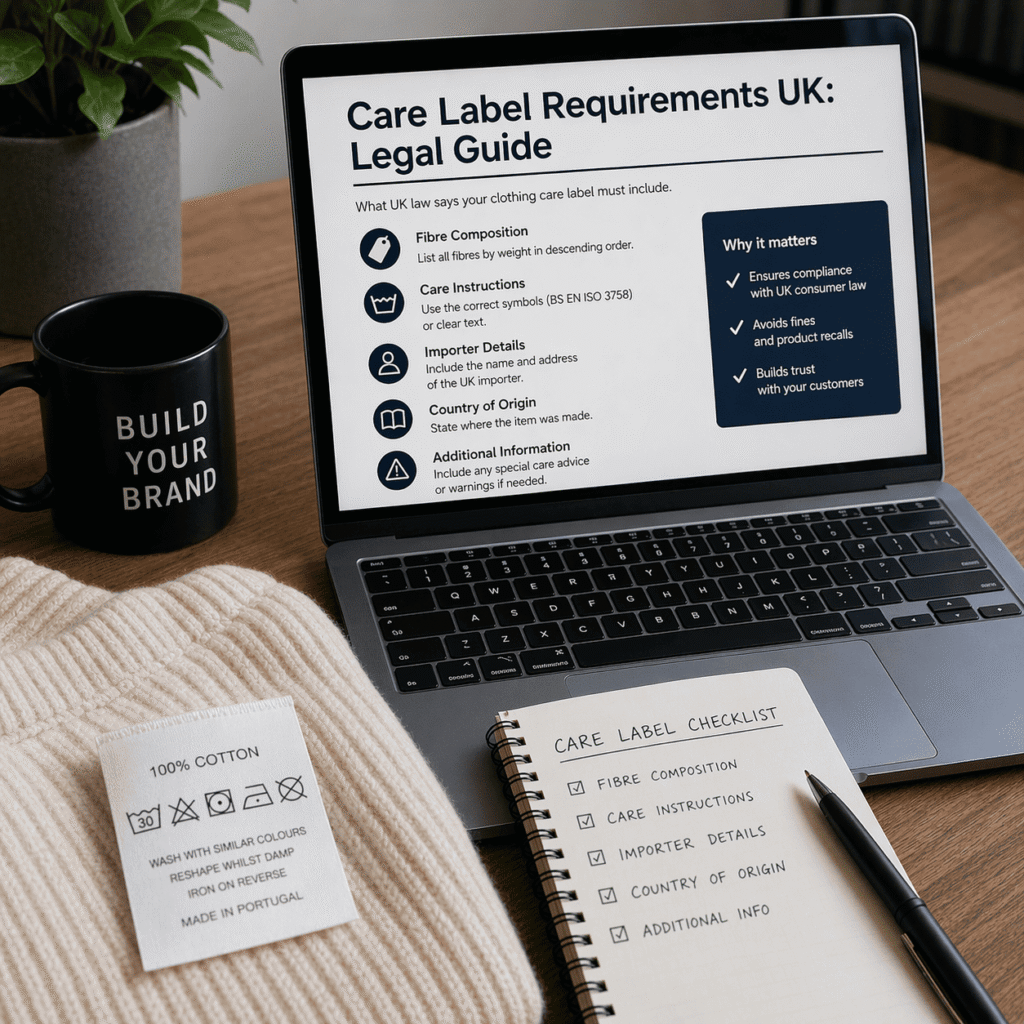
Care label compliance is not complicated. It requires knowing four things: what must appear on the label, what format it must take, what symbols are approved, and what happens if you get it wrong.
Summary
- UK care labels must include fibre content and percentage by weight, country of manufacture, brand identification, and care instructions — each governed by specific regulations
- The Textile Products (Labelling and Fibre Composition) Regulations 2012 is the primary legislation — it survived Brexit and continues to apply in full to all garments sold in the UK
- Care instruction symbols must follow the ISO 3758 standard — commonly known as GINETEX symbols — and must be accurate to the actual garment’s care requirements
- Labels must be in English for UK sales, permanently attached, legible, and accessible to the consumer
- Responsibility for compliant labelling sits with the brand — not the manufacturer — and applies from the first unit sold, not from a revenue threshold
Contents
- 1. The Legal Framework: Three Regulations, One Label
- 2. What Must Appear on Every UK Garment Label
- 3. Label Format Requirements
- 4. Children’s Clothing: Additional Requirements
- 5. Who Is Responsible for Label Compliance
- 6. Enforcement: What Actually Happens
- 7. Producing a Compliant Label: The Practical Process
- 8. Common Care Label Mistakes UK Clothing Brands Make
- 9. FAQ
- 9.1. Are care symbols legally required or just recommended?
- 9.2. Does a garment need a separate care label and a separate composition label?
- 9.3. What happens if a customer damages a garment following the care instructions?
- 9.4. Do I need to provide care instructions in languages other than English for UK sales?
- 9.5. Can I use a QR code instead of printed care instructions?
- 10. Label Compliance Is a Pre-Production Decision
- 11. Citations and Sources
The Legal Framework: Three Regulations, One Label
UK care label requirements draw from three overlapping regulatory sources. Understanding each prevents the most common compliance gaps.
Regulation 1 — Textile Products (Labelling and Fibre Composition) Regulations 2012
The primary UK textile labelling regulation. It mandates:
- Fibre content — type and percentage by weight of all constituent fibres
- Labelling language — English for UK sales
- Label permanence and legibility
- Specific provisions for multi-component garments, decorative elements, and mixed fibre compositions
This regulation is enforced by Trading Standards authorities in England, Scotland, Wales, and Northern Ireland. It applies to all textile products sold to UK consumers, including garments manufactured overseas and imported for UK sale.
Regulation 2 — General Product Safety Regulations 2005
The overarching product safety framework. It requires that all consumer products sold in the UK are safe — and that care instructions are sufficient to enable the consumer to use the product safely. A garment with incorrect care instructions that causes harm (colour bleed, shrinkage damage, fabric deterioration) may breach this regulation in addition to the textile labelling regulation.
Regulation 3 — Consumer Rights Act 2015
Requires that products sold to consumers match their description and are fit for purpose. Care instructions form part of the product description — a garment labelled “machine washable” that shrinks significantly at the stated temperature has a Consumer Rights Act compliance issue in addition to a labelling issue.
UKFT compliance guidance provides detailed regulatory interpretation for UK clothing brands — covering how these three regulations interact and how compliance is assessed by Trading Standards inspectors.
What Must Appear on Every UK Garment Label
A compliant UK garment label has five mandatory elements. All five must be present. Absence of any one creates a compliance gap.
Mandatory Element 1 — Fibre Content
Every garment must carry the name and percentage by weight of every textile fibre in the product.
| Composition | Correct Label | Incorrect Label |
|---|---|---|
| Single fibre | “100% Cotton” or “Pure Cotton” | “Cotton” (no percentage) |
| Two fibres | “80% Cotton, 20% Polyester” | “Cotton/Polyester mix” |
| Three or more fibres (each ≥ 85%) | Each fibre name + percentage | Omitting minor fibres |
| Three or more fibres (minor fibre < 2%) | “Other fibres” for minor constituent | Listing percentages that do not total 100% |
Rules for fibre content labelling:
- Fibres must be listed in descending order of percentage by weight
- Percentages must total 100% — a label reading “70% Cotton, 25% Polyester” is non-compliant
- Only approved fibre names may be used — the approved list is in Annex I of the assimilated Regulation (EU) No 1007/2011
- Decorative fibres that constitute 7% or less of the garment weight are excluded from the fibre content declaration
- The word “pure” may only be used for a garment composed entirely of one fibre
Mandatory Element 2 — Care Instructions
Care instructions must be accurate to the actual garment’s care requirements. They must use the ISO 3758 GINETEX symbol system or, alternatively, written instructions — but symbols are the industry standard and universally expected.
The five GINETEX symbol categories:
| Symbol Category | Covers | Number of Variations |
|---|---|---|
| Washing tub | Machine wash, hand wash, do not wash | Multiple temperature and agitation options |
| Triangle | Bleaching — chlorine, non-chlorine, do not bleach | 3 variations |
| Iron | Ironing temperature — low, medium, high, do not iron | 5 variations |
| Circle | Dry cleaning — solvent type, do not dry clean | Multiple variations |
| Square with circle | Tumble drying — temperature, do not tumble dry | Multiple variations |
Care symbols must be accurate — not aspirational. Labelling a garment “machine wash 60°C” when the fabric construction requires hand wash at 30°C is not cautious over-labelling — it is incorrect labelling that may cause consumer harm and breach the General Product Safety Regulations.
Who determines the correct care symbols: the manufacturer, in consultation with the fabric supplier. Care requirements are determined by fabric composition, construction, dyes used, and any finishing treatments applied. The brand is responsible for ensuring the care instructions on the label match the actual care requirements of the manufactured garment.
“We confirm care requirements with the fabric supplier before the label spec is finalised. The symbols on the label must reflect what the fabric and construction actually require — not what would be convenient for the consumer or what looks clean on the label.” — Silk Routes Manufacturing Team
Mandatory Element 3 — Country of Manufacture
Every garment sold in the UK must carry the country of manufacture. This requirement applies regardless of where the brand is based.
- “Made in the UK” — for garments manufactured in the United Kingdom
- “Made in Portugal” or “Product of Portugal” — for garments manufactured in Portugal
- “Made in China” — for garments manufactured in China
- “Made in Bangladesh” — for garments manufactured in Bangladesh
What “country of manufacture” means: the country where the garment underwent its last substantial transformation — typically where the fabric was cut and sewn. A fabric sourced from Italy and manufactured in Portugal is labelled “Made in Portugal.”
Mandatory Element 4 — Brand Identification
The brand name, trademark, or business name must appear on the label. This is both a consumer information requirement and a product traceability mechanism — it identifies the responsible economic operator if Trading Standards takes enforcement action.
Mandatory Element 5 — Size (Recommended, Not Mandatory)
Sizing is not legally mandated under the Textile Products Regulations — but it is commercially expected and may be required by specific retail channels or wholesale buyers. BS EN 13402 is the voluntary UK sizing standard.
Label Format Requirements
The content of the label is only part of compliance. The format — how the label is produced and attached — is also regulated.
Language: all mandatory information must appear in English for UK sales. A garment that is also sold in EU markets may carry multilingual labels — but the English information must be present and equally prominent for UK sales.
Permanence: the label must be durably attached to the garment and remain legible throughout the normal useful life of the product. A label that fades, detaches, or becomes illegible during normal washing is non-compliant.
Legibility: the label must be easily readable — sufficient font size, adequate contrast between text and background, no obscuring of information by folding or stitching. There is no specified minimum font size in the regulation, but the standard applied by Trading Standards inspectors is whether the information is readily readable without magnification under normal lighting conditions.
Accessibility: the label must be accessible to the consumer. A label hidden inside a sealed lining or requiring disassembly of the garment to read is non-compliant.
Position: there is no prescribed position for the care label in the Textile Products Regulations — but industry standard is inside the garment at the neckline, side seam, or waistband. Buyers and retailers expect labels in these positions. A label attached to a hang tag rather than the garment itself may not satisfy the permanence requirement.
Children’s Clothing: Additional Requirements
Children’s clothing carries additional regulatory requirements beyond the standard textile labelling obligations. These are not optional additions — they are mandatory for any garment marketed for children under 14.
Cord and drawstring restrictions:
The Regulation (EU) No 1328/2012 on drawstrings and cords in children’s clothing applies in the UK as assimilated EU law. Key requirements:
- No cords or drawstrings in the hood and neck area of garments for children aged 7 and under
- Drawstrings at the waist of garments for children under 14 must not protrude more than 14cm when the garment is fully extended
- Functional drawstrings (at the waist) must not have free ends with toggles, knots, or decorative elements
Flammability: children’s nightwear must comply with specific flammability standards. Most children’s nightwear must either meet the low flammability standard or carry a label stating “KEEP AWAY FROM FIRE.”
Chemical restrictions: children’s garments must comply with UK REACH restrictions on hazardous substances — including azo dyes, formaldehyde, heavy metals, and phthalates. Compliance typically requires testing certificates from the fabric supplier or finished garment testing.
Age labelling: while not legally mandated, age/size labelling on children’s garments is commercially expected and required by most retail buyers.
UKFT compliance guidance on children’s clothing regulations covers the full technical requirements — including testing protocols and supplier documentation required to demonstrate compliance.
For a brand manufacturing children’s clothing, confirming regulatory compliance at the product specification stage — before sampling — is essential. Our guide to low MOQ and private label clothing manufacturers UK covers how to integrate compliance requirements into your tech pack and manufacturing brief.
Who Is Responsible for Label Compliance
The Textile Products Regulations 2012 places responsibility for compliant labelling on the “economic operator” — the entity that places the product on the UK market. In practice, this is the brand whose name appears on the label.
This has three specific implications for UK clothing startups:
The factory is not responsible. A manufacturer who produces garments to a brand’s specification is not the economic operator for UK retail purposes. If the label specification the brand provided is non-compliant, the brand bears the enforcement risk — not the factory.
Overseas manufacture does not transfer responsibility. A brand importing garments from an overseas factory is the UK economic operator. The Textile Products Regulations apply to the brand from the point the garment is offered for sale in the UK.
Responsibility begins with the first sale. There is no revenue threshold, no minimum batch size, and no grace period for new brands. Compliance is required from the first unit sold.
Practical implication: the label specification — including fibre content, care symbols, country of manufacture, and brand identification — must be confirmed with the manufacturer before sampling. A sample that reaches you with a non-compliant label has already generated the compliance exposure. The correction must happen before production — not after delivery.
Enforcement: What Actually Happens
Trading Standards authorities have the power to:
- Inspect garments at the point of sale or at brand premises
- Request production of labelling documentation and supplier test certificates
- Issue enforcement notices requiring correction of non-compliant labelling
- Seize non-compliant stock
- Prosecute for persistent or wilful non-compliance — carrying fines of up to the statutory maximum and, in serious cases, custodial sentences
In practice, Trading Standards enforcement for first-time labelling errors typically proceeds as follows:
- Inspection identifies non-compliant labelling
- Brand receives an improvement notice with a compliance deadline
- Brand corrects labelling on remaining stock and provides documentation confirming correction
- File closed without prosecution
Prosecution occurs where non-compliance is persistent, where there is evidence of deliberate mislabelling (false fibre content claims), or where a garment has caused consumer harm.
The practical risk for a startup brand is not prosecution — it is the cost of correcting non-compliant labelling on stock already produced. Applying corrective stickers to 200 garments, reprinting labels, or — in the worst case — writing off non-compliant stock entirely is the real commercial consequence of label errors.
Producing a Compliant Label: The Practical Process
Step 1 — Confirm fibre content with the fabric supplier
The fabric supplier’s technical data sheet is the authoritative source for fibre composition. Confirm the composition before the label is designed. Do not estimate or copy a similar fabric’s composition from a competitor’s label.
Step 2 — Determine care requirements with the manufacturer
The manufacturer, in consultation with the fabric supplier, determines the correct wash, bleach, iron, dry clean, and tumble dry symbols. These must reflect the actual garment requirements — not the most convenient instructions for the consumer.
Step 3 — Confirm country of manufacture
Confirm the country where cutting and sewing takes place. For multi-country production (fabric from one country, construction in another), the country of manufacture is where the last substantial transformation occurred — typically the country where the garment is sewn.
Step 4 — Design the label to GINETEX symbol specifications
GINETEX symbols must be reproduced accurately. Incorrectly drawn or modified symbols are non-compliant. Use the officially licensed GINETEX symbol set — available through GINETEX UK members, specialist label printers, or purchased directly from GINETEX.
Step 5 — Review against the Textile Products Regulations checklist
| Checklist Item | Compliant? |
|---|---|
| Fibre name(s) from approved list | ☐ |
| Percentages in descending order, total 100% | ☐ |
| Care symbols accurate to garment construction | ☐ |
| Country of manufacture stated | ☐ |
| Brand name or trademark present | ☐ |
| Label in English | ☐ |
| Label durably attached | ☐ |
| Label legible and accessible | ☐ |
| Children’s garment — cord/drawstring compliance confirmed | ☐ |
| Children’s garment — flammability requirement assessed | ☐ |
Step 6 — Submit label spec to manufacturer before sampling
The label specification must be part of the tech pack submitted to the manufacturer. The first sample must be produced with the label in place — so that label placement, legibility, and attachment can be assessed alongside the garment construction.
Our guide to low MOQ and private label clothing manufacturers UK covers how to integrate label specification into your tech pack and sampling process to ensure compliance is confirmed before production begins.
Common Care Label Mistakes UK Clothing Brands Make
1. Omitting country of manufacture The most common labelling gap on garments produced overseas. Brands assume the care content and fibre content are the only mandatory elements.
Fix: country of manufacture is mandatory on every garment. “Made in [country]” must appear on the label or the garment itself.
2. Incorrect fibre percentages that do not total 100% “60% Cotton, 35% Polyester” is non-compliant — the percentages total 95%, leaving 5% unexplained. Either a fibre is missing or the percentages are wrong.
Fix: confirm total fibre composition from the fabric supplier’s technical data sheet. Every percentage must be accounted for and the total must be exactly 100%.
3. Using care symbols that do not match the actual care requirements A founder who copies care symbols from a similar brand’s label — without confirming that the symbols match their specific fabric and construction — creates a compliance gap and a potential product liability exposure.
Fix: care symbols are determined by the fabric and construction, not by reference to another brand’s label. Confirm with your manufacturer and fabric supplier.
4. Attaching the label to the hang tag rather than the garment A hang tag label satisfies neither the permanence nor the accessibility requirements of the Textile Products Regulations. If the hang tag is removed, the consumer has no access to care information.
Fix: the care and composition label must be permanently attached to the garment. A hang tag can carry additional brand information — it cannot substitute for the woven or printed garment label.
5. Not updating labels when fabric composition changes A brand that changes fabric supplier or fabric specification between production runs without updating the label is selling a garment with inaccurate fibre content information — a Trading Standards offence regardless of intent.
Fix: any change to fabric composition requires a label update. The label specification is reviewed and reconfirmed at every production run, not assumed to carry forward unchanged.
FAQ
Are care symbols legally required or just recommended?
Care symbols are not explicitly mandated by the Textile Products Regulations 2012 — the regulation requires care instructions but does not specify that they must be in symbol form. However, GINETEX care symbols are the universally accepted industry standard, expected by consumers and retail buyers alike. Written care instructions are technically compliant but commercially unusual and less clear to consumers.
Does a garment need a separate care label and a separate composition label?
No — all mandatory information can appear on a single label. Most garments carry one label (or two — a neckline label with brand/size and a side seam label with composition/care) rather than separate labels for each element. All mandatory information must be present across the label set as a whole.
What happens if a customer damages a garment following the care instructions?
If a customer follows the care instructions on the label and the garment is damaged — for example, a “machine wash 40°C” garment that shrinks significantly at that temperature — the customer has a Consumer Rights Act 2015 claim for goods not fit for purpose, and potentially a claim under the General Product Safety Regulations. The brand is liable. This is why care symbol accuracy is both a compliance requirement and a commercial imperative.
Do I need to provide care instructions in languages other than English for UK sales?
No — English is the required language for UK sales. Garments sold simultaneously in EU markets may require additional languages under EU member state requirements, but UK sales require English only.
Can I use a QR code instead of printed care instructions?
No. A QR code linking to online care instructions does not satisfy the requirement for permanently attached, legible care information. The care instructions must be physically present on the garment or its label — not accessible only through a digital intermediary that requires a working internet connection and a smartphone to access.
Label Compliance Is a Pre-Production Decision
The most expensive care label mistake is the one discovered after 200 units have been produced and delivered. Correcting non-compliant labelling on finished stock — stickering, relabelling, or in the worst case writing off stock — costs significantly more than confirming the label specification correctly before sampling begins.
Label compliance is a pre-production decision. The label specification goes into the tech pack. The first sample is produced with the label in place. The label is checked against the regulatory checklist before production is approved. By the time the production run is complete, compliance is already confirmed.
That sequence — compliance confirmed in the tech pack, not corrected after delivery — is how professional brands operate regardless of size or stage. It is also how a first production run avoids the Trading Standards exposure that catches startup brands who treat labelling as an afterthought.
For the full picture on how to integrate label specification into your tech pack, sampling process, and manufacturer brief, our guide to UK clothing manufacturers for low MOQ and private label production covers every stage of the process from brief to delivery.
Ready to confirm your label specification before your first production run? Find out how Silk Routes supports brands on compliance and product specification.
Citations and Sources
[1]. UK Government — Textile Products (Labelling and Fibre Composition) Regulations 2012. https://www.legislation.gov.uk/uksi/2012/1102/contents
[2]. UK Government — General Product Safety Regulations 2005. https://www.legislation.gov.uk/uksi/2005/1803/contents
[3]. UK Government — Consumer Rights Act 2015. https://www.legislation.gov.uk/ukpga/2015/15/contents
[4]. UKFT — Compliance and Regulatory Guidance. https://ukft.org/compliance/
[5]. GINETEX — International Association for Textile Care Labelling. https://www.ginetex.net/
[6]. UK Government — Assimilated Regulation (EU) No 1007/2011 on Textile Fibre Names. https://www.legislation.gov.uk/eur/2011/1007/contents
[7]. UK Government — Drawstrings in Children’s Clothing (Assimilated Regulation). https://www.legislation.gov.uk/eur/2012/1328/contents