
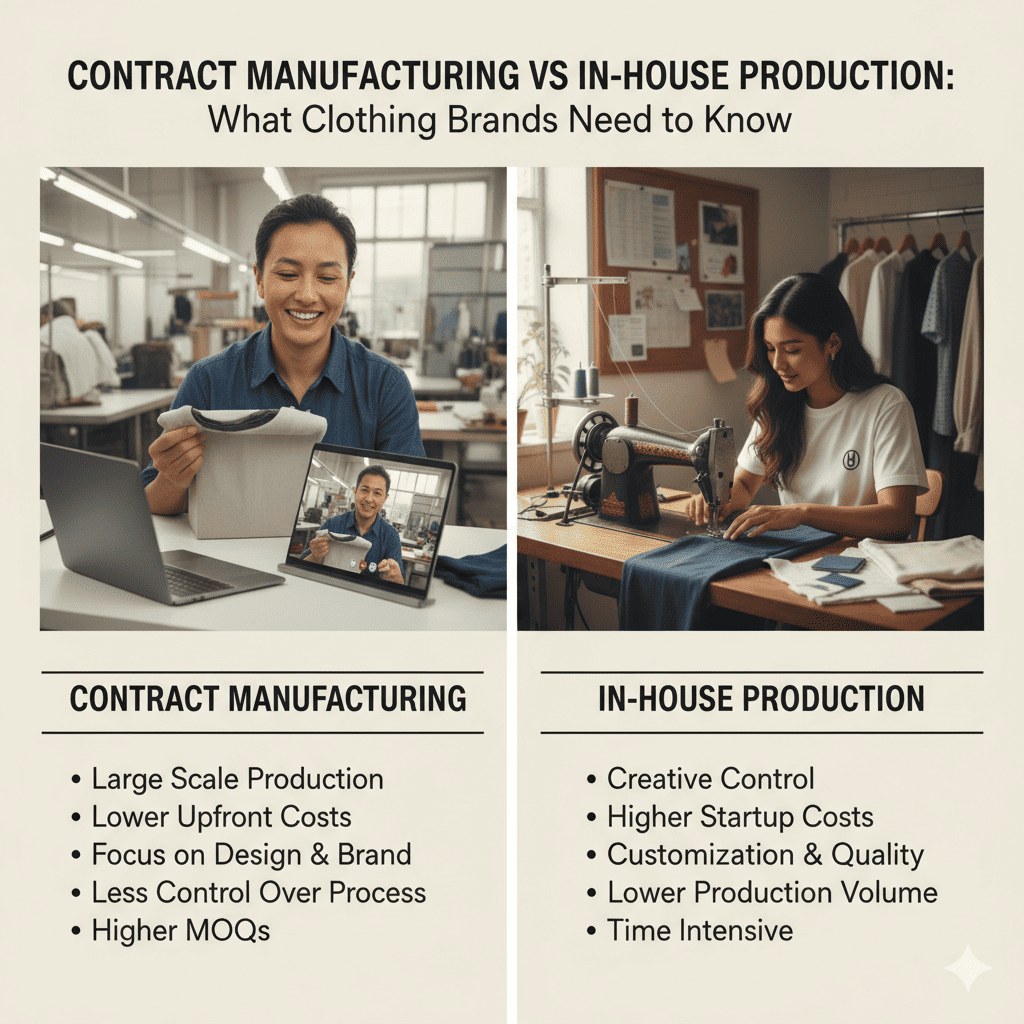
Contract manufacturing and in-house production are not competing philosophies. They’re different tools for different stages, and choosing the wrong one at the wrong stage is one of the most expensive structural mistakes a clothing brand can make.
Summary
- Contract manufacturing means outsourcing production; in-house means owning or leasing the manufacturing infrastructure yourself
- Contract manufacturing is almost always right for startup and early-growth brands — lower capital, faster setup, no fixed overhead
- In-house only becomes commercially viable at sustained volumes above roughly 1,000–2,000 units per style per season for most product types
- The decision isn’t permanent — most UK brands start with contract manufacturing and evaluate in-house only when volume justifies the capital
- Hidden costs exist on both sides and must be fully modelled before deciding
Contents
- 1. Defining the Two Models
- 2. The Economics of Contract Manufacturing
- 3. The Economics of In-House Production
- 4. Quality Control: Contract vs In-House
- 5. IP and Confidentiality in Contract Manufacturing
- 6. When to Consider Moving From Contract to In-House
- 7. Five Mistakes Brands Make Choosing Between the Two
- 8. FAQ
- 8.1. At what volume does in-house become cheaper than contract manufacturing?
- 8.2. Can a startup do in-house production from day one?
- 8.3. Does contract manufacturing mean I lose control of quality?
- 8.4. What happens to my tech pack if I end a contract relationship?
- 8.5. Is hybrid production realistic for a growing brand?
- 9. Making the Right Call at the Right Stage
Defining the Two Models
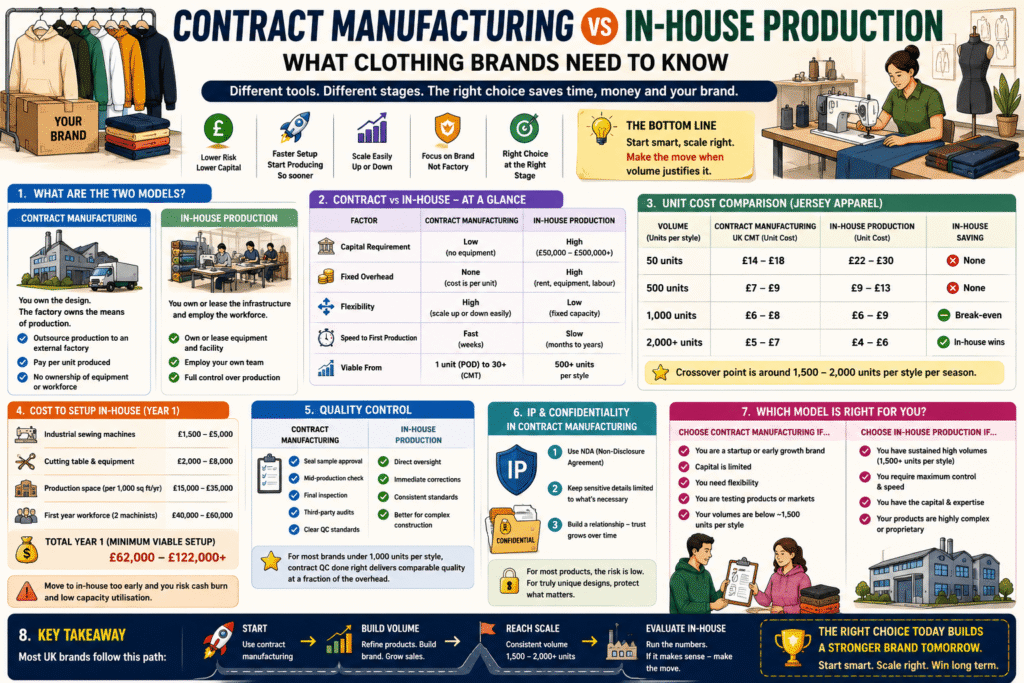
Contract manufacturing means engaging an external factory — with its own equipment, workforce, and infrastructure — to produce your garments to your specification. You own the design. The factory owns the means of production.
In-house production means owning or leasing the production infrastructure yourself — machines, cutting tables, QC stations — and employing the workforce to run it.
| Factor | Contract Manufacturing | In-House Production |
|---|---|---|
| Capital requirement | Low — no equipment purchase | High — £50,000–£500,000+ setup |
| Fixed overhead | None — cost is per unit | High — rent, equipment, labour |
| Flexibility | High — scale up or down | Low — fixed capacity |
| Speed to first production | Fast — weeks | Slow — months to years |
| Viable from | 1 unit (POD) to 30+ (CMT) | 500+ units per style |
What guides get wrong: in-house production is often presented as the “premium” option — more control, better quality, a stronger brand story. Control and quality are real advantages. They come at a capital and operational cost most early-stage brands cannot sustain and shouldn’t attempt.
The Economics of Contract Manufacturing
Contract manufacturing converts fixed production cost into variable cost — you pay per unit produced, no more, no less. That structure is a genuine advantage early on, since your cash isn’t locked into equipment, rent, or a permanent workforce.
| Volume | Contract Unit Cost (Jersey, UK CMT) | Equivalent In-House Unit Cost | In-House Saving |
|---|---|---|---|
| 50 units | £14–£18 | £22–£30 | None — in-house is more expensive |
| 500 units | £7–£9 | £9–£13 | None — in-house still more expensive |
| 1,000 units | £6–£8 | £6–£9 | Roughly breaking even |
| 2,000+ units | £5–£7 | £4–£6 | In-house starts to win |
The in-house cost model assumes UK production space at £15–£25 per sq ft annually, equipment depreciated over five years, and machinists at UK Living Wage rates — it doesn’t include management overhead or the capital cost of equipment purchase itself. The crossover point sits at roughly 1,500–2,000 units per style per season for most UK product types.
Our guide to low MOQ and private label clothing manufacturers UK covers how to structure contract relationships at low volume while you build toward that scale.
The Economics of In-House Production
In-house production converts variable cost into fixed cost. Below a certain volume, that fixed cost drags on margin; above it, spread thinly enough, it produces a real unit cost advantage.
| Item | Low Estimate | High Estimate |
|---|---|---|
| Industrial sewing machines | £1,500 | £5,000 |
| Cutting table and equipment | £2,000 | £8,000 |
| Production space (per 1,000 sq ft, annual) | £15,000 | £35,000 |
| First year workforce (2 machinists) | £40,000 | £60,000 |
| Total Year 1 (minimum viable setup) | £62,000 | £122,000+ |
What we consistently see at Silk Routes: brands that attempt in-house production underestimate how brutally volume-dependent the economics are. A brand producing 200 units per style per season against a £70,000 fixed cost base is carrying £350 in fixed overhead per unit before a single thread is sewn. At 2,000 units, that drops to £35.
“We’ve worked with brands who moved to in-house too early — usually after one strong season convinced them they’d outgrown contract manufacturing. Without exception, the ones who moved before they were ready spent 18 months unwinding the decision and its costs.” — Silk Routes Manufacturing Team
Quality Control: Contract vs In-House
Quality control is the most frequently cited reason brands consider in-house production — if you own the factory floor, the logic goes, you control what happens on it.
The quality advantage of in-house is real, and becomes decisive when your product has construction so complex that factory communication consistently fails to translate it, or your brand’s reputation rests on a precision standard that can’t be specified in a tech pack. For most brands below 1,000 units per style, structured contract QC — sealed sample, mid-production check, final inspection — delivers comparable quality outcomes at a fraction of the overhead.
Zara’s Inditex is the clearest large-scale example of the hybrid logic in practice: roughly half its production runs through owned factories in Spain and Portugal for fast-turnaround, trend-sensitive items, while basics and high-volume lines are outsourced to Turkey, Morocco, and Asia. The in-house half exists specifically where speed and precision justify the fixed cost; the rest doesn’t need it.
If you want to know how Silk Routes structures quality control on contract runs from 30 units upward, speak to our manufacturing team.
IP and Confidentiality in Contract Manufacturing
In-house production has one unambiguous advantage: your pattern and construction spec never leave your building. In contract manufacturing, your tech pack is shared with the factory — for most products this is a low risk, but for genuinely novel construction or proprietary elements, it’s worth addressing directly.
Three practical steps:
Sign an NDA before briefing. Most reputable UK manufacturers sign without hesitation — resistance to an NDA is itself a signal.
Register distinctive design elements. If your product has a distinctive shape or surface pattern, register it as a UK design at the UKIPO before sharing with any factory — official fees increased in April 2026, so confirm the current rate before filing.
Add an ownership clause to the purchase order. State explicitly that all patterns and tech packs remain the brand’s intellectual property. Most factories accept this as standard, and it gives you a clear contractual basis if a dispute arises.
When to Consider Moving From Contract to In-House
| Condition | Threshold |
|---|---|
| Consistent volume per style | 1,000+ units per season |
| Reorder frequency | 4+ runs per year per style |
| Quality failure rate on contract | Consistently above 3–5% per run |
| Margin compression from contract | 5%+ margin lost to unit cost premium |
Meeting two or three of these simultaneously is the signal to model the in-house business case. Meeting one isn’t.
The transition model that works most reliably is hybrid: contract manufacturing handles standard styles and reorders, in-house handles new development and reactive drops, starting with two or three machines and scaling as volume justifies it.
Five Mistakes Brands Make Choosing Between the Two
Moving in-house after one strong season. One season is data, not a pattern. Fix: require three consecutive seasons above 1,000 units per style before modelling an in-house business case.
Underestimating workforce cost. Equipment is the visible cost; skilled machinists and a QC lead are the larger ongoing one. Fix: model workforce cost at target volume, 30% below, and 50% below — if the model fails at 30% below target, the fixed cost base is too high.
Treating contract manufacturing as temporary. Brands that treat it as something to endure get worse service and worse terms than those who invest in it properly. Fix: give clear briefs, pay on time, provide feedback — the brands that get priority slots are the ones the factory wants to keep.
Ignoring the hybrid model. The choice isn’t binary. Fix: model hybrid before committing to either extreme — often the most efficient structure at 300–800 units per season.
Not protecting IP before sharing with factories. An NDA and a registered design are inexpensive against the cost of a competitor copying your core product. Fix: register distinctive design elements and get an NDA signed before any tech pack goes out.
FAQ
At what volume does in-house become cheaper than contract manufacturing?
For most UK clothing types, the crossover sits between 1,500 and 2,000 units per style per season — below that, in-house fixed costs produce a higher effective unit cost.
Can a startup do in-house production from day one?
Technically yes, commercially almost never. Minimum viable setup runs £62,000–£122,000+ in Year 1, and a startup at 50–200 units per style can’t distribute that fixed cost competitively against contract manufacturing.
Does contract manufacturing mean I lose control of quality?
Not if structured correctly. A sealed pre-production sample, mid-production QC check, and final inspection before payment give a brand meaningful quality control — indirect compared to in-house, but comparable in outcome for most product types.
What happens to my tech pack if I end a contract relationship?
It remains your intellectual property provided your purchase order includes an explicit IP ownership clause — always include that language and recover physical patterns from a factory at the end of a relationship.
Is hybrid production realistic for a growing brand?
Yes, often the most efficient structure at 300–800 units per season — a small in-house development capability alongside contract manufacturing for production scale.
Making the Right Call at the Right Stage
Contract manufacturing and in-house production aren’t a quality hierarchy — they’re a volume and capital hierarchy. The brand that chooses contract at 100 units and in-house at 2,000 units has made two correct decisions at two different stages.
Model the full unit economics of both options at your current volume and your projected volume in 18 months, and review the decision at every significant milestone.
Ready to discuss how contract manufacturing works at Silk Routes for your specific product and volume? Find out how we work with brands from first sample to full production.