Two hundred units of a garment you can’t sell isn’t a production problem. It’s a sampling problem — one that was avoidable.
Skipping or shortcutting the sample stage is the single most expensive decision in clothing manufacturing. Not because samples are complicated — because what they prevent is catastrophic.
Summary
- Sampling is a mandatory stage — not optional, not a formality, not a sign of distrust
- Four distinct sample types exist: proto, fit, pre-production, and size set — each does a different job
- A sealed pre-production sample is the commercial reference standard for bulk production — without it, you have no basis to reject non-conforming goods
- Budget two to three sampling rounds minimum — first samples are almost never approved without revision
- Sampling a single style correctly costs £400–£800 — a fraction of the cost of one rejected bulk run
Contents
- 1. Why Sampling Exists
- 2. The Four Sample Types: What Each One Does
- 3. Proto Sample: Concept Validation
- 4. Fit Sample: The Critical Stage
- 5. Pre-Production Sample: The Sealed Reference Standard
- 6. Size Set: Confirming Graded Fit
- 7. What Sampling Costs: Full Budget Breakdown
- 8. Five Sampling Mistakes Clothing Brands Make
- 9. FAQ
- 10. The Seal Is the Start of Production
Why Sampling Exists
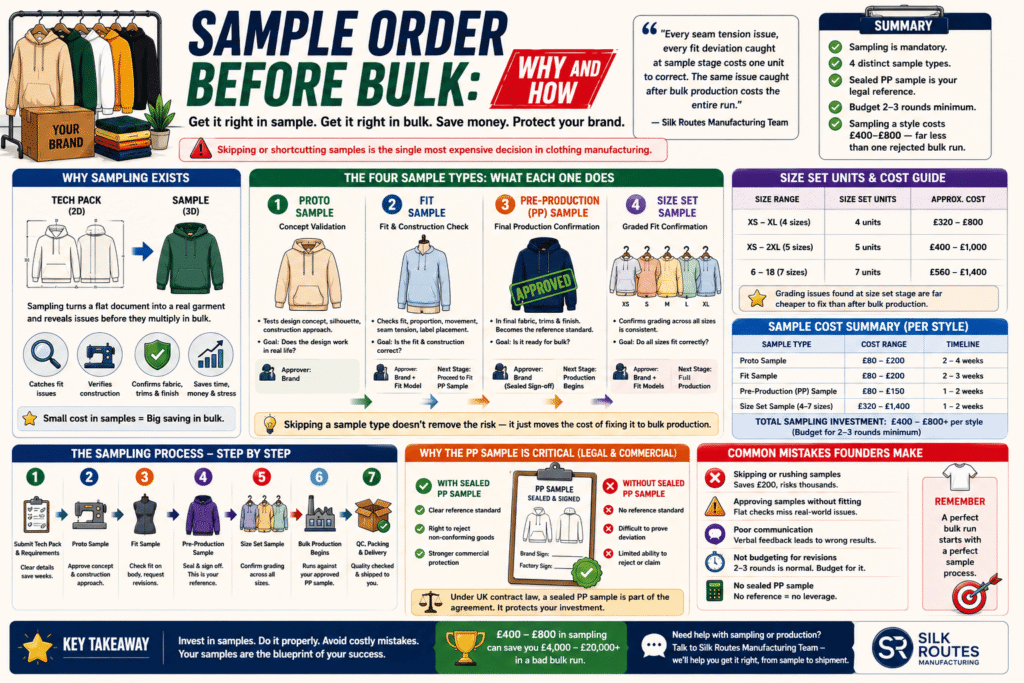
A tech pack is precise. It’s also two-dimensional.
Sampling converts a flat document into a three-dimensional garment, and identifies every gap between what the tech pack describes and what the factory produces — before those gaps multiply across a bulk run.
“Every seam tension issue, every fit deviation caught at sample stage costs one unit to correct. The same issue caught after bulk production costs the entire run — that gap is the whole commercial case for sampling.” — Silk Routes Manufacturing Team
The Four Sample Types: What Each One Does
What guides get wrong: most resources treat “getting a sample” as a single step. There are four distinct types, and conflating them produces a process that can’t catch what each is designed to find.
| Sample Type | Purpose | Approver | Trigger for Next Stage |
|---|---|---|---|
| Proto sample | Concept validation | Brand | Concept approved — proceed to fit |
| Fit sample | Fit, construction, proportion | Brand + fit model | Fit approved — proceed to pre-production |
| Pre-production sample | Final production-ready confirmation | Brand (sealed sign-off) | Sealed approval — production begins |
| Size set | Graded fit across sizes | Brand + fit models | Size set approved — full production |
Skipping a sample type doesn’t eliminate the question it answers — it defers the answer to bulk production, where the cost of getting it wrong is multiplied by the entire run quantity.
For a full breakdown of structuring your manufacturing relationship around a proper sampling process, our guide to low MOQ and private label clothing manufacturers UK covers it from the first run onward.
Proto Sample: Concept Validation
The proto sample is the first physical version of your garment, produced in a similar (not necessarily final) fabric, and exists purely to test whether the design concept works in three dimensions.
You’re assessing silhouette, proportions, construction approach, and whether any design elements simply can’t be manufactured as specified — not fine fit detail yet.
“We tell every new brand: expect to change something on the proto. That’s not a failure, it’s the proto doing its job. Brands that approve one unchanged either have a perfect brief or aren’t looking closely enough.” — Silk Routes Manufacturing Team
Cost: £80–£200 per style. Timeline: 2–4 weeks from tech pack submission.
Send feedback in writing only — annotated, referenced back to the tech pack. Verbal feedback gets reinterpreted at every stage of transmission.
Fit Sample: The Critical Stage
The fit sample is produced in the confirmed production fabric (or the closest substitute) and exists to assess fit, construction quality, and proportion on an actual body — where most sampling problems genuinely surface.
Fit issues, seam tension under movement, fabric drape, and label placement conflicts all become visible worn that aren’t visible flat. Fit-related issues are consistently one of the largest drivers of returns across UK retail, which is exactly what this stage exists to catch before a garment reaches a customer.
Cost: £80–£200 per style. Timeline: 2–3 weeks from proto approval.
One specific opinion: if you’re unsure about a fit point on a fit sample, it’s wrong. Uncertainty here is a reason to revise, not proceed — another fit round costs £80–£200; bulk production with a known fit problem costs the entire run.
Pre-Production Sample: The Sealed Reference Standard
The PP sample is the most commercially important document in your manufacturing process — the final sample in confirmed fabric, trims, and finishing, exactly as the bulk run will be produced.
Once approved, it’s physically sealed — signed by the brand, countersigned by the factory — and held as the reference standard every bulk unit is measured against.
Under standard UK contract law, a sealed pre-production sample forms part of the commercial agreement. Bulk goods that deviate materially from it are non-conforming to contract, giving you a basis to reject or require remediation. Without a sealed sample, you have no contractual reference standard — a factory can legitimately argue they produced to the tech pack, and interpretation becomes contested.
Cost: £80–£150 per style. Timeline: 1–2 weeks from fit sample approval.
Pre-production sample approval is the trigger for production to begin — not the deposit, not the delivery date.
Size Set: Confirming Graded Fit
A size set is one unit in each size across your range, confirming that grading — scaling the approved fit from your primary size to the rest of the range — produces a consistent fit throughout.
| Size Range | Size Set Units | Approximate Cost |
|---|---|---|
| XS–XL (4 sizes) | 4 units | £320–£800 |
| XS–2XL (5 sizes) | 5 units | £400–£1,000 |
| 6–18 (7 sizes) | 7 units | £560–£1,400 |
What we consistently see at Silk Routes is that grading issues compound most visibly at the extremes of a size range — a size set approved on one body size alone will miss them entirely.
What Sampling Costs: Full Budget Breakdown
| Sample Type | Cost Per Style | Timeline |
|---|---|---|
| Proto sample | £80–£200 | 2–4 weeks |
| Fit sample | £80–£200 | 2–3 weeks |
| Fit sample revision | £80–£150 | 1–2 weeks |
| Pre-production sample | £80–£150 | 1–2 weeks |
| Total (single style, 1 revision round) | £400–£800 | 9–17 weeks |
A bulk run of 100 units at £12 per unit costs £1,200. A rejected bulk run — non-conforming construction, failed fit, wrong fabric — costs £1,200 plus remediation, plus delay, plus lost sales in the window. A thorough sampling process costs less than one rejected run.
If you want to talk through sampling costs and timelines for your specific product, speak to the Silk Routes team before you commit to a production brief.
Five Sampling Mistakes Clothing Brands Make
Treating the first sample as production-ready. First samples exist to find problems, not confirm perfection. Fix: review every sample against the tech pack line by line — a review with no findings isn’t a thorough one.
Giving verbal feedback instead of written annotation. Verbal instructions get reinterpreted at every step of transmission. Fix: all feedback in writing — annotated images, numbered change lists, referenced to the tech pack.
Skipping the pre-production sample to save time. It’s the stage most brands sacrifice under schedule pressure, and the one that protects them when bulk goes wrong. Fix: build PP sample time into the schedule from the outset — it’s one to two weeks.
Approving a sample under artificial light. Colour and finish look different under fluorescent office light than natural daylight or the retail environment. Fix: review under at least two light sources and photograph in the conditions your product photography will use.
Not retaining a duplicate sealed sample. A factory holding the only sealed reference controls the standard. Fix: keep one sealed PP sample yourself, signed and dated, referencing the same approval form number as the factory’s copy.
FAQ
Do you sample first or confirm the bulk order first?
Sampling always comes first. Proto, fit, and pre-production sample approval happen before the bulk order is confirmed — the sealed PP sample is what authorises production to begin, not the deposit or delivery date.
Why are samples more expensive per unit than bulk production?
A single sample carries the full one-off cost of pattern cutting, machine setup, and manual attention that a bulk run spreads across hundreds of units. There’s no economy of scale on a run of one, which is exactly why sampling and production are priced as separate commercial processes.
What qualifies as a bulk order?
A bulk order is production at or above a factory’s minimum order quantity, typically starting from 30 units at UK CMT manufacturers and rising to 100–300+ at full-service or offshore factories. Anything below that threshold — including size sets and sample runs — is priced and treated as sampling, not production.
How many sampling rounds should I budget for?
Budget two revision rounds as a minimum before the pre-production sample. Total timeline from first proto to PP sample approval typically runs 10–18 weeks.
What is a sealed sample and why does it matter legally?
A sealed sample is a pre-production sample physically signed by both brand and factory, confirming the agreed production standard. Under UK contract law, bulk goods deviating materially from it are non-conforming, giving the brand grounds to reject or require remediation — without it, quality disputes have no objective reference point.
The Seal Is the Start of Production
The pre-production sample seal isn’t the end of sampling — it’s the authorisation for production to begin. Every bulk unit, every mid-production and final QC check, and every quality dispute afterward references that same physical standard.
Sampling isn’t overhead. It’s the mechanism that makes bulk production reliable — get it right and your factory relationship runs on a clear, shared standard.
Ready to discuss your sampling process with a UK manufacturer? Find out how Silk Routes manages sampling for brands from first run onward.