
Online fashion sales account for around 31% of the UK fashion retail market, and roughly nine in ten UK shoppers buy online — yet the platform decision that determines how a brand captures its share of that market is one most startup founders make on instinct rather than data.
Shopify and Amazon are not competing versions of the same solution. They’re structurally different business models — one builds a brand asset, one rents access to an audience. Choosing the wrong platform at the wrong stage of your brand’s development doesn’t just cost you revenue. It shapes the commercial identity of your business in ways that are expensive to reverse.
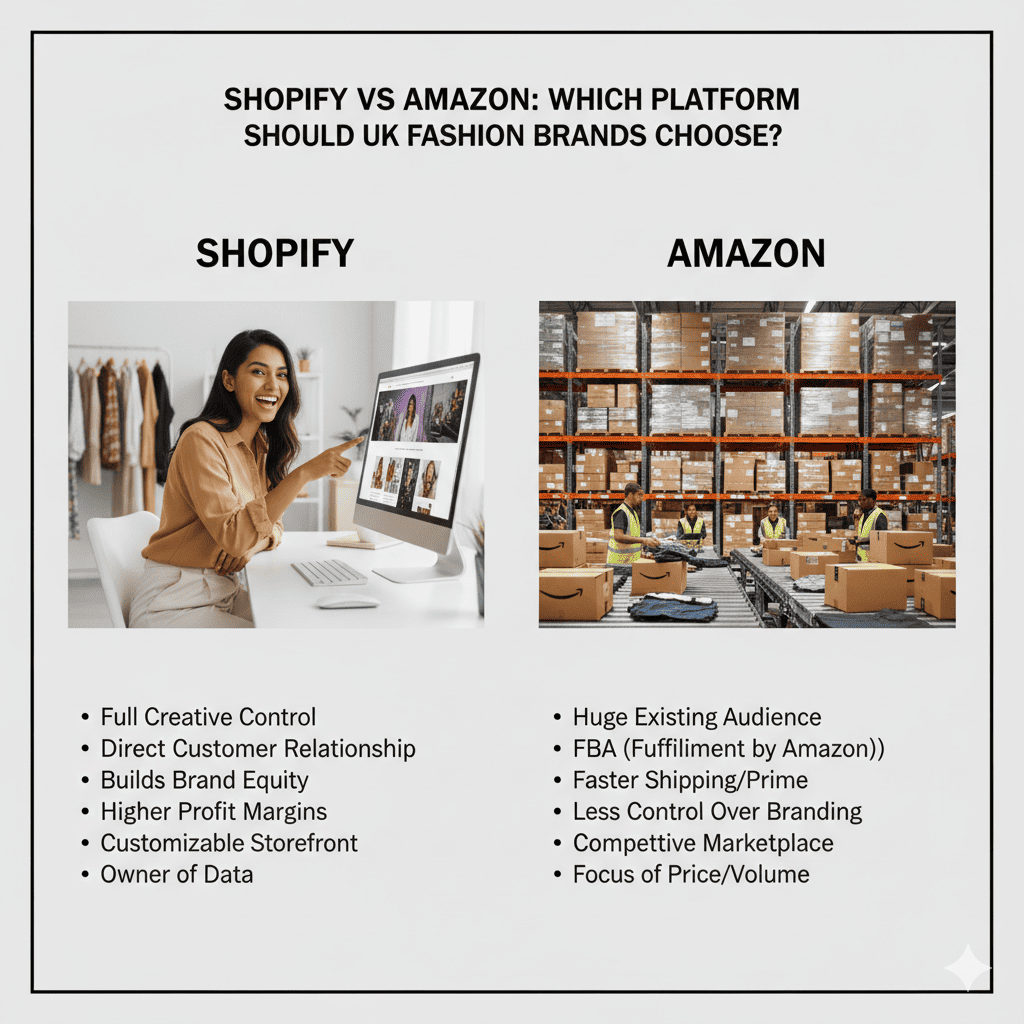
- Shopify is a brand-building platform — you own the customer relationship, the data, and the brand experience, at the cost of building your own traffic
- Amazon is an audience-access platform — you rent access to 30+ million UK active shoppers, at the cost of customer ownership, margin compression, and brand control
- Gross margins on Shopify typically run 55–70% for clothing brands; Amazon FBA clothing margins typically run 25–40% after all fees
- Neither platform is wrong, but they serve different commercial objectives and different brand stages
- Most UK clothing startup brands should launch on Shopify and evaluate Amazon as a secondary or growth channel, not the reverse
Contents
- 1. The Structural Difference That Changes Everything
- 2. Fee Structures: The True Cost of Each Platform
- 3. Brand Control: Where the Real Difference Lies
- 4. Traffic: The Shopify Challenge
- 5. Amazon’s Genuine Advantages: When It Makes Sense
- 6. The Intellectual Property and Brand Risk on Amazon
- 7. Clothing Return Rates: The Platform-Specific Challenge
- 8. Head-to-Head Comparison
- 9. The Platform Decision Framework
- 10. Common Platform Mistakes UK Clothing Startups Make
- 10.1. 1 Landed Cost
- 10.2. 2 Selling Costs
- 10.3. Your Pricing Results
- 10.4. 3 Break-Even Analysis
- 10.5. Gross Margin by Channel
- 10.6. Unit Cost vs Volume (UK CMT)
- 10.7. UK Online Clothing Return Rate vs Other Categories
- 10.8. How Margin Erodes: Gross → Net
- 10.9. DTC vs Wholesale: Net Margin Comparison
- 10.10. Scenario Comparison: Net Margin Under 4 Conditions
- 11. FAQ
- 11.1. Should a UK clothing startup launch on Shopify or Amazon first?
- 11.2. How much does it cost to sell clothing on Amazon UK?
- 11.3. Can I sell on both Shopify and Amazon simultaneously?
- 11.4. Does Amazon own my customer data if I sell there?
- 11.5. What gross margin do I need to make Amazon FBA work for clothing?
- 12. The Decision Is Not Technical — It Is Strategic
The Structural Difference That Changes Everything
Before comparing features, fees, and functionality, the most important comparison is structural.
Shopify: you build and own a destination. Every visit to your store, every purchase, every email address, every review — you own all of it. The customer relationship is yours. The data is yours. The brand experience is entirely within your control. The challenge is that you must generate every visitor yourself — Shopify brings no audience.
Amazon: you access a marketplace. Amazon’s 30+ million UK active customers can discover your product through search. The challenge is that Amazon owns the customer relationship. You receive an order notification, not a customer. Amazon’s terms prohibit direct customer contact outside the platform. The data stays with Amazon.
In our experience, brands that own their customer data and relationship tend to build compounding commercial advantages over time that marketplace sellers simply can’t replicate.
What guides get wrong: Shopify vs Amazon is presented as a traffic problem — Amazon has traffic, Shopify doesn’t. That framing misses the structural point. Amazon has traffic and keeps the customer. Shopify requires traffic investment and gives you the customer permanently. Those are different commercial models with different long-term economics, not different solutions to the same problem.
Fee Structures: The True Cost of Each Platform
Headline platform fees are not the number that matters. The number that matters is net revenue per unit sold after all platform costs — fees, commissions, fulfilment, advertising — are deducted.
Shopify fee structure:
| Plan | Monthly Fee | Transaction Fee (own payment) | Credit Card Rate |
|---|---|---|---|
| Basic | £19/month | 0% | 2% + 25p |
| Shopify | £49/month | 0% | 1.7% + 25p |
| Advanced | £259/month | 0% | 1.5% + 25p |
For a startup DTC clothing brand, Shopify Basic at £19 per month is the appropriate starting point. The primary cost is not the platform fee, it’s customer acquisition cost (CAC), which for a new clothing brand on paid social typically runs £8 to £25 per order.
Amazon fee structure (FBA, clothing):
| Fee Type | Rate / Amount | Notes |
|---|---|---|
| Referral fee | 15% of sale price | Applied to every sale |
| FBA fulfilment fee | £2.30–£4.50 per unit | Size and weight dependent |
| FBA storage fee | £0.40–£0.56 per cubic foot/month | Ongoing inventory holding cost |
| Amazon advertising (PPC) | Variable — £0.30–£2.00+ per click | Effectively mandatory for new listings |
| Returns processing | £1–£3 per return | Clothing return rates ~30% |
Net margin comparison — same product, £55 RRP, UK manufacture at 100 units:
| Cost Item | Shopify DTC | Amazon FBA |
|---|---|---|
| RRP / sale price | £55.00 | £55.00 |
| Landed cost (COGS) | −£14.00 | −£14.00 |
| Platform / referral fee | −£1.10 (2%) | −£8.25 (15%) |
| Fulfilment | −£4.00 (3PL) | −£3.20 (FBA) |
| Returns provision (30%) | −£5.50 | −£5.50 |
| Payment processing | −£1.10 | included in referral |
| CAC / advertising | −£10.00 (paid social) | −£6.00 (Amazon PPC) |
| Net margin per unit | £19.30 (35.1%) | £18.05 (32.8%) |
| Gross margin | 74.5% | 74.5% |
The net margin difference at a single-unit level is modest. The structural difference — customer ownership, brand control, data — isn’t captured in this table and compounds significantly over time.
If you’re weighing your production unit cost against these margin models before choosing a channel, see our clothing manufacturing services — the numbers above only hold if your landed cost is confirmed, not estimated.
Brand Control: Where the Real Difference Lies
For a clothing startup, brand control isn’t a philosophical preference, it’s a commercial asset.
On Shopify:
- Full control over brand presentation, photography, copy, and customer experience
- Product page design is entirely yours — no competitor products shown alongside yours
- Customer communications are entirely yours — email, SMS, post-purchase flows
- Pricing is entirely yours — no algorithmic price pressure
- Reviews are yours to manage and display
On Amazon:
- Product listing format is dictated by Amazon — all sellers use the same template
- Competitor products appear on your product page, including, often, cheaper alternatives or counterfeit versions of your product
- Amazon controls post-purchase communication — you receive an order notification, not a customer relationship
- Amazon’s algorithm can suppress your listing for reasons outside your control
- Amazon can change the rules of the marketplace at any time, and has done so repeatedly
What guides get wrong: Amazon’s brand control limitations are presented as a minor inconvenience for brands that can win on product quality. For a fashion startup whose differentiation is brand identity, positioning, and visual language, not just product specification, Amazon’s constraints are not minor. They’re structural barriers to the very thing that makes the brand worth buying.
Traffic: The Shopify Challenge
The genuine structural challenge of Shopify is that the platform provides no organic traffic. Every visitor must be acquired, through organic social, paid advertising, SEO, press, influencer, or email.
Around 9 in 10 UK consumers shop online, and fashion e-commerce is consistently one of the largest online retail categories. The audience exists. The challenge is reaching it without Amazon’s built-in search traffic.
Traffic acquisition options for Shopify clothing brands:
| Channel | Cost | Speed | Brand Value | Sustainability |
|---|---|---|---|---|
| Organic social (Instagram / TikTok) | Time | Slow | High | High |
| Paid social (Meta / TikTok ads) | £300–£1,000+/month | Fast | Moderate | Medium — requires ongoing spend |
| Google Shopping | £200–£800+/month | Medium | Low | Medium |
| SEO / blog content | Time + small budget | Very slow | High | Very high — compounds over time |
| Micro-influencer seeding | £200–£600 + product | Medium | High | Medium |
| Email marketing | Near zero | Fast (to list) | High | Very high |
| Press / PR | Time | Slow | Very high | High |
The traffic challenge on Shopify is real. It’s also solvable, and the solution (building owned channels: email list, social following, press relationships) creates brand assets that compound in value over time.
An Amazon listing that drives traffic today drives the same traffic in three years, with no brand equity accumulation. An email list of 5,000 engaged customers acquired over two years on Shopify is a commercial asset with measurable and growing value.
“We advise every startup brand to treat their first 12 months on Shopify as audience-building, not just revenue generation. The brands that understand this consistently outperform those who optimise purely for first-year sales, because they’re building something Amazon cannot replicate.” — Silk Routes Manufacturing Team
Amazon’s Genuine Advantages: When It Makes Sense
We don’t say Amazon is wrong for clothing brands. We say it’s wrong as a primary launch channel for most clothing startups. As a secondary or growth channel, it has specific advantages worth understanding.
Established customer trust: Amazon’s returns policy and purchase protection are well understood by UK consumers. A buyer uncertain about a new brand is more likely to purchase via Amazon than via an unknown brand’s website, because the risk feels lower.
Built-in product discovery: Amazon’s search function is used by UK consumers specifically to find products — high purchase intent compared to social media where discovery is passive.
FBA logistics: Amazon’s fulfilment network handles storage, picking, packing, shipping, and returns. For a brand without a 3PL relationship or self-fulfilment capability, FBA removes logistics infrastructure as a barrier.
International reach: Amazon’s EU marketplaces (Germany, France, Italy, Spain) are accessible from a single seller account, a relatively low-friction route to testing European demand before investing in country-specific infrastructure.
Fashion brands that use Amazon as a secondary channel — capturing demand-driven search traffic while building brand relationships on owned channels — tend to see stronger combined unit economics than brands relying on either channel alone.
The correct framing isn’t Shopify vs Amazon. It’s: Shopify first, Amazon later, when the brand has an established identity, a customer base, and the operational capacity to manage a second channel without cannibalising the first.
The Intellectual Property and Brand Risk on Amazon
We’re direct about this because it’s the issue most guides understate.
Amazon’s marketplace creates specific IP risks for clothing brands that aren’t present on Shopify. Understanding them before listing isn’t optional.
Counterfeit risk: once a product gains traction on Amazon, counterfeit versions appear on the same listing, sometimes as third-party sellers fulfilling against your ASIN. Amazon’s Brand Registry provides some protection, but enforcement is reactive rather than preventive.
Hijacked listings: third-party sellers can list against your ASIN at lower prices, including potentially inauthentic product. This occurs after a product establishes search ranking, which means it happens to successful listings, not failing ones.
Pricing race to the bottom: Amazon’s algorithm favours lower prices when multiple sellers list the same product. If your product is available elsewhere at a lower price, including your own Shopify store with a discount applied, Amazon may suppress your listing or reduce your Buy Box share.
A registered UK trademark provides the strongest protection against counterfeit listings and gives Amazon’s Brand Registry the authority to remove inauthentic sellers. Filing a UK trademark application in Class 25 (clothing) before listing on Amazon isn’t optional, it’s the minimum IP protection required to defend a successful listing. The UKIPO filing fee is £205 for one class online (current from 1 April 2026) — the cheapest insurance a clothing brand can buy against the most common Amazon risk.
Our guide to low MOQ and private label clothing manufacturers UK covers how private label production — product designed and made specifically for your brand — creates the product differentiation that makes counterfeiting less commercially attractive and harder to replicate.
Clothing Return Rates: The Platform-Specific Challenge
UK online clothing return rates run somewhere around 30% by most industry estimates, clothing is consistently the most-returned e-commerce category, with fit and style mismatches the primary drivers.
Both platforms handle returns, but differently, and with different commercial implications.
| Returns Factor | Shopify | Amazon FBA |
|---|---|---|
| Return rate trigger | Your returns policy | Amazon’s 30-day no-questions policy |
| Customer contact on return | Yes — you communicate directly | No — Amazon manages the process |
| Returned item condition | Inspected by brand | May be relisted as “used” without brand inspection |
| Returns data | Full — reason, product, size | Limited — reason codes only |
| Returns cost | £1–£3 per unit (3PL) | £1–£3 per unit (FBA return fee) |
| Impact on listing | None | Multiple returns can suppress listing ranking |
The data gap on Amazon is significant for a clothing brand. Understanding why customers return — wrong size, colour different from photography, fabric feel — is the information that drives product development decisions. Amazon’s return data doesn’t provide this at a useful resolution.
On Shopify, direct customer communication on returns produces the exact product feedback that informs tech pack decisions on the reorder. That feedback loop doesn’t exist on Amazon.
Head-to-Head Comparison
| Factor | Shopify | Amazon | Winner for Startup Brand |
|---|---|---|---|
| Customer ownership | Yes — full | No — Amazon owns it | Shopify |
| Brand control | Full | Constrained by Amazon template | Shopify |
| Traffic provided | None — must acquire | Yes — 30m+ UK shoppers | Amazon |
| Gross margin | 55–70% | 55–70% | Draw |
| Net margin after all fees | 30–40% | 25–35% | Shopify (marginal) |
| CAC / advertising cost | £8–£25 per order | £5–£12 per order (PPC) | Amazon (marginal) |
| Setup cost | £19–£259/month + apps | £25/month (Professional) | Shopify (for startup) |
| IP protection | Brand controls all | Requires Brand Registry + trademark | Shopify |
| Returns data quality | Full | Limited | Shopify |
| Logistics options | 3PL or self-fulfil | FBA or self-fulfil | Draw |
| International expansion | Shopify Markets | Amazon EU | Amazon (marginal) |
| Long-term brand asset built | Yes — compounding | No — rented audience | Shopify |
| Right for launch stage | Yes | No — secondary channel | Shopify |
The Platform Decision Framework
Choose Shopify first if:
- Brand identity is central to your commercial proposition
- You’re launching a new brand that needs to establish its own customer relationships
- Your product is differentiated by design, quality, or brand story, not by price
- You have a marketing plan that can generate traffic (social, paid, PR, email)
- You’re building for long-term brand equity, not short-term transaction volume
Consider Amazon as a secondary channel when:
- Your Shopify brand is established with a clear identity and a customer base
- You’ve registered your trademark and enrolled in Amazon Brand Registry
- Your product has a specific use-case or keyword that captures demand-driven search
- You have the operational capacity to manage FBA inventory alongside your DTC fulfilment
- You want to test international markets (EU) with low infrastructure investment
Do not choose Amazon first if:
- You’re launching a brand whose differentiation is identity, not product specification
- You don’t yet have a trademark registered
- You cannot absorb the 15% referral fee at your current unit cost and margin structure
- You’re not prepared to actively manage counterfeit risk and listing hijacking
Common Platform Mistakes UK Clothing Startups Make
Launching on Amazon before establishing brand identity on Shopify. A brand that hasn’t established a clear visual identity and customer proposition will find that Amazon’s constraints make that establishment significantly harder, because there’s no brand environment in which to build it.
Fix: launch on Shopify first. Build the brand world, the customer relationship, and the email list. Bring that identity to Amazon as a secondary channel when it’s established.
Treating Amazon advertising as optional. New Amazon listings without advertising spend don’t rank. The organic search ranking that established Amazon sellers have built over years isn’t accessible to a new listing without paid traffic to accelerate it.
Fix: budget Amazon PPC at £300 to £600 per month for the first 90 days on the platform. Treat it as a customer acquisition cost in the unit economics model, not a marketing expense.
Not registering a trademark before listing on Amazon. A successful Amazon listing without a registered trademark is a listing without Brand Registry protection.
Fix: file a UK trademark application before any Amazon activity.
Using the same imagery for Amazon and Shopify. Amazon’s product listing requirements favour white-background hero images with the product filling 85% of the frame. Shopify’s conversion optimisation favours lifestyle and editorial photography that communicates brand world.
Fix: produce both image types in the same photography session, one set of clean white-background product images for Amazon compliance, one set of editorial lifestyle images for Shopify and social.
Setting different prices on Amazon and Shopify without an explicit strategy. Amazon’s pricing algorithm monitors price parity across channels. If your Shopify store runs a discount that makes the Shopify price lower than your Amazon listing, Amazon may suppress the Buy Box on your Amazon listing.
Fix: decide your pricing strategy before launching on both channels. Either maintain price parity, or accept that Shopify promotions will affect Amazon ranking, and schedule promotions accordingly.
A step-by-step pricing calculator with real UK industry benchmarks — from landed cost to net margin.
Enter your figures to calculate gross margin, net margin, minimum RRP, and break-even volume in real time.
1 Landed Cost
Factory Price + Freight + Duty + Packaging2 Selling Costs
Your Pricing Results
Danger
Marginal
Viable
Strong
Excellent
RRP × return rate spread across units sold. Budget for at least 15% even with good-quality product.3 Break-Even Analysis
Fixed Costs ÷ (RRP − Variable Cost per Unit)UK fashion industry margin benchmarks and how volume affects unit cost and profitability.
Gross Margin by Channel
Sources: BFC Reports; Trueprofit.io; JOOR Wholesale Fashion Guide 2024
Unit Cost vs Volume (UK CMT)
Source: Silk Routes Manufacturing Data; UKFT Facts & Figures 2024
UK Online Clothing Return Rate vs Other Categories
Sources: Retail Economics Annual Returns Benchmark 2024; Statista UK eCommerce Returns 2024
How Margin Erodes: Gross → Net
Based on: £55 RRP, £14 landed cost, UK DTC channel, 15% return rate
DTC vs Wholesale: Net Margin Comparison
Sources: JOOR Wholesale Fashion Markup vs Margin Guide 2024; Drivepoint DTC eCommerce 2024; BFC Emerging Brand Research
Key statistics and targets for UK clothing brand pricing — all from verified, named sources.
| Channel | Gross Margin Range | Typical Net Margin | Viability | Key Cost Driver |
|---|---|---|---|---|
| DTC Website | 55–70% | 10–20% | Strong | CAC, returns, fulfilment |
| Wholesale to Retailers | 45–55% (at WSP) | 15–25% | Viable | Retailer margin (40–50% RRP) |
| Marketplace (ASOS etc.) | 40–55% | 8–15% | Marginal | Commission 15–30% RRP |
| Pop-up / Market | 60–75% | 20–35% | Strong | Event cost, time |
| Consignment | 45–60% | 12–22% | Marginal | Split terms, slow payment |
| Print-on-Demand | 20–35% | 5–12% | Low Margin | High per-unit POD cost |
Sources: British Fashion Council Reports; JOOR Wholesale Fashion Guide 2024; Trueprofit.io Apparel Profit Margin Benchmarks 2026; Opensend eCommerce Product Margin Statistics 2025
| Route | Factory Price | Freight | Duty (12%) | Landed Cost | Margin at £55 RRP |
|---|---|---|---|---|---|
| UK CMT | £10–£14 | £0.50–£1.50 | £0 | £11.50–£17 | 68–79% |
| Turkey / Portugal | £6–£10 | £3–£6 | £0.72–£1.20 | £10.72–£17.20 | 69–80% |
| Asia (standard) | £3–£7 | £5–£10 | £0.36–£0.84 | £9.86–£18.34 | 67–82% |
Sources: UKFT Facts & Figures 2024; Silk Routes Manufacturing Data; UK Gov HMRC Import Duty Schedule (clothing 12%)
See how your margin holds up under three real-world pressures every UK clothing brand faces.
Scenario Comparison: Net Margin Under 4 Conditions
Scenario data based on verified UK fashion return rates (Retail Economics 2024) and UKFT volume pricing data.
| Scenario | Return Rate | Effective Rev/Unit | Net Margin % | Status |
|---|---|---|---|---|
| Base Case | 15% | £46.75 | 43.2% | Viable |
| High Returns | 30% (UK avg) | £38.50 | 25.9% | Marginal |
| Slow Sell + Discount | 15% | £37.40 (20% off) | 15.8% | Under Pressure |
| Reorder (150 units) | 15% | £46.75 | 49.6% | Improving |
| Volume | Unit Cost (UK CMT) | Gross Margin at £55 | Net Margin (DTC) | Verdict |
|---|---|---|---|---|
| 30 units | £18–£24 | 56–67% | 20–32% | Tight |
| 50 units | £14–£18 | 67–75% | 32–40% | Viable |
| 100 units | £10–£13 | 76–82% | 40–47% | Strong |
| 200 units | £8–£11 | 80–85% | 44–50% | Excellent |
Sources: UKFT Facts & Figures 2024; Silk Routes UK Manufacturing Data; Trueprofit.io Apparel Margin Benchmarks 2026
FAQ
Should a UK clothing startup launch on Shopify or Amazon first?
Shopify first. A clothing startup’s commercial proposition is almost always brand-led, and Amazon’s structural constraints make it extremely difficult to communicate brand identity effectively. Launch on Shopify, establish the brand identity and customer base, then evaluate Amazon as a secondary demand-capture channel with Brand Registry protection in place.
How much does it cost to sell clothing on Amazon UK?
The total cost of selling clothing on Amazon FBA includes: £25/month (Professional seller account), 15% referral fee on every sale, FBA fulfilment fees of £2.30 to £4.50 per unit, FBA storage fees, and Amazon PPC advertising (effectively mandatory for new listings). At a £55 RRP, total Amazon costs typically run £18 to £22 per unit sold, leaving a net margin of approximately 25 to 35% before COGS.
Can I sell on both Shopify and Amazon simultaneously?
Yes. Many UK clothing brands run both channels — Shopify for brand building and DTC margin, Amazon for demand capture and international reach. Most brands add Amazon as a secondary channel 6 to 12 months after establishing their Shopify presence.
Does Amazon own my customer data if I sell there?
Yes. Amazon doesn’t share customer contact data with sellers. You receive order details (name, delivery address, item ordered) but you cannot add Amazon customers to your email list, contact them directly, or retarget them with advertising.
What gross margin do I need to make Amazon FBA work for clothing?
A minimum 70% gross margin (before Amazon fees) is required to absorb Amazon’s 15% referral fee and FBA fulfilment costs while leaving a viable net margin. At a £55 RRP and a £14 landed cost, your gross margin is approximately 74.5%, sufficient for Amazon FBA to work commercially.
The Decision Is Not Technical — It Is Strategic
Shopify and Amazon are both functional, reliable, and well-supported platforms. The decision between them isn’t about which platform works better. It’s about what commercial model your brand is building.
A brand that builds on Shopify builds a customer asset, an owned audience, a data set, a relationship that compounds in value over time. A brand that builds on Amazon builds a transaction channel, accessible, high-volume, and entirely dependent on a platform the brand doesn’t control.
For most UK clothing startups, whose differentiation rests on design, identity, and brand story, not on price or commodity product specification, the first platform is Shopify. Not because Amazon doesn’t work, but because the assets Shopify builds are the assets that eventually make Amazon a powerful secondary channel rather than a dependency.
Ready to discuss how your production unit cost affects your Shopify and Amazon margin models? Find out how Silk Routes works with startup clothing brands from brief to delivery.