Most free NDA templates on the internet are not wrong — they are just not built for clothing manufacturing. A generic NDA written for software, consulting, or corporate M&A does not include the clauses a clothing brand needs: pattern ownership on termination, subcontractor coverage, specific design file types as confidential information, or the return-or-destroy obligation that prevents a manufacturer from keeping your patterns after the relationship ends.
This article provides a free NDA template written specifically for UK clothing brands working with manufacturers — covering every clause the generic templates miss. Below the template is a plain-English explanation of every clause, guidance on when to use a mutual versus one-way NDA, and what an NDA cannot protect.
Note: This template is for general guidance only. For high-value designs, significant production relationships, or any situation involving complex IP ownership, review with a UK-qualified IP solicitor before use. The UK Intellectual Property Office provides free guidance and a list of accredited IP solicitors.
Contents
- 1. Post Highlights
- 2. Why Every Clothing Brand Needs an NDA Before Sharing Designs
- 3. What an Effective Clothing Manufacturer NDA Must Include
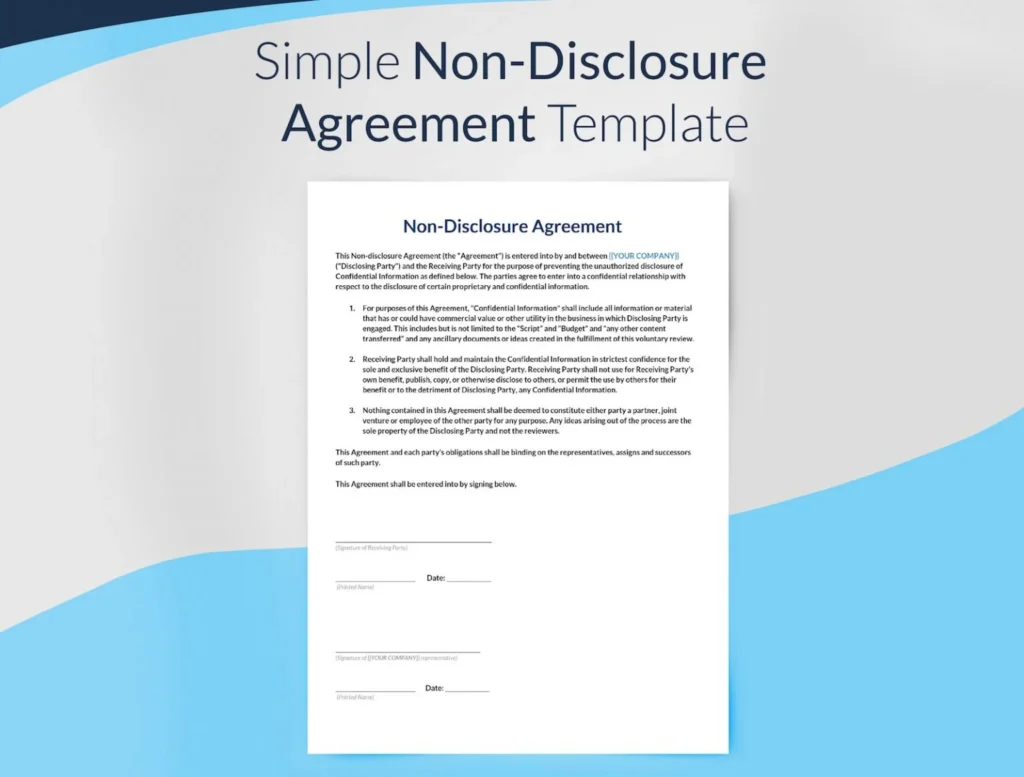
- 4. Free NDA Template for UK Clothing Brands
- 5. How to Adapt the Template for Your Situation
- 6. Mutual vs One-Way NDA — Which Do You Need?
- 7. What an NDA Cannot Protect
- 8. FAQ
Post Highlights
- A standard generic NDA is not sufficient for clothing manufacturing — it will not cover pattern ownership, design file types, or the return-or-destroy obligation
- The NDA must be signed before any design file, tech pack, or specification is shared — not alongside the bulk order paperwork
- The most commercially important clause in a clothing manufacturer NDA is not the confidentiality obligation — it is the IP ownership and return clause, which prevents patterns being held to ransom when the relationship ends
- A one-way (unilateral) NDA is appropriate in most brand-to-manufacturer situations — the brand discloses; the manufacturer receives and is bound
- An NDA does not protect ideas, general concepts, or information already in the public domain — registered design and trade mark protection are required for those functions
- The template below is formatted for immediate use — copy, insert your details in the bracketed fields, and have it signed before sharing any design materials
Why Every Clothing Brand Needs an NDA Before Sharing Designs
When you share a tech pack, a pattern file, or a design drawing with a manufacturer, you are sharing commercially sensitive, proprietary creative work. That information leaves your hands. Without an NDA, there is no contractual obligation on the manufacturer to keep it confidential, no written confirmation that the patterns they develop remain your property, and no enforceable commitment to return your files when the relationship ends.
The three most common IP problems brands encounter with manufacturers — design copying, pattern retention, and specification leakage — are all contractually preventable with a signed NDA in place before the first design exchange. They are significantly harder to address after the fact.
The NDA is not a statement of distrust. It is the standard commercial practice for any relationship involving proprietary information — the same standard a manufacturer would apply if they were sharing their own proprietary processes with you. Sign it before the first design file leaves your server.
What an Effective Clothing Manufacturer NDA Must Include
| Clause | What it does | Why it matters for clothing |
|---|---|---|
| Definition of confidential information | Specifies exactly what information is covered | Must explicitly include tech packs, CAD files, DXF pattern files, design drawings, fabric specifications, BOM, and physical pattern pieces — generic NDAs often cover only written documents |
| Permitted use restriction | Limits the manufacturer to using your information only for producing your garments | Prevents your designs being used for other clients or for the manufacturer’s own range |
| Non-disclosure obligation | Prohibits sharing with third parties | Must extend to subcontractors, employees, and any third-party supplier involved in your production |
| Subcontractor coverage | Requires subcontractors to be bound by equivalent confidentiality | A factory that subcontracts part of your order passes your designs to a third party — that third party must be under the same obligations |
| IP ownership clause ★ | Confirms all patterns, blocks, and files developed for your designs remain your property | The most commonly missing clause in generic NDAs — without it, a manufacturer who develops patterns for you may have grounds to claim ownership |
| Return or destroy obligation ★ | Requires return or destruction of all confidential information on termination | Prevents the manufacturer retaining your patterns and using them as leverage or for other purposes after the relationship ends |
| Duration | Sets the period during which the obligations apply | Must extend at least 2 years beyond the last production run — long enough to cover the commercial life of the designs |
| Governing law and jurisdiction | Specifies which country’s law applies and which courts have jurisdiction | For UK manufacturers, specify English law and England and Wales courts |
| Remedies clause | Confirms that breach would cause irreparable harm justifying injunctive relief | Important for IP cases — allows you to seek an injunction (immediate stop order) rather than waiting for a damages trial |
★ These two clauses are the most commonly missing from generic templates and the most commercially important for clothing manufacturing.
Free NDA Template for UK Clothing Brands
NON-DISCLOSURE AGREEMENT
This Agreement is made on: [DATE]
Between:
[BRAND NAME] (Company No. [COMPANIES HOUSE NUMBER], registered at [REGISTERED ADDRESS]) (“the Disclosing Party”)
and
[MANUFACTURER NAME] (Company No. [COMPANIES HOUSE NUMBER], registered at [REGISTERED ADDRESS]) (“the Receiving Party”)
together referred to as “the Parties”.
1. Purpose
The Receiving Party wishes to provide manufacturing services to the Disclosing Party in connection with the production of clothing and related products (“the Purpose”). In connection with the Purpose, the Disclosing Party will share certain confidential and proprietary information with the Receiving Party.
2. Definition of Confidential Information
“Confidential Information” means all information disclosed by the Disclosing Party to the Receiving Party in connection with the Purpose, whether disclosed in writing, orally, electronically, or in any other form, including but not limited to:
(a) Tech packs, specification sheets, technical drawings, and design illustrations;
(b) Digital pattern files in any format, including DXF, PDF, AI, and any CAD/CAM files;
(c) Physical paper pattern pieces;
(d) Grading files and size specifications;
(e) Bill of Materials (BOM) and component specifications;
(f) Fabric, lining, interfacing, and trim specifications;
(g) Colour references, Pantone specifications, and approved lab dip records;
(h) Approved sample records, PP sample approvals, and quality benchmark documentation;
(i) Production volumes, pricing, and commercial terms;
(j) Any other information designated as confidential by the Disclosing Party.
3. Obligations of the Receiving Party
The Receiving Party shall:
(a) Keep all Confidential Information strictly confidential and not disclose it to any third party without the prior written consent of the Disclosing Party;
(b) Use the Confidential Information solely for the Purpose and for no other purpose whatsoever;
(c) Limit access to Confidential Information to those of its employees, officers, and agents who need to know it for the Purpose, and ensure all such persons are bound by obligations of confidentiality no less stringent than those set out in this Agreement;
(d) Prior to disclosing any Confidential Information to any subcontractor engaged in connection with the Purpose, obtain the Disclosing Party’s written consent and ensure the subcontractor executes a confidentiality agreement containing terms equivalent to those set out in this Agreement;
(e) Not use the Confidential Information, directly or indirectly, to develop, produce, or supply any product for any third party that incorporates, reproduces, or is substantially similar to any design disclosed by the Disclosing Party;
(f) Protect the Confidential Information with the same degree of care it uses to protect its own confidential information, and in any event with no less than reasonable care.
4. Intellectual Property Ownership
(a) All Confidential Information disclosed by the Disclosing Party, and all intellectual property rights in it, remains the exclusive property of the Disclosing Party.
(b) All patterns, blocks, grading files, technical drawings, CAD files, and design adaptations created or developed by the Receiving Party in connection with the Disclosing Party’s designs and/or specifications shall be and remain the exclusive property of the Disclosing Party from the moment of their creation.
(c) The Receiving Party assigns to the Disclosing Party, with full title guarantee, all intellectual property rights in any such materials created in connection with the Purpose, and agrees to execute any further documents reasonably requested by the Disclosing Party to perfect such assignment.
(d) Nothing in this Agreement grants the Receiving Party any licence or right to use the Confidential Information except as expressly required for the Purpose.
5. Return or Destruction of Confidential Information
Upon the earlier of: (a) the termination or completion of the Purpose; (b) the written request of the Disclosing Party at any time; the Receiving Party shall promptly:
(i) Return to the Disclosing Party all physical Confidential Information in its possession, including all physical pattern pieces, approved samples retained for reference, and any printed documentation;
(ii) Permanently delete all digital Confidential Information from all devices, systems, cloud storage, and servers under the Receiving Party’s control;
(iii) Provide written confirmation to the Disclosing Party that all Confidential Information has been returned or destroyed in accordance with this clause.
The obligations in this clause shall survive the termination of this Agreement.
6. Exceptions
The obligations in this Agreement shall not apply to information that:
(a) Is or becomes publicly available other than through breach of this Agreement;
(b) Was already in the Receiving Party’s possession without restriction before disclosure by the Disclosing Party, as evidenced by written records predating the disclosure;
(c) Is independently developed by the Receiving Party without use of or reference to the Confidential Information;
(d) Is required to be disclosed by applicable law, court order, or regulatory authority — in which case the Receiving Party shall give the Disclosing Party the maximum practicable advance notice and cooperate with the Disclosing Party in seeking a protective order.
7. Duration
The obligations under this Agreement shall commence on the date of signing and continue for a period of [3] years from the date of last disclosure of Confidential Information by the Disclosing Party, or until the Confidential Information enters the public domain other than through breach of this Agreement, whichever is the earlier.
8. Remedies
The Receiving Party acknowledges that any breach of this Agreement would cause irreparable harm to the Disclosing Party for which damages alone would be an inadequate remedy. The Disclosing Party shall therefore be entitled to seek injunctive or other equitable relief in addition to any other remedies available at law or in equity, without the requirement to post a bond or prove actual damage.
9. General
(a) Entire Agreement. This Agreement constitutes the entire agreement between the Parties in relation to its subject matter and supersedes all prior representations, agreements, and understandings between them relating to confidentiality.
(b) Governing Law. This Agreement shall be governed by and construed in accordance with the laws of England and Wales.
(c) Jurisdiction. The Parties irrevocably submit to the exclusive jurisdiction of the courts of England and Wales in respect of any dispute arising out of or in connection with this Agreement.
(d) Amendments. No amendment to this Agreement shall be effective unless made in writing and signed by both Parties.
(e) Waiver. Failure by either Party to enforce any provision of this Agreement shall not constitute a waiver of that provision.
(f) Severability. If any provision of this Agreement is found to be unenforceable, the remaining provisions shall continue in full force and effect.
Signed by [BRAND NAME]:
Signature: ________________________
Name: ________________________
Title: ________________________
Date: ________________________
Signed by [MANUFACTURER NAME]:
Signature: ________________________
Name: ________________________
Title: ________________________
Date: ________________________
This template is provided for general guidance only and does not constitute legal advice. For significant design or IP value, review with a UK-qualified solicitor before use.
How to Adapt the Template for Your Situation
Bracketed fields to complete before use:
- [DATE] — the date of signing, not the date of first design sharing
- [BRAND NAME] and [MANUFACTURER NAME] — full legal registered names as they appear at Companies House
- [COMPANIES HOUSE NUMBER] — verify at find-and-update.company-information.service.gov.uk for both parties
- [REGISTERED ADDRESS] — registered office address for each party, as shown at Companies House
- [3] years in Clause 7 — adjust duration to reflect the commercial life of your designs. For seasonal collections with 12–18 month commercial life, two years is typically sufficient. For signature or heritage designs, extend to three or five years
If the manufacturer is offshore (non-UK):
Replace Clause 9(b) and 9(c) with:
“This Agreement shall be governed by the laws of England and Wales. The Parties agree that disputes shall be resolved by arbitration under the ICC Rules of Arbitration in London, England, unless the Parties agree otherwise in writing.”
Enforcing English court judgments against an offshore manufacturer is difficult in practice — arbitration under the ICC Rules provides a more internationally enforceable route. Be aware that even with arbitration, enforcement against a non-compliant offshore manufacturer is practically challenging; prevention through supplier selection and vetting remains the primary strategy.
If the manufacturer will develop patterns on your behalf:
Clause 4(b) and 4(c) — the IP ownership and assignment provisions — are particularly important in this case. Where the manufacturer is creating patterns from your design brief (rather than receiving brand-developed patterns), the assignment clause ensures those patterns vest in you from the moment of creation.
If you want a mutual NDA:
Change Clause 1 to identify both parties as capable of disclosing confidential information, replace “Disclosing Party” and “Receiving Party” throughout with “Party A” and “Party B” respectively, and adjust the opening to read: “…each Party may disclose Confidential Information to the other Party in connection with the Purpose.” A mutual NDA is appropriate where the manufacturer also shares proprietary process or costing information with you.
Mutual vs One-Way NDA — Which Do You Need?
One-way (unilateral) NDA: One party discloses; the other receives and is bound. The template above is a one-way NDA — the brand discloses; the manufacturer is bound.
Appropriate for: the standard clothing manufacturing relationship, where the brand shares designs and specifications and the manufacturer does not share proprietary information of equivalent sensitivity in return.
Mutual (bilateral) NDA: Both parties disclose confidential information and both parties are bound.
Appropriate for: situations where the manufacturer shares genuinely sensitive proprietary information — costing models, proprietary production techniques, machinery specifications, or pricing structures — and wishes to be protected equally. Some manufacturers request mutual NDAs as standard; this is reasonable and should be accommodated if the terms are balanced.
The template above can be converted to a mutual NDA by following the instructions in the How to Adapt section above.
What an NDA Cannot Protect
An NDA is a powerful tool — but it has limitations that brands frequently misunderstand.
An NDA cannot protect ideas or concepts. An NDA covers information you have disclosed — specific designs, documented specifications, recorded patterns. It does not protect a general design concept, a style direction, or a creative idea that has not been reduced to a specific documented form. If you describe a “relaxed-fit linen trouser with wide legs and side pockets” in a meeting, an NDA covers any documented specifications you subsequently share — not the idea itself.
An NDA cannot prevent a manufacturer from creating similar designs independently. The exceptions clause (Clause 6(c)) — “independently developed without reference to the Confidential Information” — means a manufacturer who genuinely develops a similar design independently has not breached the NDA. Proving they used your information rather than arriving at the design independently is evidentially difficult.
An NDA cannot give you registered design protection. If you want the strongest available right against copying — the right to prevent a third party reproducing your design regardless of whether they had access to your confidential information — you need registered design protection at the UK IPO. An NDA protects the information shared with this specific party. Registered design protects the appearance of the design against the world.
An NDA does not replace a manufacturing agreement. The NDA covers confidentiality and IP ownership. A manufacturing agreement covers delivery dates, specification compliance, CMT rates, payment terms, subcontracting, and remedies for non-performance. Both documents are needed. The NDA is signed before design sharing; the manufacturing agreement is signed before bulk order placement.
An NDA is only as good as its enforcement. A signed NDA against an offshore manufacturer in a jurisdiction with weak IP enforcement is a weaker protection than a signed NDA against a UK-registered business where English courts and trading standards apply. This is why manufacturer vetting — including Companies House verification, factory visits, and references — is the primary protection strategy, with the NDA as a legal reinforcement.
For how Silk Routes structures client confidentiality — including the IP ownership provisions in our standard manufacturing agreement — our manufacturing services page covers our approach. To find out more about Silk Routes, find out more about Silk Routes.
FAQ
Is a free NDA template legally enforceable in the UK?
Yes — a correctly drafted NDA signed by both parties is legally enforceable under English contract law regardless of whether it was prepared by a solicitor or adapted from a template. The key requirements are: offer and acceptance (both parties agree to the terms), consideration (the exchange of confidential information is typically sufficient), and certainty of terms (the agreement clearly defines what is covered). The template above meets all three requirements. For high-value IP situations, solicitor review adds an additional layer of assurance.
Do I need to register an NDA anywhere?
No. An NDA does not require registration, filing, or any government approval to be enforceable. It is a private contract between two parties. Signed copies should be retained by both parties in accessible records — digital copies with a clear filename and date are sufficient.
Can I use this NDA template with overseas manufacturers?
Yes, with modifications. The governing law and jurisdiction clauses should be adjusted for offshore manufacturers — replace the English court jurisdiction with ICC arbitration (as explained in the adaptation section above). Arbitration under international rules is more practically enforceable against overseas parties than English court judgments. Be aware that enforcement against a non-compliant offshore manufacturer is challenging regardless of which mechanism is specified — prevention through vetting is the primary strategy.
When exactly should the NDA be signed?
Before any design information is shared — including in initial conversations that involve specific design details, fabric specifications, or construction methods. The NDA should be signed before the first substantive discussion that involves sharing anything the brand considers proprietary. Not alongside the bulk order paperwork, not after the first sample is requested — before the first design email or meeting.
What is the difference between an NDA and a manufacturing agreement?
An NDA covers confidentiality — it defines what information must be kept secret and for how long. A manufacturing agreement covers the commercial and operational relationship — CMT rates, delivery dates, specification compliance, payment terms, IP ownership on termination, subcontracting permissions, and remedies for non-performance. Both are needed. The NDA is signed first (before design sharing); the manufacturing agreement is signed before bulk order placement.
