
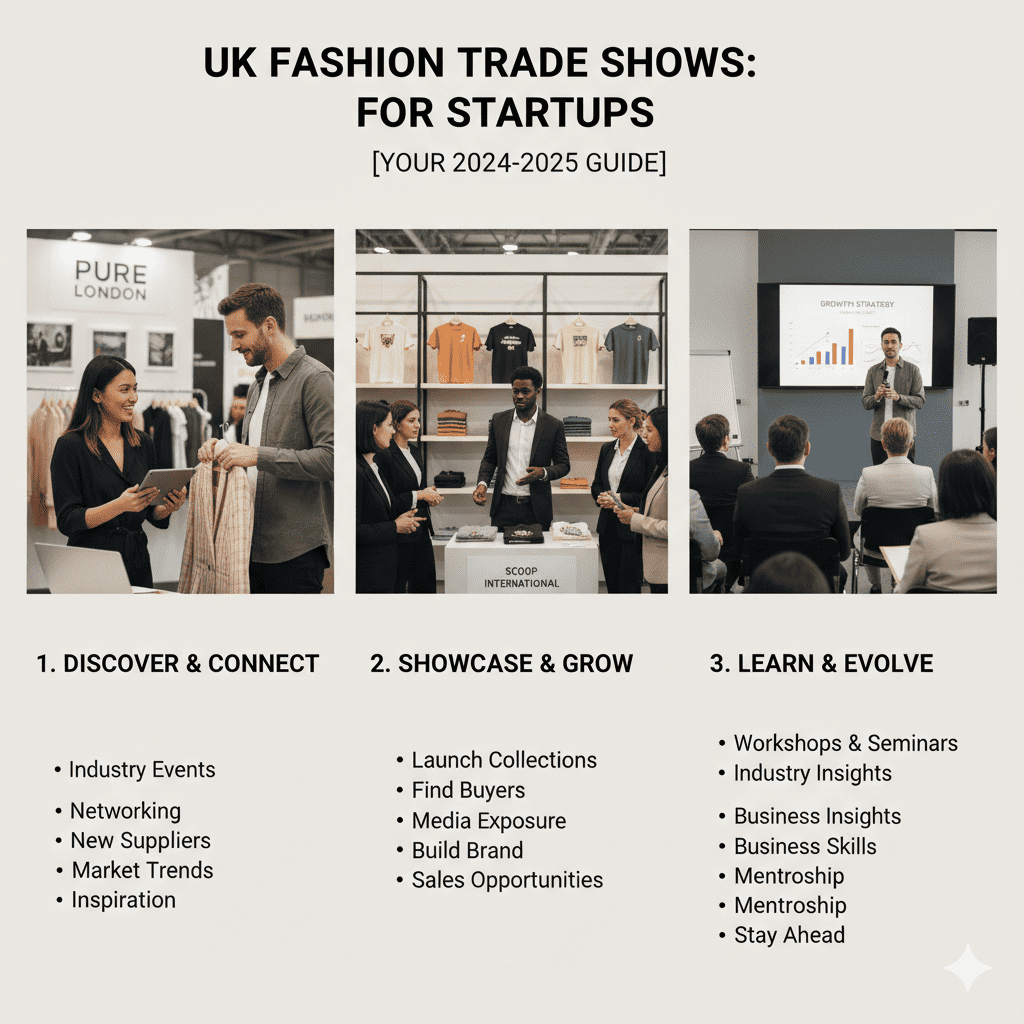
You have the product. You have the lookbook. You have no idea which trade show is worth £800 in exhibitor fees and two days of your time.
Most startup founders waste their first trade show. Wrong event, wrong format, wrong expectations. The ones who get it right spend three months preparing for a single room and leave with wholesale relationships that fund the next production run.
Here’s what the UK fashion trade show landscape actually looks like in 2026, and how to use it properly.
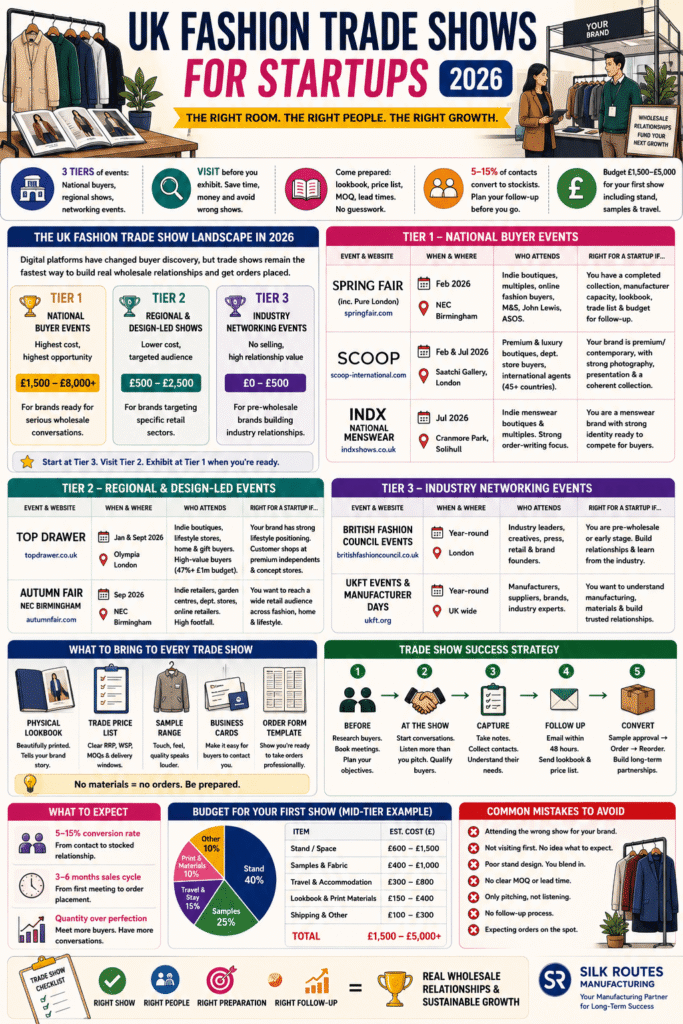
- The UK fashion trade show calendar splits into three tiers: national buyer events (highest cost, highest opportunity), regional and niche shows (lower cost, targeted audience), and industry networking events (no selling, high relationship value)
- Most startup clothing brands should attend as a visitor before exhibiting — the intelligence gathered in one visit as a buyer saves thousands in misdirected exhibitor spend
- A trade show without a physical lookbook, a trade price list, and a clear MOQ and lead time confirmation is a wasted stand
- The realistic conversion rate from trade show contact to stocked wholesale relationship is 5 to 15% — plan your follow-up process before you arrive
- Budget £1,500 to £5,000 for a first exhibitor appearance at a mid-tier UK fashion trade show including stand, materials, travel, and samples
Contents
- 1.
- 2. Tier 1 — National Buyer Events
- 3. Tier 2 — Regional and Design-Led Events
- 4. Tier 3 — Industry Networking Events
- 5. How to Prepare for a Trade Show as an Exhibitor
- 6. Visiting Before Exhibiting
- 7. The Follow-Up Process Is More Important Than the Show
- 8. Trade Show Budget for a UK Startup Brand
- 9. Common Trade Show Mistakes UK Startup Brands Make
- 10. FAQ
- 10.1. Which UK trade show is best for a startup clothing brand in 2026?
- 10.2. Do I need to be an established brand to exhibit at UK fashion trade shows?
- 10.3. How many wholesale leads should I expect from a first trade show?
- 10.4. Is it worth paying for a premium stand position at a first trade show?
- 10.5. Can I use a digital lookbook instead of a printed one at a trade show?
- 11. The Show Is the Beginning, Not the Destination
The UK fashion trade show calendar has consolidated significantly in the last few years. Digital wholesale platforms — Faire, Ankorstore, NuORDER — have absorbed a meaningful share of the buyer discovery process that trade shows once monopolised, and several standalone fashion shows have merged into larger multi-sector events rather than running independently.
What remains is more focused. Buyers who attend trade shows in 2026 are there specifically to discover new brands, build relationships, and place orders they cannot place through a screen. That selectivity is an opportunity for a startup brand, if you’re in the right room.
In our experience, independent boutique buyers and department store buyers still use trade shows as a primary discovery channel for new brands, particularly for brands under two years old with no existing wholesale relationships or press profile.
The three tiers of UK fashion trade events:
| Tier | Type | Exhibitor Cost | Best For |
|---|---|---|---|
| 1 | National buyer events (Spring Fair incl. Pure London, Scoop, INDX National Menswear) | £1,500–£8,000+ | Brands ready for serious wholesale conversations |
| 2 | Regional and design-led shows (Top Drawer, Autumn Fair) | £500–£2,500 | Brands targeting specific retail sectors |
| 3 | Industry networking events (BFC events, UKFT days, incubator shows) | £0–£500 | Pre-wholesale brands building industry relationships |
Start at Tier 3. Visit Tier 2. Exhibit at Tier 1 when you’re ready.
Tier 1 — National Buyer Events
Spring Fair (incorporating Pure London)
What it is: Pure London, formerly the UK’s largest standalone fashion trade show, has merged into Spring Fair at NEC Birmingham. The combined event now runs once a year in February and includes a dedicated “Fashion at Spring Fair” section covering womenswear, menswear, accessories, and lifestyle, alongside Spring Fair’s broader home, gift, and retail categories.
Who attends as buyers: independent boutique owners, multiples buyers, online fashion buyers, and major retailers including M&S, John Lewis, and ASOS.
Right for a startup if: you have a completed collection, a confirmed manufacturer and reorder capacity, a professional lookbook and trade price list, and a budget for the stand plus a 3-month follow-up period.
Website: purelondon.com (now redirects to the combined Spring Fair event)
Scoop
What it is: premium and contemporary womenswear trade show, held twice annually at Saatchi Gallery, London (February and July). Curated, not all brands are accepted. Smaller and more selective than the Spring Fair fashion halls.
Who attends as buyers: premium and luxury boutique buyers, department store buyers, international agents from over 45 countries. Quality over quantity.
Right for a startup if: your brand sits firmly in the premium or contemporary market, your product photography and presentation are at a professional level, and your collection has coherence and editorial clarity.
Website: scoop-international.com
INDX National Menswear Show
What it is: the UK’s current dedicated menswear order-writing trade show, held at Cranmore Park, Solihull. Jacket Required, the menswear show startups were previously pointed to, is no longer running as a standalone event — INDX has become the primary UK menswear trade fixture in its place.
Who attends as buyers: independent menswear boutiques and multiples, with a strong order-writing focus rather than just discovery.
Right for a startup if: your product sits in menswear and your brand identity is strong enough to compete for buyer attention against over 150 exhibiting brands.
Website: indxshows.co.uk
Tier 2 — Regional and Design-Led Events
Top Drawer
What it is: design-led lifestyle, gift, and fashion trade show held twice annually at Olympia London (January and September). Fashion is one of several curated sectors alongside home, gift, wellbeing, and play — and the show has absorbed what used to be the standalone Pulse event as one of its integrated sectors.
Who attends as buyers: independent boutique owners, lifestyle store buyers, and increasingly higher-value buyers — the most recent edition reported a 47% increase in buyers with £1m+ budgets.
Right for a startup if: your brand has a strong lifestyle positioning and your customer shops at premium independents alongside homeware and gift destinations.
Website: topdrawer.co.uk
Autumn Fair and Spring Fair (NEC Birmingham)
What it is: the UK’s largest trade fair for gifts, home, and fashion retail, held at NEC Birmingham. Spring Fair now also hosts the “Fashion at Spring Fair” section described above.
Who attends as buyers: mass-market retail buyers, gift buyers, and independent retailers across all categories. Very broad audience.
Right for a startup if: your brand targets mainstream independent retail rather than premium boutiques, and your price points sit in the accessible-to-mid range.
Website: autumnfair.com
Tier 3 — Industry Networking Events
These are not selling events. They’re relationship and intelligence events, and for a pre-wholesale startup, they’re the highest-ROI use of trade show budget.
British Fashion Council Events. The BFC runs a calendar of industry events, workshops, and networking sessions throughout the year, many open to emerging brand founders at low or no cost. The BFC’s New Designers showcase is specifically designed for emerging brands making their first wholesale contacts.
UKFT Industry Days. UKFT runs regular member events and industry briefings relevant to UK clothing manufacturers and brands. For a startup working on its first or second production run, UKFT membership provides access to manufacturer directories, compliance guidance, and networking events directly relevant to the manufacturing relationship that underpins every wholesale conversation.
Incubator and Accelerator Showcases. London College of Fashion, Central Saint Martins, and the BFC’s NEWGEN and Fashion Trust programmes all run showcase events where emerging brands present to buyers and press. These are highly selective but represent some of the highest-quality buyer introductions available to a brand at the startup stage, because the curation itself signals quality to attending buyers.
If you’re at the stage of confirming your first UK manufacturing partnership, see our clothing manufacturing services before you commit to a stand — you’ll need your MOQ and lead time confirmed for every trade show conversation anyway.
How to Prepare for a Trade Show as an Exhibitor
A trade show stand without the right materials is expensive networking. A stand with the right materials is a wholesale sales process running in a room full of buyers.
The non-negotiable exhibitor checklist:
Physical lookbook — minimum 50 copies. A4 or A5, professionally printed, wire-bound or perfect-bound. Not a USB drive. Not a QR code to your website. A physical document a buyer can take away, annotate, and return to.
Trade price list — wholesale price (WSP), recommended retail price (RRP), available colourways, sizes, and delivery window. One page. Clear format. Available immediately when a buyer asks.
Samples — minimum one sample per style in your hero colourway. Pressed, labelled, and displayed at their best. Buyers will handle them. Quality is assessed in 10 seconds of holding the garment.
Order form or terms sheet — MOQ per style, payment terms (deposit percentage, balance trigger), lead time from order to delivery. A buyer who wants to place an order at the show needs to know these numbers immediately.
Business cards — with your name, brand, website, email, and phone. Simple. Printed, not digital.
Stand display — a 3m × 2m shell scheme stand needs: a branded back panel or banner (£150 to £300), a rail for garment display, a small table for the lookbook and order forms, and good lighting. Don’t overfill the space.
“The brands that convert trade show contacts to wholesale orders are almost always the ones who arrive with everything resolved. The buyers don’t come back to chase you for a price list. If you can’t hand them a complete trade pack in the first two minutes of a conversation, the conversation ends.” — Silk Routes Manufacturing Team
Buyer decisions at trade shows tend to come down to brand presentation quality and product clarity more than price. A startup brand with a strong physical presence and coherent trade materials consistently outperforms a more established brand with a weak stand.
Visiting Before Exhibiting
The most valuable trade show investment for a startup brand is a visitor ticket, not an exhibitor stand.
Visiting as a trade buyer (most shows issue free or low-cost trade visitor passes) before exhibiting gives you:
- Direct intelligence on which buyers attend and what they’re looking for
- A clear view of how established brands at your tier present their product
- Stand layout ideas you can replicate at significantly lower cost
- Direct conversations with buyers — as a visitor, you can approach anyone
- A realistic assessment of whether the show’s buyer profile matches your wholesale target
Visit the show you plan to exhibit at, in the season before you exhibit. Walk every stand in your product category. Note which brands have the best buyer engagement. Understand what the buyers are asking about. That intelligence is worth more than the exhibitor stand it informs.
The Follow-Up Process Is More Important Than the Show
A trade show contact with no follow-up is a business card in a recycling bin.
The conversion rate from trade show contact to stocked wholesale relationship for a startup brand is realistically 5 to 15%. That means 85 to 95% of conversations won’t convert, and the ones that do convert almost always require a structured follow-up process, not just a single email.
The follow-up sequence that works:
Day 1 after show: personalised email to every buyer contact — reference the specific conversation, attach the lookbook PDF, confirm WSP, MOQ, and delivery window.
Day 7: follow-up email if no response, one sentence, direct ask: “Would you like to see samples, or shall I send a trade pack to your buying office?”
Day 21: final follow-up — offer to send physical samples to their store or buying office at no charge.
Day 30+: move non-responders to a seasonal update list. Send collection updates each season. Some wholesale relationships take 12 to 18 months from first trade show contact to first order.
The follow-up isn’t a sales process. It’s a relationship process. The buyer who doesn’t order at the show may order in three months, six months, or a year, if the brand has stayed in contact and the product has developed.
Trade Show Budget for a UK Startup Brand
| Item | Budget Option | Mid-Range |
|---|---|---|
| Exhibitor stand (shell scheme) | £1,500 (Tier 2) | £3,500 (Tier 1) |
| Stand design / back panel | £150 | £400 |
| Printed lookbooks (50 copies) | £150 | £350 |
| Samples (per style) | £80–£250 | £200–£500 |
| Travel and accommodation (2 days) | £100–£300 | £300–£600 |
| Stand fittings (rail, table, lighting) | £100 | £300 |
| Business cards (500) | £30 | £80 |
| Total first exhibitor appearance | £2,110–£2,780 | £5,130–£6,230 |
The realistic minimum budget for a credible first exhibitor appearance at a mid-tier UK fashion trade show is approximately £2,000 to £3,000 all-in. Below that, the stand presentation quality drops to a level that actively undermines the brand’s wholesale credibility.
Common Trade Show Mistakes UK Startup Brands Make
Exhibiting before visiting. Paying for a stand at a show you’ve never attended produces a stand designed around assumptions rather than intelligence.
Fix: visit as a trade buyer in the season before you exhibit. One visit as a visitor is worth three times the exhibitor investment that follows.
No physical lookbook on the stand. A buyer who asks for a lookbook and receives a QR code is a buyer who has already mentally moved on.
Fix: print a minimum of 50 physical lookbooks before the show. Budget £150 to £350 for trade-quality print.
Not knowing the MOQ and lead time before the show. A buyer who asks “what’s your minimum order and how long does it take?” and receives an uncertain answer doesn’t come back.
Fix: confirm your MOQ, your lead time from order to delivery, and your reorder lead time with your manufacturer before the show.
Failing to collect structured contact information. A business card with no context about the conversation is useless for follow-up.
Fix: keep a contact sheet or notebook. For every conversation, note: buyer name, company, what they were interested in, what you agreed to send, and by when.
No samples to send post-show. A buyer who expressed interest at the show, received the follow-up email, and asked to see a sample, but waited three weeks for it to arrive, is unlikely to convert.
Fix: retain a minimum of two samples per style specifically for post-show buyer requests, ready to ship within 48 hours of a request.
FAQ
Which UK trade show is best for a startup clothing brand in 2026?
For menswear, INDX National Menswear Show is currently the UK’s dedicated menswear trade fixture, following the closure of Jacket Required. For womenswear, Scoop offers a lower barrier to entry than the Spring Fair fashion halls, with a curatorial bias toward emerging and independent labels. Visit before you commit to exhibiting, to check the buyer profile matches your wholesale target.
Do I need to be an established brand to exhibit at UK fashion trade shows?
No, but you need to be production-ready. A brand with a completed first production run, a clear reorder capacity, a professional lookbook, and a confirmed trade price list is ready to exhibit. A brand with a concept, a mood board, and a manufacturer enquiry in progress is not.
How many wholesale leads should I expect from a first trade show?
Realistic expectations: 20 to 50 meaningful conversations over two days, 5 to 15 strong leads who request a follow-up, 1 to 5 who progress to sample requests, and 0 to 3 who place a first order within 90 days. Most wholesale relationships that start at a trade show convert over multiple show cycles, not immediately.
Is it worth paying for a premium stand position at a first trade show?
No. A well-presented shell scheme stand in a standard position with strong product, a physical lookbook, and a confident founder on the stand outperforms a premium position with a weak brand presentation.
Can I use a digital lookbook instead of a printed one at a trade show?
Not as your primary material. Physical printed lookbooks are what buyers take away, annotate, share with colleagues, and return to when ready to place an order. A digital lookbook as a supplement (emailed after the show) is appropriate and useful.
The Show Is the Beginning, Not the Destination
A trade show is not where wholesale relationships are closed. It’s where they begin.
The brands that build wholesale revenue from trade shows are the ones that treat the show as the opening conversation in a 6 to 18-month relationship-building process. They arrive prepared, they present professionally, they follow up consistently, and they return to the show each season with a collection that has evolved.
The foundation of every wholesale conversation at a trade show is the same: can you supply? In what volume? In what timeframe? Answering those questions confidently requires a manufacturing relationship that’s already confirmed and tested. Our complete guide to UK clothing manufacturers for low MOQ and private label production covers how to build that foundation before you enter any wholesale conversation.
Ready to confirm your production capacity before your first trade show appearance? Find out how Silk Routes works with startup brands from first run to reorder.