
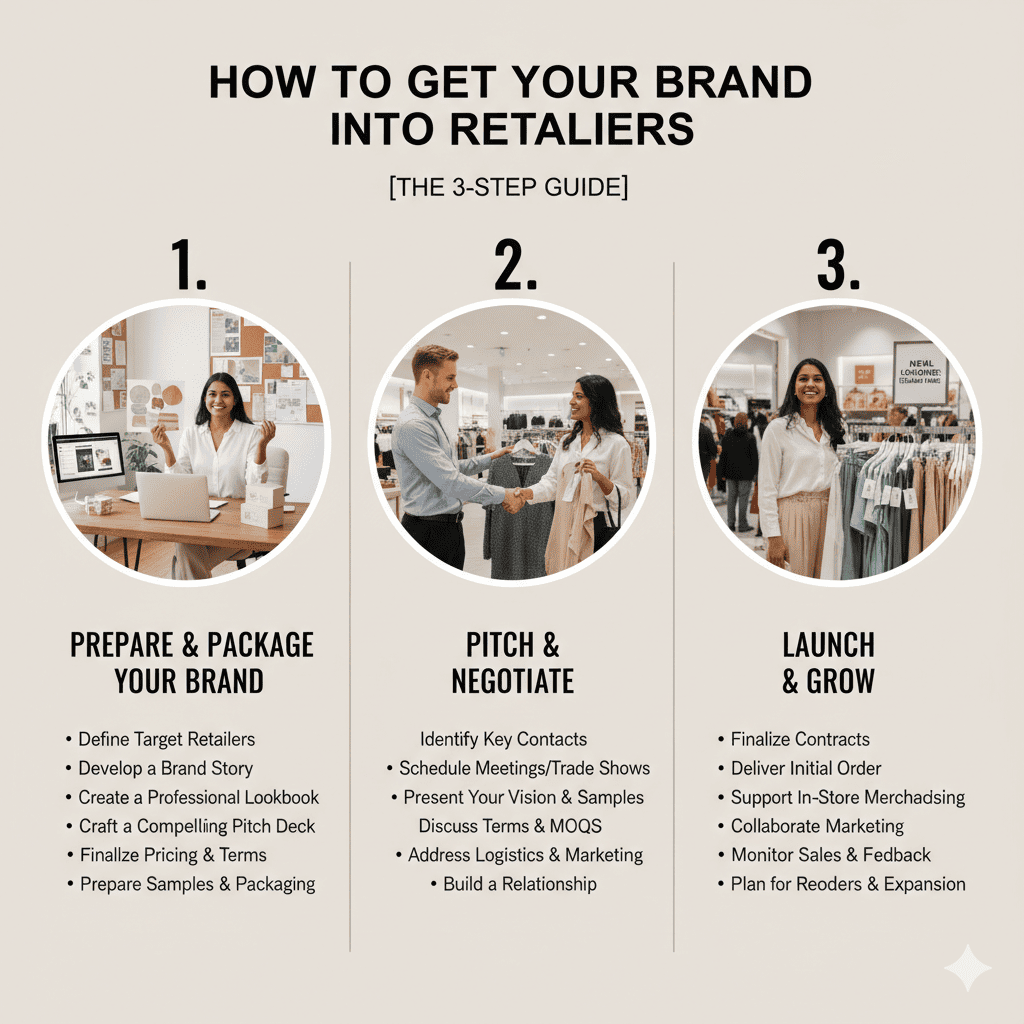
Priya had been making cold calls to boutiques for three months. She had sent forty lookbooks. She had received two polite rejections and thirty-eight silences.
Her product was good. Her photography was strong. Her pricing was right. What she was missing was not better product — it was understanding how retail buyers actually make decisions, and what a brand needs to demonstrate before a buyer will take the risk of a first order.
This guide covers what Priya learned — and what most startup guides never explain.
Summary
- Retail buyers make stocking decisions based on four criteria: brand clarity, product credibility, supply reliability, and commercial viability — most startup brands fail on supply reliability before the conversation begins
- Independent boutiques are the correct first wholesale target for a startup — not department stores, not multiples — and even boutiques require a minimum of 6 to 12 styles to take a meaningful first order
- The direct approach (cold email with lookbook) has a conversion rate of 1 to 3% — the warm approach (introduction through a shared contact, show, or press mention) converts at 10 to 25%
- A brand that cannot confirm its MOQ, lead time, and reorder capacity in the first conversation will not be taken seriously by any buyer
- The wholesale relationship is built over multiple seasons — first orders are small, reorders are where the commercial relationship becomes meaningful
Contents
- 1. How Retail Buyers Actually Make Decisions
- 2. Which Retailers to Target First
- 3. Building the Trade Pack
- 4. How to Approach Buyers
- 5. The Buyer Conversation
- 6. Consignment vs Firm Orders
- 7. Sale or Return: The Variant to Avoid
- 8. Building the Wholesale Relationship Over Time
- 9. Common Mistakes Brands Make Approaching Retailers
- 10. FAQ
- 11. What Priya Did Differently
- 12. Citations and Sources
How Retail Buyers Actually Make Decisions
Most startup guides describe getting into retailers as a sales process. It is not. It is a risk assessment process — and the buyer is assessing whether your brand will make their job easier or harder.
A retail buyer’s job is to find products that sell, arrive on time, and generate repeat customer visits. A new brand that fails to deliver on any of those three dimensions reflects directly on the buyer who stocked it.
The four criteria every buyer assesses — in this order:
1. Brand clarity: does this brand have a clear identity and a defined customer? A buyer who cannot immediately understand who the brand is for and why a customer would choose it over alternatives will not stock it — regardless of product quality.
2. Product credibility: is the product made well enough to justify its retail price? Buyers assess this in 30 seconds of handling the sample. The seam finish, the fabric weight, the label quality, the fit — all communicate whether the manufacturer relationship is credible.
3. Supply reliability: can this brand deliver, reorder, and maintain stock? This is where most startup brands fail. A buyer who stocks a new brand and then cannot reorder because the brand has no production capacity is a buyer who will not stock that brand again — and will tell other buyers why.
4. Commercial viability: does the margin work? A buyer who stocks your product at a wholesale price that leaves them with a 40% retail margin on a premium shelf position will not reorder.
British Fashion Council research on wholesale buyer behaviour confirms that supply reliability is the criterion most frequently cited by independent boutique buyers as the reason they do not repeat stock an emerging brand — ahead of both product performance and sell-through rate.
Priya’s problem was criterion 3. She had a completed first run of 80 units but no confirmed reorder capacity. Every buyer she approached was being asked to take a risk on a brand that could not guarantee supply if the product sold. Buyers do not take that risk.
For a brand at this stage, confirming manufacturing capacity before approaching any buyer is essential. Our guide to low MOQ and private label clothing manufacturers UK covers how to structure a manufacturing relationship that supports wholesale commitments from the first conversation.
Which Retailers to Target First
What guides get wrong: startup brands are advised to aim high — department stores, national chains, premium boutiques. That advice accelerates failure.
Department store buyers require: a minimum of 12 to 20 styles, a proven sell-through history, a brand with press coverage, and a trading history of at least 12 to 24 months. A startup brand with one production run and no press has nothing a department store buyer needs to see.
The correct sequencing:
| Retail Target | Stage | Min Styles Required | Min Trading History |
|---|---|---|---|
| Independent boutiques | Launch to 12 months | 6–10 styles | None — but DTC sell-through data helps |
| Regional multiples | 12–24 months | 10–15 styles | 12 months+ |
| Online fashion platforms | 6–18 months | 6–12 styles | 6 months+ |
| Department stores | 24–36 months | 15–20 styles | 2 years+ |
| National chains | 36 months+ | 20+ styles | 3 years+ |
Independent boutiques are the right first target because:
- Buying decisions are made by the owner — one conversation, one decision-maker
- First orders are smaller — 3 to 10 units per style — which your MOQ can support
- Boutique owners take creative risks that corporate buyers cannot
- A successful boutique relationship generates a genuine reference for the next tier
How to find the right boutiques:
Walk the high streets and shopping districts in your target city. Identify boutiques that already stock brands at your price point and in your aesthetic. A boutique that stocks three brands similar to yours is a better target than one that stocks nothing comparable — because their buyer already understands and sells to your customer.
Building the Trade Pack
Before approaching any buyer, the trade pack must be complete. A buyer who receives an incomplete or unclear trade pack does not ask for the missing information. They move on.
Complete trade pack for a first wholesale approach:
Lookbook — physical (50+ copies) and digital (PDF under 5MB). Minimum 8 pages. Lifestyle photography, not product-only. One strong cover image. See our earlier guide to creating a lookbook for the full brief.
Line sheet — one page per collection. Product images, colourways available, sizes, wholesale price (WSP), recommended retail price (RRP), and SKU codes. Clean format. No design flourishes — buyers use line sheets as working documents.
Order form — MOQ per style, minimum order value if applicable, payment terms (50% deposit, balance on despatch is standard for first orders), delivery window.
Terms and conditions — returns policy for wholesale (faulty goods only, not sale or return for a first order), cancellation terms, exclusivity (do you offer territory exclusivity?).
Brand one-pager — one page, maximum. Who is the brand, who is the customer, what makes the product. Not a brand history. A buying pitch.
How to Approach Buyers
There are three approaches. They have very different conversion rates.
Approach 1 — Cold email (1–3% conversion)
A cold email with a lookbook attached to a buyer you have never met, with no introduction, no shared context, and no reason for the buyer to open the attachment.
Most startup brands start here. Most stay here — because the response rate is low enough that it feels like the approach is working (occasional responses) without ever generating enough momentum to understand that it is not the right primary channel.
Cold email works — eventually, at low volume, with a very large outreach list. It should be in the mix but not the primary strategy.
McKinsey’s State of Fashion research confirms that wholesale buyer email inboxes at independent boutiques receive 20 to 40 unsolicited brand approaches per week. Differentiation at the subject line and opening sentence level is the only variable a brand controls in cold outreach.
Approach 2 — Trade show introduction (10–20% conversion)
Meeting a buyer in person at a trade show, with samples on the stand and a trade pack in hand, converts at 5 to 10 times the rate of cold email. The buyer has chosen to attend a discovery event. The physical sample does the work that no email attachment can.
The trade show is the correct primary channel for first wholesale relationships — but only after the brand is production-ready, which means confirmed manufacturing capacity for reorder volumes. Our private label and low MOQ manufacturing guide covers exactly what production-ready means before a wholesale conversation.
Approach 3 — Warm introduction (15–30% conversion)
A buyer introduction through a shared contact — a designer the buyer already stocks, a press contact, a trade association connection, a showroom agent. The introduction changes the risk calculus: the buyer is receiving a recommendation from someone they trust, not an unsolicited pitch from an unknown brand.
Warm introductions are the highest-converting channel and the hardest to engineer — because they require an existing network in the industry. Building that network takes time, but it starts with attending industry events, joining UKFT, engaging with the BFC’s emerging brand programmes, and showing up to the places where buyers and brands overlap.
“Priya’s position changed when she attended a UKFT networking event and met the owner of a London boutique she had been emailing for three months. The conversation lasted seven minutes. The buyer placed a trial order two weeks later. Same brand. Same product. Different context.” — Silk Routes Manufacturing Team
The Buyer Conversation
When a buyer conversation happens — at a trade show, at a meeting, on a call — it will cover five things, in roughly this order.
1. Who is the brand and who is the customer? One sentence answer. Not a brand history. “We make precision-cut womenswear for professional women who want a garment that does not require thought — just works.” Or equivalent for your brand. Know this answer before you walk into any room.
2. Where is the product made? Buyers ask this more often than startup guides acknowledge. UK manufacture carries a specific credibility signal. If you manufacture in the UK, say so clearly. If offshore, be clear about the quality controls you apply. Buyers who stock premium product care about manufacture origin — because their customers ask.
3. What are your terms? MOQ per style. Wholesale price. Payment terms. Delivery window. These must be answered immediately and confidently. A founder who says “I’ll need to check” on any of these four questions has communicated that the business is not yet wholesale-ready.
4. Can we see samples? Yes. Always. The sample is what closes the conversation. Have a clean, labelled sample per style available immediately — either on the stand or ready to despatch within 48 hours of the meeting.
5. What is the reorder lead time? The question most startup guides do not prepare founders for. A buyer who is considering stocking your brand is thinking about their next three to six months of trading, not just the first order. “If this sells, how quickly can I reorder?” is not a casual question. It is the question that determines whether the relationship is viable.
Know your reorder lead time — confirmed with your manufacturer in writing — before you enter any buyer conversation.
Consignment vs Firm Orders
Most startup brands are offered consignment by boutiques as a first arrangement. Understand what you are being offered before you accept.
Consignment: you supply stock. The boutique pays you only for what sells. Unsold stock is returned to you.
Firm order: the boutique purchases stock upfront at the wholesale price. Unsold stock is their risk.
| Factor | Consignment | Firm Order |
|---|---|---|
| Cash flow | Poor — payment delayed until sale | Good — payment on delivery |
| Risk | Brand carries all stock risk | Buyer carries stock risk |
| Buyer commitment | Low — easy to return unsold | High — they own the stock |
| Typical for startup? | Often offered first | Target from second season |
| Acceptability | Acceptable as first arrangement | Standard from established brands |
Consignment is not ideal — but for a startup brand with no wholesale history, it is sometimes the only arrangement a boutique will offer. Accept it as a market-entry mechanism, not a long-term model. The goal is to convert consignment arrangements to firm orders within two seasons by demonstrating sell-through data.
The consignment agreement must specify: stock quantity, sale price (your RRP), consignment split (typically 60/40 — brand/retailer or brand/boutique), payment frequency (monthly), return terms, and liability for damaged goods.
Never supply consignment stock without a signed consignment agreement. Verbal consignment arrangements produce disputes over stock quantities, payment timing, and return condition.
Sale or Return: The Variant to Avoid
Sale or return (SOR) is a variant of consignment where the buyer can return anything unsold at any time, in any condition, for a full refund.
We are direct: do not accept sale or return terms as a startup brand. SOR removes every commercial incentive for the boutique to sell your product actively — they carry no risk, so display, staff training, and promotion effort are optional from their perspective.
A boutique that will only stock your brand on SOR is telling you something about how confident they are in the product’s sell-through. Use that information.
Building the Wholesale Relationship Over Time
Priya’s first firm order was for 4 units of 3 styles — £648 at wholesale. Not transformative revenue. But she delivered on time, followed up with a sell-through conversation at 6 weeks, and sent the next season’s lookbook with a personalised note about which styles had performed best in the boutique.
Her second order was 8 units across 5 styles. Her third was 15 units across the full range.
The wholesale relationship compounds. First orders are small. They are testing the supply relationship, not the product. Every brand that delivers on time, follows up professionally, and shows the buyer that they take the relationship seriously moves toward larger orders faster than brands who treat the first order as the destination rather than the starting point.
The post-order sequence that builds the relationship:
Week 2 after delivery: check-in email — has the stock arrived in good condition, is the team happy with it, is there anything the brand can do to support selling?
Week 6: sell-through conversation — what has sold, what has not, what is the customer feedback? This data informs your next production decision.
End of season: reorder conversation — based on sell-through, what should be restocked and at what quantity? Bring the next season’s lookbook to this conversation.
New season launch: personalised approach — reference last season’s best performers, show how the new collection builds on what worked, make the reorder conversation feel like a natural progression rather than a new sales pitch.
Common Mistakes Brands Make Approaching Retailers
1. Approaching department stores before independent boutiques A rejection from a department store buyer is a credibility signal in the wrong direction — it tells every subsequent buyer that the brand tried and failed at the wrong tier. Build the wholesale track record at the boutique level first.
Fix: map your retail targets by tier. Do not approach Tier 2 until you have 2 to 3 Tier 1 stocking relationships with documented sell-through data.
2. Not knowing the MOQ and lead time when a buyer asks This single piece of missing information ends more wholesale conversations than any other factor. A buyer asking “what’s your minimum and how long does it take?” is asking whether the brand is wholesale-ready.
Fix: confirm MOQ, lead time, and reorder lead time with your manufacturer in writing before approaching any buyer. Know these numbers as well as you know your RRP.
3. Accepting SOR terms without pushing back A brand that accepts SOR from every boutique that asks has no wholesale revenue — it has a distributed storage arrangement. Unsold SOR stock ties up your capital, your inventory, and your production capacity with no guaranteed return.
Fix: counter SOR with a consignment offer that includes a fixed sell-through target and a conversion to firm order within two seasons. Most boutiques will accept this as a reasonable compromise.
4. No follow-up after the trade show or initial contact The conversion rate from initial contact to stocked relationship drops by 70% without a structured follow-up. Most startup brands send one email after a trade show and consider the follow-up done.
Fix: build a three-touch follow-up sequence: immediate contact summary, 7-day sample offer, 21-day final follow-up. After that, move to a seasonal update list.
5. Treating the first order as the destination A brand that gets a first boutique order and declares victory has missed the point. The first order is a trial. The reorder is the relationship. Everything between the first order and the first reorder — delivery, communication, sell-through support — determines whether the relationship becomes commercially meaningful.
Fix: build a post-order follow-up sequence into your wholesale process before the first order ships. The delivery is not the end of the process — it is the beginning of the next stage.
FAQ
How many styles do I need before approaching retailers?
A minimum of 6 styles for independent boutiques. Buyers need enough range to create a coherent brand presence in their store — a single style does not give them that. If your collection has fewer than 6 styles, build the DTC channel first and use sell-through data to justify range expansion before approaching wholesale.
Should I use a sales agent or approach buyers directly?
Both are valid. A sales agent has existing buyer relationships and can introduce your brand into boutiques that would take months to reach through cold outreach — but agents typically take 10 to 15% commission on all orders they generate, including reorders. Approach boutiques directly for your first 5 to 10 wholesale relationships to understand the conversation before paying an agent to have it on your behalf.
What wholesale margin should I offer retailers?
Standard wholesale is 50% of RRP — you sell to the boutique at half the price they sell to the customer. At a £55 RRP, your wholesale price is £27.50. Your landed cost must leave you a viable margin at that wholesale price — typically requiring a 45 to 55% gross margin at the wholesale price. Confirm your unit economics before confirming your wholesale terms.
How long does it take to get a first wholesale order?
Realistically 3 to 9 months from first outreach to first order, for a brand approaching the market cold. Trade show introductions can compress this to 4 to 12 weeks. Warm introductions through shared contacts can produce orders within 2 to 4 weeks of the first conversation. The timeline is a function of how you reach the buyer, not how good the product is.
Do I need a showroom to approach wholesale buyers?
No — at the startup stage. A showroom is a permanent or seasonal display space where buyers can visit to see your collection. It becomes relevant when you have enough wholesale relationships to justify the cost (typically £500 to £2,000 per month in London). At the startup stage, trade shows, direct visits to boutiques, and virtual line sheet presentations serve the same function at a fraction of the cost.
What Priya Did Differently
Six months after that UKFT networking event, Priya had five boutique stocking relationships, three firm-order accounts, and two consignment arrangements she was converting to firm orders at the end of the season.
Her manufacturing relationship was confirmed with reorder capacity for 150 units per style. Her trade pack was complete. Her follow-up process ran on a calendar.
The product had not changed. The manufacturing had not changed. What had changed was that she understood what buyers needed to hear — and could answer every question they asked, immediately, with confidence.
That confidence comes from one place: a manufacturing relationship that is confirmed, tested, and capable of delivering on the commitments made in every wholesale conversation. Our complete guide to UK clothing manufacturers for low MOQ and private label production covers how to build that foundation before you enter any retail conversation.
Ready to confirm your production capacity before your first wholesale approach? Find out how Silk Routes works with startup brands from first sample to reorder.
Citations and Sources
[1]. British Fashion Council — Reports and Research. https://www.britishfashioncouncil.co.uk/About/Reports
[2]. McKinsey & Company — The State of Fashion 2024. https://www.mckinsey.com/industries/retail/our-insights/state-of-fashion-2024
[3]. UKFT — UK Fashion & Textile Industry: Facts and Figures 2024. https://ukft.org/facts-and-figures24/
[4]. Textile Exchange — Materials Market Report 2023. https://textileexchange.org/knowledge-center/reports/materials-market-report-2023/
[5]. UK Government — Consumer Rights Act 2015. https://www.legislation.gov.uk/ukpga/2015/15/contents