
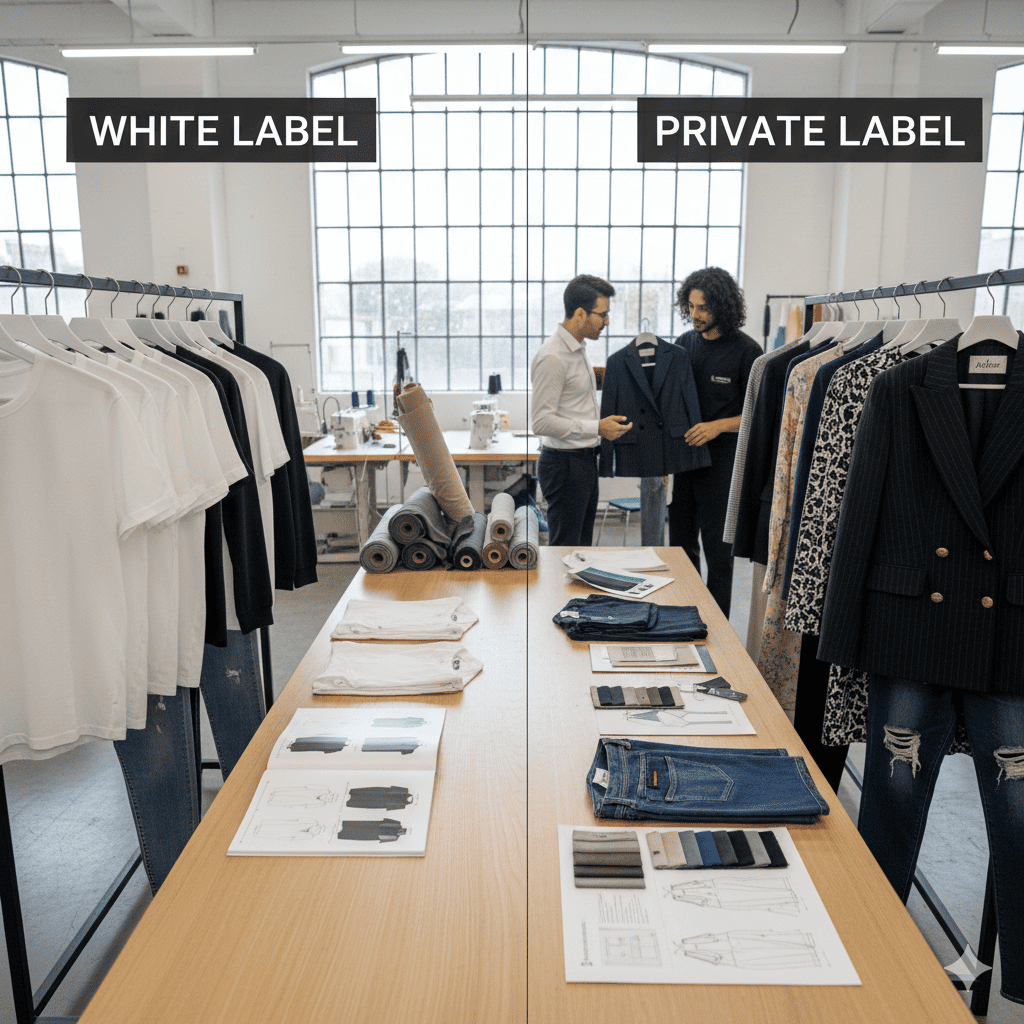
Every startup guide tells you white label is the smart, low-risk way into clothing. Most of them skip the part where you’re renting someone else’s product, not building your own.
The distinction between private label and white label isn’t semantic. It determines how much control you have, how defensible your brand is, and whether you’re building an asset or borrowing one.
Here’s what the difference actually looks like in practice — and which model fits where you are right now.
In this guide:
- The real difference between private label and white label (not just “who puts the label on”)
- How each model works in practice, from brief to finished garment
- Cost and MOQ comparison at low and mid volume
- Speed to market — and why fast isn’t always the right answer
- Which model fits your brand stage
- Five mistakes startups make when choosing between the two
Contents
- 1. Private Label vs White Label — What’s the Actual Difference?
- 2. How Private Label Manufacturing Works
- 3. How White Label Manufacturing Works
- 4. The Real Cost Difference
- 5. MOQ Comparison: Which Model Has Lower Minimums?
- 6. Speed to Market: Which Is Faster?
- 7. Which Model Fits Your Brand Stage?
- 8. Five Mistakes Startups Make Choosing Between the Two
- 9. FAQ
- 10. The Decision That Shapes Your Brand’s First Two Years
Private Label vs White Label — What’s the Actual Difference?
The common mistake is treating both as “manufacturer puts your label in it.” They’re not the same product relationship at all.
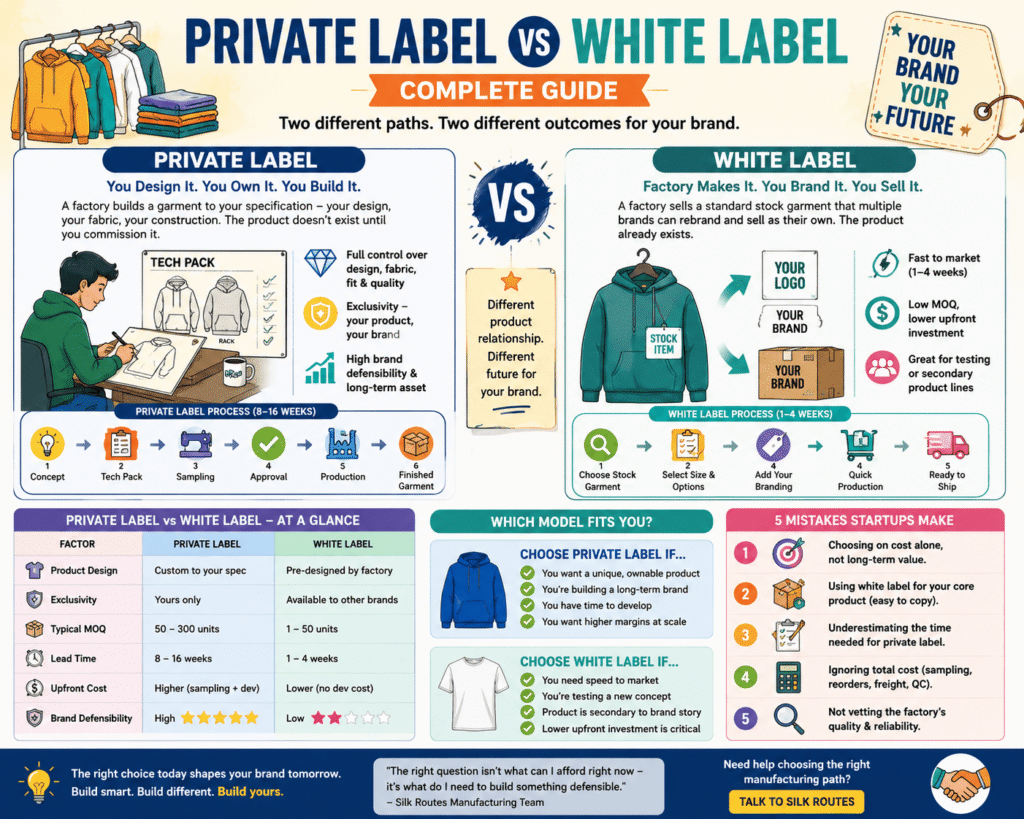
Private label means a factory builds a garment to your specification — your design, your fabric, your construction brief. The product doesn’t exist until you commission it.
White label means a factory sells a standard stock garment that multiple brands can rebrand and sell as their own. The product already exists; you’re buying access to it.
| Factor | Private Label | White Label |
|---|---|---|
| Product design | Custom to your spec | Pre-designed by factory |
| Exclusivity | Yours only | Available to other brands |
| Typical MOQ | 50–300 units | 1–50 units |
| Lead time | 8–16 weeks | 1–4 weeks |
| Brand defensibility | High | Low |
That table makes private label look more demanding. It is — and that’s exactly why it builds something white label can’t.
How Private Label Manufacturing Works
Private label runs concept → tech pack → sampling → approval → production. Every stage needs a decision from you, and every decision shapes a garment no other brand will sell.
The factory produces nothing until your spec is confirmed, which is why lead times stretch to 8–16 weeks from approved tech pack to finished goods. In exchange, you get full control over fabric, construction, fit, and finish.
What guides get wrong: private label is often framed as suitable only for well-funded brands. UK CMT manufacturers regularly work with startups from 50 units, particularly on jersey and woven basics where construction is straightforward.
The real barrier isn’t budget — it’s preparation. Brands that arrive without a tech pack or fabric references waste factory time, and end up paying for it in extra sampling rounds.
For a full breakdown of finding the right private label partner, our guide to low MOQ and private label clothing manufacturers UK covers the selection process in detail.
How White Label Manufacturing Works
White label skips the development stage entirely. You select from a factory’s existing range, specify sizing where possible, and apply your branding.
The factory has already invested in design, pattern, and fabric — you’re buying into that investment at a fraction of the development cost. Lead times can be as short as one to two weeks for stock items, with MOQs as low as a single unit from some suppliers.
What guides get wrong: white label is often sold as a cheap testing step before private label. For some brands that logic holds; for others it creates a problem that’s expensive to unwind.
If a competitor can buy the same base garment and undercut you on price, your differentiation rests entirely on marketing. That’s a fragile position the moment a better-funded brand finds the same stock item.
White label works best when the garment is genuinely secondary to the brand story — accessories, basics, branded workwear — where the product is a vehicle for identity rather than the identity itself.
The Real Cost Difference
The cost gap between private label and white label is front-loaded, not total. Private label carries tech pack and sampling costs before a single unit is made; white label carries none of that.
“We see brands make this decision on budget alone, and it creates problems six months in when they realise their product has no differentiation. The right question isn’t what can I afford right now — it’s what do I need to build something defensible.” — Silk Routes Manufacturing Team
Once your tech pack is approved and your first run is complete, reorders on private label get faster and cheaper — the development cost is already sunk. At higher volume, unit economics between the two models start to converge; the gap that really matters sits in the first 50–100 units.
McKinsey’s State of Fashion analysis has flagged brand marketing moving back into the spotlight as fashion companies shift away from pure performance marketing toward building emotional, long-term brand connections — a trend that favours differentiated, owned products over identical stock ones.
If your launch budget is under roughly £3,000 all-in, white label is the honest recommendation. Talk to the Silk Routes team about your manufacturing options if you’re not sure which side of that line you sit on.
MOQ Comparison: Which Model Has Lower Minimums?
White label wins on MOQ, but the comparison needs context.
| Model | Typical MOQ | Applies To |
|---|---|---|
| White label (stock) | 1–50 units | Per style |
| White label (custom label) | 10–30 units | Per colourway |
| Private label CMT | 30–100 units | Per style per colourway |
| Private label full-service | 100–300 units | Per style per colourway |
What guides get wrong: a low white label MOQ often hides a constraint — limited size range, no fit modification, fixed fabric weight. You’re accepting someone else’s product decisions in exchange for the lower minimum.
The honest comparison isn’t just the number — it’s what you’re committing to at that number. A 30-unit white label order gives you 30 units of a generic garment; a 50-unit private label order gives you 50 units of a product you own outright.
Speed to Market: Which Is Faster?
White label is faster, and that’s not in dispute. Private label typically runs 10–21 weeks from brief to delivery; white label can land in 1–4 weeks from a stock pick.
What guides get wrong: speed is treated as an unqualified advantage. A brand launching for a fixed date — a campaign, a crowdfunding window — has a genuine case for white label speed.
A brand building a product-led identity gets little from that speed if the product is indistinguishable from three competitors. Speed is a tactical advantage; product ownership is a strategic one.
Which Model Fits Your Brand Stage?
“White label makes sense when you’re testing a market or launching a brand where the garment is a vehicle rather than the product. Private label makes sense when the garment is central to your identity and you’ve done the preparation to enter manufacturing ready.” — Silk Routes Manufacturing Team
Three signals private label fits your stage:
- Your brand story depends on what the product is, not just what’s on the label
- You have — or can develop — a tech pack before approaching factories
- You’re planning reorders, so development cost amortises across runs
Three signals white label fits your stage:
- You’re validating demand before committing to custom development
- Your launch timeline is under eight weeks
- Construction differentiation matters less than brand identity for your category
If you’re weighing this alongside everything else in a manufacturer decision, our framework for choosing a UK clothing manufacturer walks through the full checklist.
Five Mistakes Startups Make Choosing Between the Two
Treating white label as permanent rather than a launch tool. Brands that build long-term on white label stock struggle to create product barriers competitors can’t copy. Fix: set a volume or revenue trigger before you start, at which you move to private label.
Writing off private label after one bad sample. Every first sample is wrong in some way — that’s what sampling is for. Fix: budget two to three sampling rounds into your development cost from the outset.
Applying private label branding language to a white label product. Calling a rebranded stock item “our exclusive design” is misleading if another brand sells the identical garment. UK product labelling law requires that claims about a product be accurate. Fix: brand white label on the story and curation, never on construction you don’t own.
Confusing OEM and ODM language with factories. OEM means you provide the design; ODM means the factory does. Fix: state explicitly, “we want to provide our own design” or “we want to select from your existing range,” when you first speak to a factory.
Not checking territorial exclusivity on white label stock. Some suppliers sell the same SKU to dozens of UK brands with no protection. Fix: ask directly whether the item is available to other UK brands before you commit.
FAQ
Can I start with white label and move to private label later?
Yes, and many UK brands follow that path. Set a clear trigger point — typically 200–300 units sold — at which you begin private label development.
Does white label always mean no design input?
Not entirely. Some suppliers offer limited customisation like colour or trim changes within their existing range, sometimes called bespoke private label in the UK market.
What does private label cost to set up in the UK?
Budget roughly £500–£1,500 for tech pack development and two sampling rounds, plus your production cost on top. A simple 50-unit jersey run typically brings total investment to first delivery to somewhere between £1,200 and £4,000.
Is white label clothing legal to sell as your own brand in the UK?
Yes, provided you’re not making false claims about the product’s origin, construction, or exclusivity. UK labelling law requires that statements about a product be accurate and not misleading.
Which model gives better margins long-term?
Private label, at sufficient volume — once development costs are sunk, reorder unit costs approach white label levels while your retail price can carry a premium for genuine differentiation.
The Decision That Shapes Your Brand’s First Two Years
The choice between private label and white label isn’t a production decision — it’s a brand strategy decision that happens to involve a factory.
White label gets you to market fast with minimal commitment. Private label gets you a product you own and a manufacturing relationship that scales with your business.
The British Fashion Council’s Institute of Positive Fashion work with UK brands consistently points to the same pattern — the brands that last are the ones building genuine product ownership, not just brand marketing on top of a generic item.
Most startups that launch on white label and succeed treat it as a mechanism, not a destination. Ready to work out which model fits your product? Find out how Silk Routes supports startup brands from first sample to full production.