
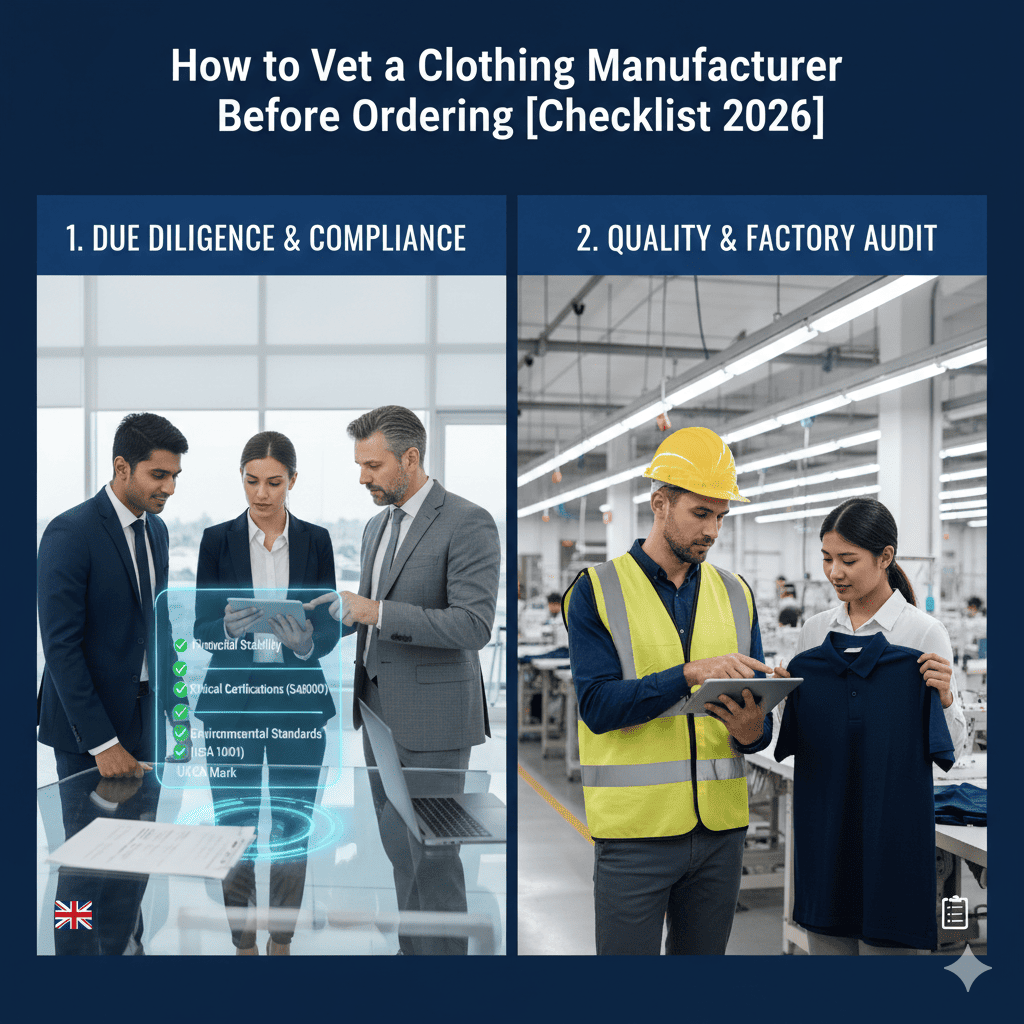
Priya placed her first production order with a UK manufacturer she found through a Google search. She had exchanged emails, received a price list, and felt reassured by the professional-looking website. She paid a 50% deposit. The delivery date passed. The manufacturer stopped responding. The deposit was lost.
Six months later, with a delayed launch and no stock, Priya rebuilt from scratch, this time with a vetting process. The manufacturer she eventually worked with had been trading for eleven years, held a SEDEX membership, provided three verifiable references, and allowed a factory visit before she placed a penny.
The difference between the first manufacturer and the second was not obvious from a Google search. It was only visible through systematic due diligence. This guide covers every step of that process, including a 20-point checklist you can use before committing to any manufacturer, UK or offshore.
For the broader context on UK manufacturing sourcing, see our Complete Guide to Clothing Manufacturers in UK.
Post Summary
- Clothing manufacturer fraud and non-performance is not rare; UK trading standards bodies see clothing deposit fraud as a recurring pattern
- Companies House verification is the most basic and most commonly skipped step; any legitimate UK manufacturer will have a registered company number, filed accounts, and a trading history
- A sample order before any bulk commitment is not optional, it is the only reliable quality signal; do not place a bulk order without a sample from that specific factory
- Three references, contacted directly and specifically, should be a non-negotiable requirement from any manufacturer seeking an order above £2,000
- SEDEX, used by over 100,000 companies worldwide, and SMETA certification are the most accessible third-party audit credentials for UK and offshore manufacturers
- The 20-point checklist at the bottom of this article covers every category that experienced fashion brands assess before committing to a new manufacturer
Contents
- 1. Why Vetting a Manufacturer Before Ordering Saves Money
- 2. Step 1 — Companies House and Online Verification
- 3. Step 2 — Request a Sample Before Any Bulk Commitment
- 4. Step 3 — Ask for References and Check Them
- 5. Step 4 — The Factory Visit Checklist
- 6. Step 5 — Review the Contract Before Signing
- 7. Red Flags That Should Stop You Proceeding
- 8. 20-Point Manufacturer Vetting Checklist
- 9. Manufacturer Vetting: Questions Brands Ask Us
- 9.1. How do I check if a UK clothing manufacturer is legitimate?
- 9.2. Do I need to sign a contract with a clothing manufacturer?
- 9.3. What is SEDEX and why does it matter for manufacturer vetting?
- 9.4. Can I vet a manufacturer without visiting their factory?
- 9.5. What should I do if a manufacturer fails to deliver?
- 10. The Checklist Exists Because the Industry Needs It
Why Vetting a Manufacturer Before Ordering Saves Money
The cost of a failed manufacturer relationship typically includes the lost deposit (30–50% of order value), the cost of emergency re-sourcing, the delayed launch window, the markdown cost of late-season stock, and in the worst cases, the reputational damage of failing to fulfil wholesale commitments.
Against this, the cost of thorough vetting is a few hours of research, a sample order (recoverable against bulk), and a factory visit where geographically practical.
The UKFT’s member support function regularly handles cases where brands have paid deposits to manufacturers who subsequently fail to deliver, a pattern documented by UK trading standards authorities across the garment sector. The majority of these cases involve manufacturers who could not have passed a basic four-stage vetting process.
Vetting is not a bureaucratic box-tick. It is the mechanism by which you distinguish between a manufacturer worth working with and one who will cost you everything you put in.
Step 1 — Companies House and Online Verification
Every legitimate UK-registered clothing manufacturer will be registered at Companies House. This is the starting point for any vetting process, not a supplementary check.
What to check at Companies House (free):
Confirm the company is active, not dissolved, dormant, or in administration. Confirm the registered address matches the address the manufacturer has given you. Check the SIC code, a genuine clothing manufacturer will have a relevant SIC code (14.xx for clothing manufacturing). Review filed accounts: for a manufacturer you intend to place a significant order with, review at least the last two years. Trading history and company size should be consistent with their claims. Check director history: look for directors associated with previously dissolved or struck-off companies in the same sector.
Beyond Companies House:
Search the company name and director names for any news coverage, trading standards notices, or consumer complaints. Verify the factory’s physical address using Google Street View or Google Maps, confirm it shows a credible manufacturing premises, not a residential address. Check whether the manufacturer has a LinkedIn company page, an active website with genuine product imagery, and a real trading presence online. AI-generated or stock photography on a manufacturer’s website should prompt further scrutiny.
For Made in Britain certification holders, verify membership at madeinbritain.org/members/sector/clothing-apparel, the searchable directory for Clothing & Apparel members specifically. For SEDEX members, any manufacturer claiming SEDEX membership should be able to provide their SEDEX member ID for confirmation.
For offshore manufacturers:
Apply the equivalent verification for the relevant jurisdiction. For Turkey, check the Turkish Trade Registry. For Bangladesh, the BGMEA maintains a member directory at bgmea.com.bd. For Portugal, CITEVE provides industry registration verification.
Step 2 — Request a Sample Before Any Bulk Commitment
No sample, no order. This is not a negotiating position, it is a non-negotiable requirement.
A physical sample from the specific factory is the only reliable signal of the actual quality, construction accuracy, and specification compliance you will receive at bulk. A manufacturer who refuses to produce a sample, asks for an unusually high sample charge without explanation, or delivers a sample that was clearly not produced in their own factory has already failed the vetting process.
What to assess on receipt of a sample:
Construction accuracy: does the garment match your tech pack precisely, seam allowances, stitch types, construction method? Measurement accuracy: measure every critical measurement against your size specification; tolerances should be within ±0.5cm for most measurements, tighter for fitted garments. Fabric compliance: is the fabric the correct weight, composition, and hand-feel to the specification? Finishing quality: check button attachment, zip function, label placement, hem evenness, and any embellishment or print registration. Consistency: if you have requested more than one sample, check consistency across them.
Sample order terms:
Sample charges are normal and legitimate. UK manufacturers typically charge £50–£200 per sample depending on complexity; offshore factories vary widely. Agree in writing whether the sample charge is deductible against the bulk order on placement. Pay the sample charge, evaluate the sample rigorously, and use the outcome to decide whether to proceed.
Step 3 — Ask for References and Check Them
Every manufacturer you consider placing an order with should provide a minimum of three client references. These should be named contacts (not a generic company email), verifiable (you can independently confirm the reference company exists and operates in the clothing sector), and contactable directly by you, not via a manufacturer-prepared testimonial document.
What to ask a reference:
How long have you been working with this manufacturer? Have they ever missed a delivery date, and how did they handle it? What is the quality consistency like across multiple orders? Have there been any disputes, and were they resolved fairly? Would you use them again for your next order?
A manufacturer who cannot provide three client references has either not served three clients, or has served clients who would not recommend them. A manufacturer who offers to provide references “after you place a deposit” has inverted the correct order of operations.
For offshore manufacturers, ask references to confirm the specific factory name and location you are evaluating matches their direct supplier, not merely that they recognise the brand name you mention. Offshore agent-led sourcing sometimes routes orders through undisclosed subcontractors; references can only verify what they have directly experienced.
Step 4 — The Factory Visit Checklist
For UK manufacturers, a factory visit before placing a first order is the most reliable single vetting step available and costs nothing beyond travel time. For offshore manufacturers, a video call production walkthrough is an accessible substitute, and third-party quality inspection companies (SGS, Bureau Veritas, Intertek) offer on-site AQL inspection services for first-time offshore production runs.
What to assess during a factory visit:
| Category | What to look for |
|---|---|
| Premises | Active production — machines running, workers present, work in progress visible. A factory that cannot show you active production has no active production |
| Equipment | Appropriate machinery for the garment types you need, industrial sewing machines, overlockers, pressing equipment, in maintained condition |
| Workforce | Skilled machinists working; staff-to-floor ratio consistent with claimed capacity |
| Quality control | A dedicated QC area or process visible; ask how they handle a garment that fails QC mid-production |
| Pattern and cutting | Cutting tables, pattern storage (paper or digital CAD system), grading capability |
| Sample room | A dedicated sample/development area; a factory without a sample room cannot develop new styles reliably |
| MOQ and capacity | Ask specifically: how many units can you produce in a typical four-week window? |
| Communication | Who is your dedicated account contact? How are technical queries handled? |
Red flags during a factory visit: a polished showroom but no production floor; machinery that is clearly not operational; workers who appear staged; a visit confined to a reception area; claimed capacity that cannot be corroborated by visible workforce or floor space.
For how Silk Routes structures new client relationships and what documentation we provide, our clothing manufacturing services page covers our process.
Step 5 — Review the Contract Before Signing
A legitimate manufacturer will have, or be willing to produce, a written manufacturing agreement. Do not proceed without one.
Key terms a manufacturing agreement should cover:
Delivery and lead time: confirmed delivery dates, not ranges, with a penalty clause or agreed remedy for late delivery. Specification compliance: the agreement should reference your approved sample and tech pack as the quality benchmark, with deviation entitling you to rejection and re-production at the manufacturer’s cost. IP and pattern ownership: confirm in writing that all patterns, blocks, and technical files developed for your designs remain your intellectual property. Subcontracting clause: confirm whether the manufacturer is permitted to subcontract any part of your order to third parties. Deposit and payment terms: confirm the deposit percentage, what it secures, and under what circumstances it is refundable if the manufacturer fails to perform. Confidentiality: for brands with proprietary designs, a basic NDA should be in place before you share detailed tech packs or design files with any manufacturer.
If a manufacturer is unwilling to sign a written agreement covering these terms, that is the answer to whether you should work with them.
Red Flags That Should Stop You Proceeding
No Companies House registration for a claimed UK manufacturer. The entity you are dealing with is not operating as a registered UK business. There is no legal structure through which to pursue a dispute, no filed accounts to assess financial health, and no accountability mechanism. Stop immediately.
Request for full payment upfront before any sample. Legitimate manufacturers do not request 100% payment before producing a sample. A full upfront payment request before sample approval is the signature pattern of deposit fraud in the clothing sector.
Prices significantly below the credible market range. UK CMT production cannot be priced at £2 per unit for a complex garment. Prices that are 40–60% below comparables are either wrong (the manufacturer cannot deliver at that price) or the garment will not be produced in the UK.
No physical premises to verify. A manufacturer who cannot provide a verifiable factory address, refuses a visit, and delivers only a mobile number and personal email address is operating without a manufacturing premises.
References that cannot be verified or contacted. If references provided by a manufacturer cannot be independently verified or do not respond to direct contact, treat the references as absent.
Pressure to commit quickly. Legitimate manufacturers have order books. They do not need to pressure you into committing before due diligence is complete. Urgency is a sales tactic; in this context, it is a red flag.
Resistance to a written contract. A manufacturer who is unwilling to put agreed terms in writing is either unable or unwilling to commit to them. That is the information you need.
20-Point Manufacturer Vetting Checklist
Legal and business verification
| # | Check | Status |
|---|---|---|
| 1 | Companies House registration confirmed active | ☐ |
| 2 | Registered address matches factory address | ☐ |
| 3 | SIC code consistent with garment manufacturing | ☐ |
| 4 | Filed accounts reviewed, trading history verified | ☐ |
| 5 | Director history checked, no pattern of dissolved companies | ☐ |
Premises and production verification
| # | Check | Status |
|---|---|---|
| 6 | Physical factory address independently verified | ☐ |
| 7 | Factory visit completed OR video walkthrough conducted | ☐ |
| 8 | Active production visible during visit | ☐ |
| 9 | Appropriate machinery for product type confirmed | ☐ |
| 10 | Dedicated sample/development area observed | ☐ |
Quality and compliance
| # | Check | Status |
|---|---|---|
| 11 | Sample ordered and evaluated against spec | ☐ |
| 12 | Measurement accuracy within tolerance confirmed | ☐ |
| 13 | Fabric composition and weight verified | ☐ |
| 14 | SEDEX / BSCI / ISO 9001 membership confirmed (where applicable) | ☐ |
| 15 | Made in Britain certification checked (for UK manufacturers) | ☐ |
References and reputation
| # | Check | Status |
|---|---|---|
| 16 | Three verifiable client references provided | ☐ |
| 17 | References contacted directly and responses received | ☐ |
| 18 | No adverse media, trading standards notices, or complaints found | ☐ |
Commercial and contractual
| # | Check | Status |
|---|---|---|
| 19 | Written manufacturing agreement reviewed covering all key terms | ☐ |
| 20 | IP ownership, subcontracting clause, and delivery terms confirmed in writing | ☐ |
A manufacturer who cannot pass all 20 checks is a manufacturer you are taking a material risk on. The appropriate response is either to resolve the failing items before proceeding, or to source a different manufacturer.
Manufacturer Vetting: Questions Brands Ask Us
How do I check if a UK clothing manufacturer is legitimate?
Start with Companies House, search by company name or number to confirm the manufacturer is registered, active, and has filed recent accounts. Verify the registered address matches the factory address. Then request a sample order, speak to at least three references directly, and visit the factory if practically possible. Use the 20-point checklist in this article as your complete framework.
Do I need to sign a contract with a clothing manufacturer?
Yes. A written manufacturing agreement covering delivery dates, specification compliance, IP ownership, payment terms, and subcontracting is the minimum contractual protection for any order of meaningful size. A manufacturer who will not sign a written agreement has given you all the information you need.
What is SEDEX and why does it matter for manufacturer vetting?
SEDEX (Supplier Ethical Data Exchange) is a platform and audit programme used by over 100,000 companies worldwide for ethical supply chain compliance. A manufacturer with SEDEX membership has completed a self-assessment on labour standards, health and safety, environment, and business ethics. Many carry an additional SMETA (Sedex Members Ethical Trade Audit) certification, a third-party on-site verification. Confirm membership directly with the manufacturer before relying on it.
Can I vet a manufacturer without visiting their factory?
For UK domestic manufacturers, a factory visit is strongly recommended; it’s free beyond travel cost and provides the most reliable quality signal available. For offshore manufacturers, a video call production walkthrough is an accessible substitute. Third-party quality inspection companies (SGS, Bureau Veritas, Intertek) offer on-site AQL inspection services for offshore factories, worth commissioning for any first-time offshore production run.
What should I do if a manufacturer fails to deliver?
If a manufacturer has a written agreement in place, enforce it, including any late delivery clause or refund provision. For UK manufacturers, trading standards authorities can investigate deposit fraud and non-performance. Citizens Advice and the Chartered Trading Standards Institute (CTSI) provide guidance. In serious cases, a solicitor’s letter or County Court claim may be appropriate. The most effective protection remains prevention through thorough vetting before any order is placed.
The Checklist Exists Because the Industry Needs It
Priya’s first manufacturer was not unusual. The pattern of a professional-looking website, a deposit paid, and a supplier who subsequently cannot be reached is common enough that trading standards bodies have documented it specifically in the clothing sector.
The 20-point checklist in this guide exists because experienced fashion brands have learned, often expensively, that every item on it matters. A manufacturer who passes 19 out of 20 has one unresolved risk. The purpose of the list is to surface that risk before you pay, not after.
Our Complete Guide to Clothing Manufacturers in UK covers the full sourcing framework that sits around this vetting process, from how to find candidates to how to structure the long-term relationship once a manufacturer has passed.