
A clothing brand can run out of money before the first proper sample is approved.
The idea may be strong. The mood board may look right. The logo may be ready. Then a factory says the minimum order is 3,000 units per style, and the project suddenly feels too risky.
That is where low MOQ clothing manufacturers UK become valuable. They help new and growing brands test products without gambling on thousands of garments before demand is proven.
At Silk Routes, we work with brands that need flexibility, honest production advice, and private label support without losing control of quality.
This guide explains how low MOQ and private label manufacturing work in practice, what it costs, where the risks sit, and how to choose the right UK production partner.
Contents
- 1. Quick Answer
- 2. Post Summary
- 3. What Does “Low MOQ” Actually Mean in Clothing Manufacturing?
- 4. Why Are More Brands Choosing Private Label Manufacturing?
- 5. Low MOQ vs Traditional Manufacturing: What Is the Real Difference?
- 6. Why Choose a UK-Based Low MOQ Manufacturer?
- 7. How Do You Choose the Right Low MOQ Private Label Manufacturer?
- 8. What Services Should a Good Private Label Manufacturer Offer?
- 9. Which Product Categories Work Best With Low MOQ?
- 10. How Is AI Changing Low MOQ Clothing Manufacturing?
- 11. Common Mistakes When Working With Low MOQ Manufacturers
- 12. What Does a Typical Low MOQ Production Timeline Look Like?
- 13. How Much Does Low MOQ Private Label Manufacturing Cost in the UK?
- 14. How Should You Brief Your Manufacturer?
- 15. How Do You Build a Long-Term Relationship With Your Manufacturer?
- 16. How Can a Brand Scale From Low MOQ to Larger Runs?
- 17. What Should You Understand Before Working With a UK Clothing Manufacturer?
- 17.1. Learn the UK Manufacturing Landscape
- 17.2. Find and Vet the Right Factory
- 17.3. Understand Bespoke and Custom Production
- 17.4. Understand Production Models
- 17.5. Plan Cost and Payment Terms
- 17.6. Protect Your Design and Brand
- 17.7. Understand Skills and UK Production Capacity
- 17.8. Check Brexit and Supply Chain Issues
- 18. What Is the Silk Routes Approach to Low MOQ Manufacturing?
- 19. What Should You Do Before Starting Your First Production Run?
- 20. Frequently Asked Questions
- 20.1. What is considered a low MOQ in UK clothing manufacturing?
- 20.2. Can I get samples before placing a bulk order?
- 20.3. How does private label differ from white label clothing?
- 20.4. Do UK clothing manufacturers cost more than overseas factories?
- 20.5. What if my clothing design is not production-ready?
- 20.6. Is sustainable manufacturing possible with low MOQ?
- 21. Citations and Sources
- 22. 📊 Low MOQ & Private Label — Key Numbers
- 23. 💷 Unit Cost by Garment Type (100–300 Units)
- 24. ⚖️ Low MOQ vs Traditional Manufacturing
- 25. 📅 Low MOQ Production Timeline (50–300 Units)
- 26. 🧮 Quick Cost Estimator
- 27. 🚀 The Scaling Journey
- 28. 🤖 AI in Fashion: Market Growth Projection
- 29. 🏷️ Private Label vs White Label
Quick Answer
Low MOQ clothing manufacturers in the UK typically accept orders from 50 to 300 units per style or colourway. Private label means the factory produces garments to your specifications under your brand name, including labels, trims, fabrics, fit, and packaging. UK-based production usually gives lead times of around 4 to 8 weeks after sample approval, depending on fabric and complexity. Unit costs can range from £8 for basic T-shirts to £60+ for structured or tailored pieces. The global private label clothing market was valued at around $15 billion in 2025, growing at roughly 8% annually. The safest route is to sample first, test demand, then scale only the styles that sell.
Post Summary
- Low MOQ clothing manufacturers in the UK help startups test products with smaller runs, usually 50–300 units.
- Private label manufacturing lets brands control their own labels, fabrics, fit, packaging, and identity.
- UK manufacturing offers faster lead times, easier communication, better quality checks, and lower transport risk.
- Sampling is essential before bulk production because it protects the brand from costly mistakes.
- Good manufacturers should offer design support, pattern making, fabric sourcing, CMT production, labelling, and packaging.
- Common mistakes include choosing only on price, skipping samples, vague briefs, ignoring fabric minimums, and underestimating lead times.
- Brands should start small, test demand, then scale only the styles that sell.
What Does “Low MOQ” Actually Mean in Clothing Manufacturing?
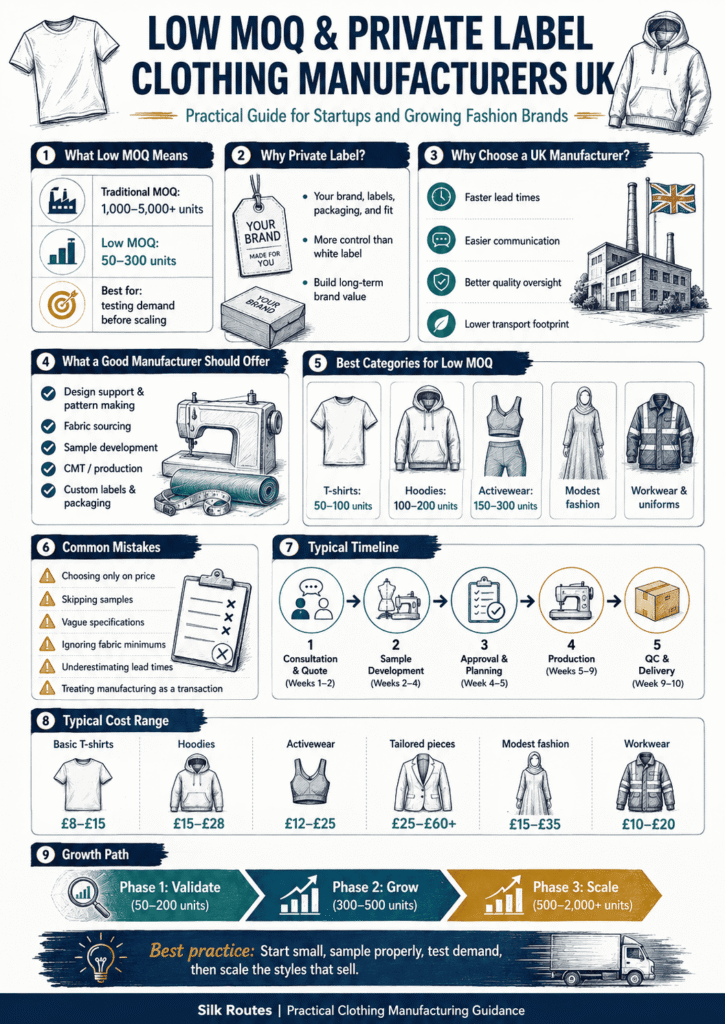
Minimum order quantity means the smallest number of garments a manufacturer will produce per style, colour, or size run.
The phrase sounds simple. The reality is more complicated.
A traditional overseas factory may set a minimum order of 1,000 to 5,000 units per colourway. For a startup testing 3 colours across 5 sizes, that can mean thousands of garments before a single customer order comes in.
That is not smart validation. That is inventory risk.
A low MOQ garment manufacturer UK usually works with smaller production runs, often from 50 to 300 units. Some UK manufacturers, including Silk Routes, can structure more flexible runs depending on garment type, fabric, trims, and production method.
Low MOQ does not mean there is no production floor. Cutting, pattern work, machine setup, thread changes, labelling, pressing, and quality checks all take time.
Our view is direct: a factory claiming “no minimum” should be questioned carefully. Genuine low MOQ production usually starts around 50 units for simple garments. Below that point, proper factory production becomes difficult to price fairly.
Our opinion: any manufacturer claiming no minimum at all is either overstating its flexibility or cutting corners somewhere you cannot see.
Why Are More Brands Choosing Private Label Manufacturing?
The private label clothing manufacturing service market was estimated at around $15 billion in 2025, with forecast growth at a CAGR of around 8% through 2033 (Source: Market Report Analytics, 2025).
Private label manufacturing means the factory makes garments under your brand name. The product carries your labels, your packaging, your fit decisions, and your quality standard.
This model sits behind many independent fashion brands, boutique labels, modest fashion brands, workwear suppliers, and e-commerce clothing businesses.
Three changes have pushed private label forward.
E-commerce has lowered the barrier to launching a clothing brand. A Shopify site, a small photoshoot, and a focused social media launch can put a new product in front of customers without a high street buyer.
Customers now buy from smaller brands when the product feels specific. Fit, niche identity, ethical sourcing, local production, and story can matter as much as price.
Private label also gives the founder control. You can change the fabric, shape, colour, label, packaging, and production quantity instead of accepting whatever a wholesaler already has.
Our opinion: private label fails when founders skip product development. It succeeds when the brand treats the manufacturer as a production partner, not a cheap supplier found during a late-night search.
Private Label Is Not the Same as White Label
White label usually means buying a pre-made blank product and adding your brand. Private label gives more control over the garment itself.
Private label can include your pattern, your fabric choice, your measurements, your trims, your care labels, and your packaging. That control is why private label costs more than basic blank stock.
| Feature | White Label | Private Label |
|---|---|---|
| Garment design | Pre-made | Built to your specification |
| Fit control | Limited | High |
| Fabric choice | Limited | Flexible |
| Branding | Usually label or print only | Labels, trims, packaging, and finish |
| MOQ | Often lower | Usually higher |
| Differentiation | Weak | Stronger |
| Best for | Fast resale | Long-term brand building |
Our opinion: white label can work for fast testing. Private label is stronger when the brand needs a product that customers cannot buy from ten other stores.
Low MOQ vs Traditional Manufacturing: What Is the Real Difference?
Traditional manufacturing is built for scale. Low MOQ manufacturing is built for testing, controlled growth, and smaller production runs.
Most guides focus only on unit cost. That misses the bigger issue.
| Feature | Traditional Manufacturing | Low MOQ Manufacturing |
|---|---|---|
| Minimum order | 1,000–5,000+ units per style | 50–300 units per style |
| Lead time | Often 8–16 weeks or longer | Often 4–8 weeks after approval |
| Unit cost | Lower per unit | Higher per unit |
| Cash risk | High | Lower |
| Flexibility | Limited once production starts | Easier to adjust |
| Sampling control | Slower if overseas | Easier with UK access |
| Best for | Proven demand and repeat styles | Startups, new collections, tests |
| Quality oversight | Harder at distance | Easier with local production |
The lowest unit cost is not useful if half the stock remains unsold. Dead inventory is one of the most expensive mistakes a new brand can make.
Paying £2 more per garment may look expensive on a spreadsheet. Holding 2,000 unsold garments is worse.
We have seen brands chase the lowest unit price and lose money because the order size was wrong. The garment was not always bad. The decision was.
Our opinion: start with low MOQ for every unproven style. Validate demand first. Improve the product second. Scale only after the numbers are clear.
The Hidden Cost of Cheap Production
Cheap production often hides cost in other places.
You may pay less per unit but pay more through shipping, duties, returns, defects, delay, storage, and slow communication. Those costs rarely appear in the first quote.
A UK run may look more expensive at first. After freight, customs, corrections, and delayed launch costs are included, the difference can shrink quickly.
The correct comparison is not UK unit price versus overseas unit price. The correct comparison is total landed cost, time risk, and the cost of mistakes.
Why Choose a UK-Based Low MOQ Manufacturer?
A UK-based manufacturer gives speed, access, and clearer communication. Those advantages matter most when a brand is new and the product still needs adjustment.
A founder can visit the factory, review samples quickly, touch fabrics, check finishing, and discuss problems in the same working day. That is difficult when the factory is thousands of miles away.
Proximity Means Faster Decisions
Local production makes product development faster. A sample can be reviewed, altered, and approved without long shipping delays.
Clothing is physical. A photograph cannot fully show weight, stretch, drape, recovery, stitching tension, or hand feel.
Our opinion: the first production run benefits most from UK manufacturing because the learning curve is steep. Once the product is proven, the brand can make a more informed scale decision.
Communication Has Fewer Gaps
A clothing manufacturer for startups UK should be able to explain production clearly. The founder should not need to decode vague replies, time-zone delays, or translated technical comments.
Small misunderstandings create large defects. A collar measurement, sleeve tolerance, seam finish, or label position can change the final product.
Quality and Compliance Are Easier to Control
UK production makes quality checks easier to oversee. You can inspect samples, approve pre-production pieces, and raise concerns before the full order is finished.
UKFT and Oxford Economics have reported that the UK fashion and textile sector contributes significantly to the economy and supports large-scale employment (Source: UKFT & Oxford Economics, 2023).
Smaller Transport Footprint
Local production can reduce transport distance compared with importing finished garments from overseas. That alone does not make a garment sustainable, but it is one practical part of a better supply chain.
WRAP has reported major textile waste challenges in the UK, including large volumes of used textiles entering general waste streams (Source: WRAP, 2024). Producing closer to demand and avoiding overproduction helps reduce avoidable waste.
Our opinion: sustainability claims should be specific. “Made locally,” “smaller run,” “reduced transport distance,” and “lower overproduction risk” are stronger than vague claims that cannot be proved.
How Do You Choose the Right Low MOQ Private Label Manufacturer?
The cheapest quote is rarely the best value. The right manufacturer is the one that fits your product, quantity, timeline, quality level, and communication needs.
A factory that makes jersey basics may not be the right choice for structured tailoring. A denim specialist may not be the right partner for silk dresses.
Check Product Category Experience
Ask what the factory makes most often. If your product is activewear, ask about stretch fabric, flatlock seams, recovery, and sweat-wicking fabrics.
A manufacturer does not need to make every product category. It needs to be strong in yours.
Our opinion: a focused factory is better than a factory that says yes to everything. Manufacturing rewards specialisation.
Ask for Samples Before Bulk Production
Garment sampling UK is not an optional extra. It is the point where the design becomes real.
A sample shows fit, fabric behaviour, seam finish, label position, size balance, and construction quality.
A £150 sample can prevent a £5,000 production mistake. That is not an expense. It is protection.
Get the True MOQ in Writing
Ask for the real minimum, not only the advertised minimum. A factory may say 50 units, but a fabric supplier may need a higher order. A print supplier may charge setup fees.
| Area to Check | Question to Ask | Why It Matters | Risk if Ignored |
|---|---|---|---|
| Garment MOQ | What is the minimum per style and colour? | Sets production floor | Order becomes unaffordable |
| Fabric MOQ | What is the supplier’s fabric minimum? | Fabric may drive total cost | Excess fabric waste |
| Label MOQ | What is the minimum for woven labels? | Branding cost can rise | Delayed labelling |
| Print setup | Is there a screen or digital setup fee? | Affects small runs | Quote changes later |
| Sampling fee | What does the sample include? | Controls development cost | Extra rounds surprise the brand |
| Delivery cost | Is shipping included? | Affects total landed cost | Margin calculation is wrong |
Our opinion: if a manufacturer cannot explain the full cost structure clearly, do not move into sampling yet.
Check Private Labelling Capability
A private label partner should handle woven labels, printed care labels, hang tags, packaging requirements, and barcode or SKU needs where relevant. Outsourcing every label and packaging task to separate suppliers can work, but it adds coordination risk.
Ask About Ethical Practice Without Accepting Vague Answers
Ask how the garments are made, who makes them, what standards are followed, and how quality is checked.
Our opinion: a factory visit tells you more than a sales page. The cutting table, sample rail, sewing line, and finishing area reveal how the business really works.
What Services Should a Good Private Label Manufacturer Offer?
A good private label partner does more than sew garments. The manufacturer should help turn a design idea into a production-ready product.
Design Assistance and Pattern Making
Many founders do not arrive with a complete tech pack. A bespoke clothing manufacturer UK should be able to translate sketches and references into measurements, pattern work, construction notes, and sampling steps.
At Silk Routes, our clothing manufacturing services page explains how we support brands from early product planning through production.
Our opinion: a 15-minute technical review can save weeks. Most sampling problems start in the brief, not on the sewing machine.
Fabric Sourcing
Garment sourcing UK requires supplier relationships. Startups rarely have access to the right fabric mills, wholesalers, and trim suppliers at sensible quantities.
A hoodie brand may need heavy brushed fleece. An activewear brand may need stretch recovery. Each choice affects cost and MOQ.
Sample Development
Sampling is the first real test. Expect at least 1 to 2 rounds for most new styles.
Our opinion: the sample is not only for the founder. It is also the factory’s instruction document for production.
Cut, Make, and Trim
A CMT manufacturer UK handles cutting fabric, sewing garments, trimming threads, finishing details, and preparing garments for inspection.
Stitch tension, seam allowance, edge finish, pressing, and consistency all affect the final product.
Custom Labelling and Packaging
Private label production should include woven neck labels, printed care labels, size tabs, swing tags, branded poly bags, tissue, and stickers.
Our opinion: private label work should be judged by the whole product, not only the stitching. A strong garment with careless labelling still feels unfinished.
Which Product Categories Work Best With Low MOQ?
Not every garment is equally suited to small batch fashion production. The best first product is usually focused, repeatable, and easy to explain to customers.
T-Shirts and Basic Tops
T-shirts are the entry point for many brands. MOQs can often start around 50 units for simple jersey styles.
We worked with a London streetwear startup that came with one oversized T-shirt idea, a sketch, and a fabric swatch. We developed the pattern, sourced a 220gsm organic cotton jersey, and produced 150 units across 3 colourways.
The brand sold out within 6 weeks through Instagram and a Shoreditch pop-up. It returned for 400 units, and the higher quantity reduced the unit cost by 18%.
That is the low MOQ model working properly. Test small, prove demand, then scale the style that sells.
Hoodies and Sweatshirts
Hoodies and sweatshirts are strong for streetwear, teamwear, fitness brands, and lifestyle labels. Expect MOQs around 100 to 200 units for most private label hoodie projects.
Activewear and Athleisure
Activewear has higher technical demands. Technical fabrics can carry higher supplier minimums, so MOQs may sit around 150 to 300 units.
Our opinion: activewear should never be rushed. A legging that fails squat testing or loses shape after 3 washes can damage a brand quickly.
Modest Fashion
Modest fashion continues to create opportunities for UK-based brands. Abayas, maxi dresses, tunics, longline shirts, and coordinated sets can work well in low MOQ if fabric sourcing is controlled.
Workwear and Uniforms
Workwear and uniforms often need repeat supply, custom branding, embroidery, colour consistency, and durability. Wholesale clothing manufacturing and low MOQ production can overlap here.
Fashion Startup Packages
Fashion startup manufacturers sometimes offer packages that combine design help, sampling, and first production.
Our opinion: bundled startup support is useful only when the deliverables are clear.
How Is AI Changing Low MOQ Clothing Manufacturing?
McKinsey’s State of Fashion 2026 report found that more than 35% of fashion executives already use generative AI across areas such as customer service, product discovery, and content creation (Source: McKinsey & Company, 2026).
The global AI in fashion market is projected to grow from approximately $3.14 billion in 2025 to over $60 billion by 2034 (Source: Precedence Research, 2025).
For small brands, the practical value is not AI hype. It is better production decisions.
At Silk Routes, we tested AI-assisted pattern nesting on a 200-unit hoodie run and reduced fabric waste by around 11%. That saved the client more than £280 on one production run.
That is the kind of AI result that matters. Not a dramatic claim. A measurable saving.
Where AI Helps Small Clothing Brands
AI can support demand forecasting from sales data, customer search behaviour, and pre-orders. It can also improve cutting plans by reducing fabric waste during marker making.
Our opinion: AI should not replace product judgement. It should reduce avoidable waste, improve planning, and help the brand ask better questions before ordering stock.
Where AI Does Not Help Yet
AI cannot feel fabric, judge drape properly, fix a bad pattern by itself, or replace a skilled sample machinist. The strongest use of AI in low MOQ production is practical: reduce waste, plan quantities, forecast demand, and catch defects faster.
Common Mistakes When Working With Low MOQ Manufacturers
Mistake 1: Choosing Solely on Price
Why it happens: startups watch every pound and compare only the headline quote.
Exact fix: ask for a full cost breakdown covering fabric, CMT, trims, labels, packaging, sampling, and delivery.
Mistake 2: Skipping the Sampling Stage
Why it happens: founders want to save £50 to £200 or move quickly.
Exact fix: budget for sampling before production. No exception.
Mistake 3: Giving Vague Specifications
Why it happens: first-time founders know the look they want but not the technical language a factory needs.
Exact fix: provide measurements, reference images, Pantone colours, fabric preferences, and construction notes.
Mistake 4: Ignoring Fabric Minimums
Why it happens: brands assume the garment MOQ is the only minimum.
Exact fix: ask about fabric, rib, lining, buttons, zips, labels, and embroidery minimums before approving the quote.
Mistake 5: Underestimating Lead Times
Why it happens: low MOQ sounds fast, so founders expect production to start immediately.
Exact fix: allow time for consultation, fabric sourcing, sampling, revisions, approval, production, and delivery. A realistic UK timeline is often 8 to 10 weeks.
Mistake 6: Treating Manufacturing as a Transaction
Why it happens: brands think production is just sending specs and receiving garments.
Exact fix: communicate clearly, answer questions quickly, approve samples on time, and treat the production team as a partner.
Our opinion: manufacturing is relationship work as much as technical work. The factory that understands your standards over 3 seasons becomes more valuable every year.
What Does a Typical Low MOQ Production Timeline Look Like?
For UK low MOQ production, 8 to 10 weeks from first consultation to delivery is a sensible planning range for many products.
Weeks 1–2: Consultation and Quoting
The brand shares design concepts, target price, reference garments, fabric ideas, and launch deadline. The manufacturer checks feasibility and prepares a quote.
Weeks 2–4: Sample Development
The first sample is produced. The brand reviews fit, fabric, length, seams, trims, and overall finish. Most styles need 1 to 2 rounds of sampling.
Week 4–5: Approval and Production Planning
Once the sample is approved, the manufacturer confirms fabric, trims, labels, colourways, sizes, and production schedule.
Weeks 5–9: Production
The garments are cut, sewn, finished, labelled, pressed, checked, and packed.
Week 9–10: Final Inspection and Delivery
Final garments are checked, packed, and sent to the brand.
Our opinion: add 2 weeks of buffer to your launch plan. Fabric delays, label delays, and courier problems are normal production risks.
How Much Does Low MOQ Private Label Manufacturing Cost in the UK?
The UK apparel market is projected to generate revenue of around $88.86 billion in 2025 (Source: Statista, 2025).
| Garment Type | Unit Cost at 100–300 Units | Typical MOQ | Main Variables |
|---|---|---|---|
| Basic cotton T-shirts | £8–£15 | 50–100 units | Fabric weight, print method, neck finish |
| Hoodies | £15–£28 | 100–200 units | Fleece weight, embroidery, rib quality |
| Activewear | £12–£25 | 150–300 units | Technical fabric, panel count, stitching |
| Tailored pieces | £25–£60+ | 100–200 units | Lining, structure, pattern work |
| Modest fashion | £15–£35 | 100–200 units | Drape, fabric width, embellishment |
| Workwear and uniforms | £10–£20 | 50–150 units | Logo, durability, repeat supply |
These are working ranges, not fixed prices. For a detailed project quote, use Silk Routes clothing manufacturing services.
Our opinion: a manufacturer that refuses to itemise costs is asking you to trust a number you cannot inspect.
How Should You Think About Margin?
A founder should not price the garment only from production cost. Add packaging, photography, returns, payment fees, marketing, and wholesale margin if boutiques are involved.
A £15 production cost can easily become a £25 landed and selling cost once the full business model is included.
Our opinion: build the margin model before sampling.
How Should You Brief Your Manufacturer?
Clothing brand development UK projects often fail early because the founder has a visual idea but not enough technical detail.
Start With a Clear Design Reference
Send a tech pack if you have one. If you do not, send sketches, reference garments, product photos, and measurements. Do not send only a mood board.
Include Fabric Preferences
A basic cotton jersey, 220gsm organic cotton, French terry, brushed fleece, rib, twill, satin, or technical stretch fabric will all behave differently.
Specify Size Range and Fit
A range from S to XXL is different from XXS to 5XL. Extended sizing needs proper grading, not careless scaling.
Provide Branding Assets
Send logo files in vector format where possible. Include Pantone references, label dimensions, and packaging expectations.
Share Budget and Timeline Honestly
A manufacturer can guide fabric and construction choices more effectively when the budget is clear.
Our opinion: vague briefing is the biggest time-waster in manufacturing. Spend an extra hour preparing the brief and you can save 2 weeks of back-and-forth.
How Do You Build a Long-Term Relationship With Your Manufacturer?
The strongest brands treat manufacturing as a long-term relationship. They do not switch factories every season to save a small amount per unit.
A repeat manufacturer can spot issues before they become expensive. They know whether your fabric usually shrinks, whether your customers prefer a looser fit, and how your packaging team needs garments folded.
For deeper relationship guidance, read How to Build Long-Term Relationship with Manufacturer.
Our opinion: if your manufacturer communicates clearly and delivers consistent quality, stay with them.
How Can a Brand Scale From Low MOQ to Larger Runs?
The first stage is validation. The brand produces 50 to 200 units and tests whether customers buy. The second stage is growth, increasing to 300 to 500 units. The third stage is scale, reaching 500 to 2,000+ units.
A Practical Scaling Path
One sustainable womenswear brand based in Manchester followed this path with us.
It started in 2021 with 100 units of one linen dress. The product sold, so the next order increased to 250 units across 2 styles. By 2023, the brand was ordering 800 units per season across 6 styles, and the average unit cost had dropped by 22% from the first run.
The brand later stocked 3 independent boutiques and generated more than 60% of sales through its own e-commerce store.
Our opinion: the first production run should teach you. The second should improve margin. The third should prove whether the brand has repeat demand.
For volume planning, read Bulk Clothing Manufacturers UK: Volume Guide.
When Should You Consider Switching Manufacturer?
Switch only when the reason is serious: quality failures, poor communication, missed deadlines, weak sampling, or repeated trust issues.
Read How to Switch Clothing Manufacturers Without Losing Quality before making the change.
What Should You Understand Before Working With a UK Clothing Manufacturer?
Learn the UK Manufacturing Landscape
Read UK Textile Industry History: From Industrial Revolution to Today for the background.
For a current market view, read UK Clothing Manufacturing Industry Report.
Find and Vet the Right Factory
Read How to Find UK Clothing Manufacturers: The Complete Sourcing Guide.
Before signing anything, read Clothing Manufacturer Red Flags: 15 Warning Signs.
Understand Bespoke and Custom Production
For custom garments, read Bespoke Clothing Manufacturers UK: Custom Production Guide.
Understand Production Models
Many brands confuse CMT, FOB, and full package manufacturing. Read FOB vs CMT vs Full Package: Models Compared and What Is CMT Manufacturing? Cut-Make-Trim Explained.
Plan Cost and Payment Terms
Read How Clothing Manufacturers Calculate Pricing and Manufacturer Payment Terms: What to Expect.
Protect Your Design and Brand
Read IP Protection When Working with Clothing Manufacturers UK and Manufacturer NDA Template.
Understand Skills and UK Production Capacity
Read UK Fashion Manufacturing Apprenticeships & Training.
Check Brexit and Supply Chain Issues
Read Brexit Impact on UK Clothing Manufacturing Update.
What Is the Silk Routes Approach to Low MOQ Manufacturing?
The Silk Routes approach is built around controlled product development, not rushed production.
We use a 5-stage sampling workflow: initial consultation, pattern development, proto sample, revision round, and pre-production approval.
What we can guarantee: transparent pricing, honest timelines, practical production guidance, and consistent communication. What we cannot guarantee: sales, viral launches, retail placements, or certifications we do not hold.
You can learn more about how we work on About Silk Routes.
Our opinion: the manufacturer’s job is not to flatter the idea. The job is to help turn a workable idea into a garment customers can buy, wear, and trust.
What Should You Do Before Starting Your First Production Run?
For the wider factory selection process, read The Complete Guide to Clothing Manufacturers UK.
Our final view is simple: prove demand before scale. A smaller order that sells teaches more than a warehouse full of stock that does not move.
Frequently Asked Questions
What is considered a low MOQ in UK clothing manufacturing?
A low MOQ in UK clothing manufacturing usually means 50 to 300 units per style or colourway. A simple T-shirt may start at 50 units, while activewear or structured garments may need 150 units or more.
Can I get samples before placing a bulk order?
Yes, and you should. Sampling often costs £50 to £200 per style depending on complexity, fabric, and pattern work.
How does private label differ from white label clothing?
Private label means the garment is made to your specification and carries your brand identity. White label usually means buying an existing blank product and adding your logo or label.
Do UK clothing manufacturers cost more than overseas factories?
UK manufacturers usually cost more per unit because wages, overheads, and smaller runs are higher. The difference can narrow once shipping, customs, delays, defect correction, and inventory risk are included.
What if my clothing design is not production-ready?
That is common for first-time founders. A manufacturer can help turn sketches, references, and fabric ideas into a production-ready specification. Pattern development may cost around £150 to £400.
Is sustainable manufacturing possible with low MOQ?
Yes. A 100-unit test run creates less overstock risk than ordering 2,000 units without proof of sales. Sustainability still depends on fabric choice, labour practice, durability, and packaging.
Citations and Sources
[1]. Market Report Analytics — Private Label Clothing Manufacturing Service Market, 2025-2033.
https://www.marketreportanalytics.com/reports/private-label-clothing-manufacturing-service-73138
[2]. UKFT & Oxford Economics — UK Fashion and Textile Industry Statistics.
https://ukft.org/industry-reports-and-stats/
[3]. Statista — Apparel Market, United Kingdom, 2025.
https://www.statista.com/outlook/cmo/apparel/united-kingdom
[4]. McKinsey & Company — The State of Fashion 2026.
https://www.mckinsey.com/industries/retail/our-insights/state-of-fashion
[5]. WRAP — Textiles Market Situation Report, 2024.
https://www.wrap.ngo/resources/report/textiles-market-situation-report-2024
[6]. Precedence Research — AI in Fashion Market, 2025.
https://www.precedenceresearch.com/ai-in-fashion-market
UK Manufacturing Guide 2026
📊 Low MOQ & Private Label — Key Numbers
💷 Unit Cost by Garment Type (100–300 Units)
Ranges based on Silk Routes production data, 2025–2026. Actual pricing varies by fabric, complexity, and quantity.
⚖️ Low MOQ vs Traditional Manufacturing
🔴 Traditional
- 1,000–5,000+ units per style
- 8–16 week lead times
- Lower unit cost
- Limited flexibility mid-production
- High upfront investment risk
- Harder to oversee quality overseas
- Best for proven, scaled brands
🟢 Low MOQ (UK)
- 50–300 units per style
- 4–8 week lead times
- Slightly higher unit cost
- High flexibility — easy to adjust
- Lower risk — test before scaling
- Quality control on your doorstep
- Best for startups & new collections
📅 Low MOQ Production Timeline (50–300 Units)
8–10 weeks for low MOQ orders vs 17–20 weeks for a full new style (see Pillar 1 guide for the complete new-style timeline).
🧮 Quick Cost Estimator
Get a rough guide on production costs. For an accurate quote, contact Silk Routes.
⚠️ Estimates only. Actual pricing depends on fabric, complexity, trims, labels and finishing. Request a formal quote for accuracy.
🚀 The Scaling Journey
How successful brands grow from first order to full-scale production.
🤖 AI in Fashion: Market Growth Projection
AI in fashion market projected from $3.14bn (2025) to $60.57bn (2034), CAGR 39.12%. Source: Precedence Research, 2025. 35% executives using gen AI: McKinsey State of Fashion 2026.
🏷️ Private Label vs White Label
🔵 Private Label
- Your patterns, your fabrics, your specs
- Full control over quality & design
- Higher unit cost — higher margins
- Stronger brand differentiation
- You own 100% of the IP
- Requires tech pack or design support
🟡 White Label
- Pre-made garments, add your labels
- Limited control — what you see is what you get
- Lower unit cost — lower margins
- Harder to differentiate from competitors
- No IP ownership on the design
- Faster to market — no sampling needed
All statistics from verified public sources: Market Report Analytics, McKinsey State of Fashion 2026, Precedence Research, UKFT, Silk Routes production data.