
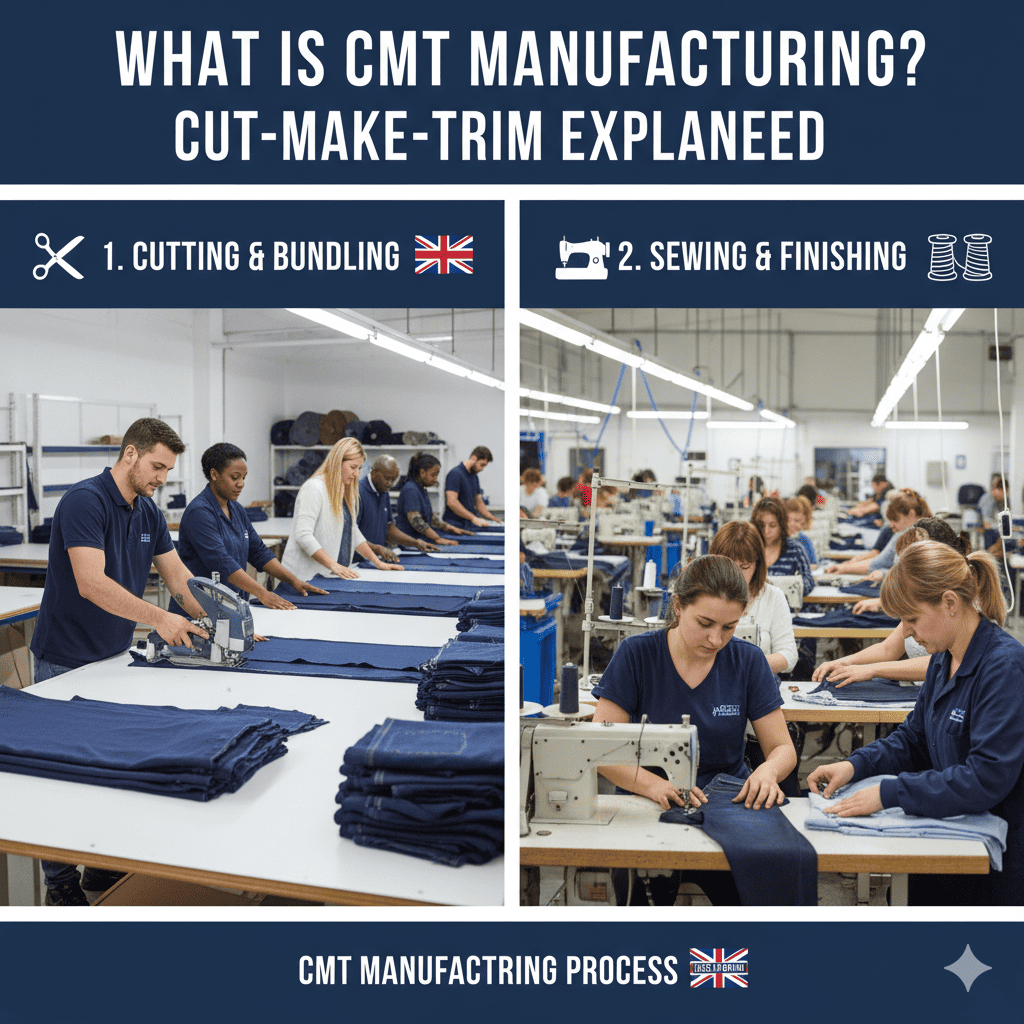
The majority of UK domestic clothing manufacturers operate as CMT factories. Most brand founders encounter the term within their first week of sourcing — and most misunderstand it in ways that cost them money, time, and production quality.
This article explains CMT manufacturing completely: what it includes, what it excludes, what the brand must supply, and when it is the right production model to use.
For the full sourcing context, see the Complete Guide to Clothing Manufacturers in UK.
Post Summary
- CMT stands for Cut, Make, Trim — a production model where the factory provides only the labour to cut fabric, sew the garment, and apply all finishing and trims; the brand supplies everything else
- CMT is the dominant production model in UK domestic clothing manufacturing — the majority of UK CMT factories do not source fabric or trims on the brand’s behalf
- The brand’s responsibility in CMT is substantial: tech pack, patterns, graded size set, all fabric delivered to the factory, all trims and notions, labels, and packaging
- CMT pricing is quoted as a per-unit rate covering only the labour element of production — it does not include fabric, trims, or any materials cost
- CMT is most commercially appropriate for brands with established fabric sourcing relationships, design infrastructure, and sufficient volume to make direct material procurement cost-effective
- The most common mistake: treating CMT as a cheaper version of full-service production — it is not cheaper overall; it is differently structured
Contents
- 1. What Does CMT Stand For?
- 2. What a CMT Manufacturer Does and Does Not Do
- 3. What the Brand Must Supply for CMT Production
- 4. CMT vs Full-Service: Key Differences
- 5. UK CMT Rate Ranges (2026)
- 6. The Advantages of CMT for Established Brands
- 7. The Disadvantages of CMT for New Brands
- 8. Five Mistakes Brands Make with CMT
- 9. When CMT Is — and Is Not — the Right Model
- 10. Frequently Asked Questions
What Does CMT Stand For?
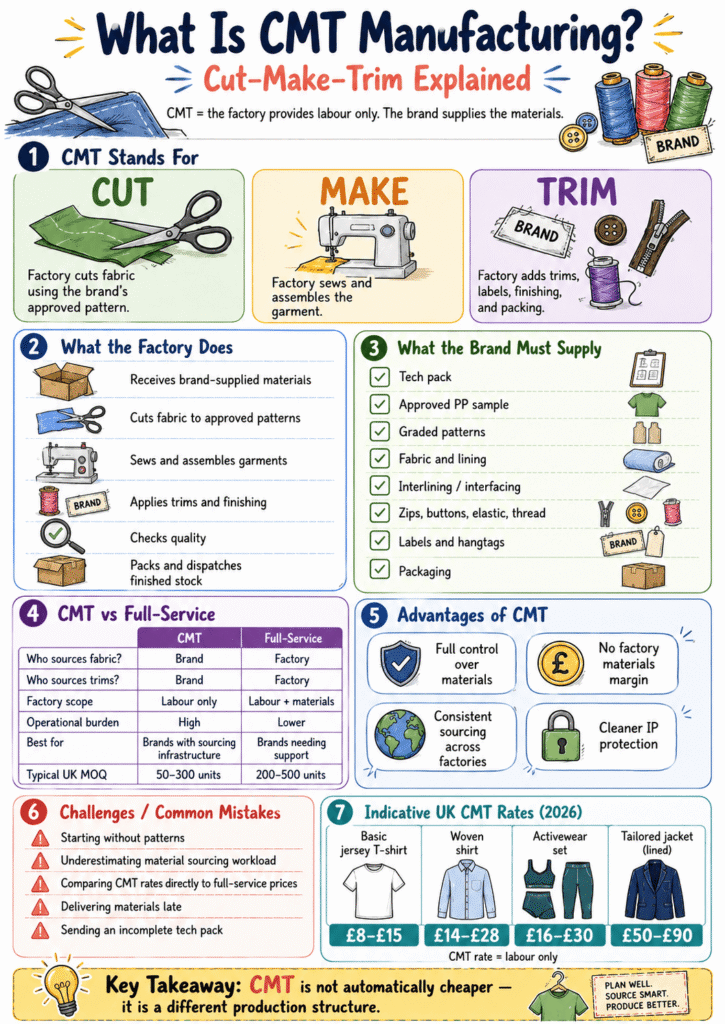
CMT stands for Cut, Make, Trim. The three words define exactly what the factory does — and what it does not do.
Cut — the factory cuts the fabric into the component panels of the garment, using the brand’s pattern (paper or digital CAD) as the template. Accurate cutting directly determines whether the finished garment measures correctly and whether fabric is used efficiently.
Make — the factory assembles the cut panels into a finished garment using industrial sewing machines, overlockers, cover stitch machines, and specialist equipment appropriate to the garment type. This is the core labour-intensive phase of production.
Trim — the factory applies all finishing components — buttons, zips, elastic, thread, labels, hangtags — and completes the garment to a finished, saleable state.
That is the complete scope of CMT. The factory provides premises, machinery, skilled operatives, and production management. Everything else — every material input — is supplied by the brand.
What a CMT Manufacturer Does and Does Not Do
A CMT manufacturer does:
- Receive fabric and materials delivered by or on behalf of the brand
- Cut fabric according to the brand’s approved patterns
- Sew and assemble the garment according to the brand’s tech pack specification
- Apply all trims provided by the brand
- Conduct in-line and end-of-line quality inspection against the approved sample
- Pack and dispatch finished garments per the brand’s brief
A CMT manufacturer does not (in standard CMT):
- Source or procure fabric on the brand’s behalf
- Order trims, labels, or packaging
- Develop patterns or grade a size range
- Create or update tech packs
- Advise on material selection or specification
The distinction matters commercially. When a brand asks a CMT factory to “also sort out the fabric,” they are asking for a service the factory has not quoted for and may not be equipped to provide — resulting in either a refusal, a significantly higher price, or an arrangement that falls outside the CMT model entirely.
What the Brand Must Supply for CMT Production
CMT requires the brand to arrive at the factory with a complete production-ready package. Missing elements cause production delays, quality failures, or additional charges.
| Item | Brand Responsibility | Notes |
|---|---|---|
| Tech pack | Complete and current | Must include all measurements, construction notes, stitch specs, Pantone references, label placement, and packaging instructions |
| Approved PP sample | Signed off before bulk | The pre-production sample from the actual bulk fabric is the quality benchmark |
| Patterns | Graded full size range | Paper or digital (DXF/PDF); factory must be able to produce from the format provided |
| Fabric | Delivered to factory, pre-approved | Correct quantity per BOM, from approved dye lot, pre-washed if required |
| Lining (where applicable) | Delivered to factory | Same conditions as face fabric |
| Interlining/interfacing | Delivered to factory | Correct weight and fusibility for the garment |
| Zips | Correct length, colour, type | Pre-ordered to BOM specification |
| Buttons/snaps/hooks | Correct size, colour, quantity | Pre-ordered to BOM specification |
| Thread | Correct colour and weight | Standard colours typically held by factory; Pantone-matched thread must be supplied |
| Labels | Supplied to factory | Care, size, brand, and country of origin labels per the tech pack placement diagram |
| Hangtags | Supplied to factory | Pre-threaded or loose as specified |
| Packaging | Supplied to factory | Polybags, tissue, boxes per the packing brief |
The completeness of this package determines the smoothness of production. In CMT, materials delays are the brand’s operational problem — not the factory’s.
CMT vs Full-Service: Key Differences
| Factor | CMT | Full-Service (Full Package) |
|---|---|---|
| Who sources fabric | Brand | Factory |
| Who sources trims | Brand | Factory |
| Who develops patterns | Brand | Factory (or both) |
| Factory’s scope | Labour only | Labour + all materials |
| Factory price includes | CMT rate per unit | CMT + materials + margin |
| Brand’s operational burden | High | Lower |
| Brand’s control over materials | Complete | Shared/delegated |
| Typical UK MOQ | 50–300 units | 200–500 units |
| Best for | Brands with sourcing infrastructure | Brands without sourcing infrastructure |
A critical point on cost. CMT is not inherently cheaper than full-service. The CMT rate per unit is lower because the factory is only charging for labour — but the brand is also separately paying for fabric, trims, labels, and packaging. A £15 CMT rate plus £22 in fabric and trims produces a £37 total cost — above many full-service quotes, before the brand’s procurement overhead is considered.
UK CMT Rate Ranges (2026)
| Product Category | CMT Rate Range Per Unit | Notes |
|---|---|---|
| Basic jersey T-shirt | £8–£15 | Low complexity; fast production |
| Jersey dress (simple) | £12–£22 | Moderate complexity |
| Woven shirt | £14–£28 | More seams; collar, cuffs |
| Jersey activewear set (2 pieces) | £16–£30 | Technical fabric handling |
| Tailored jacket (unlined) | £35–£65 | Complex construction |
| Tailored jacket (fully lined) | £50–£90 | Multiple additional operations |
| Waxed outerwear | £45–£95 | Specialist fabric handling |
| Knitwear (fully fashioned) | £20–£50 | Varies by gauge and complexity |
These figures reflect 2026 UK NLW conditions (£12.71/hour from April 2026) and are indicative. Actual rates depend on factory capacity, volume, and the specific style. Source: Silk Routes production data; GOV.UK National Living Wage.
The Advantages of CMT for Established Brands
Complete control over materials quality. In CMT, the brand selects, approves, and procures every material input. For brands where material specification is integral to product identity, CMT is the only model that provides this.
No factory materials margin. Full-service factories apply a margin of typically 10–30% on materials they source. CMT removes this entirely. For brands with strong fabric supplier relationships, direct procurement is materially cheaper than factory-sourced.
Consistent quality across factories. A brand using multiple CMT factories can standardise materials across all of them — same fabric suppliers, same trim suppliers, same label printers, regardless of which factory is producing each style.
Cleaner IP protection. The factory holds no ownership interest in the materials or the supply chain, simplifying IP protection and making switching factories easier.
The Disadvantages of CMT for New Brands
High operational burden. CMT requires the brand to manage an entire supply chain before production can begin — fabric procurement, trim sourcing, label printing, packaging ordering, and delivery logistics to the factory.
Upfront capital requirement. In CMT, the brand pays for all materials before production begins. Fabric is ordered and paid for before it reaches the factory — often weeks before the finished garments are invoiced. Full-service partially reduces this by bundling materials into the factory payment terms.
Pattern and grading requirement. CMT factories do not develop or grade patterns. A brand without production-ready patterns cannot use a CMT factory.
Materials risk. If the fabric is the wrong weight, shrinkage, or dye lot — that is the brand’s problem. A full-service factory bears the material sourcing risk; in CMT, the brand bears it entirely.
Five Mistakes Brands Make with CMT
Mistake 1: Approaching CMT before patterns exist. CMT starts from approved, graded patterns. Before approaching a CMT factory, engage a pattern cutter to produce and fit-approve a first pattern. Only then is the brand production-ready.
Mistake 2: Underestimating the materials procurement workload. The critical path runs: fabric approved → patterns graded → CMT factory confirmed → fabric delivered → production begins. These stages overlap; they cannot be sequential. Begin fabric and trim sourcing at the same time as the factory search.
Mistake 3: Comparing CMT rates to full-service prices directly. A £15/unit CMT quote is not cheaper than a £35/unit full-service quote until all materials costs are added. Compare total cost, not the rate in isolation.
Mistake 4: Delivering materials late. Build a two-week materials delivery buffer into every production critical path. A CMT factory cannot commence production without all materials on site — and losing a factory slot means losing your place in the production queue.
Mistake 5: Sending an incomplete tech pack. The tech pack must be complete and approved before the order is placed. Specification changes during production cause stoppages, rework, and cost. A CMT factory will make its closest interpretation of whatever it has been given.
When CMT Is — and Is Not — the Right Model
CMT is right when the brand has: an established fabric sourcing relationship, production-ready graded patterns, a complete and approved tech pack, the operational capacity to manage parallel procurement, and sufficient volume to make direct material procurement cost-effective.
CMT is not right when the brand: doesn’t yet have patterns, has no fabric sourcing relationship, is producing its first run, lacks the internal resource to manage a parallel supply chain, or is comparing costs without including all materials.
To understand how Silk Routes operates as a CMT manufacturer — what we need from brands before production can begin — our clothing manufacturing services page covers our process and requirements. Find out more about Silk Routes if you’re assessing whether CMT is the right fit for your production.
Frequently Asked Questions
What Does CMT Mean in Clothing Manufacturing?
CMT stands for Cut, Make, Trim — the three production operations a CMT factory performs. The factory cuts the brand’s fabric into pattern pieces, sews them into a finished garment, and applies all trims and finishing. The brand supplies all materials: fabric, lining, zips, buttons, labels, packaging. The factory supplies only the skilled labour, machinery, and production management.
What Is the Difference Between CMT and Full-Service Manufacturing?
In CMT, the brand supplies all materials and the factory provides only labour. In full-service (also called full-package) manufacturing, the factory sources all materials, manages the supply chain, and delivers finished garments — the brand provides design and specification only. CMT gives the brand complete control over materials at the cost of higher operational responsibility.
What Does a Brand Need to Provide for CMT Production?
A complete tech pack; approved patterns graded to the full size range; all fabric delivered to the factory in the correct quantity and from an approved dye lot; all trims (zips, buttons, elastic, thread); all labels (care, size, brand, country of origin); and all packaging. Missing any element delays production.
How Much Does CMT Manufacturing Cost in the UK?
UK CMT rates in 2026 range from approximately £8–£15/unit for basic jersey garments to £50–£90/unit for fully lined tailored jackets. The CMT rate covers labour only — it does not include fabric, trims, or labels. Total production cost (CMT plus materials) is typically two to three times the CMT rate alone, depending on fabric specification and garment complexity.
Is CMT Cheaper Than Full-Service Manufacturing?
Not necessarily. CMT rates per unit are lower because the factory only charges for labour — but the brand separately pays for all materials. When materials cost is added, the total may be higher or lower than full-service depending on the brand’s procurement capability and sourcing relationships. CMT is commercially advantageous for brands with strong material sourcing; it is not straightforwardly cheaper for brands without them.