
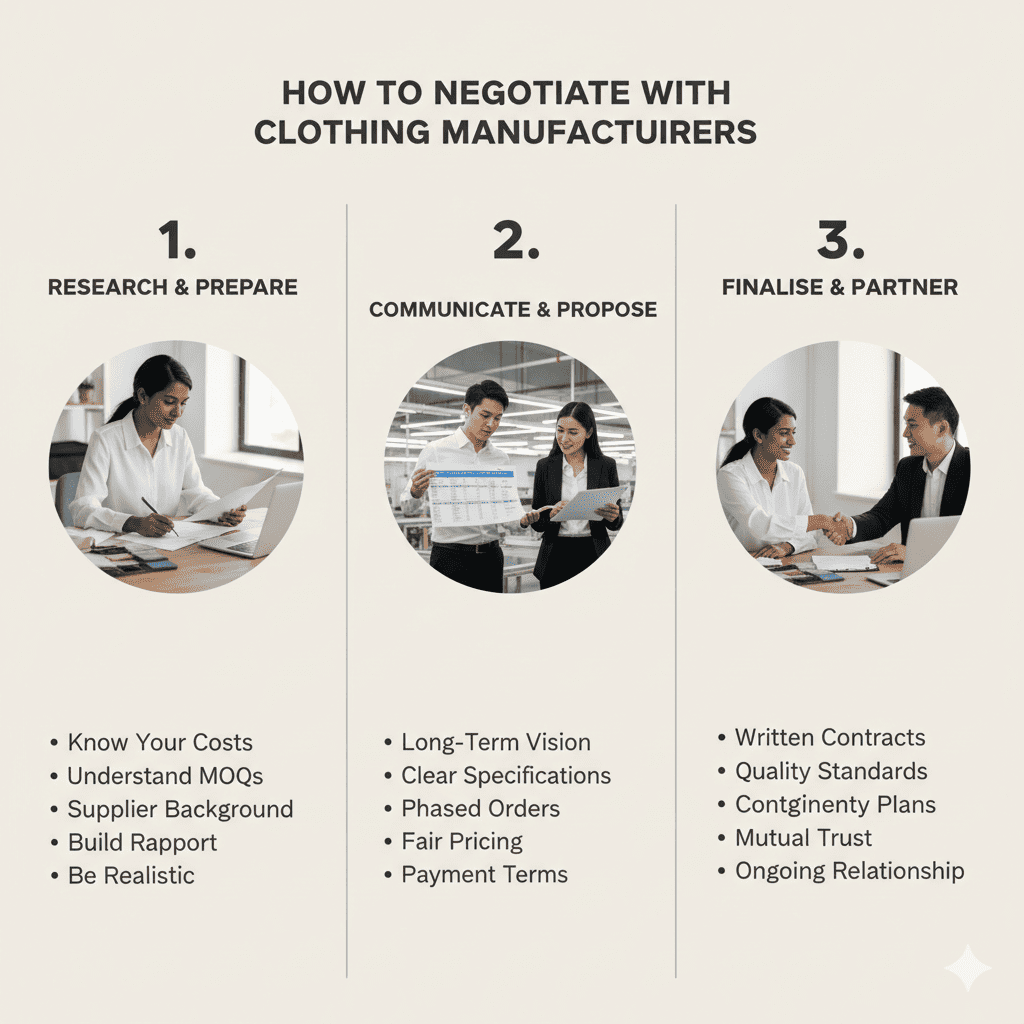
Most clothing brand founders approach a manufacturer negotiation the wrong way. They lead with what they want — lower MOQ, better price, faster turnaround — without understanding what the factory needs in return. That approach produces one outcome: no movement.
We negotiate with brands every week at Silk Routes. We know exactly what makes a factory move on price, MOQ, and lead time, and what makes them politely decline. The difference is almost never about the ask. It’s about what the brand brings to the table before the ask is made.
Here’s what actually works.
- Manufacturer negotiation is a value exchange — the factory gives flexibility on price, MOQ, or lead time only when the brand offers something of equivalent or greater value in return
- The five levers a brand can offer a factory: payment terms, production readiness, reorder commitment, volume consolidation, and long-term relationship signals
- Price negotiation is the weakest lever — factories move on price last; they move on risk reduction first
- A complete tech pack, confirmed fabric, and a sealed sample are worth more to a factory than a 20% price offer
- The best time to negotiate is before the first order, not after — use the leverage of being an unknown quantity
Contents
Why Most Brands Negotiate Wrong
The standard negotiation approach for first-time clothing brand founders is to find a manufacturer, get a quote, and then ask for a discount. That approach fails for a simple reason: it offers the factory nothing in exchange for the reduction.
A manufacturer’s price isn’t a retail price with built-in margin for negotiation. It’s a cost-plus calculation — the factory’s cost of materials, labour, overhead, and margin. When a brand asks for 15% off without offering anything in return, the factory either absorbs the margin reduction or declines. Most decline.
What guides get wrong: negotiation is presented as a price conversation. It’s a risk conversation. A factory’s price reflects the risk it’s carrying — the risk of a new, unproven client; the risk of an incomplete brief; the risk of fabric delays; the risk of a client who will be difficult to work with. Reduce the factory’s risk and the price follows.
Brands arriving with complete production documentation — tech pack, fabric spec, sealed sample — consistently get more favourable commercial terms on first runs than those arriving with incomplete briefs, across pricing, MOQ, and lead time.
Our guide to low MOQ and private label clothing manufacturers UK covers how to structure your first manufacturing brief to position yourself as a low-risk, high-value client before the negotiation begins.
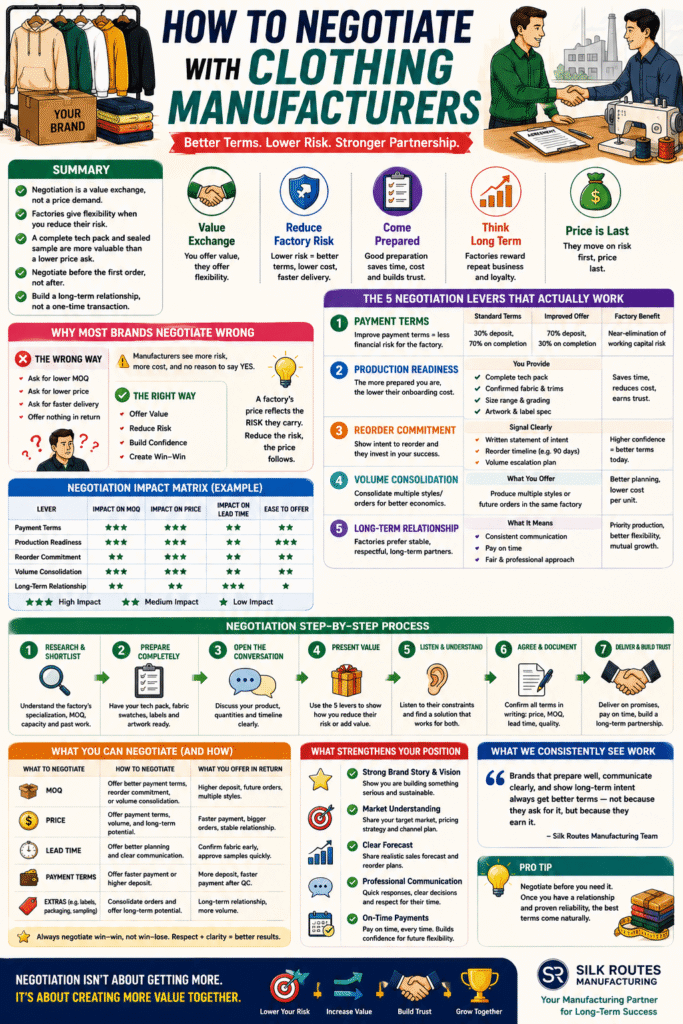
The Five Negotiation Levers That Actually Work
Lever 1 — Payment terms
Cash flow is the constraint that most limits a factory’s flexibility. A factory operating on 30/70 payment terms — 30% deposit, 70% on completion — carries significant working capital exposure on every order. Offer to change that structure and you change the economics of the relationship.
| Standard Terms | Improved Offer | Factory Benefit |
|---|---|---|
| 30% deposit, 70% on completion | 50% deposit, 50% on completion | Reduced working capital exposure |
| 30% deposit, 70% on completion | 70% deposit, 30% on completion | Near-elimination of working capital risk |
| Net 30 payment | Payment within 7 days of QC | Faster cash conversion |
We’ve extended MOQ flexibility and reduced unit pricing for brands that offered 70% upfront on a first run. The reduction in our financial risk on an unproven client directly translates into flexibility on the commercial terms.
“A brand that pays 70% upfront is telling us they’re serious and financially prepared. That’s worth more to us than any amount of negotiation on the unit price.” — Silk Routes Manufacturing Team
Lever 2 — Production readiness
A factory’s cost of onboarding a new client isn’t reflected in the quoted price — it’s absorbed as overhead. That onboarding cost includes: reviewing an incomplete brief, requesting missing information, interpreting vague specs, managing client education during sampling. A brand that eliminates that cost is a brand worth discounting.
What production readiness means in practice:
- Completed and approved tech pack before first contact
- Fabric sourced, sampled, and confirmed, not “we are thinking about using organic cotton”
- Size range confirmed with grading requirements stated
- Artwork files delivered in correct format and at correct resolution
- Label spec confirmed and compliant with UK regulations
Arrive with all of the above and the factory’s cost of onboarding your order drops significantly. That reduction in their cost is the basis for a reduction in your price, without you having to ask for it.
Lever 3 — Reorder commitment
A factory’s margin on a first run at low MOQ is thin. The relationship becomes commercially interesting on the reorder, where the factory already knows your product, your spec is proven, and their setup cost is already sunk.
A brand that signals genuine reorder intent, not aspirationally but commercially, changes the factory’s calculation on the first run entirely.
What genuine reorder commitment looks like:
- A written statement of intent in the purchase order: “Subject to sell-through of X% within Y days, Brand X intends to place a reorder at volume Z.”
- A confirmed reorder timeline: “We anticipate a reorder discussion at 90 days.”
- A volume escalation signal: “Our launch run is 100 units. Our Year 1 reorder target is 200 units per run.”
Unit costs consistently fall between a first run and a third run with the same manufacturer, once setup cost is already sunk and production has settled into a rhythm — one of the strongest arguments for signalling reorder intent early rather than treating each run as a one-off negotiation.
Lever 4 — Volume consolidation
If your range eventually includes multiple styles, manufacturing them with the same factory consolidates volume and simplifies the relationship from the factory’s perspective. A brand that commits to a single manufacturing partner, rather than splitting styles across multiple factories, is a more valuable client than one who shops each style independently.
This lever works best as a future commitment at the first run stage: “Our intention is to bring all production to you as we expand the range.”
Don’t overpromise. Only make this commitment if you intend to honour it. A factory that holds a slot open for a promised second style and receives nothing is a factory that won’t offer flexibility on the third run.
Lever 5 — Long-term relationship signals
Factories aren’t just selling production capacity. They’re entering a relationship that requires communication, trust, and repeated commercial engagement. A brand that signals it will be a reliable, long-term partner is worth accommodating on the first run, even at a lower margin.
Long-term relationship signals include:
- Clear, professional communication throughout the enquiry process
- No unreasonable deadline pressure on the first contact
- Knowledge of the manufacturing process — a brand that understands what a tech pack is, what sampling involves, and what a realistic lead time looks like
- Willingness to visit the factory if location permits
- Payment without dispute — following up a first run with a prompt, undisputed balance payment is the strongest single signal for second-run commercial flexibility
If you want a second opinion on where you have genuine room to negotiate before you approach a factory, see our clothing manufacturing services — it’s easier to fix a weak brief before the first quote than after.
What to Negotiate and When
Negotiation sequence matters as much as negotiation content. The right ask at the wrong time produces the same outcome as the wrong ask: nothing.
What to negotiate before the first order. MOQ is the most important pre-order negotiation. Use the leverage of being an unknown, potentially long-term client. Offer payment terms, production readiness, and a reorder commitment in exchange for a lower MOQ floor. This is the moment your leverage is highest — after the first order is placed, you’ve confirmed you accept their standard terms.
What to negotiate at quote stage. Unit price can be negotiated at quote stage, but only with a specific counter-offer, not a general request for a discount. “Your quote is £14 per unit at 100 units. We can achieve £12.50 if we move to 150 units and pay 60% upfront. Is that workable?” That’s a negotiation. “Can you do it cheaper?” is not.
What not to negotiate on a first run. Lead time on a first run is rarely negotiable without a significant premium. A factory that compresses your lead time to accommodate an unrealistic brief is either charging you for priority scheduling or deprioritising another client’s run. Neither is a stable foundation for a relationship.
“We can move on price or we can move on timeline, rarely both on a first run with a new client. Brands who ask for both on a first run usually get neither.” — Silk Routes Manufacturing Team
What to negotiate on reorders. Unit price, MOQ, and lead time all become more negotiable on the third or fourth run. By that point, the factory knows your product, your payment behaviour, and your communication style. That knowledge reduces their risk, and reduced risk means more flexibility.
How to Make a Counter-Offer That Works
A counter-offer that works has four components: a specific number, a specific reason, a specific concession, and a specific close.
Structure of an effective counter-offer:
“Your quote is [their number]. We need to reach [your number] to make the unit economics work at our target retail price. We can offer [your concession] in exchange for that movement. If we can agree on those terms, we’re ready to proceed to purchase order this week.”
Applied example:
“Your quote is £13.50 per unit at 100 units. We need to reach £11.50 to hit our 60% gross margin target at our £32 RRP. We can offer 65% upfront payment and a confirmed second run of 150 units at 90 days if sell-through hits 60%. If we can agree £11.50 on those terms, we’re ready to sign a purchase order by the end of the week.”
That counter-offer works because it:
- States a specific number, not a range
- Explains the commercial reason (not a complaint about price, but a unit economics statement)
- Offers two specific concessions (payment terms and reorder commitment)
- Closes with a timeline (reduces factory uncertainty about whether the order is real)
Brands that show up with a structured ask like this — a specific number, a documented commitment, a clear timeline — consistently get further than brands negotiating informally on tone alone.
Negotiating MOQ: What Works
MOQ negotiation is where most first-time brands focus, and where the most common mistakes occur.
What doesn’t work: “Can you do a lower minimum?” without any concession offered. A factory’s MOQ exists because of fixed economics — setup cost, fabric minimums, machine time. Asking for a lower MOQ without addressing the economics that created the floor is asking the factory to absorb cost with no compensation.
What works:
| Ask | Concession That Justifies It |
|---|---|
| MOQ from 100 to 50 units | 70% upfront payment + confirmed reorder at 100 units |
| MOQ from 150 to 100 units | Completed tech pack + fabric pre-sourced + 60% deposit |
| MOQ from 100 to 50 units | Consolidation of 3 styles with same factory over 12 months |
| MOQ from 200 to 100 units | 50% deposit (up from 30%) + confirmed second style within 6 months |
Every successful MOQ reduction in this table follows the same logic: the brand isn’t asking the factory to accept more risk for less money — it’s offering the factory something (cash sooner, less onboarding work, a longer relationship) that offsets the smaller order.
Common Negotiation Mistakes Clothing Startups Make
Leading with price before offering anything. Asking “can you do it cheaper?” with no concession attached tells the factory you don’t understand what drives their cost. Fix: lead with a concession, then state your number.
Negotiating lead time and price at the same time on a first run. Asking for both signals unrealistic expectations and usually gets neither. Fix: pick the one that matters more for this run — usually price or MOQ, not speed.
Making a reorder promise you don’t intend to keep. A factory that holds capacity for a second style that never materialises will not extend flexibility again. Fix: only commit to what you can genuinely deliver.
Negotiating before the brief is complete. Asking for better terms while still finalising the tech pack or fabric choice signals unreadiness, the opposite of what earns flexibility. Fix: get production-ready first, then negotiate.
Treating every factory conversation as adversarial. A negotiation framed as “us versus them” produces defensive quoting. Fix: frame it as a shared problem — how do we structure this order so it works for both of us.
FAQ
How much can I realistically negotiate on a first order?
Less than most founders expect on price alone, but often more than expected on MOQ and payment structure. A specific counter-offer backed by a concession — extra deposit, a reorder commitment — typically moves further than a general request for a discount.
Should I negotiate MOQ or price first?
MOQ. It’s the constraint that most affects your capital exposure on a first run, and factories generally have more flexibility on MOQ than on unit price, since MOQ is tied to your risk profile rather than their fixed production costs.
What if the factory says no to every ask?
Check whether your brief is genuinely production-ready first — an incomplete tech pack or unconfirmed fabric is the most common reason a factory won’t move on anything. If the brief is solid and the answer is still no, that factory’s economics may not suit a startup-scale first run, and it’s worth quoting elsewhere.
Do bigger orders always get better unit prices?
Usually, but not always linearly. Price breaks tend to cluster around specific volume thresholds tied to fabric roll sizes or machine setup batches — ask the factory where those thresholds sit before assuming that any volume increase earns a proportional discount.
When should I walk away from a negotiation?
When the factory’s only path to agreement is compressing your quality control standard or your lead time to an unrealistic degree. A cheaper unit price that arrives late or fails QC isn’t a win — it’s a different, more expensive problem.
Negotiation Is a Value Exchange, Not a Price Fight
The founders who get better terms from UK manufacturers aren’t the ones who ask hardest. They’re the ones who understand what a factory actually needs to say yes — reduced risk, faster cash, a credible reorder signal — and offer it before they ask for anything back.
Price is the weakest lever in that exchange. Readiness, payment structure, and relationship signals move a factory further, faster, and with less friction on both sides.
Get the brief right before you negotiate. The negotiation that matters most happens before the first quote, not after it.
Ready to put a production-ready brief in front of a manufacturer? Find out how Silk Routes works with brands from first enquiry to first delivery.