
Most guides on clothing production mistakes are written by people who have never run a factory. They list generic warnings about “communication” and “quality control” that apply to every industry and illuminate nothing specific about garment manufacturing.
The mistakes that actually destroy first production runs are specific, sequential, and almost always preventable. They happen at defined points in the process, and they happen to founders who didn’t know the process well enough to see them coming.
Here’s what actually goes wrong, why it goes wrong, and what to do instead.
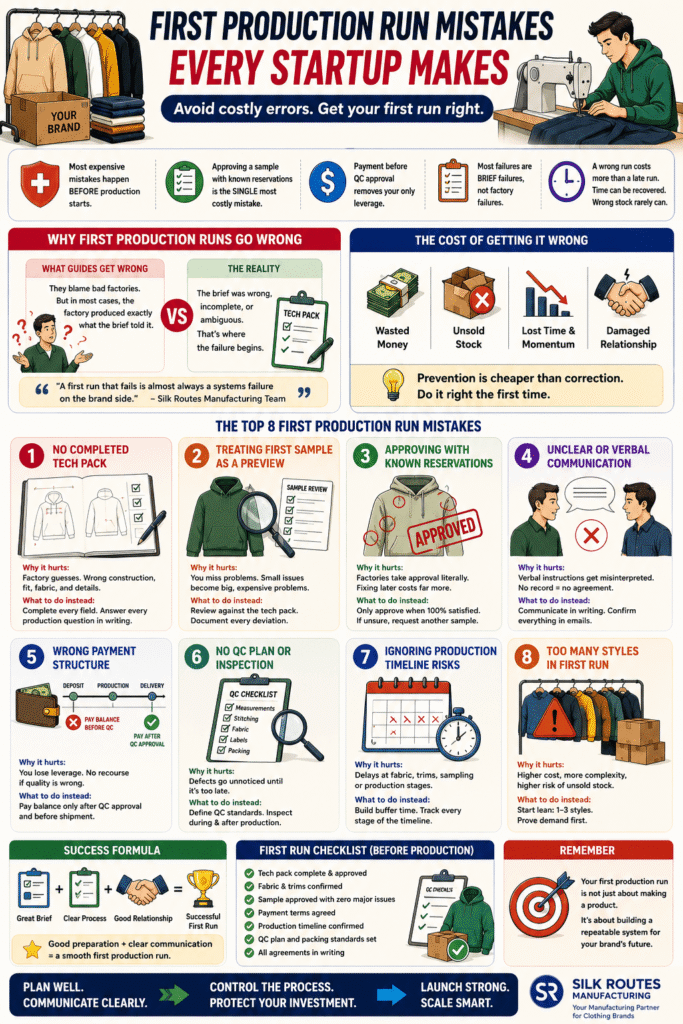
- The most expensive first production run mistakes happen before the factory starts cutting — in the briefing and sampling stages, not during production itself
- Approving a sample with known reservations is the single most costly individual mistake a startup founder can make in clothing manufacturing
- Payment structure errors — paying the balance before QC approval — remove the only commercial leverage a brand has over a factory
- Most production run failures are not factory failures — they’re brief failures: incomplete tech packs, ambiguous specifications, and verbal-only agreements
- A first production run that delivers wrong is almost always more expensive than one that delivers late — time can be recovered, wrongly produced stock rarely can
Contents
- 1. Why First Production Runs Go Wrong
- 2. Mistake 1 — Approaching the Factory Without a Completed Tech Pack
- 3. Mistake 2 — Treating the First Sample as a Production Preview
- 4. Mistake 3 — Approving a Sample With Known Reservations
- 5. Mistake 4 — Giving Verbal Feedback Instead of Written Documentation
- 6. Mistake 5 — Not Securing a Signed Purchase Order Before Production Begins
- 7. Mistake 6 — Paying the Production Balance Before QC Approval
- 8. Mistake 7 — Skipping the Mid-Production QC Check
- 9. Mistake 8 — Confusing Factory Price With Landed Cost in the Budget
- 10. Mistake 9 — Ordering All Packaging After the Production Run Arrives
- 11. Mistake 10 — No Reorder Capital Reserved After the First Run
- 12. Common Threads Across All Ten Mistakes
- 13. FAQ
- 13.1. What is the most common reason a first production run fails?
- 13.2. How many sampling rounds should a first-time brand budget for?
- 13.3. Can a first production run be cancelled after it starts?
- 13.4. How do I handle a quality failure on a first production run?
- 13.5. What does “on spec” mean in clothing manufacturing?
- 14. The Mistake Behind All the Mistakes
Why First Production Runs Go Wrong
The first production run is the most technically complex thing most clothing startup founders have ever managed. It involves a supply chain, a legal agreement, a quality control process, and a commercial relationship, all simultaneously, all for the first time.
What guides get wrong: first production run failures are attributed to bad factories. In most cases, the factory produced exactly what the brief told it to. The brief was wrong.
In our experience, the majority of first-run quality disputes between brands and manufacturers trace back to incomplete or ambiguous specifications in the original brief, not to factory negligence or intentional non-compliance.
The implication is direct: a first production run that fails is almost always a systems failure on the brand side. The factory is producing to the information it was given. Fixing the factory relationship without fixing the brief produces the same failure on the second run.
If you want a second opinion on where your production brief has gaps before you approach a factory, see our clothing manufacturing services — it’s far cheaper to fix a weak brief than a wrong production run.
Mistake 1 — Approaching the Factory Without a Completed Tech Pack
This is the most common and most consequential mistake on a first production run. It’s also the one most startup guides treat as a minor procedural point rather than a fundamental error.
A factory approached without a completed tech pack does one of two things: it declines the enquiry, or it produces a sample to its own interpretation of an incomplete brief. The second outcome is more dangerous than the first.
When a factory interprets an incomplete brief, it makes production decisions — seam type, construction approach, fabric behaviour — based on its own experience and preferences. Those decisions may not match what the brand intended. But once production begins, those decisions are built into every unit.
What guides get wrong: the tech pack is described as a formality, something to get done before the factory conversation. It is the factory conversation. Every specification question the factory would ask is answered in the tech pack before anyone picks up the phone.
Brands arriving with complete tech packs consistently reach an approved sample faster than those arriving with mood boards, reference images, or verbal descriptions.
“We can work with an incomplete brief, but we shouldn’t, and good factories will tell you so. When we receive a complete tech pack, we quote accurately, sample correctly, and produce cleanly. When we receive an incomplete brief, we’re guessing on your behalf, and if our guess is wrong, you’re paying for the correction.” — Silk Routes Manufacturing Team
The fix: the tech pack is complete when every field is answered and every production decision is specified. Not when it looks complete. When a factory can quote, sample, and produce from it without asking a single clarifying question.
Mistake 2 — Treating the First Sample as a Production Preview
The first sample is not a preview of your product. It’s a diagnostic tool, designed to identify every gap between your tech pack and what the factory can produce.
Founders who open their first sample looking for confirmation are structurally set up to miss problems. Founders who open it looking for deviations from the tech pack, annotating every one however small, are using it correctly.
What guides get wrong: first samples are described as “exciting,” the moment the product becomes real. That framing is dangerous. A first sample that’s beautiful and wrong will cost significantly more to correct than an ugly one with every problem clearly visible.
The correct review process for a first sample:
- Place the sample next to the tech pack, not next to your vision of what you hoped it would look like
- Check every specification: seam type, stitch density, measurements, label placement, trim quality, fabric weight and hand feel
- Document every deviation, not just the ones that feel significant
- Photograph every deviation with scale reference
- Return written, numbered feedback, not a phone call, not a WhatsApp voice note
A structured written sample review process — documented checklist, annotated images, numbered change list — consistently reduces revision rounds compared with informal, verbal-only reviews. Fewer revision rounds means lower sampling cost and a shorter timeline.
The fix: create a sample review checklist before the first sample arrives. Every specification in your tech pack becomes a checkbox. Review the sample against the checklist, not against your mental image of the product.
Mistake 3 — Approving a Sample With Known Reservations
This is the single most expensive individual mistake in clothing manufacturing. It happens at a specific psychological moment — after two or three sampling rounds, with a launch date approaching, when the founder is tired of the process and the factory is communicating impatience.
The reservation is usually small. A fit point the founder is “not sure about.” A seam that “might be fine.” A fabric that “feels a bit lighter than expected.” The pressure to move to production overrides the doubt.
One hundred units later, the doubt was correct.
What guides get wrong: sample approval is described as a milestone to reach, not a standard to meet. It’s a standard. The sample either meets the tech pack specification or it doesn’t. There’s no “close enough” in garment manufacturing, only approved and not approved.
Fit is consistently the single most common reason UK shoppers give for returning an online clothing purchase. A garment approved with a known fit reservation tends to produce returns at close to the rate the founder suspected during sampling, but across the entire production run, not a single unit.
The cost calculation is simple: an additional revision round costs £80 to £200 and two to three weeks. A production run of wrongly fitting garments costs the entire production investment plus the opportunity cost of a delayed and discounted clearance.
The fix: establish written approval criteria before sampling begins. The sample either meets every criterion or it doesn’t proceed to production. If a criterion is uncertain, it needs to be resolved, not assumed correct. The approval decision is binary. Not subjective.
Mistake 4 — Giving Verbal Feedback Instead of Written Documentation
Verbal feedback to a factory travels through a minimum of two people before it reaches the person making the physical correction, from brand contact to factory sales rep to pattern cutter or machinist. At each transmission point, the instruction degrades.
“The sleeve feels a bit long” becomes “adjust sleeve” becomes a half-centimetre reduction when the brand meant two centimetres. The second sample arrives with the same problem, slightly smaller. A third round begins.
This is not a factory failure. It’s a communication system failure, one the brand creates.
What guides get wrong: communication with the factory is treated as relationship management. It’s technical specification management. The emotional register of the relationship matters, but it matters far less than the precision of the technical instructions.
“Written feedback with annotated images and numbered change points is the fastest feedback we receive. It leaves no room for interpretation. A voice note describing a problem takes five minutes to leave and thirty minutes to translate into a production instruction that may or may not match what the founder meant.” — Silk Routes Manufacturing Team
The fix: every piece of feedback to a factory goes in writing. Every time. Annotated photographs with numbered change points corresponding to a written change list. The factory signs off that it has received and understood each point. That sign-off goes into the production file.
Mistake 5 — Not Securing a Signed Purchase Order Before Production Begins
Production that starts before a purchase order is signed is production that starts without a contract. The verbal confirmation that production will begin on Monday, at the agreed unit price, to the agreed specification, is not straightforward to enforce. The signed purchase order is.
This mistake has one of two outcomes: production proceeds correctly, the brand never realises the contract gap existed, and counts itself lucky. Or something goes wrong — a price increase mid-run, a specification deviation, a late delivery — and the brand has no documented basis for recourse.
What guides get wrong: the purchase order is described as an administrative formality, the paperwork that follows the commercial decision. It is the commercial decision. Until both parties have signed a document specifying price, quantity, specification, timeline, payment terms, and QC standard, no production agreement exists.
Verbal agreements can carry legal weight in the UK, but proving their exact terms in a dispute is far harder than pointing to a signed document. A purchase order countersigned by the factory is what defines exactly what was agreed, and what remedy is available when what was agreed isn’t delivered.
The fix: no production deposit is paid without a signed purchase order. The purchase order must include: unit price, total order value, MOQ, payment schedule (deposit trigger and balance trigger), confirmed delivery date, QC standard reference, sealed PP sample reference number, and an IP ownership clause confirming that all patterns and tech packs remain the brand’s property.
Mistake 6 — Paying the Production Balance Before QC Approval
The production balance, typically 50% of the total order value, is the only commercial leverage a brand holds over a factory after production begins. Releasing it before QC approval removes that leverage at the exact moment it’s most needed.
A factory that has received full payment has no commercial incentive to remediate a quality failure quickly. A factory that is waiting for balance payment before despatch has every incentive to resolve the issue and release the goods.
What guides get wrong: payment timelines are described as relationship management, paying promptly builds trust. Paying correctly builds trust and protects the brand. Those two things aren’t in conflict. Tying balance payment to QC approval is industry standard, not adversarial.
The sequence is non-negotiable:
- Production deposit paid on purchase order signature
- Production runs
- Final QC completed against sealed PP sample
- QC approved by brand
- Balance payment released
- Goods despatched
Any factory that insists on full payment before QC completion is asking the brand to remove its only quality enforcement mechanism. That request is itself a quality signal.
The fix: the balance payment trigger must be written into the purchase order as “on QC approval,” not “on completion,” not “before despatch,” not “on delivery.” On QC approval. If the factory objects to this standard term, treat the objection as significant information about how it handles quality disputes.
Mistake 7 — Skipping the Mid-Production QC Check
A mid-production QC check, conducted when approximately 30% of the production run is complete, is the only opportunity to catch a systemic issue before it’s multiplied across the remaining 70% of the run.
A seam that deviates from spec on unit 15 of 100 is a problem with 15 units. The same seam on unit 15, uncaught, becomes a problem with 100 units. The cost of correcting 15 units is manageable. The cost of correcting, or writing off, 100 units is catastrophic.
What guides get wrong: QC is described as a final inspection, a check on completion that confirms the run meets standard. Final inspection is necessary. It’s not sufficient. By the time the final inspection identifies a systemic issue, the issue has been applied to every unit in the run.
Brands with a mid-production QC checkpoint consistently report far lower full-run failure rates than brands relying on final inspection alone.
The fix: the mid-production QC check is scheduled as a confirmed date in the purchase order, not requested after production begins. It happens at approximately 30% completion. It’s documented in writing. If any deviation from the PP sample standard is found, production pauses until the deviation is resolved and the factory confirms the correction is applied going forward.
Mistake 8 — Confusing Factory Price With Landed Cost in the Budget
A production run budgeted on factory price rather than landed cost is a budget that will be exceeded before the stock arrives. The gap between factory price and landed cost — freight, import duty, packaging materials, QC inspection fees — isn’t incidental. It’s structural.
What guides get wrong: production budgets in startup guides consistently show “cost of goods” as the factory price. The cost of goods is the landed cost. Everything between the factory floor and your warehouse or fulfilment partner is part of the cost of goods.
| Cost Component | UK Manufacture | Offshore (Turkey) | Offshore (Asia) |
|---|---|---|---|
| Factory unit price | £10–£14 | £6–£10 | £3–£7 |
| Freight per unit | £0.50–£1.50 | £3–£6 | £5–£10 |
| Import duty (12% clothing) | £0 | £0.72–£1.20 | £0.36–£0.84 |
| QC inspection | £0.50–£1.00 | £0.50–£1.50 | £1–£3 |
| Packaging per unit | £0.50–£1.50 | £0.50–£1.50 | £0.50–£1.50 |
| Landed cost range | £11.50–£18 | £10.72–£20.20 | £9.86–£22.34 |
At 100 units, the gap between factory price and landed cost can be £150 to £800, money that was never in the budget.
The fix: build the budget on landed cost from the outset. The landed cost model: factory unit price + freight per unit + import duty per unit + QC inspection per unit + packaging per unit. Every other production decision — MOQ, channel pricing, gross margin target — flows from the landed cost, not the factory price. This is exactly the kind of number worth confirming with a manufacturer directly before it goes into your budget, rather than estimating it.
Mistake 9 — Ordering All Packaging After the Production Run Arrives
Production arrives. The mailer boxes have a three-week print lead time. The woven labels were forgotten. The swing tags are the wrong size.
The brand cannot despatch. The stock sits. The launch window closes.
This isn’t a production failure. It’s a sequencing failure, and it’s extraordinarily common on first production runs because packaging feels like the final step and founders prioritise the manufacturing process over the despatch infrastructure.
What guides get wrong: packaging is listed as a Phase 4 or Phase 5 consideration, something to address after the product is confirmed. Woven label MOQs, swing tag print timelines, and mailer box lead times are all independent of the production run but must be coordinated with it.
The fix: all packaging is ordered at the point of production confirmation, not on delivery. Labels, swing tags, polybags, tissue paper, and mailer boxes must all arrive before or simultaneously with the production run. The ordering sequence is: production deposit paid → packaging ordered immediately → production completes → packaging arrives → stock despatched.
Mistake 10 — No Reorder Capital Reserved After the First Run
A first production run that sells through 70% in 90 days is a commercial success. It’s also a crisis if the brand has no capital to reorder. The momentum of a successful first run — customers, reviews, social proof, algorithm traction — has a half-life measured in weeks. A brand that takes 12 weeks to reorder because it needs to generate the capital from first-run revenue loses most of that momentum before the reorder arrives.
What guides get wrong: reorder planning is described as something to address when sell-through is confirmed. It should be addressed before the first order is placed. The reorder timeline, the reorder MOQ, and the reorder capital requirement are known from the outset, because the factory relationship and the unit cost model are known from the outset.
Brands that sell out and immediately reorder tend to grow. Brands that sell out and then wait to raise the capital tend to grow more slowly, or stall entirely, while the momentum they built fades.
The fix: reserve 25 to 30% of total launch budget as a reorder fund before the first order is placed. Don’t deploy it until 50% sell-through is confirmed within 60 days, that’s the trigger that confirms a reorder is commercially justified. But the capital must exist before that trigger is hit, not after.
Common Threads Across All Ten Mistakes
Every mistake on this list shares a structural property: it’s a front-loaded problem with a back-loaded consequence.
The tech pack is incomplete at briefing. The problem surfaces at sampling. The sample is approved with reservations at Week 8. The problem surfaces at delivery in Week 18. The packaging isn’t ordered until delivery. The problem surfaces at despatch.
The earlier in the process a decision is made incorrectly, the later and more expensively the consequence arrives. The inverse is equally true: the earlier the correct decision is made, the cheaper and faster every subsequent stage becomes.
A first production run that delivers correctly, on spec, on time, to a sealed PP sample standard, is not expensive. It’s the same unit cost as a run that delivers wrongly. The difference is in everything that precedes the factory cutting the first piece of fabric.
Common Mistakes Summary Table
| Mistake | When It Happens | Consequence | Fix |
|---|---|---|---|
| Incomplete tech pack | Before sampling | Extended sampling rounds, wrong product | Tech pack complete before factory contact |
| Treating sample as preview | First sample stage | Missed deviations go into production | Review against tech pack checklist |
| Approving with reservations | PP sample stage | Wrong production run | Binary approval criteria, no grey area |
| Verbal-only feedback | Every sample round | Instruction degradation, extra rounds | Written annotated feedback always |
| No signed PO | Before production | No contract, no recourse | PO signed before deposit paid |
| Balance paid before QC | End of production | No leverage on quality failures | Balance trigger = QC approval |
| No mid-production check | During production | Systemic issue across full run | Mid-production check in PO |
| Factory price as budget | Planning stage | Budget exceeded before delivery | Budget on landed cost always |
| Packaging ordered late | After delivery | Cannot despatch, launch delayed | Order packaging on production confirmation |
| No reorder capital | After sell-through | Momentum lost waiting for capital | Reserve 25–30% as reorder fund |
FAQ
What is the most common reason a first production run fails?
An incomplete or ambiguous tech pack, not factory negligence. The majority of first-run quality disputes trace back to incomplete specifications rather than factory non-compliance. The factory produced what the brief described. The brief was wrong.
How many sampling rounds should a first-time brand budget for?
Two to three rounds: one proto or fit sample, one revision, and one pre-production sample. Brands that arrive with a complete and precise tech pack sometimes achieve approval in two rounds. Brands that arrive with an incomplete brief regularly need four or five. Budget for three and treat two as the optimistic scenario.
Can a first production run be cancelled after it starts?
In theory, yes, subject to what the purchase order says about cancellation. In practice, a factory that has already cut fabric and begun construction will claim the material costs and a proportion of the labour at minimum. A signed purchase order with a cancellation clause is the only document that defines what a cancellation costs. Without it, the factory sets the terms.
How do I handle a quality failure on a first production run?
First, document everything: photograph every failing unit against the sealed PP sample, with measurements where relevant. Second, present the documented failure to the factory with reference to the PP sample reference number in the purchase order. Third, withhold the balance payment pending resolution. The resolution options are: factory remakes at their cost, factory provides a partial refund, or brand accepts a negotiated discount. Without a sealed PP sample and a balance-payment-on-QC clause, none of these levers exist.
What does “on spec” mean in clothing manufacturing?
“On spec” means the finished production units match the sealed pre-production sample in every measurable dimension: construction, seam type, stitch density, measurements within tolerance (typically ±0.5cm), fabric weight, label placement, and trim quality. A unit that deviates from the sealed PP sample in any specified dimension is off-spec, regardless of whether the deviation looks significant to the eye.
The Mistake Behind All the Mistakes
Every mistake on this list is a variant of the same fundamental error: treating the first production run as a purchase rather than a managed process.
A purchase is transactional. Money exchanges for product. The outcome is a function of the supplier’s quality.
A managed process is sequential. Every stage is documented, every decision is explicit, every agreement is written, and every payment is tied to a verified outcome rather than a calendar date.
First production runs that succeed are managed processes. First production runs that fail are purchases that went wrong, where the brand handed over capital and specification authority to a factory, and was surprised when the factory’s interpretation of an incomplete brief didn’t match the brand’s mental image of the product.
The factory is a production partner. It executes what you specify. Specifying correctly, documenting thoroughly, and paying at the right trigger points, not before, is the brand’s responsibility. Get those three things right and the production run has a very high probability of delivering correctly.
For the full picture on how to structure a UK manufacturing relationship from first contact through to reorder, our guide to low MOQ and private label clothing manufacturers UK covers every stage of the process.
Ready to discuss your first production run with a UK manufacturer who works with startup brands from 30 units? Find out how Silk Routes approaches first-run production.