
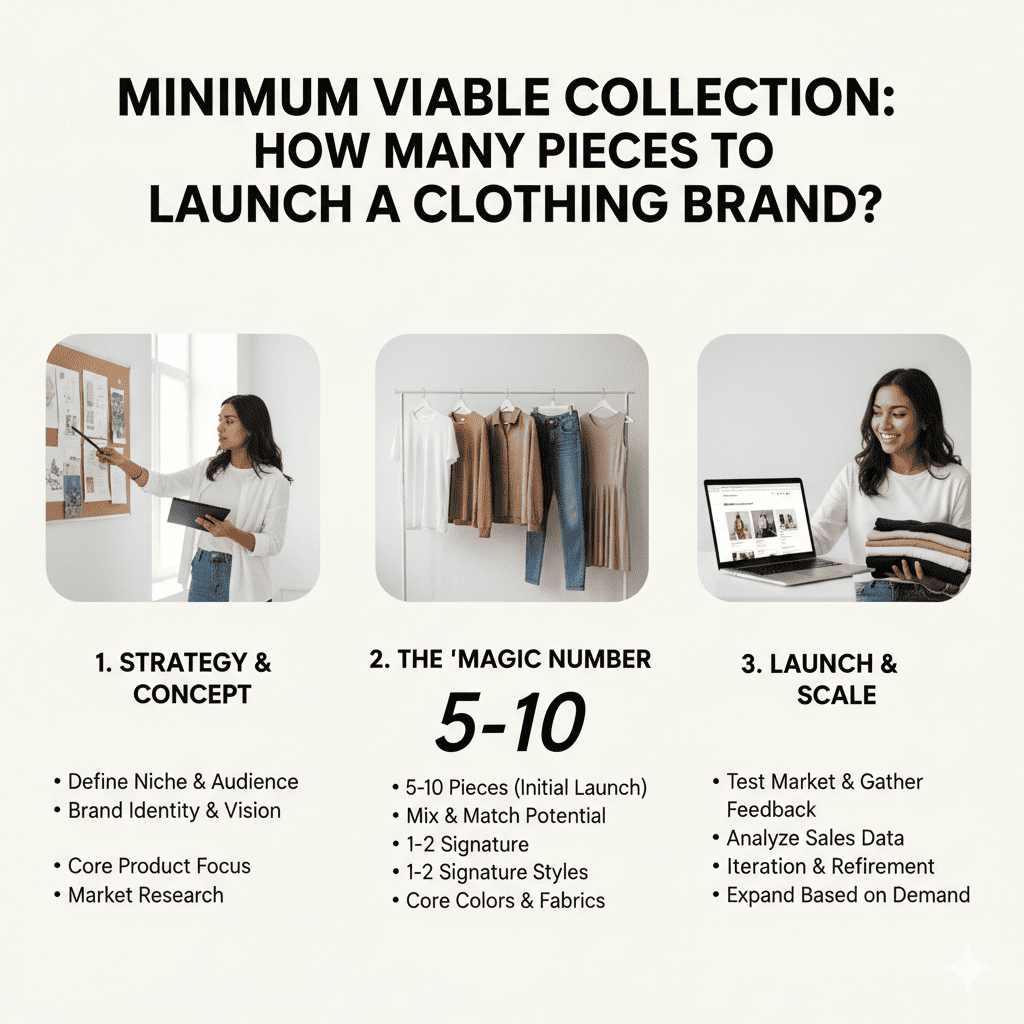
Every fashion startup guide tells you to launch with a full collection. Ten styles, multiple colourways, a complete seasonal range. That advice has ended more clothing brands in their first year than almost any other single piece of received wisdom.
A minimum viable collection is not a reduced version of a full collection. It’s a deliberate commercial strategy — and the number of pieces in it is determined by your unit economics, your manufacturing capacity, and your ability to prove demand, not by what looks complete on a website.
Here’s what the number actually should be, and how to arrive at it.
- A minimum viable collection (MVC) for a UK clothing startup should be one to three styles maximum at launch, not a full seasonal range
- Each additional style at launch multiplies your capital requirement, your manufacturing complexity, and your unsold stock risk proportionally
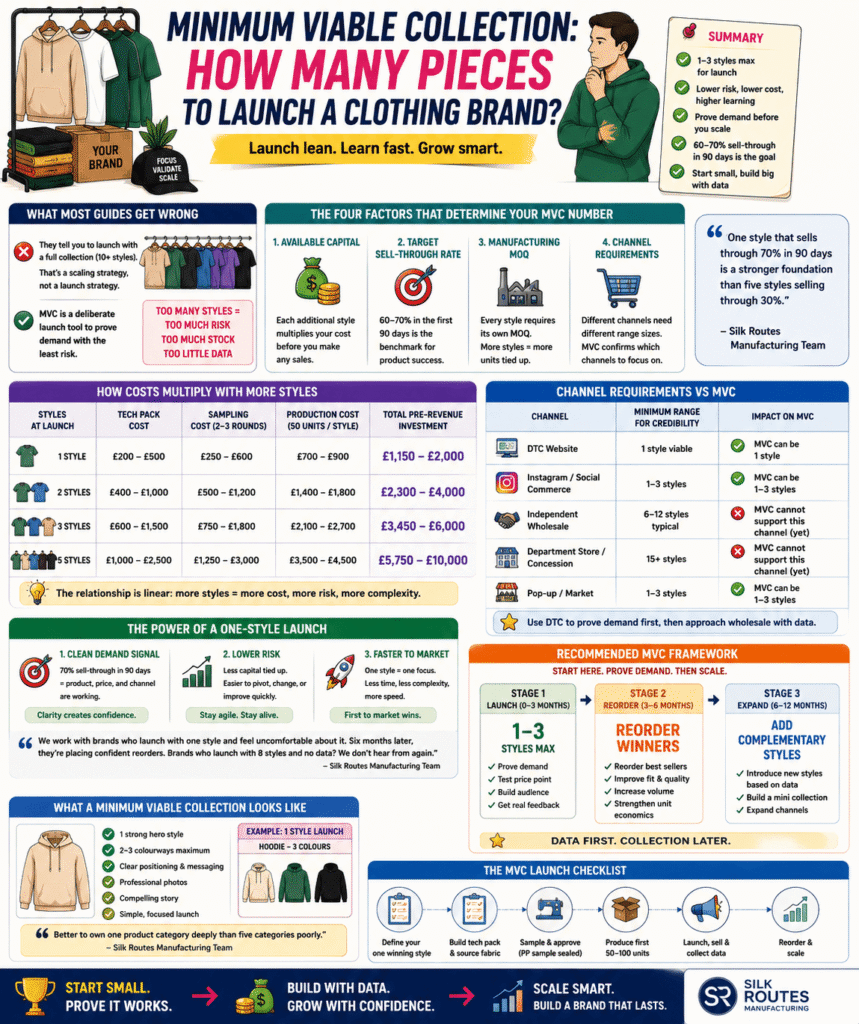
- The correct number of pieces is determined by four factors: available capital, target sell-through rate, manufacturing MOQ, and channel requirements
- One style that sells through 70% in 90 days is a stronger commercial foundation than five styles that collectively sell through 30%
- The MVC framework isn’t a permanent constraint — it’s a launch tool that generates the demand data needed to justify a wider range on the reorder
Contents
- 1. What Most Guides Get Wrong About Launch Collections
- 2. The Four Factors That Determine Your MVC Number
- 3. The One-Style Launch: Why It Works
- 4. The Two-Style Launch: When It Makes Sense
- 5. The Three-Style Maximum: When It Is Justified
- 6. How to Choose Which Style to Launch First
- 7. What Happens After the MVC: Scaling the Range
- 8. Common MVC Mistakes Clothing Startups Make
- 9. FAQ
- 9.1. How many styles does a clothing brand need to launch online?
- 9.2. Can I launch a clothing brand on wholesale with just one or two styles?
- 9.3. How do colourways affect my minimum viable collection count?
- 9.4. What is the right sell-through rate before expanding the range?
- 9.5. Does a minimum viable collection work for activewear or sets?
- 10. The Number Is One — Until the Evidence Says Otherwise
What Most Guides Get Wrong About Launch Collections
The fashion industry runs on the idea of a collection — a cohesive range of complementary pieces that tell a brand story. That concept is valid for brands with production infrastructure, wholesale relationships, and marketing budgets measured in tens of thousands.
It’s not valid for a brand launching at 50 to 100 units with a first-time manufacturing relationship and an unproven customer base.
What guides get wrong: the collection model is presented as the baseline, the minimum acceptable approach to launching a clothing brand. It isn’t. It’s a scaling model dressed up as a launch model — and the brands most likely to run into trouble in their first year are usually the ones that over-invest in initial range width before they’ve validated demand for a single style.
The minimum viable collection is a direct response to that pattern. It asks one question before any other: what’s the smallest number of styles that lets you prove commercial demand without betting the entire business on the answer?
The Four Factors That Determine Your MVC Number
Factor 1 — Available capital
Every additional style at launch requires: a separate tech pack (£150–£500), a separate sampling process (£250–£800 across rounds), separate fabric sourcing, and a separate production run at MOQ.
| Styles at Launch | Tech Pack Cost | Sampling Cost | Production (50 units/style) | Total Pre-Revenue Investment |
|---|---|---|---|---|
| 1 style | £200–£500 | £250–£600 | £700–£900 | £1,150–£2,000 |
| 2 styles | £400–£1,000 | £500–£1,200 | £1,400–£1,800 | £2,300–£4,000 |
| 3 styles | £600–£1,500 | £750–£1,800 | £2,100–£2,700 | £3,450–£6,000 |
| 5 styles | £1,000–£2,500 | £1,250–£3,000 | £3,500–£4,500 | £5,750–£10,000 |
The relationship is roughly linear. Five styles cost approximately five times as much as one style to develop, sample, and produce, before a single unit is sold.
Factor 2 — Target sell-through rate
A useful working benchmark is 60 to 70% sell-through within the first 90 days as the signal that a product has genuine commercial demand at its price point. Below 40%, the product has a pricing problem, a marketing problem, or a product-market fit problem — and the fewer styles you’re running that diagnosis against, the faster you find the answer.
A brand launching five styles cannot easily diagnose which style has a problem and why. A brand launching one style has a single data point to interpret and act on.
Factor 3 — Manufacturing MOQ
Every style requires its own production run at or above the factory’s MOQ. At a 50-unit MOQ, three styles means 150 units of total production — 150 units of capital tied up in untested stock across three different product decisions.
If you’re weighing MOQ against capital exposure for your first run, see our clothing manufacturing services for how we structure low-MOQ private label production to keep that exposure down.
Factor 4 — Channel requirements
Different sales channels have different minimum range requirements:
| Channel | Minimum Range for Credibility | Impact on MVC |
|---|---|---|
| DTC website | 1 style viable | MVC can be 1 style |
| Instagram / social commerce | 1–3 styles | MVC can be 1–3 styles |
| Independent wholesale | 6–12 styles typical | MVC cannot support this channel |
| Department store / concession | 15+ styles | MVC cannot support this channel |
| Pop-up / market | 1–3 styles | MVC can be 1–3 styles |
The channel choice doesn’t change the MVC number — it confirms which channels are viable at MVC stage. A wholesale buyer won’t take a meeting with a one-style brand. That’s not a reason to launch with eight styles. It’s a reason to use DTC to prove demand first, then approach wholesale buyers with data.
“We work with brands who launch with one style and feel uncomfortable about it. Six months later, those same brands are placing confident reorders because they know exactly what their customer wants. The brands who launch with eight styles and no data are usually the ones we don’t hear from again.” — Silk Routes Manufacturing Team
The One-Style Launch: Why It Works
A single-style launch isn’t a compromise. It’s a deliberate commercial decision that produces three specific advantages.
Advantage 1 — Clean demand signal. When one style sells through 70% in 90 days, you know with certainty that the product, the price, and the channel are working. Five styles selling through a combined average of 50% tell you almost nothing useful.
Advantage 2 — Concentrated marketing. Every pound of marketing spend on a one-style launch drives awareness and conversion for one product. The same spend across five styles is diluted to one-fifth per style, rarely enough to generate statistical significance on any of them.
Advantage 3 — Manufacturing relationship quality. A factory that produces one style for you at 50 units, receives clear feedback, and processes a confident reorder at 150 units builds a relationship on demonstrated commercial capability. A factory managing five simultaneous first-run styles for the same brand is managing five separate risk exposures, and treats the relationship accordingly. Brands that arrive with a focused first-run brief — one style, a clear spec, clean feedback — consistently get faster second-run turnaround and more flexible MOQ terms on reorders than those managing multiple simultaneous first-run styles.
The Two-Style Launch: When It Makes Sense
A two-style launch makes commercial sense when the two styles share fabric, construction, or manufacturing process, reducing the incremental cost of the second style materially.
Complementary product pair. A fitted tee and a relaxed tee in the same fabric. The second style requires a new pattern but uses the same fabric sourcing, the same factory setup, and the same label spec.
Core + statement. A base style that anchors the range and a statement style that creates interest and content. The base style drives volume at a lower price point; the statement style justifies a higher RRP and creates visual interest on social channels.
Size-led differentiation. One style in two distinct fits — a slim and a relaxed cut — targeted at different body types. Technically two patterns, but the same fabric, construction approach, and label spec.
What does not justify a two-style launch: two styles in different fabrics, requiring different fabric sourcing, different construction processes, and different factory capabilities. That’s two independent product development processes, not a minimum viable collection.
The Three-Style Maximum: When It Is Justified
Three styles is the realistic ceiling for a minimum viable collection. Beyond three, the capital requirement, the manufacturing complexity, and the demand ambiguity all increase beyond what a startup capital base can manage effectively.
Three styles is justified when:
- All three styles share a primary fabric or construction family, reducing sourcing complexity
- The brand is launching into a market where a single style doesn’t create a credible brand presence — activewear sets, for example, where a matching two or three-piece set is the standard customer expectation
- The brand has secured pre-orders or wholesale commitments that confirm demand across all three styles before production begins
- The total production budget comfortably accommodates three styles at MOQ without exhausting the reorder reserve
The reorder reserve is the test. If launching three styles leaves no capital for a reorder on the style that sells through fastest, the collection is too wide. The reorder isn’t optional — it’s the mechanism that converts a successful first run into a brand.
How to Choose Which Style to Launch First
When a brand has multiple product ideas, the MVC decision is also a prioritisation decision. Which style goes first determines which commercial question gets answered first.
| Criterion | Why It Matters |
|---|---|
| Simplest construction | Reduces sampling rounds and factory risk |
| Fabric available from UK stock | Eliminates fabric lead time |
| Highest target gross margin | Maximises return on first capital deployment |
| Strongest customer demand signal | Pre-orders, waitlist, social interest |
| Most defensible at your RRP | Least vulnerable to competitive pricing |
| Lowest returns risk | Fit-dependent styles carry higher return risk |
Score each potential first style against these criteria. The style with the highest combined score is your MVC, not the style you’re most personally attached to, and not the most ambitious design in your range.
Brands that launch with the operationally simpler product — lower construction complexity, established fabric supply — consistently reach reorder faster than brands that launch with a complex or technically demanding first style. The complex, ambitious style becomes Style 2, after Style 1 has generated the cash and the manufacturing relationship to support it.
What Happens After the MVC: Scaling the Range
The MVC is a launch tool, not a permanent ceiling. The demand data it generates tells you how and when to expand the range with confidence rather than assumption.
The range expansion sequence that works:
- Months 1–3: Launch Style 1. Target 60%+ sell-through. Monitor sell-through rate weekly.
- Month 2: If sell-through is on track, initiate reorder conversation with factory. Confirm slot.
- Month 3: If sell-through hits 60%+, confirm reorder at 1.5× launch volume. Begin tech pack for Style 2.
- Month 4–5: Style 1 reorder in production. Style 2 sampling underway. Capital for Style 2 funded partially by Style 1 revenue.
- Month 6: Style 2 launches. Style 1 established in reorder cycle.
Every stage in this sequence is funded by the commercial success of the previous stage. No stage requires the brand to bet on untested demand. The range expands on evidence, not aspiration.
Common MVC Mistakes Clothing Startups Make
Launching with complementary accessories alongside core styles. A clothing brand launching a tee, a cap, a tote, and a hoodie simultaneously isn’t launching a minimum viable collection — it’s launching four independent product development processes at once, each with its own MOQ, sampling cost, and demand uncertainty.
Fix: Launch the core apparel style first. Add accessories as proven revenue generators in the reorder phase, not as launch stock.
Treating colourways as separate styles. A tee in three colourways at 50 units each is 150 units of production, not one style.
Fix: Launch in one colourway, your best-performing predicted colour or the most commercially neutral option. Add colourways on the reorder.
Expanding the range before the first style is in reorder. Brands that begin developing Style 2 before Style 1 has sold through 50% are financing a range expansion from capital that should be reserved for the reorder of the proven first style.
Fix: The trigger for beginning Style 2 development is 50% sell-through on Style 1 within 60 days, not a calendar date.
Choosing the most ambitious style as the first style. The most technically complex style in the range carries the highest sampling cost and the highest manufacturing risk on a first-run factory relationship.
Fix: Launch with the simplest viable style. Prove the commercial model on a style the factory can execute cleanly.
Not modelling the reorder in the launch budget. A budget that covers one production run with no reserve is a one-shot experiment, not a launch budget.
Fix: Reserve 25 to 30% of your total budget as a reorder fund from the outset. Don’t deploy it until the sell-through trigger is met, but confirm it exists before the first order is placed.
FAQ
How many styles does a clothing brand need to launch online?
One. A single style launched on a DTC website with quality photography, a clear brand story, and a focused marketing budget is a complete, credible launch. The perceived need for multiple styles at launch is a branding instinct, not a commercial requirement.
Can I launch a clothing brand on wholesale with just one or two styles?
Not effectively. Independent wholesale buyers typically expect a minimum of six to twelve styles before taking a meeting. If wholesale is your primary channel, your MVC isn’t one style — it’s a funded DTC proof-of-concept that generates the demand data and range breadth wholesale buyers want to see.
How do colourways affect my minimum viable collection count?
Each colourway is a separate production commitment at your MOQ floor. One style in three colourways at a 50-unit MOQ means 150 units of production, equivalent in capital terms to three styles at 50 units each. For an MVC, launch in one colourway.
What is the right sell-through rate before expanding the range?
60% sell-through within 90 days at full retail price is the benchmark that indicates genuine commercial demand. Below 40%, the product has a problem that more styles won’t solve. Between 40 and 60%, investigate the cause — pricing, photography, marketing reach — before committing to a reorder or a range expansion.
Does a minimum viable collection work for activewear or sets?
Yes, with one adjustment. Categories where the consumer expectation is a matching set — a sports bra and leggings, for example — should treat the set as a single style rather than two independent styles. Launch the set as Style 1; standalone pieces, additional colourways, and complementary styles follow in the reorder phase.
The Number Is One — Until the Evidence Says Otherwise
The minimum viable collection for most UK clothing startups is one style. Not because one style is the limit of ambition, but because one style is the minimum number that can generate a clean, actionable demand signal without the capital and complexity of a multi-style launch.
The brands that build durable ranges don’t launch with ten styles. They launch with one, prove it, reorder it, and add the second style from a position of commercial evidence rather than commercial hope.
For the full picture on how to structure your first production run, from choosing your first style to managing the reorder cycle, our guide to low MOQ and private label clothing manufacturers UK covers every stage of the process from brief to delivery.
Ready to confirm the right manufacturing approach for your minimum viable collection? Find out how Silk Routes works with brands on first runs from 30 units upward.