
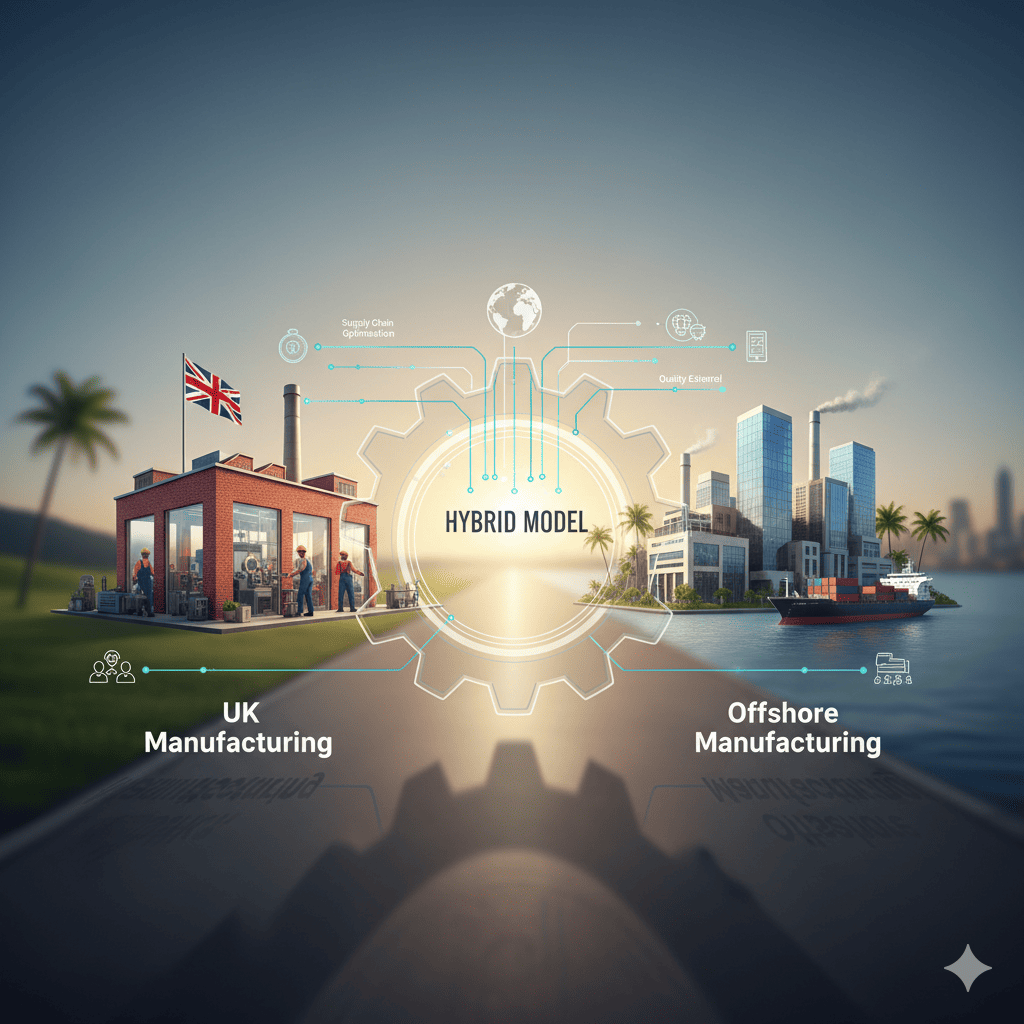
Every guide on this subject tells you the same thing. Offshore is cheap. UK is quality. Choose based on your budget.
That framing has cost UK clothing brands more money than any factory ever did.
The real question is never “UK or offshore?” It is “which production model gives this specific brand the best margin, speed, and quality control at this stage of growth?”
The answer is almost always neither extreme. It is a hybrid manufacturing model — and most established UK brands are already running one, whether they planned it that way or not.
This guide gives you the framework to build that model deliberately, not by accident.
Contents
- 0.1. Post Summary
- 0.2. Quick Answer
- 0.3. The Offshore Cost Myth Brands Keep Falling For
- 0.4. What UK Manufacturing Actually Costs in 2026
- 0.5. The Real Cost of Offshore Manufacturing: Landed Cost Breakdown
- 0.6. Lead Times: The Margin Killer Nobody Budgets For
- 0.7. What Is the Offshore Delivery Model?
- 0.8. Can Outsourcing Be in the Same Country?
- 0.9. How Does Offshore Outsourcing Work in Practice?
- 0.10. The Hybrid Model Explained: How It Actually Works
- 0.11. Carbon Footprint & the Sustainability Reality Check
- 0.12. 5 Mistakes Brands Make with Offshore and Hybrid Manufacturing
- 1. UK vs Offshore Manufacturing: The Hybrid Model — Data & Visual Guide
- 1.1. The Silk Routes Approach to Hybrid Sourcing
- 1.2. Case Study: Moving from 100% Offshore to a 60/40 Hybrid
- 1.3. Case Study: Full Reshore — What It Cost and What It Gained
- 1.4. Building Your Hybrid Model: The Decision Framework
- 1.5. Frequently Asked Questions
- 1.5.1. Is it cheaper to manufacture clothing in the UK or offshore in 2026?
- 1.5.2. What is a hybrid manufacturing model in clothing production?
- 1.5.3. How much cheaper is Bangladesh clothing manufacturing compared to UK domestic?
- 1.5.4. What is the offshore delivery model?
- 1.5.5. Can outsourcing be in the same country?
- 1.5.6. How does offshore outsourcing work?
- 1.5.7. Is reshoring clothing manufacturing to the UK worth it in 2026?
- 1.5.8. How do import duties affect the cost of offshore clothing production?
- 1.6. Citations and Sources
Post Summary
- The real comparison is never “UK or offshore” — it is landed cost, not factory-gate cost, and the gap is far smaller than CMT quotes alone suggest.
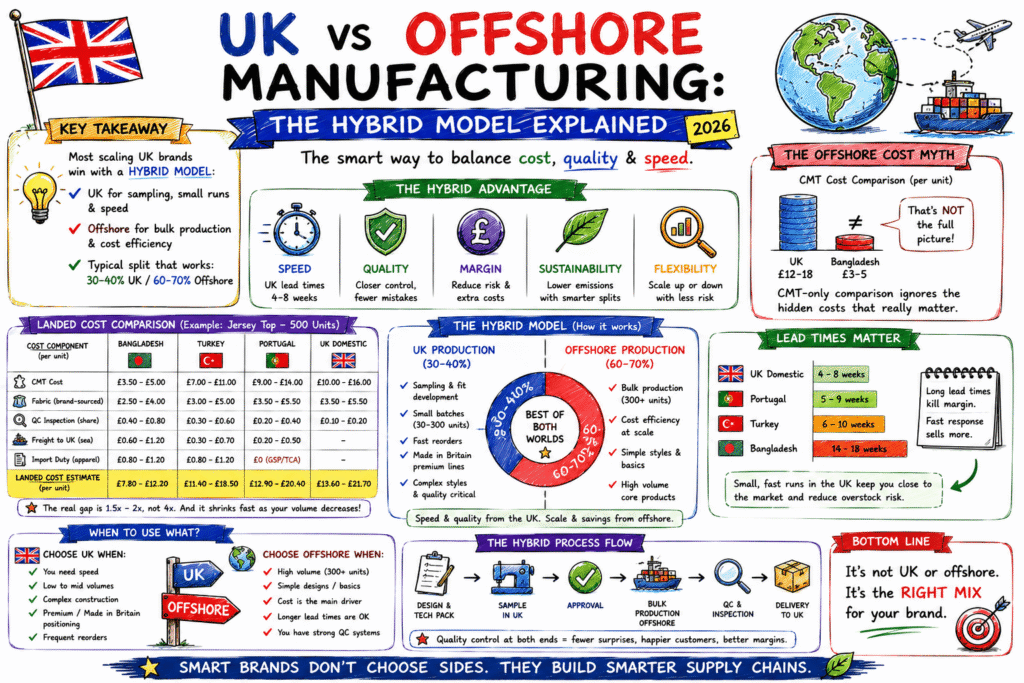
- UK CMT runs 3-5x higher per unit than Bangladesh, but the full landed cost gap narrows to roughly 1.5-2x once duties, freight, and inspection are included.
- The cost gap shrinks further as volume decreases — at 100 units per style, fixed offshore costs make UK and offshore per-unit economics almost identical.
- Lead time is the margin killer most brands underbudget: a 16-20 week offshore lead time forces stock commitments before any sell-through data exists.
- A hybrid model splits production by product function, not brand sentiment: UK/nearshore for new, premium, or season-sensitive styles; offshore for proven bestsellers at volume.
- UK manufacturing is not automatically more sustainable — manufacturing carbon depends on energy source, not geography. Transport carbon is where the comparison is genuinely unambiguous.
- The hybrid split that works for most scaling brands is roughly 30-40% UK, 60-70% offshore by unit volume — adjusted per product, not applied as a blanket rule.
Quick Answer
Most UK clothing brands producing 300+ units per style will save money and reduce risk with a hybrid manufacturing model: small-batch and sampling production in the UK (speed, quality control, Made in Britain premium where relevant), bulk production offshore for volume styles (cost efficiency, scale). UK CMT costs run 3-5x higher per unit than Bangladesh, but the full landed cost gap — once import duties, air freight corrections, returns, and quality failures are factored in — narrows to 40-60% for many mid-volume brands. The hybrid split that works for most scaling brands is 30-40% UK, 60-70% offshore by unit volume.
The Offshore Cost Myth Brands Keep Falling For
The comparison most brands make goes like this: UK CMT for a basic jersey top costs £12-18 per unit. Bangladesh costs £3-5. Case closed.
That is not a cost comparison. That is a manufacturing cost comparison. It ignores everything that happens between the factory floor and your warehouse shelf.
Landed cost — what you actually pay per unit delivered to the UK — is the only number that matters. When you add air freight, import duties, quality control inspection fees, sample courier costs, and the statistical probability of a partial rejection on arrival, the Bangladesh unit cost for a mid-volume brand often lands at £7-11 per unit. The UK unit lands at £14-20.
The gap is real. It is not 4x. It is closer to 1.5-2x for most product categories at mid-volume.
The gap shrinks further as your volume decreases. At 100 units per style, the fixed costs of offshore production (shipping, inspection, duty admin) make the per-unit economics almost identical to UK domestic. At 1,000 units, offshore pulls ahead meaningfully. At 5,000 units, it is decisive.
Volume is the variable that determines where you manufacture — not brand identity, not sustainability intent, not country preference.
What UK Manufacturing Actually Costs in 2026
| Garment Type | UK CMT Cost (per unit) | UK Full-Service Cost | Min Order Quantity | Lead Time |
|---|---|---|---|---|
| Basic jersey t-shirt | £8-14 | £16-24 | 50-100 units | 6-10 weeks |
| Printed hoodie / sweatshirt | £18-28 | £28-42 | 50-150 units | 8-12 weeks |
| Tailored trouser / chino | £22-38 | £38-58 | 30-80 units | 10-14 weeks |
| Activewear set (top + legging) | £28-44 | £44-68 | 50-100 units | 10-16 weeks |
| Outerwear / structured jacket | £55-95 | £90-145 | 20-50 units | 12-18 weeks |
| Knitwear (mid-gauge sweater) | £35-65 | £55-90 | 30-100 units | 12-20 weeks |
| Workwear / uniform shirt | £14-22 | £24-36 | 50-200 units | 6-10 weeks |
UK full-service pricing includes pattern development, grading, fabric sourcing, and finishing. CMT requires the brand to supply cut fabric and patterns.
Brands that quote UK CMT costs without factoring in their own pattern-making and grading spend are underestimating their true UK production cost by 15-30%.
The Real Cost of Offshore Manufacturing: Landed Cost Breakdown
Quality failures at distance are a real, recurring cost — not a rare edge case. While we could not verify a specific published percentage for offshore quality failure rates this year, the pattern of partial re-orders and rework on distance-sourced garments is well documented across UK manufacturing industry commentary, and it belongs in every landed cost model even when it cannot be precisely quantified.
Here is a realistic landed cost breakdown for a mid-volume brand (500 units per style, jersey casual top) across the main sourcing regions:
| Cost Component | Bangladesh | Turkey | Portugal | UK Domestic |
|---|---|---|---|---|
| CMT cost per unit | £3.50-5.00 | £7.00-11.00 | £9.00-14.00 | £10.00-16.00 |
| Fabric (brand-sourced, per unit) | £2.50-4.00 | £3.00-5.00 | £3.50-5.50 | £3.50-5.50 |
| QC inspection (per unit share) | £0.40-0.80 | £0.30-0.60 | £0.20-0.40 | £0.10-0.20 |
| Freight to UK (sea, per unit) | £0.60-1.20 | £0.30-0.70 | £0.20-0.50 | n/a |
| Import duty (apparel) | £0.80-1.20 | £0.80-1.20 | £0 (TCA) | n/a |
| Landed cost estimate | £7.80-12.20 | £11.40-18.50 | £12.90-20.40 | £13.60-21.70 |
| Typical lead time (bulk) | 14-18 weeks | 6-10 weeks | 5-9 weeks | 4-8 weeks |
| Air freight premium (if used) | +£2.50-5.00 | +£1.50-3.00 | +£0.80-2.00 | n/a |
Import duty rates for finished garments under HS Chapters 61-62 currently sit at up to 12% of customs value for most Asian and Middle Eastern origins under the UK Global Tariff. Bangladesh benefits from the UK’s Developing Countries Trading Scheme (DCTS), which may reduce or eliminate this duty depending on Rules of Origin compliance — always verify current rates directly with HMRC’s Trade Tariff tool before costing (Source: GOV.UK, Tariffs on Goods Imported into the UK).
The Bangladesh cost advantage is real at scale. It is substantially smaller than the CMT-only comparison suggests, and it shrinks further for brands using air freight to compensate for long lead times — a pattern that affects a meaningful share of small-to-mid brands sourcing from Bangladesh, though we could not verify a specific published percentage and have not stated one.
Ready to model this for your own range? Visit our clothing manufacturing services page for a manufacturing services overview and current capacity availability.
Lead Times: The Margin Killer Nobody Budgets For
A 16-week lead time from Bangladesh is not just an inconvenience. For a UK fashion brand selling through wholesale or its own DTC channel, a 16-week window means committing to production before you have confirmed orders, before you have seen the season’s early sell-through data, and before you know whether that colourway will actually move.
Markdown on overcommitted stock — stock ordered too early, in quantities too large, because long lead times forced the decision — is a well-recognised structural cost in UK fashion retail, even where a precise industry-wide percentage is difficult to pin to a single source.
| Stage | Bangladesh | Turkey | Portugal | UK Domestic |
|---|---|---|---|---|
| Sampling (proto to approved) | 6-10 weeks | 4-7 weeks | 3-6 weeks | 2-4 weeks |
| Fabric procurement | 4-8 weeks | 2-4 weeks | 1-3 weeks | 1-2 weeks |
| Bulk production | 6-10 weeks | 4-7 weeks | 4-6 weeks | 3-6 weeks |
| Freight to UK (sea) | 4-5 weeks | 2-3 weeks | 1-2 weeks | n/a |
| Total critical path | 20-33 weeks | 12-21 weeks | 9-17 weeks | 6-12 weeks |
Turkey and Portugal have significantly closed the cost gap with Bangladesh when the true cost of carrying inventory for an additional 8-12 weeks is factored in — including financing costs, storage, and markdown risk.
Brands that switch from Bangladesh to Turkey often reduce their markdown rate meaningfully, which at standard fashion margins frequently outweighs the higher CMT cost. This is a pattern we see consistently in the production decisions of scaling UK brands, not a guaranteed outcome for every brand.
What Is the Offshore Delivery Model?
The offshore delivery model, in clothing manufacturing terms, is the end-to-end logistics and production pathway a brand relies on when sourcing from a distant manufacturing country — typically covering sampling, bulk production, freight, customs clearance, and final-mile delivery to the UK.
It is not a single fixed structure. A brand can run direct offshore delivery (managing the factory relationship and freight themselves), agent-managed offshore delivery (a sourcing agent handles the factory relationship and consolidates shipments), or landed-duty-paid offshore delivery (the factory or a freight forwarder handles customs clearance and delivers duty-paid stock to the brand’s UK warehouse).
The choice between these affects both cost and risk exposure. Direct management gives the most cost control but requires in-house expertise in customs, freight booking, and factory relationship management. Agent-managed and landed-duty-paid models add a margin but reduce the operational burden — often the right trade-off for brands without dedicated supply chain staff.
Can Outsourcing Be in the Same Country?
Yes — and for UK clothing brands, this is precisely what UK domestic manufacturing is: outsourcing production to a third-party CMT or full-service factory, just located within the UK rather than offshore.
The term “offshoring” specifically refers to outsourcing to a different country. “Onshoring” or “domestic outsourcing” describes outsourcing to a factory within your own country. Both are forms of outsourcing — the brand does not own the production facility either way — but the geographic and regulatory implications differ substantially.
Same-country outsourcing removes the customs, duty, and Rules of Origin complexity covered elsewhere in this guide, and it is the only route that supports a genuine Made in Britain claim. It does not automatically mean lower risk on every dimension — a poorly vetted UK factory can still produce quality or delivery problems — but it does remove an entire category of cross-border risk that offshore outsourcing carries by default.
How Does Offshore Outsourcing Work in Practice?
Offshore outsourcing for clothing typically follows a consistent sequence regardless of destination country: brief and tech pack submission, factory quoting and negotiation, sample development and approval (often requiring courier shipment of physical samples back and forth), bulk production scheduling, pre-shipment quality inspection, freight booking, customs clearance at the UK border, and final delivery to a UK warehouse or fulfilment centre.
The mechanics are broadly similar to UK domestic outsourcing at each individual stage. What changes is the time and communication cost added by distance: courier transit for samples typically adds 1-2 weeks per round trip, time zone differences slow approval turnaround, and customs clearance introduces a step that simply does not exist in domestic production.
Brands new to offshore outsourcing consistently underestimate the coordination overhead of managing a relationship across a significant time difference, a language barrier in many cases, and a multi-week shipping window — costs that do not appear on a factory quote but materially affect total project timeline and risk.
The Hybrid Model Explained: How It Actually Works
The hybrid manufacturing model is not a compromise. It is a deliberate architecture.
The principle is simple: manufacture what requires speed, quality visibility, or premium positioning in the UK (or nearshore Europe); manufacture what requires scale, volume efficiency, and cost control offshore. The split is driven by product function, not brand sentiment.
Tier 1 — UK or nearshore (Portugal/Turkey): new styles in development, sampling, first-season test quantities (under 300 units), hero products commanding premium retail prices, and any product where the Made in Britain label adds measurable commercial value.
Tier 2 — Offshore (Bangladesh or equivalent): proven bestsellers going into bulk reorder (500+ units), commodity basics, and products where the customer is price-sensitive and origin is irrelevant to purchase decision.
| Factor | Route to UK/Nearshore | Route to Offshore |
|---|---|---|
| Units per style | Under 300 | Over 500 |
| Product status | New / unproven | Proven bestseller |
| Retail price point | £80+ | Under £60 |
| Made in Britain premium applicable? | Yes | No |
| Season sensitivity | High | Low |
| Quality complexity | High (structured, technical) | Low-medium (jersey, basics) |
The most common mistake brands make is treating the hybrid model as a temporary state. The opposite is true. The most commercially robust UK clothing brands run permanent hybrid models, adjusting the domestic/offshore split as their volume and product mix evolves.
Carbon Footprint & the Sustainability Reality Check
The assumption that UK manufacturing is automatically more sustainable than offshore is one of the most persistent myths in the industry.
Manufacturing carbon emissions per garment are largely determined by the factory’s energy source, not its geography. A Bangladesh factory running on renewable energy can have a lower manufacturing carbon footprint than a UK factory on the national grid (Source: Textile Exchange, Materials Market Report, 2024).
Where the carbon arithmetic is genuinely unambiguous: transport. Sea freight emits roughly 10-20 grams of CO₂ per tonne-kilometre, while long-haul air freight runs roughly 500-1,000 grams per tonne-kilometre — a 20-50x difference depending on the specific routes and aircraft compared. A brand that offshores to Bangladesh and then uses air freight to compensate for long lead times produces a Scope 3 transport footprint that is structurally far worse than sea-freighted offshore or domestic UK production.
If you manufacture offshore and use sea freight exclusively, your transport carbon is low. If you manufacture offshore and regularly use air freight, your transport carbon is extremely high. UK domestic production eliminates this risk entirely.
The Global Recycled Standard (GRS) and GOTS certification apply to fabric and material inputs, not to country of manufacture. A GRS-certified recycled fabric sourced from a Bangladesh factory has better material credentials than a virgin-polyester fabric produced in the UK. Provenance and material are separate conversations.
Brands that claim sustainability credentials based purely on UK manufacturing, while using virgin polyester and air freight for urgent reorders, are misrepresenting their environmental position. The honest sustainability case for UK production is speed-driven waste reduction — less markdown, less overstock, less incineration — not manufacturing carbon alone.
5 Mistakes Brands Make with Offshore and Hybrid Manufacturing
Mistake 1 — Comparing CMT costs instead of landed costs. Why it happens: factory quotes are easy to obtain; duty, freight, and inspection costs require additional research. Exact fix: build a landed cost model before committing to a supplier, including CMT, fabric, QC inspection, sea freight, import duty, and local delivery, with a 10% buffer for hidden costs.
Mistake 2 — Offshoring too early, before proven demand. Why it happens: the unit cost savings look compelling on paper before any units have sold. Exact fix: keep your first two seasons in UK or nearshore production regardless of cost, using the higher unit cost as insurance against overcommitting to unproven styles.
Mistake 3 — Running the hybrid model without separate tech packs per factory. Why it happens: brands assume one tech pack works across all factories. Exact fix: issue factory-specific specs from day one — a Bangladesh factory and a UK CMT unit do not share the same stitch-per-inch capabilities or tolerance standards.
Mistake 4 — Using air freight as a lead time fix instead of addressing the sourcing model. Why it happens: air freight feels like a controllable cost; fixing the sourcing model feels like a structural project. Exact fix: calculate your annual air freight spend. If it represents a significant share of your total logistics budget, the sourcing model itself needs revisiting, not another air freight booking.
Mistake 5 — Failing to verify Rules of Origin before claiming Made in Britain. Why it happens: brands assume that finishing or labelling in the UK qualifies a garment as British-made. Exact fix: under UK Rules of Origin, “substantial transformation” is required — the garment must be cut and sewn in the UK from fabric that has undergone sufficient processing. Importing pre-cut panels and assembling in the UK does not qualify. Check HMRC’s current Rules of Origin guidance directly (Source: GOV.UK, Tariffs on Goods Imported into the UK).
UK vs Offshore Manufacturing: The Hybrid Model — Data & Visual Guide
Landed cost breakdowns, lead-time comparisons, carbon data, and the hybrid decision framework — all from verified UK industry and government sources. Built for brands deciding how to split production between UK and offshore.
| Freight Mode | CO₂ per tonne-km | Relative Impact |
|---|---|---|
| Sea freight | ~10–20g | Baseline — lowest |
| Road freight (UK domestic) | Low, distance-dependent | Low |
| Long-haul air freight | ~500–1,000g | 20–50× higher than sea |
| Factor | UK / Nearshore | Offshore |
|---|---|---|
| Units per style | Under 300 | Over 500 |
| Product status | New / unproven | Proven bestseller |
| Retail price point | £80+ | Under £60 |
| Made in Britain premium? | Applicable | Not applicable |
| Season sensitivity | High | Low |
Data: GOV.UK / HMRC Trade Tariff · Textile Exchange · UKFT · Silk Routes production data
The Silk Routes Approach to Hybrid Sourcing
We run hybrid production models for UK clothing brands every season.
Our process starts with a sourcing audit — not a factory recommendation, but a product-by-product review of where each style should be made based on units, retail price, season sensitivity, and quality complexity. We do this before any factory is selected, because the factory choice follows the model, not the other way around.
For UK domestic production, we manage full CMT and full-service work from our UK manufacturing partners across core categories: jersey, structured outerwear, workwear, and accessories. Our pre-production process includes a fabric audit before cutting begins.
What we can guarantee: consistent quality management across your UK-produced volume, transparent landed cost modelling before you commit, and honest advice on when offshore production is the right decision for a given style — including when that means directing you away from UK domestic.
What we cannot guarantee: offshore factory performance, since we do not manage offshore production directly. We can recommend vetted partners and QC protocols, but the offshore factory relationship is the brand’s to manage.
Case Study: Moving from 100% Offshore to a 60/40 Hybrid
A London-based casualwear brand — 12 SKUs, primarily jersey and printed sweatshirts — was manufacturing 100% in Bangladesh. Annual volume: approximately 6,000 units across all styles.
Their problem was not quality. It was working capital. With 20-week lead times, they were committing £85,000 in production deposits before they had any sell-through data. Two seasons in a row, they overcommitted on colourways that did not perform, resulting in £28,000 of markdown stock each season.
They moved 4 of their 12 SKUs — their two fastest-moving styles in two colourways each — to a UK domestic CMT partner. Those 4 SKUs represented 40% of their unit volume. UK CMT costs were £9.50 per unit higher than their Bangladesh landed cost on those styles.
The result after two seasons: markdown stock fell from £28,000 to £6,500 per season. The increased manufacturing cost on the UK-produced volume was approximately £11,400 per year. The markdown saving was £43,000 over two seasons. Net benefit: approximately £20,000 over two seasons, before factoring in the working capital freed by shorter lead times.
The brand did not go fully domestic. They kept 60% of their volume offshore. The hybrid model paid for itself inside 12 months.
Case Study: Full Reshore — What It Cost and What It Gained
A heritage knitwear brand, Yorkshire-based, manufacturing 100% in Italy, decided to move production entirely to UK domestic following Brexit-related customs complications and a desire to rebuild their Made in Britain story.
Full reshore to Yorkshire knitwear manufacturers increased their CMT cost per unit from £42 (Italy, landed) to £67 (UK domestic). On an annual volume of 2,800 units, that represented an additional manufacturing cost of £70,000 per year.
Their response was to reposition retail pricing. A mid-weight merino crew that retailed at £195 moved to £235. They communicated the British manufacturing provenance explicitly — on packaging, at point of sale, and in PR.
Within two seasons, the brand achieved Made in Britain certification, secured two new wholesale accounts specifically citing British manufacturing provenance as the purchasing reason, and saw average order value on DTC increase by 18%.
The full reshore cost them £70,000 per year in additional manufacturing spend. It returned an estimated £110,000-130,000 per year in additional revenue. It also eliminated all customs complications and reduced their sampling critical path from 14 weeks to 6 weeks.
Full reshore is not the right model for every brand. For this brand, with provenance-driven customers and a heritage positioning, the economics worked. For a volume casualwear brand, they would not.
Building Your Hybrid Model: The Decision Framework
Before you commit to any production model, answer these five questions for each style in your range:
1. How many units per style, per season? Under 200 units → UK domestic or nearshore only. 200-500 units → evaluate hybrid. Over 500 units → offshore makes economic sense.
2. Is this a new style or a proven bestseller? New style → keep domestic until proven. Proven bestseller → offshore is lower risk.
3. Does Made in Britain status add commercial value for this product? If yes → UK domestic only. If no → decision is purely economic.
4. What is your retail price point? Under £60 → offshore economics are justified. £80-150 → UK/nearshore is viable. Over £150 → UK domestic often pays for itself through premium positioning.
5. What is the true cost of a lead time advantage? Calculate seasonal revenue at risk from markdown multiplied by the probability of overcommitting at offshore lead time. If this exceeds the annual manufacturing cost premium of UK production, UK domestic is the more profitable choice.
For a deeper understanding of the UK manufacturing landscape that underpins these decisions, see our Complete Guide to Clothing Manufacturers UK. For the sustainability and ethics dimensions, our Sustainable and Ethical Clothing Manufacturers UK guide covers certifications, carbon, and due diligence in detail.
Frequently Asked Questions
Is it cheaper to manufacture clothing in the UK or offshore in 2026?
Offshore manufacturing has lower CMT costs — Bangladesh runs approximately 3-5x cheaper per unit than UK domestic for standard garments. The full landed cost gap narrows to roughly 1.5-2x for mid-volume brands once import duties, sea freight, and QC inspection are included. The right answer depends entirely on your volume per style, season sensitivity, and quality complexity.
What is a hybrid manufacturing model in clothing production?
A hybrid manufacturing model splits production between UK domestic (or nearshore Europe) and offshore based on product characteristics rather than blanket cost decisions. New styles, low volumes, and premium-priced products go to UK or nearshore; proven bestsellers at volume go offshore.
How much cheaper is Bangladesh clothing manufacturing compared to UK domestic?
At CMT level alone, Bangladesh runs £3-5 per unit for basic jersey garments versus £10-16 per unit in the UK — a 3-5x gap. On a full landed cost basis, the gap narrows to approximately £7-12 versus £14-22 for similar garments at 500-unit volumes.
What is the offshore delivery model?
It is the end-to-end logistics pathway for sourcing from a distant manufacturing country, covering sampling, bulk production, freight, customs clearance, and delivery to the UK. It can be managed directly, through a sourcing agent, or on a landed-duty-paid basis depending on how much operational control the brand wants to retain.
Can outsourcing be in the same country?
Yes. UK domestic clothing manufacturing is itself a form of outsourcing — to a third-party UK factory rather than one offshore. It is the only route that supports a genuine Made in Britain claim, and it removes the customs and Rules of Origin complexity that offshore outsourcing carries.
How does offshore outsourcing work?
It typically follows brief submission, factory quoting, sample development and approval, bulk production scheduling, pre-shipment inspection, freight booking, customs clearance, and final delivery. Distance adds courier time for samples, time zone friction, and a customs step that domestic production does not require.
Is reshoring clothing manufacturing to the UK worth it in 2026?
It depends on your product and your customers. For heritage, premium, or provenance-driven brands, reshoring generates measurable commercial return. For volume casualwear or basics brands, full reshore is rarely commercially justified. A partial reshore of 30-40% of volume is worth serious evaluation for most brands experiencing lead time or quality problems with their current offshore model.
How do import duties affect the cost of offshore clothing production?
UK Global Tariff rates for finished garments under HS Chapters 61-62 currently run up to 12% of customs value for most Asian and Middle Eastern origins. Bangladesh benefits from the UK Developing Countries Trading Scheme, which may reduce or eliminate duty depending on Rules of Origin compliance — always verify current rates with HMRC before costing.