
![Reshoring Fashion Manufacturing to UK: Complete Guide [2026]](https://silkroutes.co.uk/wp-content/uploads/2026/04/Reshoring-Fashion-Manufacturing-to-UK-Complete-Guide.png)
Maya had been manufacturing in Bangladesh for six years. Quality was fine. Costs were low. Then a factory fire held up her spring collection for eleven weeks, her biggest wholesale account cancelled, and she spent a month fielding emails from customers asking why “Made in Bangladesh” was on a sustainable fashion brand.
She started the reshoring conversation with us at Silk Routes that autumn. This guide is built on what she, and brands like her, actually went through, alongside the real industry data on what reshoring looks like in practice.
For the broader sourcing context, see our Complete Guide to Clothing Manufacturers in UK.
Post Summary
- Reshoring interest is genuinely rising, but most UK brands use it for agile, low-volume needs like printing and knitwear, not as a wholesale replacement for offshore volume production
- The true cost of reshoring isn’t just the higher unit price; it includes pattern redevelopment, sampling rounds, tooling, and a parallel production period of 3–6 months
- UK government grants for manufacturing investment exist but require proactive application; they’re not automatically available to reshoring brands
- Ethical compliance concerns about UK manufacturing remain a real barrier for many brands, not just a historical footnote
- Most brands that reshore successfully do it in phases, not by cutting offshore suppliers overnight
- The biggest reshoring mistake is underestimating how long the UK sampling and approval process takes when starting from scratch with a new factory
Contents
- 1. Why Brands Are Reshoring to UK in 2026
- 2. The True Cost of Reshoring: What Brands Don’t Account For
- 3. Step-by-Step: How to Transition From Offshore to UK Production
- 4. The Ethical Reputation Problem Most Guides Skip
- 5. UK Government Grants for Reshoring Fashion
- 6. Brands That Have Reshored: What Happened Next
- 7. Mistakes to Avoid When Reshoring
- 8. UK Reshoring: Questions Brands Ask Us
- 8.1. Which country is No. 1 in the garment industry?
- 8.2. How do I start a fashion brand in the UK?
- 8.3. How big is the UK fashion industry?
- 8.4. What is sourcing in the fashion industry?
- 8.5. How long does it take to fully reshore clothing manufacturing to the UK?
- 8.6. Is reshoring clothing manufacturing to the UK financially viable in 2026?
- 8.7. What grants are available for UK fashion brands reshoring manufacturing?
- 8.8. Do I need to get Made in Britain certification when I reshore?
- 8.9. Can I reshore only part of my range and keep some production offshore?
- 9. Making Reshoring Work on Your Terms
Why Brands Are Reshoring to UK in 2026
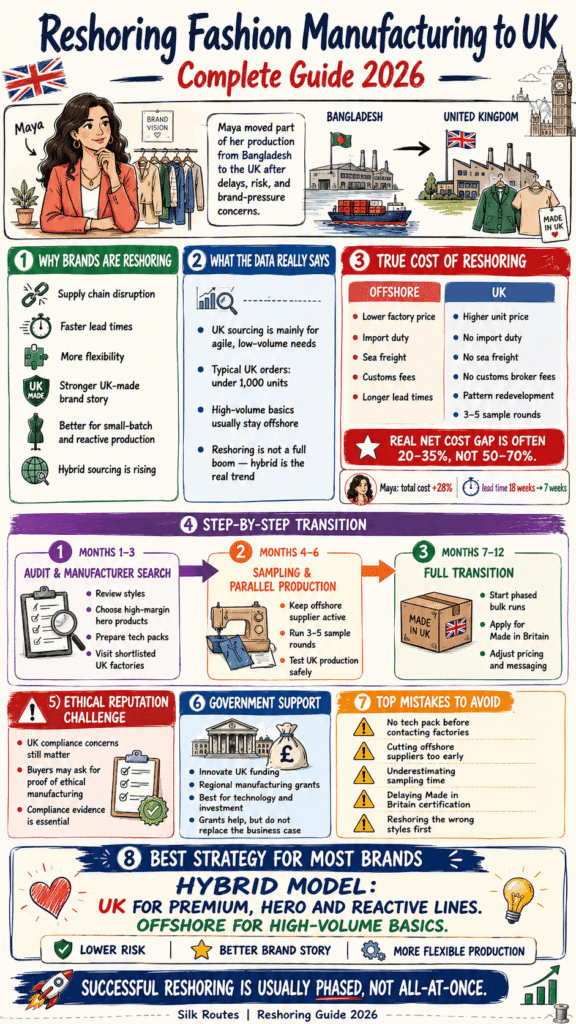
Supply chain disruption accelerated the reshoring conversation more than any single commercial calculation. A 2025 UKFT report on UK reshoring, based on insights from eight major UK retailers with a combined turnover of £26.1 billion, found that two-thirds of those brands experienced real Brexit-related supply chain challenges, with three-quarters reporting higher admin costs and delivery delays.
The picture that report paints is more measured than the “reshoring boom” narrative suggests. 75% of those brands already source something from the UK, but mostly for agile, niche needs: printing, knitwear, and test-and-react models, with average order volumes typically under 1,000 units. Not one of the eight brands surveyed reported placing high-volume orders in the UK, and none said they planned to massively shift volume production back domestically. They’re using the UK for speed and flexibility while keeping cost-driven volume production offshore.
What the data doesn’t show: reshoring is not a mass movement. What is changing is that the offshore-only default is being questioned more seriously, and the case for a hybrid model, UK for core and reactive product, offshore for volume basics, is being made more frequently and with better evidence behind it.
The True Cost of Reshoring: What Brands Don’t Account For
The reshoring conversation almost always starts with the wrong number. Brands compare offshore unit costs to UK unit costs and react to the gap. The actual financial picture is more complex.
| Cost Element | Offshore (continuing) | UK (reshoring) | Notes |
|---|---|---|---|
| Unit production cost | Lower | Higher, typically 40–70% more | Varies by category and volume |
| Import duty | 0–12% depending on origin | None | Significant on EU/non-preferential origins |
| Sea freight | £0.60–£1.50 per unit | None | Removed entirely |
| Customs broker fees | £100–£300 per shipment | None | Removed entirely |
| Pattern redevelopment | None | £500–£2,000 per style | UK factories need UK-standard patterns |
| Sampling rounds (UK) | Already paid offshore | 3–5 rounds at £200–£600 each | New factory relationship from scratch |
When all costs are modelled honestly, the net unit cost gap between offshore and UK production is frequently 20–35%, not the 50–70% that factory gate price comparisons suggest.
Maya’s numbers worked out at a 28% higher total cost per unit after duty, freight, and QC were stripped out of her Bangladesh model. Her margin dropped, but not by as much as the headline unit price comparison implied. Her lead time dropped from 18 weeks to 7.
Step-by-Step: How to Transition From Offshore to UK Production
The brands that reshore successfully treat it as a structured project, not a single decision. Here’s the process we walk brands through at Silk Routes.
Months 1–3: Audit and Manufacturer Search
Start with a full audit of your current range. Not every style is worth reshoring. Identify which products justify the unit cost increase, typically your highest-margin lines, your brand signature pieces, and anything carrying a sustainability or origin claim.
Research UK manufacturers against your specific product category. Do not approach UK factories without a completed tech pack, this is the single most common mistake at this stage. A UK manufacturer can’t give you an accurate quote without production-ready patterns and specifications.
Use the UKFT membership directory and the Made in Britain member database as starting points. Visit shortlisted factories in person before committing to sampling.
“The audit stage is where most reshoring projects succeed or fail. Brands that try to reshore their entire range at once almost always hit capacity problems or cost shocks. Start with your top three styles and prove the model.” — Silk Routes Manufacturing Team
Months 4–6: Sampling and Parallel Production
Run UK sampling in parallel with your existing offshore production. Don’t cut offshore supply until UK production is approved and a bulk run has been successfully completed.
Budget for three to five sample rounds per style. UK factories, particularly those used to bespoke or small-run work, will iterate carefully. This is slower than offshore sampling but produces more precise results.
Keep your offshore supplier active during this period. Cutting them before UK production is proven is a significant commercial risk, and our how to choose a UK clothing manufacturer guide covers the compatibility checks worth running before you commit to any single new UK factory.
This is where Maya spent most of her reshoring budget, four sample rounds per style across six styles. It took longer than she planned. But when bulk production started, the rejection rate was zero.
If you want to understand how Silk Routes structures the sampling and approval process for reshoring brands, our clothing manufacturing services page covers our onboarding approach in detail.
Months 7–12: Full Transition
Begin phased bulk production with your UK manufacturer. Start with one or two styles at commercial volume before transitioning the full range.
Build your Made in Britain certification application into this phase, the application requires evidence of UK manufacturing, so it can only be submitted once production is live.
Monitor the full cost model against your projections from Month 1. Adjust pricing strategy if needed; most brands that reshore successfully increase retail price on reshored lines by 10–20% and communicate the origin story explicitly.
By month twelve, Maya was manufacturing four of her six hero styles in the UK. Her two highest-volume basics remained offshore. That hybrid model reduced her total risk and gave her a credible UK-made story on her premium lines.
The Ethical Reputation Problem Most Guides Skip
This is the part of reshoring most guides leave out entirely, and it’s a real, quantified barrier, not a footnote.
UKFT’s reshoring research found that 95% of brands by turnover said reports of unethical trade practices in UK factories had limited or eliminated their willingness to source domestically, and 58.3% of brands surveyed had an explicit company policy against UK sourcing altogether. Historic labour compliance failures in parts of the UK garment sector have left a reputational shadow that hasn’t fully lifted, even for compliant, well-run factories.
This matters practically: if you’re reshoring, factory ethical compliance and the ability to evidence it aren’t optional extras. They’re often the first question a wholesale buyer or press contact will ask, precisely because the sector’s history makes scrutiny higher than it would be for, say, a Portuguese or Italian supplier.
UK Government Grants for Reshoring Fashion
Government support for UK fashion manufacturing exists but requires active pursuit, it’s not automatic and not always easy to navigate.
Innovate UK funding covers manufacturing innovation and technology adoption. Brands investing in digital sampling, sustainable materials, or production technology as part of reshoring may qualify for match-funded grants, alongside other co-funders depending on the specific opportunity.
Local enterprise partnerships and mayoral combined authorities, particularly in traditional textile regions such as the North West, Yorkshire, and the East Midlands, sometimes offer business development grants for manufacturing investment. These are regional and inconsistent, but worth investigating if your reshoring involves local factory investment.
What doesn’t work: assuming a grant will cover the cost gap. Most available grants support capital investment and technology, not operational cost differences. Don’t build a reshoring business case that depends on grant income; grants are a supplement, not a foundation.
Brands That Have Reshored: What Happened Next
The reshoring conversation is often framed around cost. The brands that have done it successfully report that the commercial benefit is broader than the unit cost calculation.
Brands with UK manufacturing credentials report stronger wholesale relationships with independent retailers who actively seek British-made suppliers. PR and press coverage of UK manufacturing stories is meaningfully easier to secure than offshore supply chain stories.
What doesn’t work: reshoring without a clear brand communication strategy. UK manufacturing costs more. If your customer doesn’t understand why, if the origin story is buried in the product description rather than front and centre, the premium won’t hold.
Maya launched her UK-made collection with a factory visit series on Instagram and a dedicated “Made in the UK” product category on her site. Her average order value on UK-made lines was 23% higher than her Bangladesh-produced equivalents. Her return rate was lower.
Mistakes to Avoid When Reshoring
Mistake 1 — Approaching UK factories without production-ready tech packs. Brands assume the factory will help develop specifications from sketches or samples. UK factories, particularly premium and specialist operations, expect a production-ready brief. Fix: commission pattern making and full tech pack development before approaching any UK manufacturer. Budget £500–£2,000 per style and 6–8 weeks for this stage.
Mistake 2 — Cutting offshore suppliers before UK production is proven. Brands want a clean break. The reality is that offshore production is the safety net during the transition period. Fix: maintain your offshore supplier relationship through at least one successful UK bulk run. Give formal notice only when you have UK production confirmed and a completed order in hand.
Mistake 3 — Underestimating the sampling timeline. Brands assume UK sampling will be faster because the factory is closer. Proximity reduces approval time, but the number of sample rounds required when starting a new factory relationship is typically three to five regardless of location. Fix: plan for five sample rounds in your reshoring timeline. If you need fewer, you’re ahead of schedule. If you need more, you’re not behind.
Mistake 4 — Not applying for Made in Britain certification during the transition. Brands focus on production and leave certification as an afterthought. Fix: start the Made in Britain application process as soon as the first bulk run is confirmed. Certification provides commercial credibility and marketing asset value that compounds over time.
Mistake 5 — Reshoring the wrong styles first. Brands try to reshore their highest-volume, lowest-margin basics, the very styles where the unit cost gap is most painful. Fix: reshore your highest-margin, brand-defining styles first. These are where the Made in Britain premium holds. Use offshore production for volume commodity product where margin is already thin.
UK Reshoring: Questions Brands Ask Us
Which country is No. 1 in the garment industry?
China is the world’s largest garment manufacturer and exporter by a wide margin, accounting for roughly 30–40% of global textile and apparel exports. Bangladesh holds the No. 2 position globally. The UK doesn’t compete on this kind of volume manufacturing scale at all; its strength is speed, quality, and agile small-batch production rather than mass-market output, which is exactly why reshoring suits specific product categories rather than full-range volume replacement.
How do I start a fashion brand in the UK?
Reshoring assumes you already have a brand, but if you’re starting fresh, the sequence is broadly: define your product and target customer, commission a tech pack and graded pattern from a UK pattern cutter, shortlist UK manufacturers against your specific garment category, and budget for 3–5 sampling rounds before any bulk order, the same vetting discipline covered in detail in our manufacturer selection framework earlier in this guide.
How big is the UK fashion industry?
The UK fashion and textile industry contributes around £62 billion to the UK economy and supports roughly 1.3 million jobs, equivalent to about 1 in every 25 UK jobs. That figure spans design, manufacturing, retail, and the wider supply chain, not domestic production alone; most of the clothing sold in the UK is still imported, which is exactly the dynamic reshoring sits within.
What is sourcing in the fashion industry?
Sourcing is the process of finding, vetting, and contracting the manufacturers, fabric mills, and trim suppliers who actually produce a brand’s garments. It covers everything from identifying a factory with the right machinery and MOQ for your product, to managing the relationship, quality control, and logistics once production starts. Reshoring is a specific sourcing decision, choosing UK-based manufacturing partners over offshore ones, rather than a separate discipline.
How long does it take to fully reshore clothing manufacturing to the UK?
A realistic full transition, from audit to completed first UK bulk run, takes 9–12 months for a brand reshoring three to six core styles. The sampling phase alone typically takes 3–5 months. Brands that attempt faster transitions without completed tech packs or parallel production periods consistently hit problems in the first bulk run.
Is reshoring clothing manufacturing to the UK financially viable in 2026?
For many brands, yes, when the full cost model is used rather than factory gate price comparisons. When import duty, sea freight, customs costs, and QC overhead are removed from the offshore model, the net cost gap between offshore and UK domestic production is typically 20–35% rather than 50–70%. Brands that reshore premium, high-margin lines and communicate the UK origin story effectively can hold or increase margin.
What grants are available for UK fashion brands reshoring manufacturing?
Innovate UK and regional enterprise partnership grants are the primary routes most brands can access directly. Most grants support capital investment and technology rather than operational cost differences. Check current open funding opportunities directly with UKRI, as funding rounds open and close regularly.
Do I need to get Made in Britain certification when I reshore?
It isn’t legally required, but it’s commercially valuable. The Made in Britain collective mark is recognised by UK buyers, retailers, and press as a credible origin indicator. It requires evidence of UK manufacturing and a straightforward application process. Most brands that reshore find the certification pays back in wholesale and PR value within 12 months.
Can I reshore only part of my range and keep some production offshore?
Yes, and this is the model most brands adopt successfully. Industry research confirms it’s also the dominant pattern already: the large majority of UK retailers surveyed use UK sourcing for agile, low-volume needs while keeping cost-driven volume production offshore. A hybrid approach, UK production for hero and premium lines, offshore for high-volume basics, balances cost management with brand story while reducing risk during the transition.
Making Reshoring Work on Your Terms
Maya finished her first full UK-produced season twelve months after that first conversation. Four styles, seven weeks from order to delivery, zero customs paperwork, and a brand story her wholesale accounts actually wanted to talk about.
She kept two styles in Bangladesh. The hybrid model worked for her margin and her range architecture. That’s the honest reshoring outcome for most brands, not a complete pivot, but a deliberate repositioning of where UK production adds the most value, backed by the same pattern the wider industry data shows.
For the full picture of how UK manufacturing sits within a broader sourcing strategy, our Complete Guide to Clothing Manufacturers in UK covers every sourcing option available to UK brands.