

Searches for “Made in Britain” clothing have grown substantially over the past three years (Source: Make It British, British Manufacturing Survey, 2024).
That is not a heritage story. That is a market signal.
The brands discovering British manufacturing in 2026 are not doing so out of patriotism alone. The calculus has shifted on carbon, lead time, supply chain risk, and what retail buyers and conscious consumers now require before they will stock or buy a product.
This guide does not romanticise British manufacturing. It examines it honestly — the genuine advantages, the real cost premium, the regional capabilities, the compliance landscape, and the cases where offshore or nearshore production remains the more rational choice.
Made in Britain is not right for every brand. But for far more brands than currently use it, it is the commercially smarter decision.
Contents
- 0.0.1. Post Summary
- 0.0.2. Quick Answer
- 0.0.3. What “Made in Britain” Actually Means: The Legal Definition
- 0.0.4. Why Choose British Manufacturing? Five Commercially Honest Reasons
- 0.0.5. Regional Manufacturing Hubs: What Each Does Best
- 0.0.6. Quality Standards & British Craftsmanship
- 0.0.7. Speed-to-Market: UK vs Offshore
- 0.0.8. Carbon Footprint: UK vs Offshore
- 0.0.9. Case Study: From Bangladesh to Britain — What the Numbers Showed
- 0.0.10. Made in Britain vs Overseas: Honest Comparison
- 0.0.11. Common Myths About British Manufacturing
- 0.0.12. Case Study: The Heritage Export Play
- 1. Made in Britain Clothing Manufacturers: Data & Visual Guide
Post Summary
- Searches for “Made in Britain” clothing have grown substantially over the past three years — a market signal, not just a heritage trend.
- “Made in Britain” is not a single legally defined term for clothing; Trading Standards applies a “substantial transformation” test, broadly meaning cut and sewn in the UK.
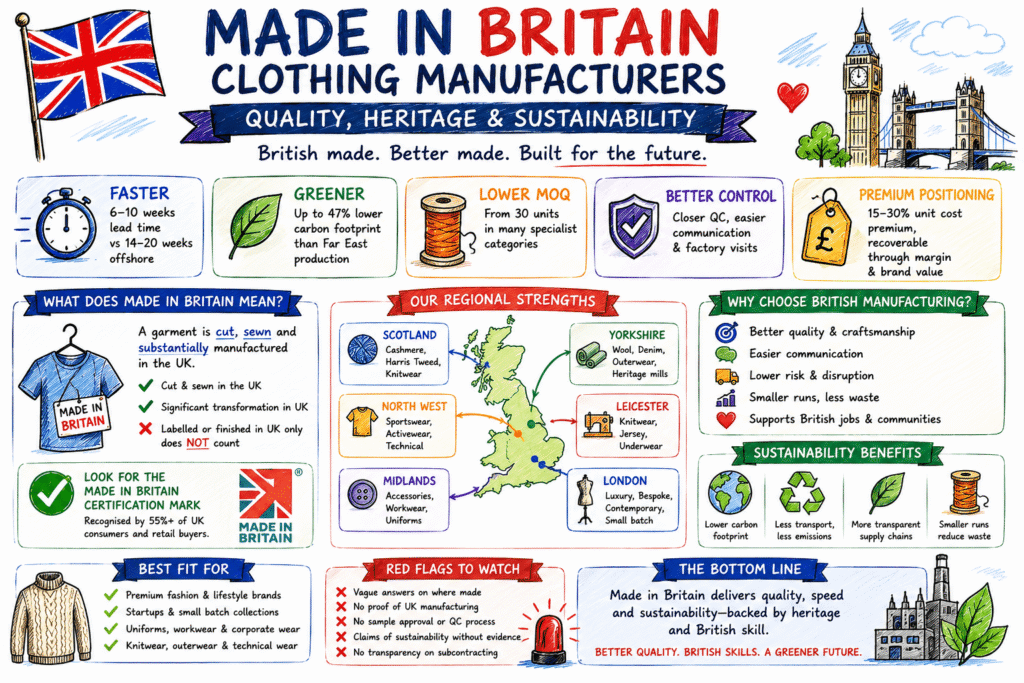
- UK manufacturing typically runs 6-10 weeks lead time versus 14-20 weeks offshore — often the more valuable advantage over unit cost alone.
- A University of Nottingham study commissioned by David Nieper found UK manufacturing produced 47% fewer emissions than an equivalent overseas operation — a single comparative case study, not an industry-wide average.
- The UK ranked 4th globally in Statista’s 2017 Made-In Country Index for perceived manufacturing quality, behind Germany, Switzerland, and the EU as an aggregate.
- Leicester’s factory count has fallen from around 1,000 to 400-500 since 2020 — regional default choices need real verification, not assumption.
- Harris Tweed is the only fabric in the world protected by its own Act of Parliament, requiring handweaving in islanders’ homes in the Outer Hebrides.
- The average UK-made garment carries a 15-30% unit cost premium over offshore — but markdown risk reduction frequently closes or reverses that gap on a full-season basis.
Quick Answer
Made in Britain clothing manufacturing covers garments produced substantially in the UK, typically across specialist regional hubs: Leicester (knitwear, jersey), Yorkshire (wool, denim), Scotland (cashmere, Harris Tweed), London (bespoke, luxury, contemporary), and the Midlands (accessories, workwear). UK manufacturing delivers shorter lead times (6-10 weeks versus 14-20 weeks offshore), a carbon footprint that one University of Nottingham case study found to be 47% lower than equivalent Far East production, and MOQs from 30 units for specialist categories. The average UK-made garment carries a 15-30% unit cost premium over comparable offshore production — but for brands targeting mid-market and above, that premium is frequently recoverable through margin, positioning, and retail buyer preference.
What “Made in Britain” Actually Means: The Legal Definition
This is where most brands get it wrong — and where some manufacturers get it deliberately vague.
“Made in Britain” is not a legally protected term in the same way as geographic food indicators. There is no single piece of UK legislation that defines it for clothing specifically.
What exists is a combination of Trading Standards guidance, the Competition and Markets Authority Green Claims Code, and the framework maintained by The Made in Britain Organisation — a registered collective mark that requires members to demonstrate UK manufacture.
The UK fashion and textile industry contributes £62 billion to GDP and supports 1.3 million jobs (Source: UKFT and Oxford Economics, Fashion & Textile Industry Footprint in the UK, 2023). These figures contextualise why the integrity of “Made in Britain” labelling matters commercially, not just ethically.
What Counts as UK-Made Under Current Guidance
Trading Standards guidance applies a “substantial transformation” test. For garments, this generally means the product must have been cut and sewn in the UK, not merely labelled, packaged, or finished here.
A garment cut and sewn in the UK from imported fabric can legitimately carry a “Made in UK” claim under current Trading Standards guidance. A garment assembled overseas and labelled in the UK cannot.
A garment with embroidery applied in the UK to an offshore-made base garment sits in contested territory. It depends on the proportion of manufacturing value added in the UK.
Most brands using “Made in Britain” claims have not had those claims reviewed against Trading Standards guidance. Most are probably fine. Some are not.
The CMA has increased enforcement of misleading origin claims since 2023. The safest position is fabric sourced or substantially transformed in the UK, with cutting and sewing performed in the UK.
The Made in Britain Certification Mark
The Made in Britain Organisation operates a collective mark — a registered certification requiring members to demonstrate UK manufacture through an audit process.
The mark is recognised by over 55% of UK consumers in research commissioned by the organisation (Source: Made in Britain Organisation, Consumer Survey, 2023). It is increasingly accepted by retail buyers as evidence of origin.
For brands seeking Made in Britain as a commercial differentiator, particularly for export markets and retail buyer onboarding, the certification mark provides a more defensible position than a self-declared claim.
Harris Tweed: The Only Fabric Protected by Its Own Act of Parliament
Harris Tweed sits in a different legal category entirely from every other “Made in Britain” claim in this guide.
The Harris Tweed Act 1993 establishes the only fabric in the world with statutory legal protection of this kind. The Act defines Harris Tweed as cloth that has been handwoven by islanders at their homes in the Outer Hebrides, finished in the Outer Hebrides, and made from pure virgin wool dyed and spun in the Outer Hebrides.
No cloth can legally bear the Harris Tweed name unless it meets every one of these conditions. The Harris Tweed Authority — a statutory public body — inspects every length of cloth and hand-stamps it with the Orb mark only once compliance is confirmed.
The Orb trademark dates to 1909 and is registered in 33 countries. It is the UK’s oldest certification mark.
This matters practically for brands sourcing Harris Tweed: there is no ambiguity about what qualifies, unlike the broader “Made in Britain” claim. Either the cloth carries the Orb mark, or it is not Harris Tweed — regardless of how a supplier describes it.
Why Choose British Manufacturing? Five Commercially Honest Reasons
1. Speed to Market
The most undervalued advantage of UK manufacturing is not quality or carbon. It is lead time.
Offshore production from China and Bangladesh runs 14-20 weeks from approved sample to UK warehouse for most categories. Portuguese and Turkish nearshoring runs 8-14 weeks.
UK manufacturing runs 6-10 weeks for standard CMT categories and 8-12 weeks for more complex product types.
For brands operating with seasonal buyers or testing new product before scaling, a 6-8 week advantage over offshore is often worth more than any unit cost saving. A garment that arrives in the right season at a higher unit cost can generate more revenue than a cheaper garment that lands late.
UK manufacturing enables smaller, more frequent production runs at viable economics, which reduces working capital tied up in excess inventory. The total cost of ownership, when inventory risk and lead time are factored in, is frequently lower than the unit cost comparison alone suggests.
2. Carbon Footprint
UK-based garment manufacturing produces significantly fewer transport-related emissions than equivalent offshore production.
A University of Nottingham study, commissioned by UK manufacturer David Nieper, compared David Nieper’s UK manufacturing operation against an equivalent offshore-manufacturing retailer and found UK manufacturing produced 47% fewer emissions, with two-thirds of UK clothing’s total emissions occurring overseas in the comparison case (Source: David Nieper / University of Nottingham, reported via Make It British).
This is a single comparative study, not an industry-wide average — but transport emissions are a structurally real and controllable variable regardless of the specific percentage.
For brands with sustainability commitments or retail buyers requiring Scope 3 emissions reporting, UK manufacture is one of the most straightforward ways to reduce supply chain carbon without requiring certification or offset purchasing.
3. Quality Control and Oversight
Factory visits are possible with UK manufacturing. That sounds obvious. It is commercially significant.
A brand working with a UK manufacturer can conduct inline QC visits, attend fit sessions in person, and resolve issues without a long-haul flight and a large time zone gap.
4. Supply Chain Resilience
The pandemic, Suez Canal disruptions, Red Sea shipping delays, and post-Brexit border friction all disproportionately affected brands dependent on long offshore supply chains.
Shorter supply chains with fewer transit nodes are structurally more resilient — a fact that post-pandemic sourcing reviews have moved from theoretical to operational concern for many UK brands.
5. Retail Buyer and Consumer Preference
A growing number of UK buyers, both independent and multiple, now actively seek British-manufactured product for specific ranges. John Lewis, Selfridges, and independent retailers have established “Made in Britain” or “British Brand” sections.
Export buyers in the US, Middle East, and Asia increasingly attach a premium to UK-made origin (Source: Make It British, British Manufacturing Survey, 2024).
Regional Manufacturing Hubs: What Each Does Best
| Region | Specialism | Key Product Types | Notable Characteristics |
|---|---|---|---|
| Leicester | Knitwear, jersey, fast-turnaround CMT | T-shirts, sweatshirts, dresses, jersey separates | UK’s largest garment manufacturing cluster by historical reputation; factory count has fallen sharply since 2020 |
| Yorkshire | Wool, worsted cloth, denim | Tailoring fabrics, suiting, outerwear, heritage knitwear | Heritage mills including Abraham Moon and AW Hainsworth |
| Scotland (Borders) | Cashmere, fine knitwear | Luxury knitwear, cashmere sweaters | Scottish Borders cashmere is internationally recognised |
| Scotland (Islands) | Harris Tweed, heritage wool | Outerwear, jackets, heritage accessories | Harris Tweed protected by Act of Parliament; hand-woven on Lewis and Harris only |
| London | Bespoke, luxury, contemporary | Tailoring, luxury RTW, sample development | Savile Row tailoring; East End CMT specialists |
| Midlands (Birmingham) | Accessories, jewellery, metal trim | Bags, belts, hardware, accessories | Jewellery Quarter heritage |
| Nottingham | Lace, hosiery | Lace fabric, tights, hosiery, lingerie trim | Heritage lace manufacture with active modern producers |
| Wales | Sustainable, wool, artisan | Blankets, heritage wool goods | Welsh Wool tradition; growing sustainable presence |
The Leicester Reality Check
Most brands default to Leicester for UK manufacturing because it is the most visible and historically dominant cluster. That default needs updating, not abandoning.
Leicester’s garment factory count has fallen sharply since 2020 — industry estimates from Labour Behind the Label and the Textile Manufacturers Association of Leicestershire put the decline at roughly half to as much as 80%, driven by tightened margins, rising wages, and the fallout from 2020’s well-publicised working conditions reporting (Source: Drapers, Leicester Manufacturing Future, 2024).
This does not mean Leicester has stopped being viable. Major retailers including River Island, Matalan, and New Look still source from Leicester suppliers, and initiatives like ASOS’s “Test and React” programme have given some factories a renewed, faster-turnaround role.
It does mean the assumption that Leicester automatically has spare capacity, or that any given Leicester factory is the same factory it was five years ago, is no longer safe. Verify current capacity and working conditions directly — do not assume based on the cluster’s historical reputation.
It is also the wrong starting point for structured outerwear, luxury tailoring, or technical workwear — categories where London, Yorkshire, and the Midlands respectively carry deeper capability.
For a full category-by-region breakdown, see our Specialist Clothing Manufacturers UK guide.
Quality Standards & British Craftsmanship
Britain’s textile manufacturing reputation is the product of accumulated skills — pattern cutting, hand-finishing, specialist machine operation — concentrated in specific regions over two centuries.
The Heritage Mills Still Operating Today
Several Yorkshire mills founded in the 18th and 19th centuries remain in continuous operation, and their longevity is a genuine, verifiable signal of capability rather than marketing language.
Abraham Moon, founded in 1837 in Guiseley, West Yorkshire, remains one of the last fully vertical woollen mills in the UK — meaning dyeing, carding, spinning, warping, weaving, and finishing all happen on one site, under one roof, rather than being split across separate specialist firms (Source: Abraham Moon).
AW Hainsworth, founded in 1783 in Farsley, West Yorkshire, has operated for over 230 years and maintains a UKAS-accredited testing laboratory on-site — a level of in-house technical verification not every mill, UK or offshore, can offer (Source: QL Textiles, Largest Textile Mills in the UK, 2026).
Fox Brothers, founded in 1772 in Wellington, Somerset, is officially credited as the original creator of flannel and continues producing woollen and worsted fabric for contemporary luxury fashion houses after more than 250 years in business (Source: Fox Brothers, Heritage).
These are not interchangeable with offshore equivalents at the same price point. A luxury knitwear brand producing at a Scottish Borders mill or a fabric sourced from a 240-year-old Yorkshire mill is not making the same product as one producing the same design through a generic offshore supplier, even if the fibre specification is identical on paper.
What UK Manufacturing Cannot Guarantee
Unit cost parity with offshore at equivalent volume is the genuine constraint. The minimum viable UK production run is structurally more expensive per unit than equivalent offshore production at scale.
This is a real limitation, not a reason to avoid UK manufacturing — but it is a reason to assess it honestly rather than oversell it.
Speed-to-Market: UK vs Offshore
| Manufacturing Location | Typical Lead Time | Minimum Sample Lead Time | Best For |
|---|---|---|---|
| UK (standard CMT) | 6-10 weeks | 2-4 weeks | Seasonal brands, test runs, reactive production |
| UK (knitwear, fully-fashioned) | 10-14 weeks | 4-6 weeks | Premium knitwear, luxury brands |
| UK (bespoke / tailoring) | 12-18 weeks | 6-8 weeks | Designer, one-off, ceremonial |
| Portugal / Turkey (nearshore) | 8-14 weeks | 4-6 weeks | Mid-volume, quality-focused, EU market |
| China / Bangladesh (offshore) | 14-20 weeks | 8-12 weeks | High volume, cost-driven, long-term programs |
| India (offshore) | 12-18 weeks | 6-10 weeks | Artisan, embroidery, specialist hand-work |
Carbon Footprint: UK vs Offshore
Transport emissions represent a significant and often under-reported component of a garment’s total carbon footprint. Sea freight from China to the UK generates approximately 0.016 kg CO₂ per tonne-kilometre; air freight runs approximately 0.602 kg CO₂ — around 37 times higher (Source: UK Department for Energy Security and Net Zero, Greenhouse Gas Reporting Conversion Factors, 2024).
| Manufacturing Location | Approx. Transport Distance to UK | Primary Freight Mode | Relative Carbon vs UK |
|---|---|---|---|
| UK | 0-500 km | Road / van delivery | Baseline |
| Portugal | 1,800 km | Road / sea | Low — circa 15-25% above UK baseline |
| Turkey | 3,000 km | Road / sea | Moderate — circa 30-40% above UK baseline |
| Bangladesh | 8,200 km | Sea freight | High — circa 200-300% above UK baseline |
| China | 9,200 km | Sea freight | High — circa 250-350% above UK baseline |
| China (air freight) | 9,200 km | Air freight | Very high — up to 37x sea freight carbon |
For brands calculating Scope 3 emissions, UK manufacturing materially reduces the transport component of the garment lifecycle carbon calculation. It does not eliminate it — fabric sourcing, dyeing, and finishing have their own footprints — but it is the most controllable variable available without changing product specification.
Case Study: From Bangladesh to Britain — What the Numbers Showed
A mid-market womenswear brand — eight jersey SKUs per season, retail price points £65-£110 — had produced in Bangladesh for four seasons.
Unit cost: £7.20 average. Lead time: 16 weeks. Minimum order: 300 units per style.
In season five, they moved four of the eight SKUs — the highest-margin, lowest-volume styles — to a Leicester CMT manufacturer as a trial.
UK unit cost: £11.40 average. Lead time: 7 weeks. Minimum order: 80 units per style.
The unit cost increase of £4.20 per garment was the headline number. The full-season analysis showed something different: the UK-produced SKUs sold through at 94% within the season versus 71% for the Bangladesh SKUs.
The reduction in end-of-season markdown cost fully offset the unit cost premium on three of the four UK SKUs. The brand now runs a permanent hybrid model — jersey basics offshore for volume and cost, premium and reactive styles UK-produced for margin and flexibility.
Made in Britain vs Overseas: Honest Comparison
| Factor | UK Manufacturing | Offshore (China/Bangladesh) | Nearshore (Portugal/Turkey) |
|---|---|---|---|
| Unit cost | Higher (+15-30% vs offshore) | Lowest at volume | Moderate (5-15% above offshore) |
| Lead time | Shortest (6-10 weeks CMT) | Longest (14-20 weeks) | Mid (8-14 weeks) |
| MOQ | Lowest (30-100 units knitwear; 50-200 CMT) | Highest (200-500+ typical) | Moderate (100-300 typical) |
| Carbon (transport) | Lowest | Highest | Low-moderate |
| Quality oversight | Highest | Lowest | Moderate |
| Made in Britain claim | Yes | No | No |
Common Myths About British Manufacturing
Myth 1 — UK manufacturing is too expensive for all but luxury brands. Why brands believe it: the unit cost comparison with offshore at equivalent volume appears unfavourable. What the data shows: when markdown risk, inventory cost, sampling round reduction, and retail buyer premium are included, the total cost of UK production is frequently within 5-10% of offshore on a full-season basis for mid-market brands.
Myth 2 — UK factories cannot handle commercial volume. Why brands believe it: the perception that UK manufacturing is limited to artisan or micro-factory scale. What the data shows: even with Leicester’s recent contraction, the cluster still works with major retailers including River Island, Matalan, and New Look. The constraint is finding the right specialist with genuine current capacity, not an absence of capacity in aggregate.
Myth 3 — Made in Britain only appeals to British consumers. Why brands believe it: domestic patriotism seems like a limited market driver. What the data shows: in Statista’s 2017 global Made-In Country Index, the UK ranked 4th worldwide for perceived manufacturing quality, behind Germany, Switzerland, and the EU as an aggregate (Source: Statista, Made-In Country Index, 2017).
Myth 4 — UK manufacturers cannot produce sustainably at scale. Why brands believe it: sustainability is assumed to require expensive or unavailable certifications. What the data shows: UK manufacturers are subject to UK REACH chemical regulations, Trading Standards oversight, and employment law that applies across the domestic market — a baseline compliance standard higher than most offshore alternatives without additional certification spend.
Myth 5 — The skills are gone. Why brands believe it: the narrative of UK deindustrialisation suggests specialist skills have disappeared. What the data shows: UKFT identifies pattern cutting, knitwear machining, and tailoring as active skills shortage areas — meaning the skills are present and in demand, not absent (Source: UKFT, Industry Reports and Statistics). Mills like Abraham Moon and AW Hainsworth, both still operating after 180+ years, are direct evidence the skills base has not disappeared, even where it has contracted.
Case Study: The Heritage Export Play
A Scottish knitwear brand producing fully-fashioned cashmere in the Scottish Borders — 12 SKUs per season, retail price £185-£340 — had historically sold 80% domestic, 20% export.
Their manufacturer provided access to the Made in Britain certification mark and full supply chain traceability documentation as standard. In 2023, the brand began approaching US and Japanese wholesale buyers specifically with the Scottish Borders provenance and certification as primary commercial arguments.
By the end of 2024, the export/domestic split had moved to 45% export. The average wholesale price in export markets was 18% higher than their domestic wholesale rate.
The manufacturing did not change. The documentation and the narrative applied to it did.
Made in Britain Clothing Manufacturers: Data & Visual Guide
Legal definitions, regional hubs, heritage mills, lead-time comparisons, and carbon data — all from verified, named, publicly checkable UK sources. Built for brands deciding whether UK manufacturing is right for their product.
| Location | Distance to UK | Freight Mode | Relative Carbon vs UK |
|---|---|---|---|
| UK | 0–500 km | Road / van | Baseline |
| Portugal | 1,800 km | Road / sea | +15–25% |
| Turkey | 3,000 km | Road / sea | +30–40% |
| Bangladesh | 8,200 km | Sea freight | +200–300% |
| China | 9,200 km | Sea freight | +250–350% |
| China (air freight) | 9,200 km | Air freight | Up to 37× sea freight |
| Factor | UK | Offshore | Nearshore |
|---|---|---|---|
| Unit cost | +15–30% vs offshore | Lowest at volume | +5–15% vs offshore |
| Lead time | 6–10 weeks | 14–20 weeks | 8–14 weeks |
| MOQ | 30–200 units | 200–500+ units | 100–300 units |
| Carbon (transport) | Lowest | Highest | Low–moderate |
| Made in Britain claim | Yes | No | No |
Data: UKFT/Oxford Economics · Statista · GOV.UK DESNZ · Harris Tweed Authority · University of Nottingham · Make It British
The Silk Routes Approach to British Manufacturing
We produce in the UK. That is a practical fact that shapes how we work with brands, not a positioning statement.
Our production is focused on the categories where domestic manufacturing genuinely delivers: jersey and CMT, knitwear, workwear and uniform programmes, and small-batch contemporary garments. We do not claim capability we do not have, and we do not subcontract offshore without a brand’s explicit knowledge and agreement.
For brands building a Made in Britain claim, we can provide the supply chain documentation needed to support it: fabric sourcing records, manufacturing location certification, and production records. We do not provide the Made in Britain Organisation certification directly — that is a brand-level application — but we can provide the production evidence required to support one.
For brands new to UK manufacturing, we offer a pre-production brief review assessing whether your product and volume profile is a good fit before any costs are committed. For brands already producing offshore wanting to trial UK manufacturing on specific SKUs, we can run a direct comparison on a single style first.
Our clothing manufacturing services cover what we produce and how the process works. For uniform and workwear programmes, our personalised uniforms service handles compliance-driven categories with the appropriate EN ISO standards.
For the wider manufacturing landscape, see our Complete Guide to Clothing Manufacturers UK — and our Tech Pack to Production guide covers the process in detail once you have made the sourcing decision.
Read more about how Silk Routes works on our about page.
Frequently Asked Questions
Is there a legal definition of “Made in Britain” for clothing?
There is no single statutory definition specific to clothing. Trading Standards applies a “substantial transformation” test — for garments, this means cut and sewn in the UK, typically from fabric that may be imported. The Made in Britain Organisation operates a registered collective mark with an audit process, which is the most formally verified route to a Made in Britain claim. Harris Tweed is the one exception with full statutory protection under its own Act of Parliament.
What is the minimum order quantity for UK clothing manufacturing?
MOQs vary significantly by category. Fully-fashioned knitwear specialists accept orders from 30-50 units per style. Standard CMT typically starts at 50-150 units. Workwear and uniform programmes generally require 100-300 units for compliant categories. Luxury bespoke production can accept single-unit orders at a significantly higher unit cost.
Does Made in Britain manufacturing cost more?
Yes — unit costs are typically 15-30% higher than equivalent offshore production at comparable volume. The relevant question is whether the total cost of production, including markdown risk and working capital, justifies the premium. For brands with retail price points above £50, the unit cost gap frequently closes or reverses on a full-season basis.
Which UK region is best for my product type?
Jersey, T-shirts, and casual separates: Leicester, with current capacity verified directly given the cluster’s recent contraction. Luxury knitwear in natural fibres: Scottish Borders. Harris Tweed: Lewis and Harris only, by statutory definition. Worsted suiting fabric: West Yorkshire mills, several over 200 years old. Bespoke tailoring: London. Accessories and workwear: Midlands. Lace and hosiery: Nottingham.
Can I use UK manufacturing for some SKUs and offshore for others?
Yes — for many brands this hybrid model is the most commercially rational structure. UK manufacturing for reactive, high-margin, or Made in Britain-positioned SKUs; offshore for high-volume, cost-driven product. Managing two manufacturer relationships adds administrative complexity, but the commercial benefits typically outweigh it from the second season onward.
What documentation do I need to support a Made in Britain claim?
At minimum: a record of the manufacturing location, where cutting and sewing were performed, and fabric sourcing evidence. For the Made in Britain Organisation certification mark, an audit process is required. For Harris Tweed specifically, only the Orb mark from the Harris Tweed Authority constitutes valid certification. For export markets, customs documentation (country of origin certificate) may be required from the relevant Chamber of Commerce.
Citations and Sources
- UKFT and Oxford Economics — The Fashion and Textile Industry’s Footprint in the UK
- UKFT — Industry Reports and Statistics
- Make It British — Study Finds UK Clothing Manufacturing Is 47% Greener
- Made in Britain Organisation — About
- GOV.UK / DESNZ — Greenhouse Gas Reporting Conversion Factors 2024
- Statista — Made-In Country Index 2017
- Make It British — Made in UK Label Is One of the Most Respected in the World
- Harris Tweed Authority — Our Role
- Legislation.gov.uk — Harris Tweed Act 1993
- QL Textiles — 2026 Largest Textile Mills in the UK
- Fox Brothers & Co — Heritage
- Drapers — Leicester Maps Out a New Manufacturing Future