
A brand places its third order with a manufacturer. Lead times are tight, the factory floor is busy, and two larger clients are competing for the same production slots.
Whose order gets prioritised?
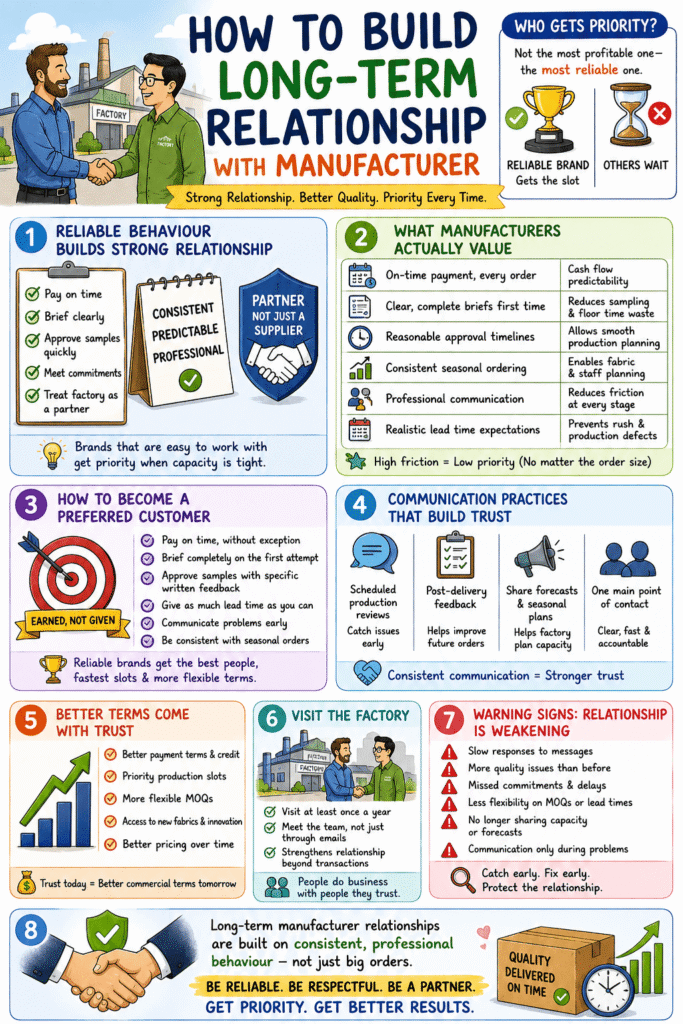
Not the most profitable one — the most reliable one. The brand that pays on time, briefs clearly, approves samples without unnecessary back-and-forth, and treats the factory as a partner rather than a service provider. That brand gets the slot. The others wait.
Long-term manufacturer relationships are not built on goodwill. They are built on behaviour — consistent, predictable, professional behaviour that makes a brand worth prioritising over everyone else competing for the same factory capacity.
For context on finding and vetting a manufacturer before the relationship-building phase begins, see the Complete Guide to Clothing Manufacturers in UK.
Post Summary
- Most brands treat manufacturers as interchangeable suppliers — the ones that don’t get better pricing, priority slots, and fewer production problems
- Preferred customer status is real and earnable — what manufacturers actually look for in long-term brand partners
- Communication practices that build trust over 12–24 months, not just during crisis points
- How to negotiate better payment terms and capacity allocation as the relationship matures
- The warning signs that a manufacturer relationship is quietly deteriorating — and how to catch them early
Contents
- 1. Why Long-Term Manufacturer Relationships Deliver Better Business Results
- 2. What Manufacturers Actually Want From Brand Partners
- 3. How to Become a Preferred Customer
- 4. Communication Practices That Build Trust Over Time
- 5. Negotiating Better Terms As the Relationship Matures
- 6. When to Visit Your Factory — and What to Do When You’re There
- 7. Warning Signs That the Relationship Is Deteriorating
- 8. Frequently Asked Questions
- 8.1. How Long Does It Take to Build Preferred Customer Status with a Manufacturer?
- 8.2. What Is the Right Frequency for Factory Visits?
- 8.3. Can a Small Brand Build a Strong Manufacturer Relationship?
- 8.4. When Should I Renegotiate Payment Terms?
- 8.5. What Should I Do If a Key Contact at My Manufacturer Leaves?
Why Long-Term Manufacturer Relationships Deliver Better Business Results
Brands that stay with one manufacturer for three or more seasons consistently report fewer production defects, shorter sampling cycles, and more flexibility on minimum order quantities than brands that switch regularly (Source: UKFT, 2024).
The reason is straightforward. A manufacturer who knows your product deeply — your tolerance for variation, your finishing preferences, your customer’s expectations — does not need to be retaught those standards every season. That institutional knowledge translates directly into production efficiency and quality consistency.
Preferred customer status is the commercial expression of this. Factories allocate their best operators, fastest turnaround slots, and most flexible terms to the clients they want to keep. Earning that status is not complicated. It is rarely discussed honestly.
What Manufacturers Actually Want From Brand Partners
Most brands assume manufacturers want volume. Volume matters — but it is not the primary driver of preferred status. Reliability is.
| What Manufacturers Value | Why It Matters to Them |
|---|---|
| On-time payment, every order | Cash flow predictability on the factory floor |
| Clear, complete briefs first time | Reduces sampling iterations and floor time waste |
| Reasonable approval timelines | Allows production scheduling without gaps |
| Consistent seasonal ordering | Enables fabric pre-procurement and staff planning |
| Professional communication | Reduces operational friction at every stage |
| Realistic lead time expectations | Prevents rushed production and associated defects |
The brands that struggle with manufacturer relationships are usually the ones that pay late, change briefs mid-sample, demand unrealistic turnarounds, and then express surprise when quality suffers.
A manufacturer operating at capacity will always deprioritise the client who creates the most friction — regardless of order size.
How to Become a Preferred Customer
Preferred customer status is not granted. It is accumulated through behaviour over multiple orders.
Pay on time, without exception. This is the single highest-impact action available to any brand. A client who pays the agreed deposit on order placement and the balance on shipment confirmation — every time, without chasing — is genuinely rare. Manufacturers remember it.
Brief completely on the first attempt. Every incomplete brief costs the manufacturer time they cannot bill for. Arriving with a finished tech pack, sealed reference sample, confirmed fabric choice, and clear trim specifications signals that you respect the factory’s operational process. It also shortens your own lead time.
Approve samples with specific written feedback. Vague approval comments — “the fit is slightly off” — force another sample iteration. Specific written feedback — “left sleeve length 1.5cm too long, collar stand 0.5cm too high, approved on all other points” — allows the manufacturer to correct and proceed. One round of specific feedback is worth three rounds of vague feedback.
Give as much lead time as you can. Brands that book production slots 10–12 weeks in advance get more flexibility than brands that call with six weeks’ notice. When a manufacturer knows your seasonal calendar, they can plan around it.
Communicate problems early. If a payment is going to be delayed, a brief is changing, or a seasonal order is being reduced, tell the manufacturer before it affects their planning — not after. Early communication is recoverable. Surprises are not.
If you are building a new manufacturer relationship and want to understand how Silk Routes structures the first 12 months with new clients, our clothing manufacturing services page covers our onboarding process.
Communication Practices That Build Trust Over Time
The brands that build the strongest manufacturer relationships do not just communicate well during problems. They communicate consistently, at every stage of the production cycle.
Scheduled production reviews. A brief call or written update at the midpoint of every production run costs 20 minutes and catches problems before they become defects. Most brands only call when something has already gone wrong.
Post-delivery feedback. Telling your manufacturer what came back from customers, what sold through fastest, and what generated complaints closes a feedback loop that most factories never receive. A manufacturer who understands your end customer makes better production decisions than one operating blind.
Named contacts on both sides. Relationship continuity depends on people, not companies. Know your account manager, your floor supervisor, and where relevant your senior pattern cutter by name. When those individuals change, acknowledge it and rebuild the working relationship deliberately.
“At Silk Routes, we run a formal mid-production check-in on every order — a written update to the client covering fabric status, cutting progress, and any flag that needs a decision. Most clients tell us no manufacturer has ever done this unprompted.” — Silk Routes Manufacturing Team
Negotiating Better Terms As the Relationship Matures
A manufacturer relationship that has run for two or more seasons — with consistent ordering, clean payment history, and professional working practice — creates a legitimate basis for renegotiating terms.
Deposit percentage. A 50/50 deposit-on-order, balance-on-shipment structure is standard for new clients. Brands with 18+ months of clean payment history can often negotiate to 30/70 or milestone-based payments, which improves cash flow significantly.
MOQ flexibility. Manufacturers set minimum order quantities partly to protect their floor efficiency. A brand that orders consistently and predictably represents lower risk per unit than a new client ordering the same volume. That lower risk is negotiable as a reduced MOQ on new product introductions or sample-adjacent runs.
Priority slot access. Long-term clients who book early and plan consistently earn earlier access to production slots than newer or irregular clients — but this is a negotiation, not an assumption. Have the conversation explicitly.
Fabric pre-procurement. For brands with consistent seasonal ranges, a manufacturer who knows your fabric requirements 16–20 weeks in advance can pre-purchase fabric at better prices and pass a portion of that saving on. This requires a level of forward planning most brands do not maintain.
When to Visit Your Factory — and What to Do When You’re There
A factory visit once per year is the minimum for any brand placing regular production orders. Two visits — one during a production run, one for a relationship and planning conversation outside of active production — produces better operational outcomes.
What a mid-production visit accomplishes that nothing else does:
- You see your product being made, which reveals undocumented standards the floor team have developed
- You meet the operators who actually produce your garments, which changes how you write briefs
- You identify machinery limitations or floor constraints that explain quality patterns you have been attributing to other causes
What to do during a non-production relationship visit:
- Share your seasonal plan for the next 12 months — volume expectations, new categories, timing
- Ask the manufacturer what is changing on their side — new machinery, capacity changes, team changes
- Discuss what has worked and what has not, without agenda
Brands that visit their factories build better products. At Silk Routes, we actively encourage new clients to visit within the first two production cycles.
Warning Signs That the Relationship Is Deteriorating
Most manufacturer relationships do not fail suddenly. They deteriorate through a pattern of small signals that brands miss until the problem is structural.
Response times slowing without explanation. A manufacturer who previously responded within 24 hours and is now taking 3–4 days is signalling where your account sits in their priority order.
Sample quality dropping without a change in brief. When a manufacturer who has produced consistent samples for several seasons begins returning samples that miss the mark, the most likely explanation is that attention has shifted to other clients.
Lead time extensions becoming routine. One extension for a genuine supply chain reason is operational. A pattern of extensions across consecutive orders is a capacity or prioritisation signal.
Key contacts changing without introduction. When your account manager or primary contact leaves and no one tells you or makes an introduction to their replacement, the relationship management on their side has broken down.
Invoicing errors or payment disputes emerging. Commercial disputes that did not previously arise indicate stress in the relationship — operational, financial, or relational — that needs to be surfaced and addressed directly.
Address each of these signals with a direct conversation rather than passive de-escalation. A manufacturer relationship worth keeping is worth the uncomfortable conversation.
Frequently Asked Questions
How Long Does It Take to Build Preferred Customer Status with a Manufacturer?
Most manufacturers form a clear view of a client’s reliability within the first two to three orders. Consistent, professional behaviour — on-time payment, clean briefs, reasonable approvals — produces measurable relationship benefits within 12–18 months. The brands that reach preferred status fastest treat the manufacturer as a partner from the first order, not after they have established themselves.
What Is the Right Frequency for Factory Visits?
A minimum of one visit per year for any brand placing regular production orders. For brands placing three or more orders annually, two visits — one mid-production and one planning visit outside of active production — produces the best operational outcomes. Visits should be scheduled, not reactive.
Can a Small Brand Build a Strong Manufacturer Relationship?
Yes — volume is not the determining factor. Manufacturers value reliability over size. A small brand that pays on time, briefs clearly, and maintains consistent seasonal ordering is more valuable to a manufacturer than a larger brand that creates constant operational friction. The behaviours that build preferred status are available to brands of any size.
When Should I Renegotiate Payment Terms?
After a minimum of 18 months of clean payment history and consistent ordering. Approach the conversation explicitly and frame it around the track record — not as a request, but as a commercial conversation between established partners. Bring data: number of orders placed, total volume, payment record. Manufacturers respond to evidence, not to assertions.
What Should I Do If a Key Contact at My Manufacturer Leaves?
Contact the manufacturer immediately to request an introduction to the replacement contact. Do not wait to be introduced — proactive outreach signals that you value the relationship. Schedule a brief call with the new contact to bring them up to speed on your brand, your standards, and your seasonal plan. Treat it as a mini onboarding, not an inconvenience.