
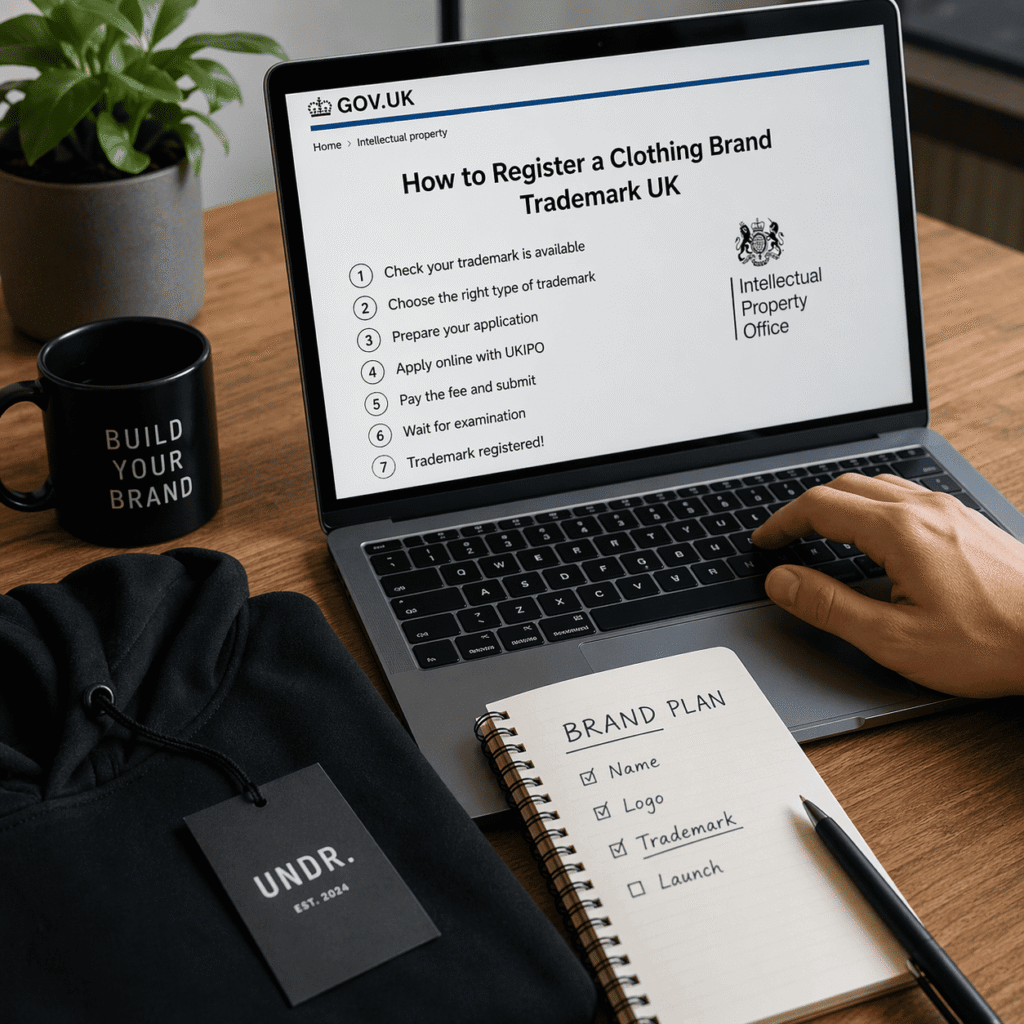
Someone just registered your brand name. You’ve been trading for eight months, building an audience, spending on photography and production. You have no trademark.
This happens more than any startup guide acknowledges. A competitor, a copycat, or a trademark troll files first. Once registered, they can legally prevent you from using your own brand name in the UK.
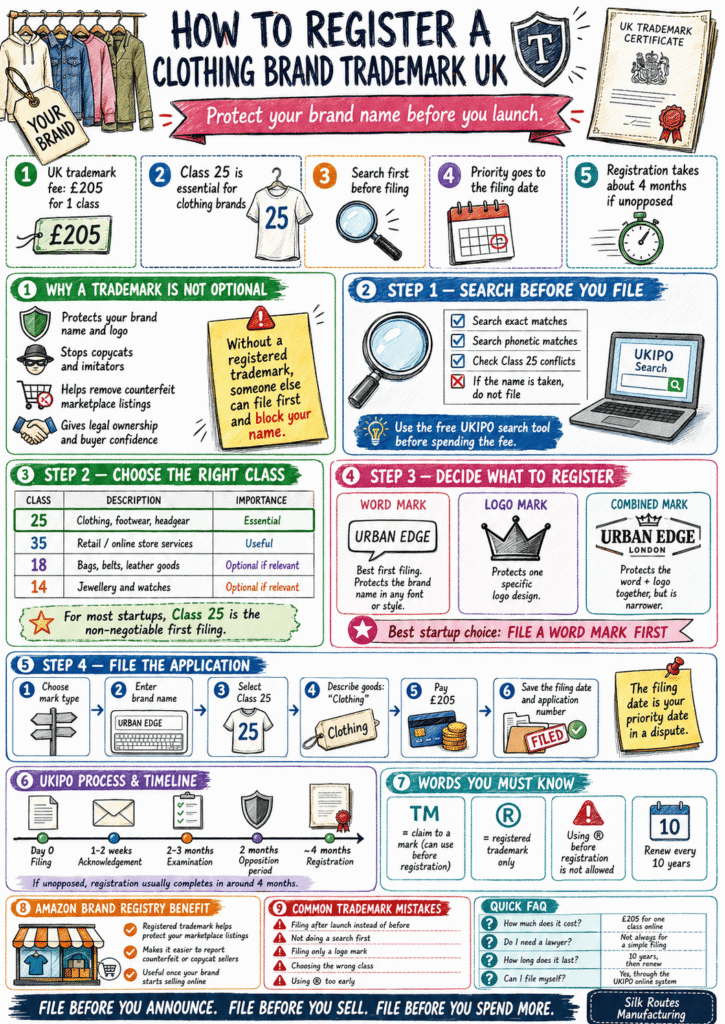
A trademark now costs £205 for one class (the fee rose from £170 on 1 April 2026). Filing takes 20 minutes. Most clothing brands still don’t do it before launch. Here’s how, and why, to do it properly.
- A UK trademark registration costs £205 for one class and protects your brand name and logo from being used by competitors — it’s the cheapest legal protection a clothing brand can buy
- You must file in Class 25 (clothing, footwear, and headgear) to protect a clothing brand — filing in the wrong class provides no protection for your core product
- The UKIPO takes approximately 4 months to complete the registration process if unopposed — the application date, not the registration date, determines priority in any dispute
- A trademark search must be done before filing — filing on a name that conflicts with an existing registered mark wastes the filing fee and delays your launch
- Your trademark protects the name as used in commerce — a name you’re not actively using is vulnerable to cancellation through non-use after 5 years
Contents
- 1. Why a Clothing Brand Trademark Is Not Optional
- 2. Step 1 — Conduct a Trademark Search Before Filing
- 3. Step 2 — Identify the Right Classes
- 4. Step 3 — Decide What to Register
- 5. Step 4 — File the Application
- 6. Step 5 — The UKIPO Examination Process
- 7. Step 6 — Using and Maintaining Your Trademark
- 8. UK Trademark vs EU Trademark
- 9. Amazon Brand Registry: Using Your Trademark
- 10. Common Trademark Mistakes UK Clothing Brands Make
- 11. FAQ
- 12. The £205 Decision That Protects Everything Else
Why a Clothing Brand Trademark Is Not Optional
A trademark is not just a legal formality. It’s the single document that proves you own your brand name in the UK.
Without a registered trademark:
- Any competitor can register your name and legally prevent you from using it
- Amazon and other platforms will not remove copycat listings without trademark evidence
- Wholesale buyers and retail partners who ask for IP documentation have nothing to receive
- Your brand name, and all the equity built into it, has no legal protection
Under UK intellectual property law, an unregistered brand name has some common law protection under the tort of passing off, but passing off claims require proof of reputation and financial damage, and they’re expensive to pursue. A registered trademark shifts the burden of proof entirely. You own the name. Anyone using it infringes it.
The clothing industry has specific trademark risks that other sectors don’t. Fashion brands are frequently copied. Counterfeit versions of successful clothing products appear on Amazon, eBay, and Chinese wholesale platforms within months of a brand gaining traction. Without a UK trademark registered and enrolled in Amazon’s Brand Registry, the brand has no mechanism to remove those listings.
For a brand investing £3,000 to £15,000 in a first production run, the £205 trademark filing fee is the cheapest protection available. It’s the first legal step that should be taken, before the domain, before the social handles, before the first sale.
Step 1 — Conduct a Trademark Search Before Filing
Filing a trademark on a name that conflicts with an existing registered mark is a waste of £205 and a delay to your launch. The UKIPO will not automatically refund a failed application.
The search process: the UKIPO trademark search tool is free and publicly accessible. Search your proposed brand name before filing.
What to search for:
- Exact matches — your proposed brand name, spelled exactly
- Phonetic matches — names that sound similar even if spelled differently
- Visual matches — if your mark includes a logo, search for visually similar existing marks
- Class 25 specifically — a trademark in a different class doesn’t prevent your registration in Class 25, but a trademark in Class 25 does
What the search results mean: a search result showing an existing registered mark in Class 25 that’s identical or confusingly similar to your proposed name is a blocking mark. Filing on that name will result in either UKIPO refusal or an opposition from the existing trademark holder.
A search result showing a similar mark in an unrelated class does not automatically block a Class 25 filing, but may cause a UKIPO examiner to raise an objection if the marks are very similar.
What to do if the name is taken: do not file. Trademark holders in Class 25 monitor for new applications in their class — they receive notification from UKIPO and have 2 months to oppose. Modify the name, or change it entirely. The cost of rebranding after a trademark dispute is significantly higher than the cost of rebranding before launch.
Step 2 — Identify the Right Classes
A trademark is registered for specific classes of goods and services. Filing in the wrong class provides no protection for your actual product.
The classes relevant to clothing brands:
| Class | Covers | Relevant to clothing brands? |
|---|---|---|
| Class 25 | Clothing, footwear, headgear | Yes — essential for every clothing brand |
| Class 35 | Retail services, online retail | Yes — if you sell through your own retail store or platform |
| Class 18 | Leather goods, bags, accessories | Yes — if your range includes bags, belts, or leather goods |
| Class 14 | Jewellery and watches | Yes — if your range includes jewellery |
| Class 41 | Education, entertainment | No — not relevant to standard clothing brands |
For a startup clothing brand: Class 25 is the non-negotiable first filing. Every other class is secondary and can be added later as the brand range expands.
Multi-class filing: a single UKIPO application can cover multiple classes. The base fee covers the first class (£205 online). Each additional class costs £60 (up from £50 before 1 April 2026). Filing Class 25 and Class 35 together now costs £265.
What “clothing” covers in Class 25: the UKIPO’s Class 25 specification is broad, covering all articles of clothing, footwear, and headgear. You don’t need to list every product type. “Clothing” is sufficient. However, if your brand extends to footwear or headwear specifically, include those terms explicitly in your specification.
Step 3 — Decide What to Register
A UK trademark can protect three things: a word, a logo, or a combination of both.
Word mark: protects the brand name as text, in any font, any size, any colour. This is the broadest protection and the most valuable type of trademark for a clothing brand.
Figurative mark (logo): protects a specific logo design, including its shape, colour, and visual composition. It protects the logo as depicted but doesn’t protect the words in a different visual context.
Combined mark: protects both the word and the logo together as a single mark. This is narrower than a word mark — it protects the specific combination shown.
Recommendation for a startup clothing brand: file a word mark first. It’s the broadest protection and covers every future use of the name, regardless of how the logo evolves. File the logo separately once the visual identity is finalised.
Step 4 — File the Application
The UKIPO online application system is at gov.uk/apply-for-a-trade-mark. The process takes approximately 20 minutes.
What you need before filing:
- The exact name or logo you’re registering (high-resolution image for logo marks)
- A description of the goods covered — “clothing” is sufficient for Class 25
- Your contact details and address
- Payment method for the £205 fee (higher if filing on paper)
The filing process step by step:
- Select the type of mark: word mark, figurative mark, or combined mark. For most clothing brands: word mark.
- Enter the mark: type your brand name exactly as it will be used. Capitalisation matters — “BRANDNAME” and “Brandname” are different marks.
- Select the class: Class 25. Add Class 35 if including retail services. Add additional classes at £60 each if applicable.
- Describe the goods: “Clothing” covers the full Class 25 specification.
- Pay the fee: £205 online for one class. Confirm payment.
- Note the application number and filing date: this date is your priority date. In any dispute, the brand that filed first wins, regardless of who was trading first.
If you’re preparing your IP position before approaching wholesale buyers or retail platforms, see our clothing manufacturing services — a trademark in place before those conversations is a commercial advantage, not just a legal one.
Step 5 — The UKIPO Examination Process
After filing, UKIPO examines the application. The full process takes approximately 4 months from filing to registration if unopposed.
| Stage | Timeframe | What Happens |
|---|---|---|
| Filing | Day 0 | Application submitted, filing fee paid, priority date established |
| Acknowledgement | 1–2 weeks | UKIPO confirms receipt, assigns application number |
| Examination | 2–3 months | UKIPO examiner reviews for absolute and relative grounds of refusal |
| Publication | After examination | Application published in the Trade Marks Journal for a 2-month opposition period |
| Opposition period | 2 months | Third parties can oppose the registration |
| Registration | After opposition period | If unopposed, certificate of registration issued |
Grounds for UKIPO refusal:
- The mark is descriptive — “Clothing” or “Fashion” cannot be registered as a trademark
- The mark is identical or confusingly similar to an existing registered mark in the same class
- The mark is a generic term, a geographic name, or a common surname
- The mark is contrary to public policy or morality
If an examiner raises an objection, you have the opportunity to respond with arguments or evidence — an objection is not automatic refusal. If an opposition is filed, it can be contested, but oppositions are expensive to defend if the opposing mark is genuinely similar. This is why the trademark search in Step 1 is critical.
Step 6 — Using and Maintaining Your Trademark
A registered trademark is not permanent unless used. A trademark not genuinely used in commerce in the UK for 5 consecutive years is vulnerable to cancellation by a third party through a non-use revocation application.
What counts as use: selling products bearing the mark in the UK market; using the mark on your website, in advertising, and on social media in connection with UK sales; using the mark in wholesale and retail contexts.
What doesn’t count as use: registering the mark and never trading; using a modified version of the mark that’s materially different from what was registered.
The ® symbol: you can only use ® once your trademark is registered. Using ® before registration is a criminal offence under the Trade Marks Act 1994. Use ™ before registration — it signals a claim to the mark but has no legal standing.
Renewal: UK trademarks must be renewed every 10 years. The renewal fee is now £245 for one class (up from £200 before 1 April 2026), plus £60 per additional class. UKIPO sends renewal reminders 6 months before the renewal date. Non-renewal results in the mark lapsing, and becoming available for registration by a competitor.
UK Trademark vs EU Trademark
Post-Brexit, a UK trademark provides protection only in the UK (England, Scotland, Wales, and Northern Ireland). It doesn’t cover the EU.
If you sell, or plan to sell, into EU markets, a separate EU trademark (EUTM) is required. The EUTM is administered by the EU Intellectual Property Office (EUIPO) and covers all 27 EU member states in a single application.
| Mark | Covers | Filing Fee | Timeline |
|---|---|---|---|
| UK trademark (UKIPO) | UK only | £205 (one class) | ~4 months |
| EU trademark (EUIPO) | All 27 EU member states | From €850 (one class) | ~4–6 months |
| International trademark (WIPO) | Selected countries globally | Varies by country | 12–18 months |
For a startup brand selling only in the UK market: file the UK trademark first. Add the EU trademark when, and if, EU sales become a material part of the business. For a brand that plans EU wholesale relationships from launch, including Irish retailers, file both simultaneously.
Our low MOQ and private label UK manufacturing guide covers how IP protection integrates with your manufacturing contracts and wholesale agreements, including the IP ownership clause that must appear in every purchase order.
Amazon Brand Registry: Using Your Trademark
A registered UK trademark is the key that unlocks Amazon Brand Registry, Amazon’s system for protecting brand owners from counterfeit listings and listing hijackers.
What Brand Registry provides: ability to report and remove counterfeit or inauthentic listings using your brand name; enhanced product listing content (A+ Content, brand storefront); proactive monitoring of listings that may infringe your trademark; Transparency programme access.
What Brand Registry requires: a registered trademark (application pending is not sufficient — registered is required); the trademark must be in a text or image+text format; the trademark must appear on your products or packaging.
Without Brand Registry, a clothing brand that gains traction on Amazon has no mechanism to remove counterfeit sellers from their listing, one of the most common and most damaging risks for a successful clothing product. This is why the trademark filing sequence matters: file the trademark before your Amazon listing gains traction, not after the counterfeits appear.
Common Trademark Mistakes UK Clothing Brands Make
Filing after launch instead of before. An eight-month trading history doesn’t protect a brand name if a competitor files a trademark on that name during those eight months. The priority date is the filing date, not the date trading began.
Fix: file the trademark application before the brand name is made public.
Filing only a logo mark, not a word mark. A logo mark protects the specific visual design. It doesn’t protect the brand name in a different font, colour, or context.
Fix: file a word mark as the primary registration. File the logo separately if the visual identity is stable and distinct.
Not doing a trademark search first. Filing on a name that conflicts with an existing mark wastes the filing fee and produces a UKIPO objection or a third-party opposition.
Fix: the trademark search takes 20 minutes on the UKIPO database. It’s the first step, before the domain is purchased, before the social handles are secured.
Filing in the wrong class. A trademark filed in Class 41 doesn’t protect a clothing brand’s name in Class 25.
Fix: Class 25 is the essential filing for any clothing brand. No exceptions.
Using ® before the mark is registered. Using the ® symbol before registration is a criminal offence under the Trade Marks Act 1994.
Fix: use ™ until the UKIPO registration certificate is received. Switch to ® only after the certificate is issued.
FAQ
How long does a UK trademark last?
A UK trademark registration lasts 10 years from the filing date. It can be renewed indefinitely in 10-year increments, subject to continued use of the mark in commerce. The renewal fee is £245 for one class as of 1 April 2026.
Can I register a trademark if my brand name includes a common word?
It depends on the combination and context. A trademark on a single common word (“Fashion,” “Clothing,” “Style”) will be refused as descriptive. A trademark on a distinctive combination of common words, or a common word combined with a distinctive design element, may be accepted. When in doubt, consult a trademark attorney before filing.
What is the difference between ™ and ®?
™ indicates a claim to a trademark and can be used at any time, without registration. It has no legal standing but signals that the brand considers the name its trademark. ® indicates a registered trademark and can only be used once the UKIPO registration certificate has been issued. Using ® without a valid registration is a criminal offence under the Trade Marks Act 1994.
Do I need a trademark attorney to file a UK trademark?
No. The UKIPO online application is designed for self-service filing and most standard clothing brand word mark applications can be filed without professional assistance. A trademark attorney is advisable if the search reveals similar existing marks, the examiner raises objections requiring a written response, or a third party files an opposition. Attorney fees for a standard filing without complications typically run £300 to £800 including the UKIPO fee.
What happens if someone infringes my registered trademark?
You have the right to take legal action for trademark infringement. The first step is usually a cease and desist letter. If the infringement continues, you can apply to the court for an injunction and damages. For online platforms (Amazon, eBay, Instagram), a registered trademark allows you to file a straightforward IP infringement report that the platform is legally obliged to act on. Without a registered trademark, the same report has no legal basis for removal.
The £205 Decision That Protects Everything Else
Every pound invested in your clothing brand, the tech pack, the sampling, the production run, the photography, the lookbook, the marketing, is built on the assumption that the brand name is yours.
A trademark costing £205 confirms that assumption legally. Without it, the brand name is an unprotected asset that can be registered by anyone, at any time, from the moment your brand becomes visible.
File before you announce. File before you sell. File before you spend another pound on production or marketing. The priority date is the filing date, and the filing date is the only thing that matters in a trademark dispute.
For the full picture on how IP protection integrates with your manufacturing contracts, including the IP ownership clause that must appear in every purchase order, our guide to low MOQ and private label clothing manufacturers UK covers every legal touchpoint in the manufacturing relationship.
Ready to discuss how your manufacturing agreement protects your intellectual property? Find out how Silk Routes works with startup brands from brief to delivery.
People also ask
How much does it cost to trademark a clothing brand in the UK? £205 online for one class (Class 25 for clothing), as of the fee increase on 1 April 2026 — up from £170 previously. Each additional class costs £60. Renewal every 10 years costs £245 for one class.
Can I register a trade mark myself? Yes. The UKIPO’s online system is designed for self-service filing, and most straightforward clothing brand word mark applications can be completed without a trademark attorney. Professional help is worth considering if your search turns up similar existing marks, or if you receive an objection or opposition you’re unsure how to respond to.
Can I use TM without registering in the UK? Yes. The ™ symbol has no legal registration requirement — it simply signals that you consider a name or logo to be your trademark, whether or not it’s registered. It carries no formal legal protection on its own, unlike ®, which can only be used once a trademark is actually registered.
Is it worth registering a trademark? For a clothing brand, yes. At £205 for a first filing, it’s one of the cheapest protections available relative to what it secures: the ability to stop competitors using your name, the ability to remove counterfeit listings via Amazon Brand Registry, and clear legal ownership that wholesale buyers and platforms will ask for as your brand grows.