
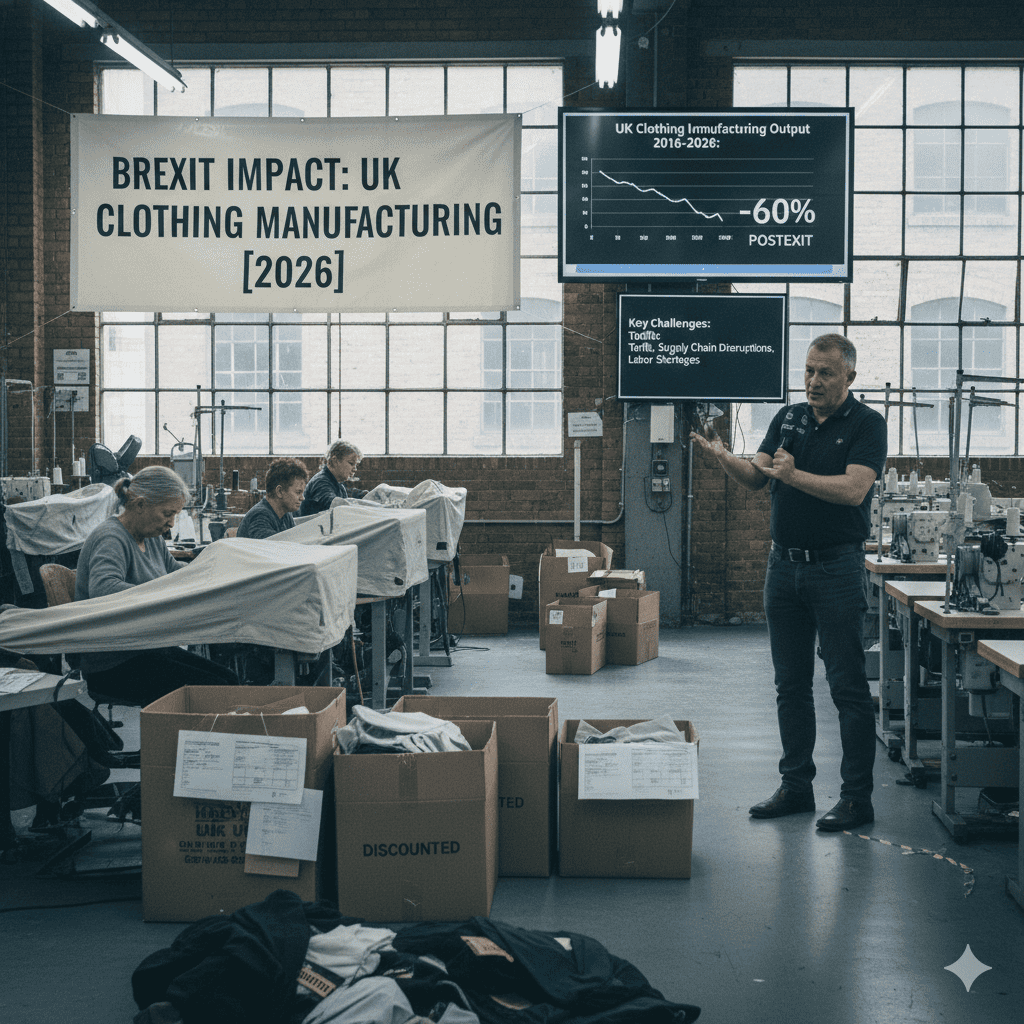
UK apparel exports to the European Union fell by 63% between 2018 and 2023 — a decline UKFT described as the clearest measurable consequence of the post-Brexit trading environment for UK fashion businesses.
That single figure captures what six years of post-Brexit adjustment looks like for the clothing sector. The UK-EU Trade and Cooperation Agreement’s zero-tariff provision sounds like free trade. For the majority of UK clothing brands using non-EU fabric, it is not.
This update covers what has actually changed since January 2021, where the data has moved, what brands have done to adapt, and what remains structurally unresolved heading into 2027.
For the complete guide to UK manufacturing operations and costs, see the Complete Guide to Clothing Manufacturers in UK.
Post Summary
- UK apparel exports to the EU fell 63% between 2018 and 2023, recovering partially but remaining well below pre-Brexit levels (Source: UKFT, 2024)
- Rules of Origin is the most commercially disruptive post-Brexit mechanism for UK fashion brands — the TCA’s double transformation requirement means garments made from Asian fabric in the UK do not qualify for zero-tariff EU export
- Standard EU tariff on non-qualifying UK clothing exports: 12% ad valorem (Source: UKFT Rules of Origin Guide)
- The UK Global Tariff on clothing has remained broadly aligned with EU rates — tariff divergence has not been the primary Brexit cost; customs compliance overhead has
- Industry estimates put the annual administrative cost of Brexit compliance for a small-to-mid UK clothing brand at £8,000–£25,000 in overhead versus the pre-Brexit position
- For UK manufacturers producing primarily for the domestic market, Brexit’s operational impact is minimal — the disruption is concentrated in brands with EU export volumes or EU fabric sourcing dependencies
Contents
- 1. Where UK Clothing Manufacturing Stands After Brexit in 2026
- 2. Rules of Origin — The Most Disruptive Post-Brexit Mechanism
- 3. Import Duty Changes — What Has and Has Not Changed
- 4. EU Fabric Sourcing — How Costs Have Changed
- 5. How Brands Have Adapted Post-Brexit
- 6. Is Brexit Still a Live Issue in 2026?
- 7. Frequently Asked Questions
- 7.1. Does the UK-EU Trade Deal Mean Clothing Exports to the EU Are Tariff-Free?
- 7.2. What Is the Standard EU Tariff on UK Clothing Exports That Do Not Meet Rules of Origin?
- 7.3. Has UK Clothing Manufacturing Grown or Shrunk Since Brexit?
- 7.4. Do UK Brands Need to Register for VAT in EU Countries to Sell There?
- 7.5. What Has Been the Biggest Unexpected Brexit Impact on UK Clothing Brands?
Where UK Clothing Manufacturing Stands After Brexit in 2026
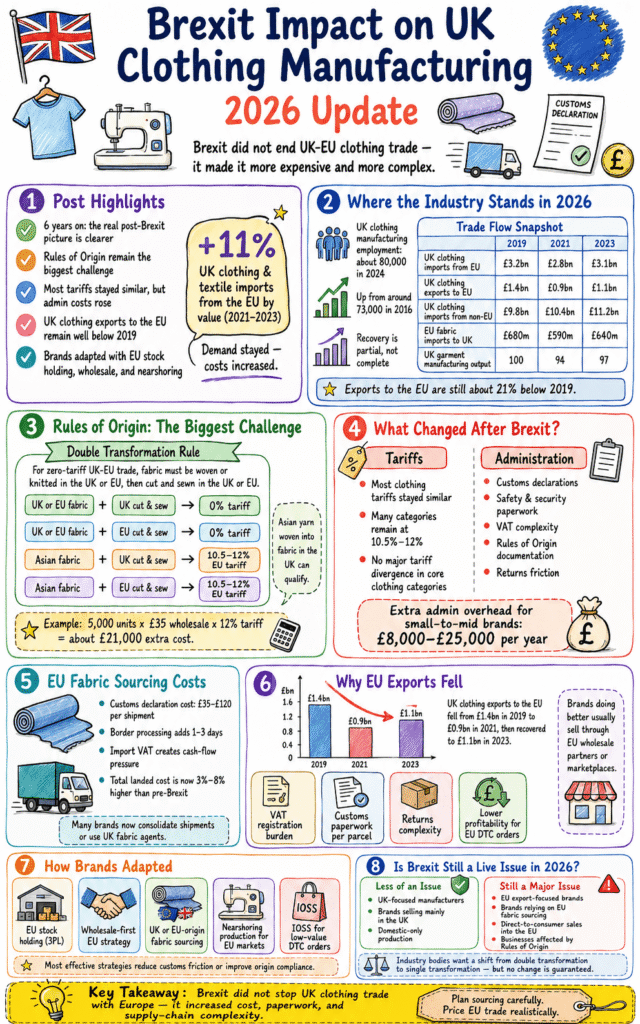
UK clothing manufacturing employment recovered modestly from a low point in the mid-2010s to approximately 88,000 in recent ONS estimates — though isolating a Brexit effect from the broader reshoring trend driven by pandemic-era supply chain disruption is difficult. The structural factors are multiple and overlapping.
What is measurable is the trade direction.
UK apparel exports to the EU fell by 63% between 2018 and 2023, while exports to non-EU markets rose 14% over the same period — a reorientation that reflects the administrative friction of the UK-EU border rather than any collapse in demand for British product internationally. Source: UKFT Apparel Exports Analysis, 2024.
The overall export picture shows a 47% decline in total UK apparel exports between 2018 and 2023, driven almost entirely by the EU decline. The non-EU trajectory was positive throughout the same period, which matters for how brands approach the export question going forward.
Rules of Origin — The Most Disruptive Post-Brexit Mechanism
Rules of Origin (RoO) is the mechanism that determines whether a product qualifies as UK-origin for the purposes of the TCA’s zero-tariff provisions.
For clothing and textiles, the UK-EU TCA applies a double transformation rule — fabric must be woven or knitted in the UK or EU, and then cut and sewn in the UK or EU, to qualify for zero tariff on export. Source: UKFT Rules of Origin Guide; GOV.UK Rules of Origin Guidance.
The practical implication for UK clothing brands:
| Fabric Source | Cut and Sewn | Origin Status | EU Export Tariff |
|---|---|---|---|
| UK or EU woven fabric | UK | Qualifies as UK origin | 0% |
| Asian fabric (China, Bangladesh, India) | UK | Does NOT qualify | 12% standard rate |
| Asian yarn, woven in UK | UK | Qualifies (yarn-to-fabric transformation counts) | 0% |
The majority of UK clothing brands sourcing fabric from Asia — Bangladesh, China, India — and manufacturing in the UK cannot claim UK-origin status under the double transformation rule. Exporting those garments to the EU attracts the standard tariff of 12% on clothing, 8% on fabrics, and 4% on yarns (Source: UKFT).
For a brand exporting 5,000 units at £35 average wholesale value, a 12% tariff adds approximately £21,000 to a single seasonal export shipment.
“Rules of Origin has been the single most misunderstood post-Brexit mechanism for clothing brands. The zero-tariff agreement sounds like free trade. For brands using non-EU fabric — which is the majority of UK fashion production — it is not.” — Silk Routes Manufacturing Team
An additional complexity: the EU’s DCTS-equivalent arrangements with Bangladesh and other developing countries mean that fabric from Bangladesh woven into garments in the EU qualifies for preferential EU import terms in ways that the same fabric processed in the UK does not when re-exported to the EU. This asymmetry has driven some UK brands to move finishing operations to EU-based manufacturers for EU-bound stock.
November 2024 update: the TCA was revised to align with the Harmonised System (HS) 2022 tariff schedule. Product-specific Rules of Origin have been revised to reflect the new HS codes — traders who had previously confirmed origin status should verify their supplier declarations remain valid under the updated classification.
Import Duty Changes — What Has and Has Not Changed
The UK Global Tariff, which replaced the EU Common External Tariff for UK imports after Brexit, has diverged from EU schedules less dramatically than initially anticipated in most clothing categories.
| Clothing Category | UK Global Tariff | EU Common External Tariff | Difference |
|---|---|---|---|
| Men’s suits and jackets (HS 6203) | 12% | 12% | None |
| Women’s outerwear (HS 6202) | 12% | 12% | None |
| T-shirts and jersey tops (HS 6109) | 12% | 12% | None |
| Technical / performance clothing | 6.5–12% | 6.5–12% | Minimal |
| Woven cotton fabric (HS 5208) | 8–10% | 8–10% | None |
Source: UK Trade Tariff Tool
For most standard clothing categories, tariff continuity has been maintained. What has changed is the administrative cost of crossing the UK-EU border in either direction — customs declarations, safety and security declarations, Rules of Origin documentation, and VAT treatment. Industry estimates put the annual compliance overhead for a small-to-mid clothing brand at £8,000–£25,000 above the pre-Brexit position (Source: British Fashion Council, 2024).
EU Fabric Sourcing — How Costs Have Changed
The UK’s historical fabric sourcing from EU mills — Italian wovens, Portuguese jersey, German technical fabrics — has become more expensive in administrative terms since 2021, even where tariff rates have not changed.
Additional cost layers on EU fabric imported to the UK:
Customs declarations — each fabric shipment requires a full customs declaration. Cost per declaration typically £35–£120 depending on broker and complexity. A brand importing fabric six times per year adds £210–£720 in declaration costs annually.
Entry summary declarations — required for all goods entering the UK from the EU since full border controls were implemented in January 2022, and for UK exports to the EU (exit summary declarations).
Extended lead times — border processing has added 1–3 days to typical UK-EU fabric shipment timelines, with periodic disruption at peak periods.
VAT cash flow — import VAT is now due at the UK border on EU fabric imports. VAT-registered businesses can use postponed VAT accounting (PVA) to defer to their VAT return rather than paying upfront.
The net effect: EU fabric sourcing to the UK is estimated at 3–8% more expensive in total landed cost than pre-Brexit, even where the underlying tariff rate has not changed.
How Brands Have Adapted Post-Brexit
The adaptations that have proven most effective by 2026 fall into five categories:
EU stock holding. Maintaining inventory in an EU-based 3PL (third-party logistics) facility allows DTC fulfilment to EU customers without per-parcel customs declarations. Viable from approximately 500+ EU orders per quarter.
Wholesale-first EU strategy. Exiting EU DTC in favour of EU wholesale partners who import stock in bulk and absorb customs and VAT compliance. Reduces brand margin but removes operational complexity.
UK-origin fabric sourcing. Brands selling into the EU at volume have in some cases shifted to UK or EU-origin fabric to qualify for the TCA’s zero-tariff provision. Most viable in categories where UK or EU fabric exists at competitive quality — wool, certain jerseys, some technical fabrics.
Nearshoring EU-bound production. Commissioning EU-based manufacturers (Portugal, Turkey under relevant GSP terms) to produce EU-bound stock separately from UK-bound stock. The EU-produced garments export within the EU single market tariff-free. Running two production streams is the trade-off.
IOSS registration for low-value DTC. Registering for the EU’s Import One Stop Shop (IOSS) scheme allows UK brands to pre-collect EU VAT on orders under €150 and ship direct-to-consumer without per-parcel customs holds. Effective for brands with high volumes of low-value EU DTC orders.
Is Brexit Still a Live Issue in 2026?
For domestic-focused manufacturers producing for UK brands selling primarily in the UK market, Brexit’s operational impact is minimal. The UK-EU border is irrelevant to their core activity.
For UK brands with meaningful EU export volumes, EU fabric sourcing dependencies, or EU DTC operations, Brexit remains a live cost and complexity issue with no structural resolution confirmed.
The TCA’s Rules of Origin provisions for textiles are the most likely area of future negotiation. UKFT and the British Fashion Council have advocated for a relaxation from double transformation to a single transformation standard — which would allow Asian fabric made into garments in the UK to qualify for zero-tariff EU export. At the UK-EU Summit in May 2025, discussions focused primarily on agri-food (the SPS Agreement) rather than textiles Rules of Origin.
Brands planning EU export strategies in 2026 should assume current Rules of Origin provisions remain in place and cost their EU business accordingly.
To understand how Silk Routes works with brands navigating post-Brexit sourcing decisions — domestic CMT production, UK-origin positioning, lead time advantages — our manufacturing services page covers our approach. Find out more about Silk Routes.
Frequently Asked Questions
Does the UK-EU Trade Deal Mean Clothing Exports to the EU Are Tariff-Free?
Only if the garments meet the Rules of Origin requirement — specifically the double transformation rule, which requires fabric to be woven or knitted in the UK or EU, and cut and sewn in the UK or EU. Garments made from Asian fabric, even if manufactured in the UK, do not qualify and face the standard EU clothing import tariff of 12%. Most UK clothing brands using Asian fabric cannot claim the zero-tariff provision.
What Is the Standard EU Tariff on UK Clothing Exports That Do Not Meet Rules of Origin?
The standard rate is generally 12% for clothing, 8% for fabrics, and 4% for yarns — applied as ad valorem duty on the customs value (Source: UKFT Rules of Origin Guide). For a brand exporting at £35 wholesale unit value, the 12% tariff adds approximately £4.20 per unit to the landed cost for EU buyers.
Has UK Clothing Manufacturing Grown or Shrunk Since Brexit?
UK clothing manufacturing employment has recovered modestly from a low point in the mid-2010s. The Brexit effect is difficult to isolate from the reshoring trend driven by pandemic-era supply chain disruption. UK apparel exports overall fell 47% between 2018 and 2023, with the EU decline (63%) accounting for almost all of that fall, while non-EU exports grew 14% over the same period (Source: UKFT, 2024).
Do UK Brands Need to Register for VAT in EU Countries to Sell There?
UK brands selling direct-to-consumer to EU customers must either register for VAT in each EU member state where they exceed local distance selling thresholds, or register for the EU’s OSS (One Stop Shop) scheme. For orders under €150, IOSS registration allows pre-collection of EU VAT and simplifies customs clearance. For orders above €150 dispatched from the UK, standard import procedures apply at the EU border.
What Has Been the Biggest Unexpected Brexit Impact on UK Clothing Brands?
The administrative cost of customs compliance — rather than tariff levels — has been most frequently cited as the most disruptive operational change. Industry estimates of £8,000–£25,000 annual administrative overhead for a small-to-mid brand represent a material fixed cost increase that affects smaller brands disproportionately and has made low-volume EU DTC operations commercially unviable for many (Source: British Fashion Council, 2024).