
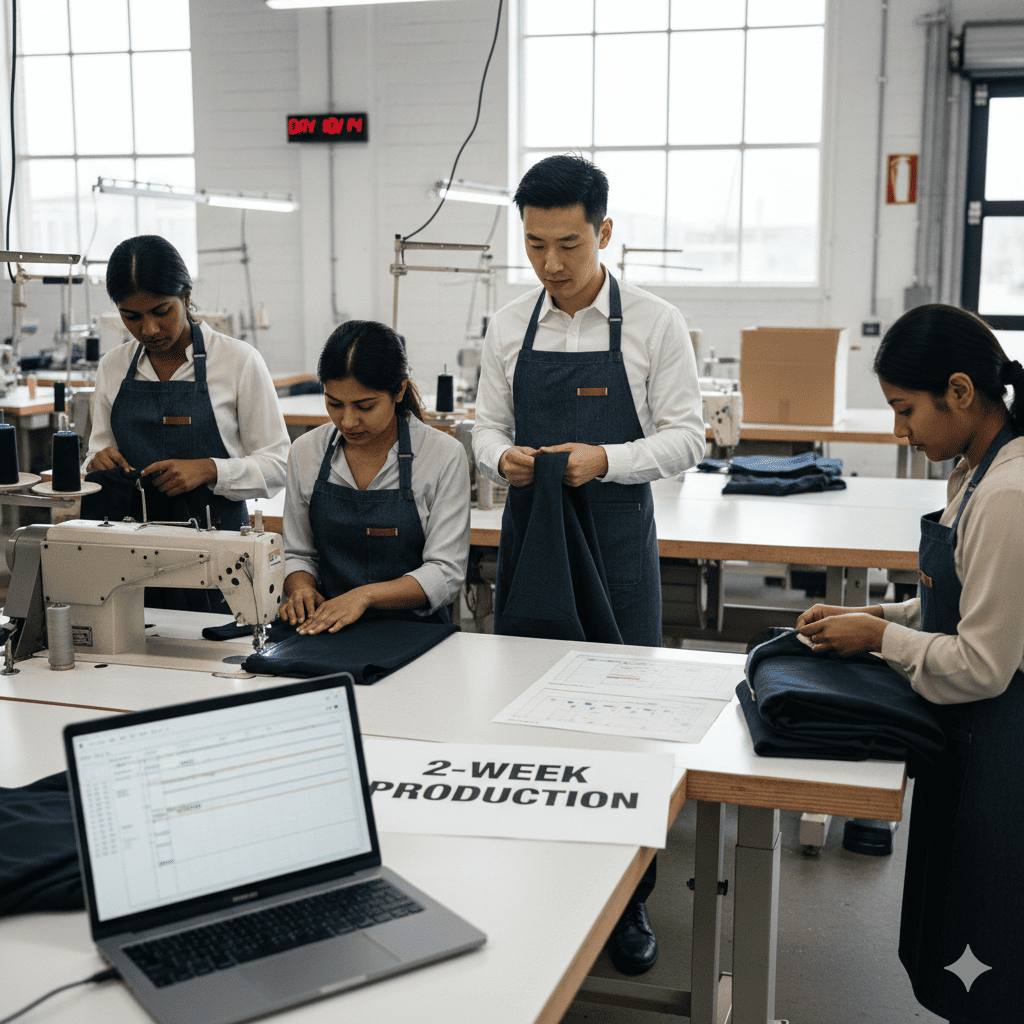
You have a launch date. Your manufacturer just quoted eight weeks. That gap kills more clothing brands than bad products ever do.
Fast turnaround UK production genuinely exists, but it works differently from standard manufacturing. Knowing what’s achievable in two weeks — and what has to be resolved before you call a factory — is what separates a brand that ships on time from one that misses its window.
In this guide:
- What “fast turnaround” actually means in UK manufacturing, and what it excludes
- Which product types can realistically hit a 2-week production window
- How fast-turnaround factories are structured differently from standard ones
- The four things you must have ready before you call
- When fast turnaround is worth the premium — and when it isn’t
- Five mistakes that blow up a fast-turnaround timeline
Contents
- 1. What “Fast Turnaround” Actually Means
- 2. Which Product Types Support 2-Week Production
- 3. How Fast Turnaround Factories Actually Operate
- 4. What You Must Have Ready Before You Call
- 5. Fast Turnaround vs Standard Production — When Each Makes Sense
- 6. Five Mistakes That Blow Up a Fast-Turnaround Timeline
- 7. FAQ
- 8. Getting Fast Turnaround Right From the First Run
What “Fast Turnaround” Actually Means
Two weeks is real. It isn’t the default.
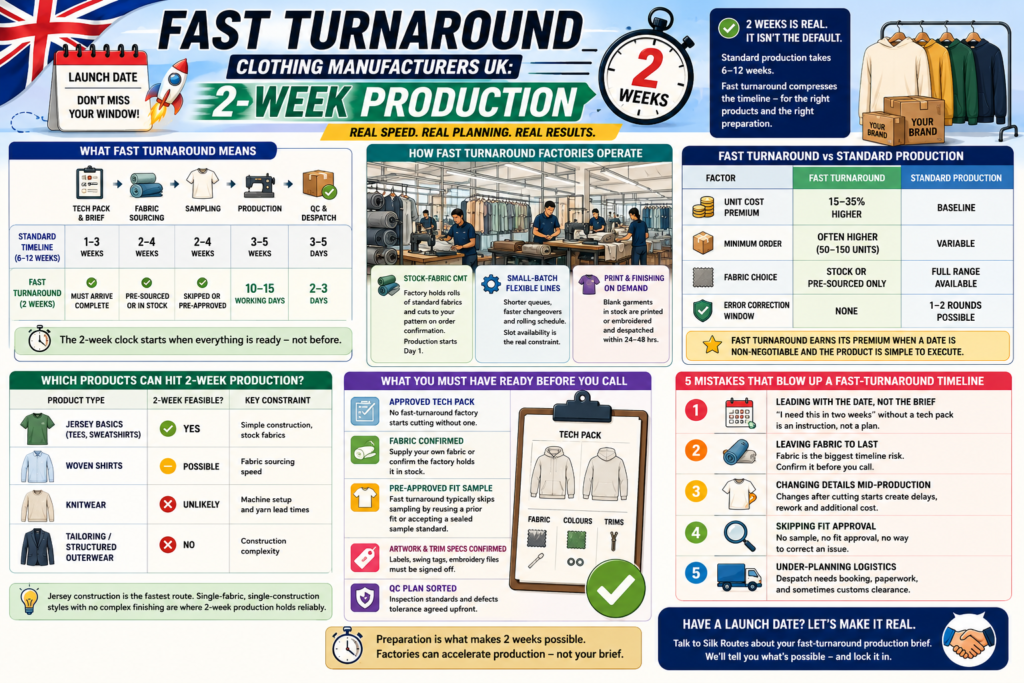
Standard UK production runs 6–12 weeks from approved tech pack to finished goods. Fast turnaround compresses that — but only for specific product types and brands that arrive prepared.
| Production Stage | Standard Timeline | Fast Turnaround Timeline |
|---|---|---|
| Tech pack and brief | 1–3 weeks | Must arrive complete |
| Fabric sourcing | 2–4 weeks | Pre-sourced or in factory stock |
| Sampling | 2–4 weeks | Skipped or pre-approved |
| Production | 3–5 weeks | 10–15 working days |
| QC and despatch | 3–5 days | 2–3 days |
The table makes one thing clear: fast turnaround only works when the preparation is done before the factory starts the clock.
Which Product Types Support 2-Week Production
Not every garment can be made in two weeks. Construction complexity and fabric lead time are the two hard constraints.
| Product Type | 2-Week Feasible? | Key Constraint |
|---|---|---|
| Jersey basics (tees, sweatshirts) | Yes | Simple construction, stock fabrics |
| Woven shirts | Possible | Fabric sourcing speed |
| Knitwear | Unlikely | Machine setup and yarn lead times |
| Tailoring / structured outerwear | No | Construction complexity |
Jersey construction consistently offers the fastest route. Single-fabric, single-construction styles with no complex finishing are where 2-week production holds reliably.
“Brands that approach us with complex woven styles and expect a two-week timeline are asking us to compress construction, not just scheduling. Complexity doesn’t compress — it just moves the pressure onto quality.” — Silk Routes Manufacturing Team
If you’re planning a fast-turnaround launch, speak to our team about your production brief before locking in a date.
How Fast Turnaround Factories Actually Operate
Fast-turnaround factories are structured differently from standard manufacturers, and understanding that structure changes how you approach them.
Stock-fabric CMT. The factory holds rolls of standard fabrics — jersey, fleece, poplin — and cuts to your pattern on order confirmation. No fabric lead time; production starts day one.
Small-batch flexible lines. Shorter production queues with faster changeovers mean your order enters a rolling schedule rather than a sequential one. Slot availability, not production speed, is the real constraint here.
Print-on-demand and finishing. Blank garments held in stock are printed or embroidered to order and despatched same or next day — genuinely 24–48 hour turnaround for branded basics, though not bespoke manufacturing.
“The brands that get fast turnaround right treat the factory like a sprint partner, not a service provider. They arrive with everything resolved — we cut, we make, we ship. The timeline holds because nothing is waiting on the brand.” — Silk Routes Manufacturing Team
What You Must Have Ready Before You Call
A factory can’t accelerate your brief — it can only accelerate production once the brief is complete.
Approved tech pack. No fast-turnaround factory starts cutting without one. The 2-week clock starts after tech pack approval, not before.
Fabric confirmed. Supply your own fabric or confirm the factory holds it in stock. External sourcing adds a minimum of one to two weeks regardless of how fast the factory can cut.
Pre-approved fit sample. Fast turnaround typically skips sampling by reusing a prior fit or accepting a sealed sample standard. A new fit sample adds two to three weeks.
Artwork and trim specs confirmed. Labels, swing tags, and embroidery files must be signed off before production starts. This includes making sure your fibre content and care labelling meet the UK’s Textile Products (Labelling and Fibre Composition) Regulations — missing this on day three of a 10-day run halts the line.
Fast Turnaround vs Standard Production — When Each Makes Sense
Fast turnaround costs more, and the premium is real.
| Factor | Fast Turnaround | Standard Production |
|---|---|---|
| Unit cost premium | 15–35% higher | Baseline |
| Minimum order | Often higher (50–150 units) | Variable |
| Fabric choice | Stock or pre-sourced only | Full range |
| Error correction window | None | 1–2 rounds possible |
McKinsey’s State of Fashion 2024 analysis flagged a growing “bullwhip effect” across fashion supply chains, where shifts in consumer demand create order volatility that reverberates unpredictably — pressuring the suppliers on the receiving end of last-minute, time-critical orders. Fast turnaround exists partly to absorb that pressure, at a price.
Fast turnaround earns its premium when a date is genuinely non-negotiable — a campaign, a wholesale delivery window, a seasonal drop — and the product is simple enough to execute cleanly at speed. For new styles with untested fit, standard production with a sampling round is the lower-risk route; skipping sampling to hit a date and receiving 200 poorly fitting units costs more than missing the date by two weeks.
Five Mistakes That Blow Up a Fast-Turnaround Timeline
Leading with the date, not the brief. “I need this in two weeks” without a tech pack isn’t a fast-turnaround brief — it’s an incomplete one with an unrealistic expectation attached. Fix: lead with what’s ready — tech pack, fabric, sample — then ask for the earliest slot.
Choosing fabric outside the factory’s stock range. External mill sourcing adds two to four weeks regardless of cutting speed. Fix: get the factory’s in-stock fabric list before finalising your design.
Treating every run as fast turnaround. Paying the premium continuously exhausts both your budget and the factory’s goodwill. Fix: reserve fast turnaround for genuinely time-critical orders only.
Not confirming slot availability first. A factory with no free slot for three weeks isn’t a fast-turnaround option for your order. Fix: call and confirm the slot before you brief anything else.
Skipping mid-production QC. Problems surfacing at despatch on a 10-day run leave no time to fix them. Fix: build in one QC checkpoint around day seven — it costs half a day and saves a full rerun.
FAQ
Can UK manufacturers genuinely produce in two weeks?
Yes, for simple construction where fabric is in stock, the tech pack is approved, and no sampling round is needed. Complex construction, tailoring, or knitwear can’t reliably hit two weeks regardless of factory capacity.
Does fast turnaround cost more?
Yes — expect a 15–35% unit cost premium over standard production, reflecting priority scheduling and shorter, less efficient runs. It’s worth it when missing the delivery window costs more than the premium itself.
What’s the minimum order for fast turnaround?
Most UK fast-turnaround manufacturers set a floor of 50–150 units per style for priority runs, since the economics don’t work below that for most factories. Some print-on-demand operations accept single units with 24–48 hour turnaround, but these aren’t bespoke manufactured garments.
How far ahead should I book a fast-turnaround slot?
Two to four weeks ahead of your required start date is realistic. Leaving it a week before you need production to begin is too late — priority slots aren’t held open speculatively.
What happens if there’s a quality issue on a fast-turnaround run?
Correction time is severely limited — a fault caught at despatch on a 10-day run leaves no room for a rerun within the original window. This is why a mid-production QC check around day five is non-negotiable, not optional.
Getting Fast Turnaround Right From the First Run
Two-week production is a logistics achievement before it’s a manufacturing one. The brands that hit fast-turnaround targets consistently aren’t the ones pushing factories hardest — they’re the ones who arrive with nothing unresolved.
The British Fashion Council’s Institute of Positive Fashion work with emerging brands points to the same pattern repeatedly: preparation, not pressure, is what actually moves a factory.
For the complete picture of how UK manufacturing timelines work from tech pack to finished goods, our tech pack to production guide covers the full process. Ready to discuss a fast-turnaround run? Find out how Silk Routes works with brands on time-critical orders.