

Starting a clothing brand in the UK costs more than most founders expect, and less than they fear, if the budget is built correctly.
The honest 2026 range is £3,000 at the lean end (single product, pre-order model, DIY everything) to £50,000+ for a full professional collection launch. Most first-time founders land between £8,000 and £20,000 for a credible, sellable launch.
This guide covers:
- Realistic pre-production costs — design, tech packs, sampling
- First production run costs by MOQ and manufacturing model
- Branding, packaging, legal, website, and marketing budgets with real figures
- Three budget scenarios — lean, standard, premium
- The cost categories founders most consistently underestimate
Contents
- 1. What’s the Realistic Budget for 2026?
- 2. Pre-Production Costs
- 3. Production Costs — First Run
- 4. Branding, Packaging, and Labels
- 5. Legal and Registration Costs
- 6. Website and E-Commerce Setup
- 7. Marketing Budget for Launch
- 8. Three Budget Scenarios
- 9. How to Stretch Your Startup Budget
- 10. Five Budget Mistakes First-Time Founders Make
- 11. FAQ
- 12. Building a Budget That Survives Contact With Reality
What’s the Realistic Budget for 2026?
Most first-time founders underestimate their total launch cost by 40–60%. They focus on the per-unit production quote and miss everything around it — sampling, branding, website, photography, legal setup, marketing.
“We consistently see startups launch under £5,000 and end up compromising on either quality or credibility — usually both, because there’s no slack left for a second sampling round or decent product photography.” — Silk Routes Manufacturing Team
Your realistic budget depends on four variables: how many styles you’re launching, your manufacturing model, how much you DIY versus outsource, and whether you’re building for DTC, wholesale, or both.
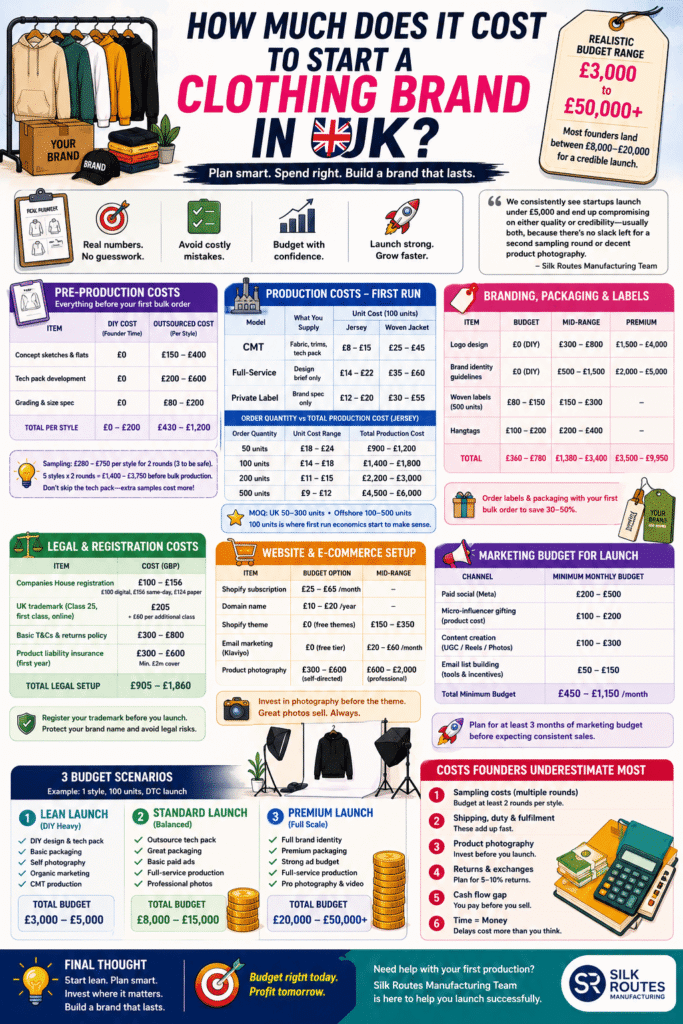
Pre-Production Costs
Pre-production is everything before a single bulk unit is cut — and where founders spend the least and lose the most time.
| Item | DIY Cost | Outsourced Cost |
|---|---|---|
| Concept sketches and flats | £0 (founder time) | £150–£400 per style |
| Tech pack development | £0 (if skilled) | £200–£600 per style |
| Grading and size spec | £0 (if skilled) | £80–£200 per style |
| Total per style | £0–£200 | £430–£1,200 |
A tech pack is the non-negotiable document your manufacturer needs before they can quote or sample. Skip it and you pay for it in extra sampling rounds — which cost more than the tech pack would have.
Our take: for a first-time founder without garment construction experience, outsourcing the tech pack is almost always worth the £300–£500. The alternative is typically two or three additional sample rounds at £100–£300 each.
Sampling: budget £280–£750 per style for two rounds, three to be safe. A 5-style collection with 2 sample rounds per style runs £1,400–£3,750 in sampling alone, before a single bulk unit is ordered — the single most underestimated line item in most startup budgets.
If your manufacturer doesn’t include pattern development, a freelance UK pattern cutter charges £80–£250 per style for a basic pattern.
Production Costs — First Run
| Model | What You Supply | Unit Cost (100 units, jersey) | Unit Cost (100 units, woven jacket) |
|---|---|---|---|
| CMT | Fabric, trims, tech pack | £8–£15 | £25–£45 |
| Full-Service | Design brief only | £14–£22 | £35–£60 |
| Private Label | Brand spec only | £12–£20 | £30–£55 |
CMT is cheaper per unit but you source fabric and trims yourself — extra cost, time, and sourcing expertise most first-time founders don’t have. For a first run, full-service almost always produces a cleaner outcome.
| Order Quantity | Unit Cost Range | Total Production Cost |
|---|---|---|
| 50 units | £18–£24 | £900–£1,200 |
| 100 units | £14–£18 | £1,400–£1,800 |
| 200 units | £11–£15 | £2,200–£3,000 |
| 500 units | £9–£12 | £4,500–£6,000 |
The counterintuitive part: 50 units isn’t necessarily cheaper than 100. You pay a higher unit cost, and your sampling cost is identical either way — 100 units is where a first run’s economics start to make sense for most startups.
For the full breakdown of how manufacturer type affects your costs, our guide to low MOQ and private label clothing manufacturers UK covers production costs in full.
Branding, Packaging, and Labels
A brand that looks amateur on packaging and website loses customers before product quality gets a chance to prove itself.
| Item | Budget | Mid-Range | Premium |
|---|---|---|---|
| Logo design | £0 (DIY) | £300–£800 | £1,500–£4,000 |
| Brand identity guidelines | £0 (DIY) | £500–£1,500 | £2,000–£5,000 |
| Woven labels (500 units) | £80–£150 | £150–£300 | — |
| Hangtags | £100–£200 | £200–£400 | — |
| Total branding + packaging | £360–£780 | £1,380–£3,400 | £3,500–£9,950 |
“Order labels and packaging in the same production run as your first bulk order. Ordering separately at lower quantities costs 30–50% more per unit on most packaging items.” — Silk Routes Manufacturing Team
Legal and Registration Costs
Legal setup isn’t optional — it’s the foundation everything else sits on, and these are the figures most guides get wrong once fees change.
| Item | Cost | Notes |
|---|---|---|
| Companies House registration | £100–£156 | £100 digital, £156 same-day, £124 paper |
| UK trademark (Class 25, first class, online) | £205 | Plus £60 per additional class |
| Basic T&Cs and returns policy | £300–£800 | Template-based, worth the cost |
| Product liability insurance (first year) | £300–£600 | Minimum £2m cover, required by most retailers |
| Total legal setup | £905–£1,860 | — |
Trademark registration is the most commonly skipped legal step at startup. Trading under a name doesn’t establish ownership of it — a competitor can register your brand name as a trademark while you’re trading under it, and you’d have limited recourse without a registered mark of your own. Register before you launch, not after.
Website and E-Commerce Setup
| Item | Budget Option | Mid-Range |
|---|---|---|
| Shopify subscription | £25–£65/month | — |
| Domain name | £10–£20/year | — |
| Shopify theme | £0 (free themes) | £150–£350 |
| Email marketing (Klaviyo) | £0 (free tier) | £20–£60/month |
| Product photography | £300–£600 (self-directed) | £600–£2,000 (professional) |
A clean Shopify store on a free theme with professional photography outperforms an expensive custom site with poor product images, every time. Invest in the photography before the theme.
Marketing Budget for Launch
| Channel | Minimum Monthly Budget |
|---|---|
| Paid social (Meta) | £200–£500 |
| Micro-influencer gifting (product cost) | £100–£200 |
| Content creation | £0–£200 |
| Total monthly marketing | £300–£930 |
Budget a minimum of three months of marketing spend before expecting meaningful return. What we see repeatedly at Silk Routes: brands that run out of money at launch almost always put 90% of budget into production and 10% into marketing — the workable ratio for a DTC launch is closer to 60/40.
Three Budget Scenarios
| Scenario | Description | Total Cost |
|---|---|---|
| Lean | 1–2 styles, 50–100 units, DIY branding and photography, pre-order funded | £3,000–£8,000 |
| Standard | 3–5 styles, 100–200 units, freelance branding, 3-month marketing budget | £8,000–£20,000 |
| Premium | 6–10 styles, 200–500 units, studio branding, trade show attendance | £20,000–£50,000+ |
The lean model isn’t inferior — it’s appropriate for testing demand before committing capital. A pre-order campaign generating 50 confirmed orders before production begins validates the product and funds the run.
“If your initial budget is under £8,000, the lean model with a pre-order strategy is a more viable path than trying to compress a standard launch into an insufficient budget.” — Silk Routes Manufacturing Team
How to Stretch Your Startup Budget
Start with one hero product, not a collection. A single style at 100–200 units costs a fraction of a 10-style collection and validates demand with real sales data before you expand.
Use a pre-order model to fund your first run. Take deposits before production starts, set a minimum threshold, and only proceed once it’s hit.
DIY your content, not your tech pack. The one place not to cut costs is the document that determines your sampling costs — film your own content on a phone with good lighting instead.
Buy labels and packaging at production volume. Bundling 500 woven labels into your production order costs 40–50% less per unit than ordering 200 separately.
Five Budget Mistakes First-Time Founders Make
Budgeting for one sample round. Founders assume the first sample will be close to correct. Fix: budget three rounds minimum — if you only need two, the surplus is a saving.
Forgetting the cash flow gap. Production deposit is paid 8–12 weeks before goods arrive and sales revenue follows. Fix: model cash flow separately from total budget — a £5,000 run at 50% deposit means £2,500 tied up before cutting starts.
Underallocating marketing budget. Whatever’s left after production, branding, and legal becomes the marketing budget. Fix: set marketing budget first — minimum £900 for three months — and build production costs around it.
Skipping trademark registration to save £205. It feels discretionary before the brand has traction. Fix: register before you launch — losing a trademark dispute after building a customer base costs orders of magnitude more than the filing fee.
Not including VAT in cost estimates. Founders compare quotes without accounting for VAT on business purchases. Fix: if you’re not VAT registered, all costs including 20% VAT are your real cost; if you are, you can reclaim input VAT but must charge it on sales.
FAQ
How much money do I need to start a clothing brand in the UK?
The realistic minimum for a credible launch is £3,000–£5,000 using a lean model. A standard launch with 3–5 styles and a 3-month marketing budget needs £8,000–£20,000.
Can I start a clothing brand with £5,000?
Yes, with a lean model: one hero product at 100 units (£1,400–£1,800 production), two sample rounds (£200–£500), basic branding and labels (£400–£600), Shopify and photography (£600–£900), trademark registration (around £205), and a short influencer gifting programme. There’s no room for error at this level, which is why the pre-order model matters.
What’s the biggest single cost when launching?
Production is typically the largest single line item at 40–60% of a standard budget, but sampling is the biggest surprise — a 5-style collection can run £1,400–£3,750 in sampling before a single bulk unit is ordered.
Is it cheaper to manufacture in the UK or overseas for a first run?
For quantities under 200–300 units per style, UK manufacturing is frequently comparable in total landed cost once freight, duty, extended sampling timelines, and quality-failure risk are included. Below 100 units per style, UK manufacturing is almost always the more practical choice.
How do I fund a clothing brand startup?
The most common routes are personal savings, the government-backed Start Up Loans scheme (up to £25,000 at a fixed 7.5% rate as of April 2026), pre-order campaigns, and friends-and-family investment. Grants through programmes like the British Fashion Council’s NewGen are competitive and rarely cover total startup costs.
Building a Budget That Survives Contact With Reality
The brands that launch successfully aren’t the ones who spent the most — they’re the ones who allocated their budget honestly, including the costs that are easy to overlook, and left enough in reserve for the inevitable surprises.
Sample an extra round. Register the trademark. Hire the photographer. Cut costs on the Shopify theme and the trade show stand you can skip in year one.
To discuss realistic first-run costs for your specific product and volume, find out more about how Silk Routes works with startup brands.