
Contents
- 1.
- 2. Swimwear Manufacturers UK: Production Guide
- 2.1. Choose the Right Swimwear Production Route
- 2.2. Interactive Manufacturer-Fit Tool
- 2.3. Swimwear Performance Stack
- 2.4. Technical Comparison
- 2.5. Production Complexity Profile
- 2.6. Swimwear Development Timeline
- 2.7. What Buyers Commonly Get Wrong
- 2.8. Authoritative Reference Links
- 2.9. Swimwear Fabrics: What UK Manufacturers Work With
- 2.10. Lining, Seams and Chlorine Resistance
- 2.11. Plus-Size Swimwear Manufacturing
- 2.12. UPF and Sun-Protective Swimwear
- 2.13. MOQ and Lead Times for UK Swimwear
- 2.14. Cost of UK Swimwear Production
- 2.15. How to Brief a UK Swimwear Manufacturer
- 2.16. Common Swimwear Production Mistakes
- 2.17. How Silk Routes Supports Swimwear Brands
- 2.18. FAQ
- 2.19. Building Swimwear That Performs in Real Use
A swimwear sample can look perfect on a hanger and still fail in the water.
For founders researching swimwear manufacturers UK, the real test comes from stretch, recovery, lining, seam construction, chlorine exposure, opacity and fit under movement. Swimwear is closer to technical activewear than ordinary fashion basics.
That is why the strongest manufacturer is not simply the one that can sew Lycra. It is the one that can control fabric performance, stretch direction, lining, construction and fit across the full size range.
Post Summary
UK swimwear production is available across fashion, technical and sustainable categories
Stretch and recovery matter as much as fabric appearance
Chlorine resistance should be specified by end use
Lining affects opacity, support and comfort
Plus-size swimwear needs proper grading, not simple enlargement
Sustainable swimwear often uses recycled nylon or polyester blends
MOQ depends on style, colour, lining and fabric choices
Samples should be tested wet, stretched and after laundering
Is Swimwear Still Manufactured in the UK?
Yes, swimwear can still be manufactured in the UK.
The available capability is more specialist than general jersey or T-shirt production because swimwear uses high-stretch fabrics and requires tighter control over seams, elastic, lining and fit.
UK manufacturing can suit brands that value:
Closer communication
Faster sample revisions
Lower-volume development
Smaller first collections
Easier factory visits
More direct quality control
The mistake is assuming every stretch-fabric factory can make swimwear well.
Swimwear demands specialist handling.
A legging factory may understand stretch fabrics, but swimwear introduces additional issues such as water exposure, lining, elastic tension, chlorine and coverage.
Our view is that buyers should ask for examples of comparable swimwear before requesting a quote.
Types of Swimwear Production Available in the UK
UK swimwear manufacturers can work across several product types.
| Swimwear Type | Main Requirement | Typical Production Challenge |
|---|---|---|
| Fashion swimwear | Fit, shape, appearance | Complex panels and trims |
| Bikini production | Support and proportion | Small components and elastic tension |
| One-piece swimwear | Body shaping and stretch | Torso length and recovery |
| Competitive swimwear | Technical performance | Chlorine resistance and compression |
| Plus-size swimwear | Support and grading | Bust, torso and elastic balance |
| Sustainable swimwear | Recycled materials | Fabric consistency and certification |
Fashion and Lifestyle Swimwear
Fashion swimwear focuses strongly on silhouette and design.
Typical products include:
Bikinis
One-piece swimsuits
Tankinis
Resort swimwear
Swim tops
High-waisted bottoms
Cut-out styles
The challenge is balancing appearance with movement.
A bikini top may need support without looking overly structured.
A one-piece may need enough stretch to fit comfortably while still recovering after wear.
Competitive and Technical Swimwear
Technical swimwear has a different priority.
Performance may matter more than decorative detail.
Chlorine-resistant fabric becomes important for products designed for repeated pool use.
Technical products may also prioritise:
Compression
Reduced drag
Secure fit
Seam placement
Shape retention
Repeated chlorine exposure
A fashion swimsuit worn occasionally on holiday does not have the same requirements as a training swimsuit used several times each week.
Sustainable and Recycled Swimwear
Many brands now use recycled nylon or recycled polyester blends.
These materials can reduce reliance on virgin synthetic fibres, but they still need the same technical checks as conventional swimwear fabrics.
The Textile Exchange publishes standards and material guidance around recycled and preferred fibres.
A recycled claim should be supported by documentation.
“Made from recycled fabric” is not enough on its own.
Ask:
Recycled percentage
Fibre source
Certification
Fabric supplier
Stretch performance
Chlorine performance
Colourfastness
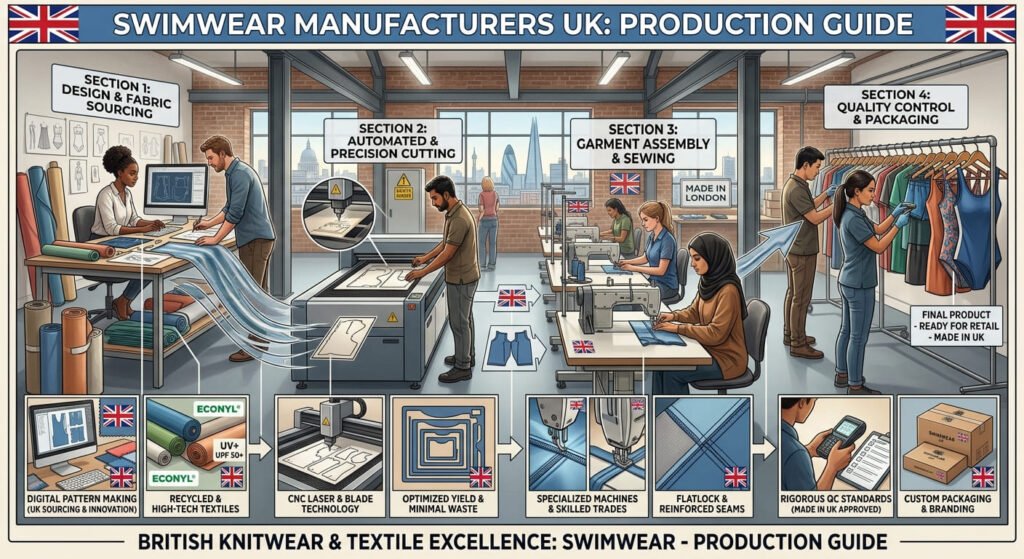
Swimwear Manufacturers UK: Production Guide
Interactive sourcing dashboard for fashion, technical, plus-size and sustainable swimwear production.
Choose the Right Swimwear Production Route
Best when silhouette, fit, lining, trims and visual design lead the product.
Best when chlorine resistance, compression, recovery and technical construction matter most.
Best when grading, support, recycled materials or traceability are central to the range.
Interactive Manufacturer-Fit Tool
Which manufacturer specialism fits your product?
Swimwear Performance Stack
This sequence is a practical development framework, not a regulated testing protocol.
Technical Comparison
| Requirement | Fashion Swimwear | Competitive Swimwear | Plus-Size / Support |
|---|---|---|---|
| Primary focus | Silhouette + appearance | Performance + recovery | Support + grading |
| Fabric priority | Stretch + opacity | Chlorine resistance + compression | Supportive stretch + lining |
| Critical sample test | Wet opacity | Pool / wear test | Multi-size fit test |
| Common sourcing error | Approving dry fabric only | Using non-technical stretch fabric | Simple size scaling |
Qualitative buyer guidance only; not market statistics.
Production Complexity Profile
Bars communicate relative development complexity only; they are not measured industry statistics.
Swimwear Development Timeline
What Buyers Commonly Get Wrong
Testing fabric only when dry
Wetness and stretch can change opacity and fit. Test the exact production fabric under realistic use conditions.
Ignoring lining stretch
A restrictive lining can distort an otherwise suitable outer fabric. Test the two materials together.
Simple scaling for plus sizes
Support, torso length and elastic tension need dedicated grading rather than uniform enlargement.
Making unsupported UPF or chlorine claims
Performance language should be backed by supplier documentation or relevant test evidence.
Authoritative Reference Links
- Textile Exchange — preferred fibres, recycled materials and textile standards
- OEKO-TEX — textile testing and certification systems
- UK Fashion & Textile Association — UK fashion and textile manufacturing industry
- WRAP — textiles and circular economy guidance
Swimwear Fabrics: What UK Manufacturers Work With
Swimwear usually depends on synthetic stretch fabrics.
Common constructions include:
Nylon-elastane
Polyester-elastane
Recycled nylon-elastane
Recycled polyester-elastane
Compression knits
Textured stretch fabrics
Lycra / elastane provides stretch and recovery.
The amount of elastane alone does not tell you how the fabric behaves.
Fabric construction matters.
| Fabric Property | Why It Matters | What to Test |
|---|---|---|
| Stretch | Controls movement | Direction and percentage |
| Recovery | Prevents bagging | Repeated stretch |
| Opacity | Prevents transparency | Wet and stretched test |
| Chlorine resistance | Supports pool use | Repeated exposure |
| UV performance | Relevant for outdoor use | Supplier documentation |
| Colourfastness | Maintains appearance | Pool, seawater and washing |
| Surface durability | Controls pilling | Abrasion test |
The mistake is approving fabric dry and unstretched.
A fabric can look completely opaque on the roll and become transparent when wet or stretched.
Silk Routes Manufacturing Team: Always test swimwear fabric wet and under stretch before bulk approval. Dry fabric inspection does not reveal the conditions the garment will face in use.
Brands developing technical or fashion swimwear can review our clothing manufacturing services before moving into sampling.
Lining, Seams and Chlorine Resistance
Swimwear construction is where many problems appear.
Lining
Swimwear lining can provide:
Opacity
Support
Structure
Comfort
Improved coverage
The lining also needs suitable stretch.
A highly elastic outer fabric paired with a restrictive lining can distort fit.
The two materials should work together.
Seams
Swimwear seams need to stretch with the garment.
Common approaches may include:
Overlock
Flatlock
Coverstitch
Zigzag
Specialist stretch stitching
The correct method depends on garment type and desired finish.
A beautiful seam that breaks under stretch is useless.
Elastic
Elastic tension affects fit dramatically.
Too much tension can create digging and distortion.
Too little can create loose leg openings or slipping straps.
This becomes especially important around:
Leg openings
Waistbands
Necklines
Armholes
Bikini straps
Bust edges
Chlorine Resistance
Chlorine can damage some fibres and elastomeric components over time.
If the product is designed for regular pool use, the fabric should be selected specifically for that environment.
What guides get wrong is using the phrase “chlorine resistant” as if all fabrics perform identically.
The manufacturer should work from the intended use.
Plus-Size Swimwear Manufacturing
The supplied Google related-search data shows interest around plus size swimwear manufacturers UK, and it fits naturally within the production discussion.
Plus-size swimwear should not be created by simply enlarging a base pattern.
That approach often fails around:
Bust support
Strap width
Cup depth
Torso length
Leg opening
Waist position
Elastic tension
Grading needs to account for body proportion.
A size 20 is not simply a scaled-up size 10.
This matters more in swimwear because the garment is close-fitting and highly dependent on stretch.
What brands get wrong is testing only the base size.
At minimum, the sample process should include representative sizes across the intended range.
UPF and Sun-Protective Swimwear
Some swimwear is designed with sun protection in mind.
UPF swimwear refers to clothing intended to provide a measured level of ultraviolet protection.
A brand should not make a UPF performance claim without supporting test evidence.
Fabric colour, construction, stretch and wetness can all influence UV transmission.
A claim such as “UPF 50” should therefore come from documented testing rather than marketing language.
For ordinary fashion swimwear where no UV performance claim is being made, the manufacturer should avoid implying technical protection that has not been verified.
MOQ and Lead Times for UK Swimwear
MOQ varies by manufacturer and production setup.
The real minimum may be affected by:
Fabric supplier
Colour
Lining
Elastic
Style
Size range
Printing
Trims
| Order Structure | Relative Complexity |
|---|---|
| One style, one colour | Lower |
| One style, several colours | Moderate |
| Several styles, same fabric | Moderate |
| Several fabrics | Higher |
| Custom print | Higher |
| Custom-dyed fabric | Higher |
| Wide size range | Higher |
A 200-piece swimwear order can become difficult if it contains four styles, five colours and multiple lining options.
This is why MOQ should be discussed per style and fabric.
The useful question is not simply, “What is your MOQ?”
Ask how the MOQ applies.
Lead time should also be counted from final approval, not first enquiry.
Fabric sourcing, pattern development, fit samples and wear testing happen before bulk production.
Cost of UK Swimwear Production
The supplied brief does not provide verified live 2026 unit-cost figures, so fixed prices would be misleading.
Swimwear pricing depends heavily on construction.
| Cost Driver | Lower Cost Direction | Higher Cost Direction |
|---|---|---|
| Style | Simple bikini | Structured one-piece |
| Fabric | Stock stretch fabric | Technical or recycled fabric |
| Lining | Partial | Full lining |
| Support | Minimal | Cups, power mesh, underband |
| Printing | Solid colour | Custom print |
| Trims | Standard | Branded hardware |
| Quantity | Larger run | Small fragmented order |
| Sampling | Simple | Multiple fit rounds |
The cheapest sewing quotation can become expensive if the garment needs repeated redevelopment.
Swimwear fit problems are particularly costly because small changes in elastic or torso length can affect the whole garment.
How to Brief a UK Swimwear Manufacturer
A strong swimwear brief should include:
Product type
Intended use
Fabric composition
Stretch direction
Lining
Support requirements
Elastic specification
Seam type
Size range
Fit
Colour
Print
Branding
Hardware
Quantity
Packaging
Target delivery date
For technical swimwear, add:
Chlorine requirement
UV claim if applicable
Compression requirement
Testing requirement
For plus-size collections, specify the full intended size range at the beginning.
Do not develop the product in one size and decide later to extend it.
Common Swimwear Production Mistakes
1. Testing Only Dry Fabric
Why it happens: Fabric is approved from a swatch.
Why it fails: Wetness and stretch can change opacity.
Fix: Test fabric wet and stretched.
2. Using the Wrong Lining
Why it happens: Lining is treated as secondary.
Why it fails: Incorrect stretch can distort the garment.
Fix: Test outer and lining fabrics together.
3. Ignoring Elastic Tension
Why it happens: Elastic appears to be a small trim.
Why it fails: It controls fit around openings.
Fix: Approve tension on a finished sample.
4. Extending Sizes by Simple Scaling
Why it happens: Brands want to add plus sizes quickly.
Why it fails: Body proportions do not increase uniformly.
Fix: Review grading and fit across the size range.
5. Making Unsupported Chlorine Claims
Why it happens: Technical wording helps marketing.
Why it fails: Fabric performance may not support the claim.
Fix: Use supplier documentation or testing.
6. Using Too Many Fabrics in a Small Launch
Why it happens: Each style is developed separately.
Why it fails: MOQ and sourcing complexity increase.
Fix: Reuse approved fabrics where possible.
How Silk Routes Supports Swimwear Brands
Swimwear sourcing starts with intended use.
A fashion bikini, technical swimsuit and plus-size one-piece should not be developed from the same assumptions.
Silk Routes can help organise fabric, lining, fit, construction, size range and branding requirements before sampling.
That gives the manufacturer a clearer production brief.
For smaller brands, limiting the number of fabrics and colours can also make first production easier to control.
You can read more about our manufacturing background on the About Silk Routes page.
FAQ
No live Google People Also Ask questions were supplied for this keyword. The questions below are buyer FAQs and are not presented as Google PAA data.
What should I look for in the best swimwear manufacturers UK?
Look for experience with stretch fabrics, lining, elastic, wet testing and fit development.
Compare at least 5 areas—fabric capability, sampling, size grading, technical testing and MOQ—before choosing a manufacturer.
Can UK manufacturers produce plus-size swimwear?
Yes, provided the manufacturer can grade and fit the garments properly across the intended size range.
A strong plus-size programme should test at least 2 representative sizes beyond the base size rather than relying on simple scaling.
What fabric is best for swimwear?
There is no single best fabric for every product.
Compare at least 4 factors—stretch, recovery, opacity and chlorine performance—because fashion, competitive and resort swimwear have different needs.
Is recycled swimwear fabric suitable for technical products?
It can be, provided the fabric meets the required performance specification.
A buyer should verify at least 1 documented recycled-content claim plus the technical properties needed for the actual product.
Should swimwear be tested before bulk production?
Yes.
At least 1 approved sample should be tested for fit, stretch, wet opacity and the intended washing or pool-use conditions before bulk production.
Building Swimwear That Performs in Real Use
The final test is not how the swimsuit looks on the sample rail.
It is how it performs after stretch, water, movement and repeated wear.
That is why fabric, lining, elastic and fit should be approved as one system.
For the wider context of specialist garment production, see our Specialist Clothing Manufacturers UK guide.