Contents
- 1.
- 2. Which Hoodie Production Route Fits Your Brand?
- 2.1. Three Hoodie Production Routes
- 2.2. Interactive Hoodie Route Finder
- 2.3. Fabric & Product Direction
- 2.4. Hoodie Development Complexity Ladder
- 2.5. Relative Product-Control Profile
- 2.6. Decoration Decision Guide
- 2.7. Custom Hoodie Production Timeline
- 2.8. What Makes a Premium Hoodie?
- 2.9. Common Buyer Mistakes
- 2.10. Authoritative Reference Links
- 2.11. Rib, Hood and Pocket Construction
- 2.12. Decoration Methods for Branded Hoodies
- 2.13. Wholesale Hoodies vs Custom Manufacturing
- 2.14. MOQ for UK Hoodie and Sweatshirt Production
- 2.15. Cost Benchmarks for UK Hoodie Manufacturing
- 2.16. Organic and Sustainable Hoodie Options
- 2.17. How to Brief a UK Hoodie Manufacturer
- 2.18. Common Mistakes When Ordering Custom Hoodies
- 2.19. How to Evaluate Hoodie Manufacturer Reviews
- 2.20. How Silk Routes Supports Hoodie and Sweatshirt Brands
- 2.21. FAQ
- 2.22. Building a Hoodie That Feels Like Your Brand
A hoodie can look premium in a mock-up and still feel cheap in the hand.
The difference usually comes down to fabric weight, fibre blend, shrinkage, rib quality, hood shape, stitching and decoration. For brands searching for hoodie sweatshirt manufacturers UK, those details matter more than the product name itself.
A 280GSM promotional hoodie and a 450GSM heavyweight streetwear hoodie are not the same manufacturing job.
The right UK supplier should understand that difference before sampling starts.
Post Summary
UK manufacturers can produce custom hoodies and sweatshirts for private-label brands
French terry, loopback fleece and heavyweight fleece behave differently
400GSM+ fabric is usually associated with heavier streetwear-style products
Rib quality affects cuffs, waistbands and shape retention
Screen printing suits many graphic-led collections
Embroidery adds texture but increases garment weight locally
MOQ depends on fabric, colour, style and decoration
Wholesale blanks and custom manufacturing are different sourcing routes
Manufacturer reviews should be treated as one part of supplier due diligence
UK Hoodie and Sweatshirt Manufacturing in 2026
UK hoodie production covers several different routes.
Some businesses decorate ready-made wholesale blanks.
Others produce private-label garments from fabric, patterns and tech packs.
Those are not the same service.
A brand choosing an existing blank mainly controls:
Colour
Print
Embroidery
Labels
Packaging
A custom manufacturer can potentially control:
Fabric
GSM
Fit
Hood shape
Rib
Pocket design
Construction
Labels
Trims
That extra control also creates more development work.
For a startup, that distinction should be clear before asking for quotations.
Fabric Options for UK Hoodies and Sweatshirts
Fabric choice affects almost everything.
It changes weight, warmth, drape, print behaviour, shrinkage and perceived quality.
| Fabric Type | Typical Feel | Best Use |
|---|---|---|
| French terry | Loop-backed, lighter | Lifestyle / transitional |
| Loopback fleece | Soft loop interior | Premium casualwear |
| Brushed fleece | Soft, warm interior | Winter / casual |
| Heavyweight 400GSM+ | Dense and structured | Streetwear / premium |
| Cotton blend | Stable and practical | General branded hoodies |
| Organic cotton | Fibre-led positioning | Sustainable collections |
French Terry
French terry usually has a smooth face and looped reverse.
It can feel lighter and less bulky than brushed fleece.
Brands often use it for:
Sweatshirts
Lightweight hoodies
Transitional collections
Premium casualwear
French terry also works well when the garment should drape rather than feel heavily structured.
Loopback Fleece
Loopback constructions retain visible loops on the inside.
They can give a cleaner, premium feel without the fluffy interior of brushed fleece.
The fabric still needs testing for:
Shrinkage
Recovery
Surface appearance
Colourfastness
A heavier loopback can work well for premium sweatshirts.
Heavyweight 400GSM+
Heavyweight hoodies are strongly associated with streetwear and premium casual brands.
400GSM+ gives the garment more structure and weight.
That does not automatically mean better quality.
A poor-quality 450GSM fabric can still shrink badly or lose shape.
The buyer should assess:
Fibre composition
Knit quality
Compactness
Shrinkage
Pilling
Recovery
Handle
Silk Routes Manufacturing Team: GSM tells you fabric weight, not fabric quality. Always approve the exact fabric after washing before bulk production.
Which Hoodie Production Route Fits Your Brand?
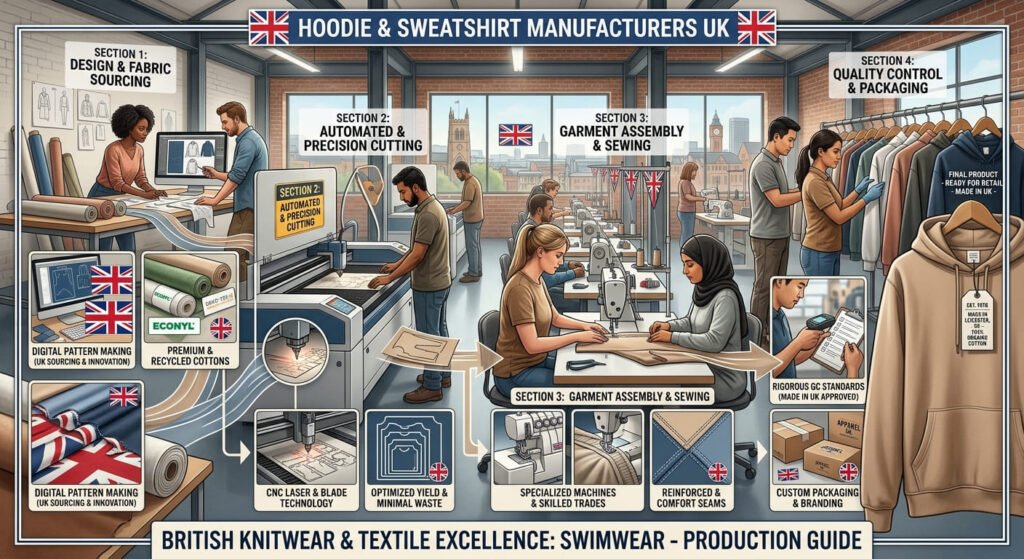
Interactive sourcing guide for wholesale blanks, private-label hoodies and full custom sweatshirt production.
Three Hoodie Production Routes
Start with an existing hoodie and add screen print, DTG, embroidery, labels or packaging.
Use a standard or semi-custom base, then add stronger branding, labels and finishing.
Develop fabric, GSM, pattern, hood, rib, pocket, trims, labels and decoration from specification.
Interactive Hoodie Route Finder
Find the production route that best matches your brand
Fabric & Product Direction
| Fabric Direction | Typical Character | Key Check | Best-Fit Product |
|---|---|---|---|
| French terry | Looped reverse, less bulky | Shrinkage + recovery | Lifestyle / transitional hoodie |
| Loopback fleece | Premium loop interior | Handle + shape retention | Premium casualwear |
| Brushed fleece | Softer, warmer interior | Pilling + wash behaviour | Winter / casual hoodie |
| 400GSM+ | Dense, structured, heavyweight | Shrinkage + rib balance | Heavyweight streetwear |
These are qualitative product-development categories. GSM measures fabric mass per square metre; it does not measure fabric quality.
Hoodie Development Complexity Ladder
Relative Product-Control Profile
Bars show relative product-control only. They are not measured industry statistics.
Decoration Decision Guide
| Method | Strong Use Case | Check Before Bulk |
|---|---|---|
| Screen print | Large repeat graphics | Ink behaviour on exact fabric |
| DTG | Detailed artwork | Fabric compatibility + wash test |
| Embroidery | Small premium logos | Stiffness, backing and garment distortion |
| Mixed decoration | Multi-technique streetwear | Placement, weight and production repeatability |
Custom Hoodie Production Timeline
What Makes a Premium Hoodie?
Common Buyer Mistakes
Choosing GSM alone
Fabric weight does not prove recovery, shrinkage control or surface quality.
Ignoring rib quality
Weak cuff and waistband rib can make a good body fabric feel poor.
Skipping decoration testing
Large prints and embroidery can change drape, stiffness and comfort.
Confusing wholesale with manufacturing
A blank supplier controls the base garment; a custom manufacturer can develop the garment itself.
Authoritative Reference Links
- Textile Exchange — preferred fibres, recycled fibres and textile standards
- OEKO-TEX — textile testing and certification systems
- UK Fashion & Textile Association — UK fashion and textile manufacturing industry
- WRAP — textiles and circular economy guidance
Rib, Hood and Pocket Construction
Hoodies rely on more than the main body fabric.
Rib matters.
Poor cuff or waistband rib can ruin an otherwise good garment.
Check:
Recovery
Stretch
Density
Colour match
Width
Attachment method
The hood also needs attention.
A premium hood should be shaped deliberately.
Important variables include:
Single or double layer
Drawcord
Eyelets
Neck opening
Hood depth
Centre seam
Kangaroo pockets should sit correctly and remain symmetrical.
Small construction errors become highly visible on simple garments.
Decoration Methods for Branded Hoodies
Decoration is often the main visual difference between products.
| Method | Strength | Limitation |
|---|---|---|
| Screen printing | Strong for repeated graphics | Setup required |
| DTG | Good for detailed artwork | Fabric-dependent |
| Embroidery | Premium texture | Adds local weight |
| Heat transfer | Flexible | Finish varies |
| Appliqué | Strong visual effect | More complex |
Screen Printing
Screen printing works well for many hoodie collections.
It can suit:
Logos
Large front graphics
Back prints
Sleeve prints
The fabric surface matters.
Heavy fleece can affect ink behaviour differently from smooth jersey.
Embroidery
Embroidery gives a raised, textured finish.
It can work well for:
Chest logos
Sleeve branding
Small motifs
Large embroidery areas can make the garment stiff.
The backing material can also affect comfort.
Screen Print vs Embroidery
The choice depends on artwork and brand positioning.
Use screen printing when:
Artwork is large
Graphic impact matters
Multiple garments share the same design
Use embroidery when:
Branding is smaller
Texture matters
The finish needs a premium appearance
Wholesale Hoodies vs Custom Manufacturing
The supplied Google related-search terms include hoodie & sweatshirt manufacturers UK wholesale.
That search usually reflects two different needs.
The first is wholesale supply.
The second is manufacturing.
They should not be confused.
Wholesale Route
You buy an existing garment.
Then you add:
Printing
Embroidery
Labels
Packaging
Advantages include:
Faster launch
Lower development burden
Easier sampling
Limitations include:
Fixed fit
Fixed fabric
Fixed GSM
Limited construction control
Custom Manufacturing Route
You develop the garment itself.
That can include:
Fabric selection
Pattern
Fit
Hood construction
Rib
Pocket shape
Labels
Decoration
This route suits brands that want the garment itself to be distinctive.
MOQ for UK Hoodie and Sweatshirt Production
MOQ varies by manufacturer.
It also varies by production route.
A decorated blank may allow lower starting quantities.
Custom production usually depends on more variables.
These include:
Fabric minimum
Dyeing
Colour
Rib
Style count
Size range
Print method
Embroidery
Labels
Packaging
| Order Structure | Relative MOQ Pressure |
|---|---|
| One blank style | Lower |
| One custom hoodie | Moderate |
| Multiple colours | Higher |
| Custom-dyed fabric | Higher |
| Multiple fabrics | Higher |
| Several embroidery designs | Higher |
A 100-piece order can become inefficient if it contains many colours and styles.
The better question is:
“How is the MOQ calculated per style, colour and fabric?”
That gives a more useful answer.
Cost Benchmarks for UK Hoodie Manufacturing
The brief requests cost benchmarks.
There is no verified live pricing source available here, so fixed 2026 unit prices would be unreliable.
Cost is driven by:
| Cost Driver | Lower-Cost Direction | Higher-Cost Direction |
|---|---|---|
| Fabric | Standard stock fleece | Custom heavyweight fleece |
| GSM | Lighter | Heavier |
| Hood | Single layer | Double layer |
| Decoration | Small print | Large embroidery |
| Trims | Standard | Custom |
| Labels | Basic | Full private label |
| Quantity | Larger run | Small fragmented run |
| Sampling | Simple | Multiple revisions |
The cheapest quote is not automatically the cheapest production route.
Repeated sampling and rejected fabric can cost more than a higher initial quote.
Organic and Sustainable Hoodie Options
Brands can source hoodies using:
Organic cotton
Recycled polyester
Recycled cotton blends
Certified preferred fibres
The Textile Exchange publishes standards and guidance around preferred and recycled fibres.
A sustainability claim should be supported by documentation.
Ask for:
Fibre composition
Certification
Supplier information
Recycled percentage
Traceability
For chemical and textile testing, OEKO-TEX provides established certification systems.
Silk Routes Manufacturing Team: Do not approve “organic” or “recycled” wording based only on a supplier description. Ask for the supporting documentation.
Brands developing custom hoodies can review our clothing manufacturing services before moving into sampling.
How to Brief a UK Hoodie Manufacturer
A useful hoodie brief should include:
Hoodie or sweatshirt type
Pullover or zip
Fabric composition
GSM
Brushed or unbrushed
Fit
Hood construction
Rib specification
Pocket type
Drawcord
Zip
Print
Embroidery
Labels
Size range
Colour
Quantity
Packaging
For heavyweight streetwear, also specify:
Oversized or regular fit
Drop shoulder
Body length
Sleeve width
Hood depth
Rib depth
A vague phrase such as “premium oversized hoodie” is not enough.
Common Mistakes When Ordering Custom Hoodies
1. Choosing GSM Alone
Why it happens: Heavy fabric sounds premium.
Why it fails: Weight does not guarantee recovery or shrinkage control.
Fix: Approve fabric after testing.
2. Ignoring Rib Quality
Why it happens: Buyers focus on body fabric.
Why it fails: Weak rib loses shape quickly.
Fix: Test cuffs and waistband separately.
3. Using Oversized Artwork Without Testing
Why it happens: Digital mock-ups look clean.
Why it fails: Large prints can alter fabric feel.
Fix: Approve a finished decorated sample.
4. Overusing Embroidery
Why it happens: Embroidery feels premium.
Why it fails: Large areas become heavy and stiff.
Fix: Match stitch area to garment structure.
5. Treating Wholesale and Manufacturing as the Same
Why it happens: Both suppliers sell hoodies.
Why it fails: One controls the base garment; the other may only decorate it.
Fix: Ask whether the supplier manufactures the garment or sources blanks.
6. Ordering Too Many Colours
Why it happens: Brands want variety.
Why it fails: Colour fragmentation raises production complexity.
Fix: Start with fewer core colours.
How to Evaluate Hoodie Manufacturer Reviews
The supplied related-search terms also include hoodie & sweatshirt manufacturers UK reviews.
Reviews can be useful.
They should not replace factory due diligence.
A strong review does not prove that the supplier can manufacture your product.
Check:
Comparable product examples
Sample quality
Communication
Lead-time history
Fabric sourcing
Decoration capability
Quality-control process
Reviews mainly show previous customer experience.
They do not replace technical evaluation.
How Silk Routes Supports Hoodie and Sweatshirt Brands
A good hoodie starts with the fabric and fit.
Decoration comes later.
Silk Routes can help brands organise:
Fabric options
GSM
Rib
Hood construction
Decoration
Labels
Fit
Sampling
Production briefing
For smaller brands, simplifying fabric and colour choices can make the first production run easier to manage.
You can learn more about our background on the About Silk Routes page.
FAQ
No live Google People Also Ask questions were supplied for this keyword. The questions below are buyer FAQs and are not presented as Google PAA data.
What should I look for in a UK hoodie manufacturer?
Check fabric capability, fit development, decoration, labels and quality control.
Compare at least 5 areas before choosing a supplier: fabric, sampling, construction, decoration and production capacity.
Is 400GSM good for a hoodie?
It can be suitable for heavyweight streetwear.
A 400GSM+ fabric usually gives more weight and structure, but quality still depends on fibre, knitting, finishing and shrinkage control.
Is screen printing or embroidery better for hoodies?
Neither method is automatically better.
Compare at least 3 factors—artwork size, texture and garment weight—before choosing.
Can UK manufacturers make organic cotton hoodies?
Yes, if the required fabric is available and supporting documentation exists.
Ask for at least 1 valid certification or traceability document before using an organic claim.
Should I use wholesale blanks or custom manufacturing?
Use blanks when speed and lower development complexity matter.
Choose custom manufacturing when you need control over at least 4 major product areas such as fit, fabric, GSM and construction.
Building a Hoodie That Feels Like Your Brand
The finished product should not depend on decoration alone.
Fabric, rib, fit, hood shape and construction all affect how the garment feels.
Wholesale blanks can work well for fast launches.
Custom manufacturing gives more control when the garment itself needs to be distinctive.
For the wider product-manufacturing context, see our Specialist Clothing Manufacturers UK guide.