

Contents
- 1.
- 1.1. Post Summary
- 1.2. Why Healthcare Workwear Rules Are Different from Standard Uniforms
- 1.3. The Main Frameworks Affecting Healthcare Workwear in the UK
- 1.4. NHS Uniform Colour Coding — What Does It Mean?
- 1.5. Fabric Requirements for Healthcare Workwear
- 1.6. Healthcare Uniform Procurement Compliance Checklist
- 1.7. Common Healthcare Workwear Compliance Mistakes
- 1.7.1. 1. Treating Every Uniform as PPE
- 1.7.2. 2. Assuming Scrubs Automatically Meet Surgical Standards
- 1.7.3. 3. Approving Fabric Without Laundry Testing
- 1.7.4. 4. Copying Another Organisation’s Colour Coding
- 1.7.5. 5. Adding Branding Without Checking Garment Performance
- 1.7.6. 6. Failing to Keep Compliance Records
- 1.8. How Silk Routes Supports Healthcare Uniform Sourcing
- 1.9. FAQ
- 1.9.1. What are the regulations regarding work uniforms in the UK?
- 1.9.2. What are the main healthcare regulations in the UK?
- 1.9.3. What PPE is required for healthcare workers?
- 1.9.4. Are healthcare uniforms legally required to be colour coded?
- 1.9.5. Do healthcare uniforms need wash testing before bulk production?
- 1.10. Building a Compliant Healthcare Uniform Specification
Healthcare uniforms can look like ordinary work clothing. Procurement rules become very different once a garment is used for infection control, clinical protection or regulated PPE.
For buyers researching healthcare workwear regulations UK, the first task is to separate ordinary uniforms from protective equipment. A tunic worn for identification and professionalism is not regulated in the same way as a garment designed to protect its wearer from a defined workplace hazard.
That distinction affects specification, laundering, documentation and supplier selection.
Post Summary
Ordinary healthcare uniforms and PPE are not regulated in the same way
Infection prevention policy influences uniform design and laundering
PPE selection must follow workplace risk rather than appearance
Surgical clothing can fall under additional technical standards
Fabric choice should reflect laundering and clinical use
Colour coding is operational rather than a single UK-wide legal requirement
Procurement teams should document garment purpose before selecting specifications
Compliance evidence should be checked before bulk ordering
Why Healthcare Workwear Rules Are Different from Standard Uniforms
The UK’s Health and Social Care Act infection-control framework requires registered healthcare providers to maintain appropriate systems for preventing and controlling infection. The government publishes the supporting Code of Practice on the prevention and control of infections.
A corporate polo is primarily a branding and workwear decision. A healthcare garment may also sit inside an infection-control procedure.
That changes the questions procurement teams need to ask.
Can the garment tolerate the required washing process? Does its design create unnecessary contamination risks? Is it simply a uniform, or is it being supplied as protective equipment?
A frequent mistake is putting every healthcare garment into the same compliance category.
Uniforms, theatre clothing, disposable protective garments and certified PPE need to be assessed according to their actual purpose.
Our view is that the intended use should be written at the top of every healthcare garment specification before fabric, colour or logo discussions begin.
The Main Frameworks Affecting Healthcare Workwear in the UK
The Health and Safety Executive states that PPE should be considered where workplace risks cannot be adequately controlled by other means. Its PPE guidance covers selection, use and employer responsibilities.
Several frameworks can therefore affect healthcare clothing, but they do different jobs.
| Framework or Standard | Main Relevance | Typical Garments |
|---|---|---|
| Infection Prevention and Control policy | Reducing avoidable contamination risks | Tunics, scrubs, clinical uniforms |
| Healthcare laundry guidance | Cleaning and decontamination | Reusable healthcare clothing |
| PPE legislation | Protection against identified hazards | Aprons, gowns, protective clothing |
| BS EN 13795 | Performance requirements for surgical clothing and drapes | Certain surgical gowns |
| Employer risk assessment | Decides required protection level | Role-specific PPE |
A uniform does not become PPE simply because it is worn in a hospital.
PPE has a protective function connected to a recognised hazard. That may include biological contamination, chemicals or other workplace risks.
Healthcare organisations considering custom garment programmes can review our clothing manufacturing services when translating operational requirements into production specifications.
NHS Infection Prevention and Control Policy
Infection-control policy affects how uniforms are worn, handled and cleaned.
The clothing specification should support the healthcare provider’s local procedures rather than work against them.
Long decorative cuffs, unnecessary loose accessories or difficult-to-clean components may create avoidable problems in clinical environments.
The manufacturing specification should therefore reflect the actual job role.
A receptionist in a medical centre does not necessarily need the same garment construction as a nurse providing direct patient care.
Healthcare Laundry and Decontamination Requirements
Healthcare laundering is not the same as checking whether a garment survives an ordinary domestic wash.
Reusable workwear may be exposed to repeated cleaning cycles, detergents, drying and pressing.
Fabric stability matters.
Colour loss, shrinkage, seam distortion and deterioration of trims can shorten the useful life of a garment even when the fabric itself remains intact.
Procurement teams should provide the intended cleaning method before bulk fabric approval.
A wash test carried out after production is too late.
PPE Requirements
The UK’s Personal Protective Equipment at Work Regulations guidance places PPE selection within the wider process of workplace risk management.
That means the correct question is not, “Which protective garment looks suitable?”
The question is, “Which hazard has been identified, and what level of protection is required?”
Protective aprons, gowns and other garments need to match the risk assessment.
A normal polyester-cotton tunic should not be presented as protective clothing unless it genuinely meets the relevant requirements.
BS EN 13795 and Surgical Clothing
BS EN 13795 relates to surgical clothing and drapes intended to help control microbial contamination within surgical settings.
This should not be applied automatically to every scrub set.
The garment’s intended function matters.
Standard staff scrubs used as routine workwear and surgical gowns designed for controlled clinical environments are different products.
Procurement teams should therefore specify whether they are buying ordinary clinical clothing or a garment requiring documented technical performance.
NHS Uniform Colour Coding — What Does It Mean?
Colour coding is used by many healthcare organisations to make staff roles easier to identify, but buyers should not assume that every healthcare provider follows one universal colour specification.
Local policy remains a key procurement input.
| Uniform Element | Possible Operational Purpose | Procurement Check |
|---|---|---|
| Main garment colour | Identify department or role | Confirm local colour policy |
| Trim colour | Differentiate seniority | Approve exact shade |
| Epaulettes or piping | Role identification | Check placement and washability |
| Embroidered job title | Staff recognition | Confirm wording |
| Logo | Organisation identification | Approve size and thread colour |
Colour accuracy matters when garments are reordered.
Two visually similar navy or blue fabrics can look noticeably different when employees wear old and new stock together.
Pantone references alone may not solve every fabric-matching issue because dye behaviour varies by material.
Physical approval samples remain useful.
Fabric Requirements for Healthcare Workwear
Healthcare garment fabric needs to be selected around the working environment and cleaning regime.
There is no useful single specification for every role.
| Fabric Requirement | Why It Matters | Check During Sampling |
|---|---|---|
| Wash stability | Controls shrinkage and distortion | Measurements before and after washing |
| Colourfastness | Maintains professional appearance | Shade change after repeated washing |
| Breathability | Helps wearer comfort | Wear trial |
| Strength | Supports repeated use | Seams and high-stress areas |
| Crease recovery | Maintains appearance | Drying and pressing test |
| Fabric weight | Affects comfort and durability | Seasonal and workplace suitability |
A fabric described as “easy care” still needs testing against the buyer’s real cleaning process.
Labels are not a substitute for performance testing.
For direct-care roles, sleeve construction, neckline, pocket placement and garment length should also be reviewed from an infection-control and movement perspective.
Silk Routes Manufacturing Team: Approve healthcare fabrics only after testing them with the cleaning process the client actually intends to use. A sample that has never been washed tells you very little about long-term uniform performance.
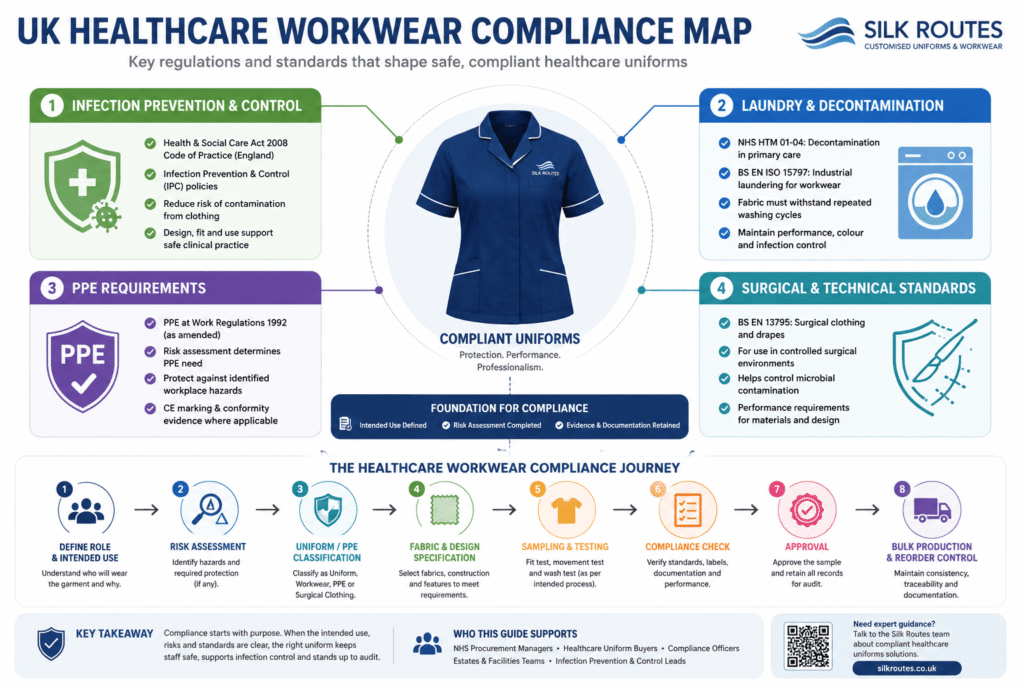
Healthcare Uniform Procurement Compliance Checklist
The Care Quality Commission assesses infection prevention within the wider requirement for safe care and treatment. Providers can review the CQC’s infection prevention and control guidance.
Procurement documentation should connect garment decisions with operational requirements.
A practical checklist includes:
| Check | What Procurement Should Record | Evidence |
|---|---|---|
| Intended use | Uniform, workwear or PPE | Written specification |
| Staff role | Clinical, support or administrative | Role list |
| Hazard exposure | Relevant workplace risks | Risk assessment |
| Cleaning process | Laundry method and frequency | Care specification |
| Fabric requirement | Composition and performance | Supplier data |
| Colour coding | Department or role colours | Approved colour standard |
| Branding | Logo and staff identification | Artwork approval |
| Size range | Required staff sizing | Size schedule |
| Sampling | Fit and wash approval | Signed sample |
| Reorders | Future continuity requirement | Production reference |
The garment specification and the risk assessment should agree.
If the risk assessment demands protective performance, procurement should not substitute ordinary workwear because it is cheaper or easier to source.
Common Healthcare Workwear Compliance Mistakes
HSE guidance makes PPE selection a risk-based process rather than a styling decision.
Several sourcing errors keep appearing because buyers start with the garment rather than its purpose.
1. Treating Every Uniform as PPE
Why it happens: Healthcare clothing and protective clothing are discussed together.
Why it fails: PPE has a specific protective purpose.
Fix: State whether each garment is ordinary workwear or protective equipment before requesting quotations.
2. Assuming Scrubs Automatically Meet Surgical Standards
Why it happens: Similar-looking garments are treated as interchangeable.
Why it fails: Routine scrubs and surgical protective garments can have different performance requirements.
Fix: Specify the clinical use and any required standard explicitly.
3. Approving Fabric Without Laundry Testing
Why it happens: Colour and hand-feel look good during sampling.
Why it fails: Repeated washing can change dimensions, shade and surface appearance.
Fix: Run wash tests before bulk approval.
4. Copying Another Organisation’s Colour Coding
Why it happens: Buyers assume healthcare colours are nationally identical.
Why it fails: Role identification systems can vary.
Fix: Use the commissioning organisation’s approved colour policy.
5. Adding Branding Without Checking Garment Performance
Why it happens: Embroidery is treated as a final decorative step.
Why it fails: Dense stitching can distort lighter fabrics or create stiff areas.
Fix: Approve the logo on the actual production fabric.
6. Failing to Keep Compliance Records
Why it happens: Procurement evidence is spread across emails and supplier documents.
Why it fails: Future reorders become difficult to verify.
Fix: Retain one approved specification containing fabric, colour, sizing, branding and applicable compliance requirements.
How Silk Routes Supports Healthcare Uniform Sourcing
Healthcare workwear sourcing starts with defining purpose.
We separate standard uniforms from garments that need specific protective or technical requirements before discussing construction and decoration.
Sampling can then cover fit, movement, laundering, logo application and colour consistency.
For organisations managing several job roles, retaining approved garment specifications also makes future replacement orders easier to control.
You can learn more about our manufacturing background and sourcing approach on the About Silk Routes page.
FAQ
What are the regulations regarding work uniforms in the UK?
There is no single law that governs every work uniform in the UK.
Requirements depend on the garment’s purpose, with PPE covered by specific workplace safety rules and ordinary uniforms affected by employer policies, risk assessments and relevant sector requirements. PPE selection should begin with 1 documented workplace risk assessment.
What are the main healthcare regulations in the UK?
Healthcare providers operate under several regulatory frameworks rather than one uniform-specific rule.
For clothing procurement, 3 areas deserve particular attention: infection prevention, workplace safety and any product-specific protective requirements that apply to the garment.
What PPE is required for healthcare workers?
Required PPE depends on the hazard, task and exposure identified through risk assessment.
A healthcare worker may need more than 1 PPE item for some tasks, such as gloves, eye protection, respiratory protection, aprons or gowns, but the combination should follow the employer’s clinical and safety procedures.
Are healthcare uniforms legally required to be colour coded?
A single statutory UK-wide colour code does not apply to every healthcare organisation.
Before production, procurement teams should confirm 1 approved local colour schedule covering each staff role that needs visual identification.
Do healthcare uniforms need wash testing before bulk production?
Wash testing is a practical procurement control because repeated laundering can alter size, colour and appearance.
At least 1 approved pre-production garment should be tested using the intended cleaning method before a large customised order is released.
Building a Compliant Healthcare Uniform Specification
Compliance starts before the first sample is sewn.
Define the job role, intended use, cleaning method, colour policy and any protective requirement in writing. Then match the fabric, construction and branding to those conditions.
That approach also makes supplier comparisons easier because every manufacturer is quoting against the same requirement.
Silk Routes treats healthcare garments as role-specific products rather than one generic uniform category. For the wider manufacturing context, see our Specialist Clothing Manufacturers UK guide.