
Contents
- 1.
- 2. Which Lingerie Production Route Fits Your Product?
- 2.1. Three Main Production Routes
- 2.2. Interactive Production Route Checker
- 2.3. Manufacturer Capability Matrix
- 2.4. Four Production Risk Zones
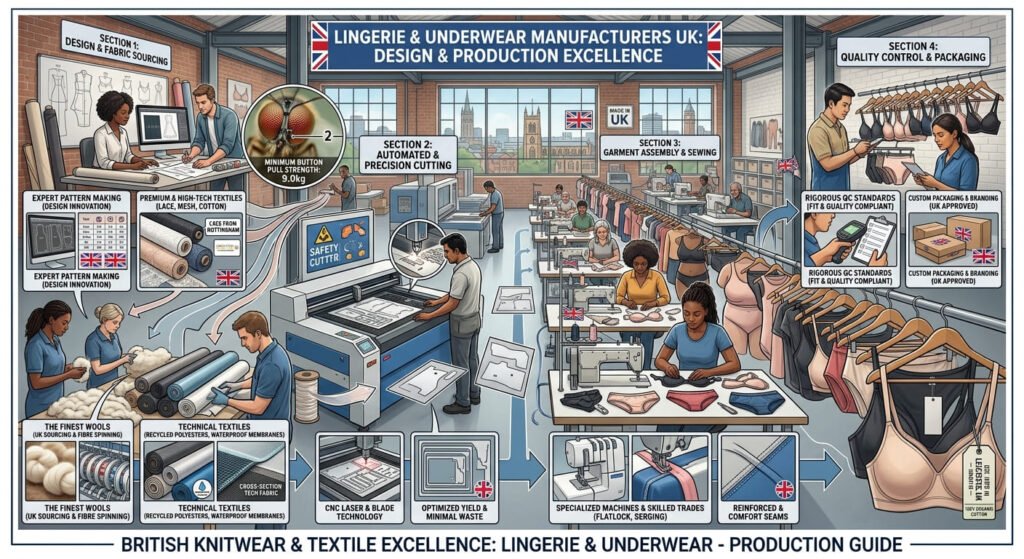
- 2.5. Anatomy of Lingerie Manufacturing
- 2.6. Pre-Production Timeline
- 2.7. Fabrics and Materials for UK Lingerie Production
- 2.8. Specialist Skills and Equipment Required
- 2.9. Bra Construction: Cups, Underbands, Straps and Closures
- 2.10. Lace, Mesh and Elastic — Where Production Often Goes Wrong
- 2.11. Seamless Underwear UK
- 2.12. MOQ and Lead Times for UK Lingerie
- 2.13. Cost of UK Lingerie Manufacturing
- 2.14. How to Brief a UK Lingerie Manufacturer
- 2.15. Common Lingerie Production Mistakes
- 2.16. How Silk Routes Supports Lingerie and Underwear Brands
- 2.17. FAQ
- 2.18. Build the Fit Before You Build the Order
A lingerie sample can look perfectly acceptable on a cutting table and still fail the moment it is worn.
The cup can collapse. Elastic can bite into the skin. Lace can twist. Straps can pull at the wrong angle. A hook-and-eye closure can sit slightly off-centre and ruin the entire fit.
That is why finding suitable lingerie and underwear manufacturers UK is different from sourcing ordinary fashion production.
Intimate apparel needs specialist pattern work, machines, operators, elastic control and very small tolerances.
Post Summary
Lingerie manufacturing is specialist work, not standard garment production
Structured bras need different skills from bralettes and basic underwear
Elastic tension can change the fit of the whole garment
Lace and stretch mesh need careful handling to avoid distortion
Cup shape, underband, straps and closures must work together
Underwear seams need to balance durability with comfort
MOQ depends on fabric, trims, cup components, colours and specialist processes
A low MOQ is not useful if the factory lacks intimate-apparel experience
Sampling should use production-equivalent elastic, lace, trims and closures
The manufacturer should be able to explain how fit and tension are controlled
Why Lingerie Requires a Specialist UK Manufacturer
Lingerie uses many of the same raw materials as other clothing.
The difference is how tightly everything has to work together.
A small change in elastic tension can alter:
Underband fit
Leg opening
Waist fit
Strap position
Cup stability
A few millimetres in cup, cradle or bridge construction can also affect comfort.
That is why a factory that makes dresses or T-shirts is not automatically suitable for lingerie.
The article brief specifically calls for specialist coverage of structured bras, soft-cup products and basic underwear, followed by fabrics, machinery, MOQ, cost and briefing.
Types of UK Lingerie and Underwear Manufacturers
Different intimate-apparel products need different capabilities.
| Manufacturer Type | Typical Products | Main Capability |
|---|---|---|
| Structured lingerie specialist | Underwired bras, balconettes, moulded bras | Cup, cradle and support construction |
| Soft-cup specialist | Bralettes, crop tops, non-wired bras | Stretch fit and elastic control |
| Underwear manufacturer | Briefs, boxers, trunks, high-waist briefs | Repetitive stretch construction |
| Luxury lingerie specialist | Lace bras, briefs, bodysuits | Delicate material handling |
| Seamless specialist | Seamless briefs, bras, base layers | Specialist knitting equipment |
| Technical underwear producer | Performance briefs, support underwear | Moisture and stretch management |
Bra and Structured Lingerie Specialists
Structured bras are among the most technically demanding garments in fashion manufacturing.
The factory may need to handle:
Cups
Cradles
Bridges
Underwires
Channeling
Wing elastic
Strap elastic
Rings and sliders
Hook-and-eye closures
Each element affects support.
A structured bra manufacturer should understand not only stitching but also the relationship between cup volume, band tension and strap placement.
Soft Cup and Bralette Producers
Bralettes are simpler than structured bras, but they are not basic garments.
They still rely on:
Stretch recovery
Underband stability
Strap positioning
Cup coverage
Seam comfort
A bralette with weak recovery may feel good during fitting but lose shape after repeated wear.
Underwear and Basics Manufacturers
Briefs, boxers and everyday underwear can look simple.
Production quality depends heavily on consistency.
The manufacturer needs control over:
Waist elastic
Leg elastic
Gusset placement
Coverstitch
Overlock
Seam bulk
Stretch recovery
For repeat production, elastic tension needs to remain consistent from garment to garment.
Which Lingerie Production Route Fits Your Product?
Interactive sourcing guide for bras, bralettes, briefs, bodysuits and seamless underwear.
Three Main Production Routes
Best for underwired, moulded or multi-piece cup products.
Best for soft bras, briefs, boxers and stretch basics.
Best for knitted-in shaping, smooth construction and reduced seams.
Interactive Production Route Checker
Find the manufacturer specialism that best matches your product
Manufacturer Capability Matrix
| Product | Best-Fit Capability | Critical Control | Typical Risk |
|---|---|---|---|
| Underwired bra | Structured bra specialist | Cup, cradle, band, closure | Fit imbalance |
| Bralette | Soft-cup lingerie specialist | Underband + strap tension | Weak support / gaping |
| Brief | Underwear specialist | Waist + leg elastic | Digging / bagging |
| Bodysuit | Lingerie specialist | Torso length + stretch | Pulling / distortion |
| Seamless underwear | Seamless knitting specialist | Yarn + knit zones | Wrong factory route |
Four Production Risk Zones
Anatomy of Lingerie Manufacturing
Pre-Production Timeline
All route suggestions are qualitative sourcing guidance and do not represent universal factory classifications.
Fabrics and Materials for UK Lingerie Production
Lingerie often combines several materials in one product.
| Material | Typical Use | Main Manufacturing Issue |
|---|---|---|
| Lace | Cups, panels, briefs | Distortion and pattern matching |
| Stretch mesh | Cups, wings, panels | Recovery and transparency |
| Microfibre | Briefs, bras, linings | Stretch and edge control |
| Cotton jersey | Everyday underwear | Shrinkage and recovery |
| Power mesh | Support panels | Compression and tension |
| Elastic | Waist, legs, straps | Tension consistency |
| Foam | Bra cups | Shape and lamination |
| Narrow trims | Decorative edges | Alignment and handling |
Lace
Lace needs careful cutting.
The design often has a visible repeat.
Poor placement can make the left and right sides of a bra or brief look unrelated.
For premium lingerie, symmetry matters.
Stretch Mesh
Stretch mesh can provide support without heavy weight.
But it can distort during cutting and sewing.
The manufacturer needs to control:
Grain
Stretch direction
Tension
Seam handling
Organic Cotton Underwear
Organic cotton can work well for everyday underwear.
Brands making an organic claim should keep supporting documentation for the fibre or fabric source.
For industry standards and preferred-fibre information, Textile Exchange is an established reference.
Specialist Skills and Equipment Required
Lingerie production often needs machines or attachments that are not central to normal fashion production.
| Capability | Typical Use | Why It Matters |
|---|---|---|
| Zigzag stitching | Elastic and lace | Allows controlled stretch |
| Three-step zigzag | Elastic attachment | Durable stretch seam |
| Coverstitch | Underwear hems | Flat and stretchable finish |
| Overlock | Seaming | Stretch construction |
| Elastic feeders | Waist/leg elastic | Helps tension consistency |
| Bartack | Strap or stress points | Reinforcement |
| Cup equipment | Structured bras | Shape control |
| Narrow-binding attachment | Edges | Consistent finishing |
The most important factor is still operator experience.
The right machine does not automatically create good lingerie.
The person using it needs to understand stretch behaviour.
Bra Construction: Cups, Underbands, Straps and Closures
A bra works as a system.
Cup
The cup controls shape and coverage.
It may be:
Cut-and-sew
Foam-lined
Moulded
Lace
Mesh
Underband
The underband provides much of the support.
If it is too loose, the bra rides up.
If it is too tight, the product becomes uncomfortable.
Straps
Straps should support without carrying the entire load.
Placement matters.
A small change at the back or front can affect pressure and cup position.
Hook-and-Eye Closure
The closure needs accurate positioning.
If the left and right wings do not align, fit and appearance both suffer.
Silk Routes Manufacturing Team: In lingerie, a tiny construction inconsistency can become a large fit problem once elastic tension is involved.
Lace, Mesh and Elastic — Where Production Often Goes Wrong
These three materials cause many avoidable problems.
Lace Distortion
Lace can stretch while sewing.
Result: uneven edges or asymmetry.
Control: stabilise handling and check left/right alignment.
Mesh Stretching
Mesh may be pulled too tightly during sewing.
Result: rippling or distorted fit.
Control: adjust machine tension and feeding.
Elastic Tension
Elastic can be stretched too much or too little.
Result: digging, gaping or uneven leg openings.
Control: define application tension during sample approval.
Seamless Underwear UK
Seamless underwear uses a different production route.
The garment may be knitted close to final shape using specialist machinery.
Benefits can include:
Reduced seam bulk
Smooth appearance
Stretch comfort
But “seamless” does not mean no development work.
The manufacturer still needs to control:
Yarn
Knit structure
Compression zones
Leg openings
Waist
Finishing
A normal cut-and-sew factory may not have this capability.
MOQ and Lead Times for UK Lingerie
There is no single useful MOQ for lingerie manufacturing.
MOQ depends on the construction route.
| Production Factor | Relative MOQ Pressure |
|---|---|
| Basic cotton briefs | Lower |
| Bralette | Moderate |
| Lace bralette | Moderate to higher |
| Structured bra | Higher |
| Moulded cup | Higher |
| Custom-dyed lace | Higher |
| Seamless production | Specialist / potentially higher |
MOQ can also be influenced by:
Fabric minimums
Elastic minimums
Lace minimums
Cup components
Hook-and-eye colours
Ring and slider colours
Dye lots
One garment can contain many small components.
Each component can create its own minimum.
The supplied brief requests MOQ statistics, but I have not included fixed 2026 figures without a verified current source.
Cost of UK Lingerie Manufacturing
Lingerie cost depends heavily on complexity.
| Cost Driver | Lower Complexity | Higher Complexity |
|---|---|---|
| Cup | Soft cup | Structured / moulded |
| Fabric | Single fabric | Lace + mesh + lining |
| Elastic | Basic | Several specialist elastics |
| Closures | None | Hook-and-eye |
| Hardware | Minimal | Rings + sliders |
| Pattern | Simple brief | Multi-piece bra |
| Stitching | Standard | Multiple specialist operations |
| Sampling | Fewer rounds | Fit-intensive development |
A structured bra can contain many more operations than a basic brief.
That means the labour cost cannot be judged from garment size alone.
How to Brief a UK Lingerie Manufacturer
The brief should be more detailed than a normal fashion sketch.
Include:
Product type
Size range
Cup range if relevant
Base size
Measurement chart
Fit intention
Fabric
Stretch direction
Lace
Mesh
Elastic type
Elastic width
Strap width
Rings
Sliders
Hook-and-eye
Underwire where relevant
Cup foam where relevant
Gusset
Stitching
Colours
Quantity
Packaging
For bras, also specify:
Cup construction
Cradle
Bridge
Wing
Underband
Strap placement
Closure width
Brands planning intimate-apparel collections can review our clothing manufacturing services before moving into sampling.
Common Lingerie Production Mistakes
1. Choosing a General Clothing Factory
Why it happens: The factory already makes other products for the brand.
Why it fails: Lingerie requires specialist elastic and fit control.
Fix: Ask for comparable intimate-apparel samples.
2. Approving the Wrong Elastic
Why it happens: Elastic looks similar in hand.
Why it fails: Recovery and tension differ.
Fix: Approve the actual production elastic.
3. Testing Fit Without Final Components
Why it happens: Temporary trims speed up sampling.
Why it fails: Strap, band and closure behaviour changes.
Fix: Use production-equivalent components for final fit approval.
4. Ignoring Lace Direction
Why it happens: The focus stays on colour.
Why it fails: Stretch and motif direction affect symmetry.
Fix: Mark cutting direction in the specification.
5. Treating Bralettes as Simple Tops
Why it happens: They have no underwire.
Why it fails: Underband and cup balance still matter.
Fix: Fit-test under movement.
6. Using One Elastic Tension Everywhere
Why it happens: Production is easier.
Why it fails: Waist, leg and underband areas behave differently.
Fix: Define each elastic application separately.
How Silk Routes Supports Lingerie and Underwear Brands
Intimate apparel needs coordination between pattern, materials, trims and fit.
Silk Routes can help brands organise:
Product specifications
Fabric selection
Lace
Mesh
Elastic
Hardware
Sampling
Fit feedback
Production instructions
The objective is to settle tension, fit and component choices before bulk production.
You can learn more about our manufacturing background on the About Silk Routes page.
FAQ
No Google People Also Ask results were available for this query, so the questions below are buyer FAQs rather than claimed PAA data.
Do I need a specialist manufacturer for lingerie?
For most lingerie products, yes.
A useful supplier check covers at least 4 areas: elastic handling, intimate-apparel patterns, specialist machinery and comparable samples.
Can a normal clothing factory make underwear?
Some can, especially simple cotton basics.
For more technical products, compare at least 3 capabilities: stretch stitching, elastic tension control and intimate-apparel fit experience.
What should I look for in a UK bra manufacturer?
Look for experience with cups, cradles, underbands, straps and closures.
A structured bra combines at least 5 interacting fit areas, so relevant production experience matters.
Is a bralette easier to manufacture than an underwired bra?
Usually, but it still requires careful fit and elastic control.
Check at least 3 areas: underband tension, cup coverage and strap placement.
What materials are commonly used for lingerie?
Common materials include lace, mesh, microfibre, jersey and elastic.
A single style may combine 4 or more different material types, so compatibility should be checked during sampling.
Build the Fit Before You Build the Order
Good lingerie manufacturing is about control.
Cup, elastic, lace, straps, seams and closures all affect the final garment.
The safest sourcing approach is to choose a manufacturer that already understands those interactions.
Ask to see comparable production.
Ask how tension is controlled.
Ask how fit is approved.
Those answers tell you far more than the MOQ alone.
For broader specialist manufacturing guidance, see our Specialist Clothing Manufacturers UK guide.