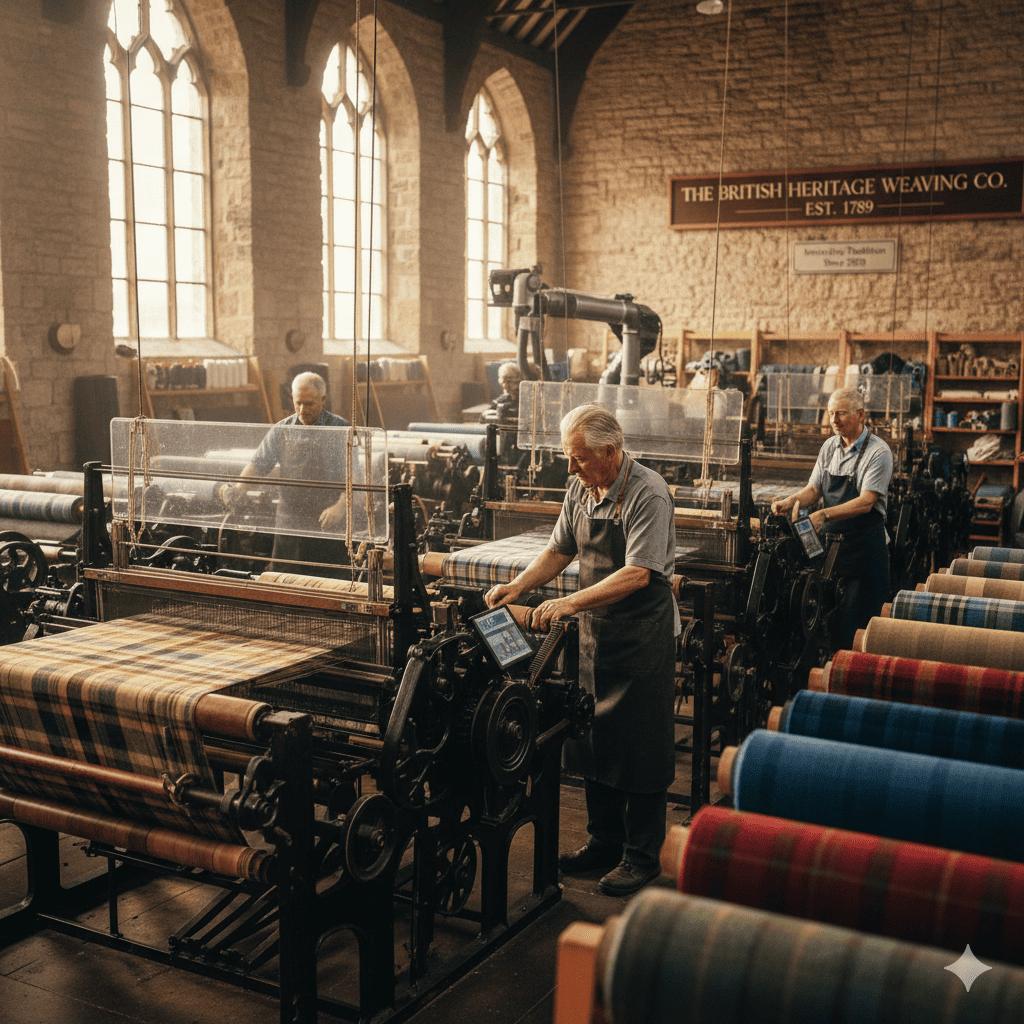
Britain’s fashion and textile industry contributes around £62 billion to the UK economy and supports roughly 1.3 million jobs. A meaningful slice of that manufacturing base runs through mills that have been operating for over a century, some considerably longer.
That’s the surprising fact most brands miss. The heritage mill sector isn’t a museum piece. It’s active, producing, and in several genuine cases owned or backed by major fashion houses, driven by demand for verified British provenance from domestic and international brands.
This guide covers the mills still operating, what they make, and how to approach them for a brand order.
For the broader context on UK manufacturing and sourcing, see our Complete Guide to Clothing Manufacturers in UK.
Post Summary
- Yorkshire remains the global centre for luxury woollen and worsted fabric production, with mills including Abraham Moon & Sons still active and accessible to brand-level orders
- Scotland’s cashmere and knitwear mills, led by Johnstons of Elgin and Todd & Duncan, remain among the most respected producers in the world, serving luxury brands globally
- Harris Tweed is the only fabric in the world protected by its own Act of Parliament; only cloth handwoven on the Outer Hebrides under the Orb hallmark qualifies
- Fox Brothers in Wellington, Somerset has produced cloth continuously on the same site since 1772, and remains accessible to smaller and emerging brands alongside its institutional clients
- Wales retains a small but genuine active flannel and wool weaving sector, with mills such as Melin Tregwynt still producing commercially
- Heritage mill relationships work differently to garment factory relationships, expect longer lead times, real minimum orders, and a seasonal production calendar
Contents
- 1. How Many British Heritage Textile Mills Are Still Active in 2026?
- 2. Yorkshire Wool and Worsted Mills
- 3. Scottish Cashmere and Knitwear Mills
- 4. West Country and Somerset Cloth Mills
- 5. Welsh Wool and Flannel Mills
- 6. How to Approach a Heritage Mill for a Brand Order
- 7. What Heritage Fabrics Command in Premium Retail Pricing
- 8. Mistakes Brands Make When Working With Heritage Mills
- 9. Heritage Mills: Questions Brands Ask Us
- 9.1. Which British heritage textile mills are still operating in 2026?
- 9.2. How do I source fabric from a British heritage mill as a small brand?
- 9.3. What is Harris Tweed and why is it different from other tweeds?
- 9.4. What minimum orders do Yorkshire wool mills typically require?
- 9.5. Is British heritage textile fabric more expensive than imported alternatives?
- 10. Heritage Fabrics Work When the Story Is Part of the Product
How Many British Heritage Textile Mills Are Still Active in 2026?
The UK textile manufacturing sector has contracted significantly from its Victorian-era peak but retains genuine depth in specific categories and regions. The sector’s continued scale, around £62 billion contributed to the UK economy and 1.3 million jobs across the wider fashion and textile industry, reflects design, retail, and the supply chain as a whole, not domestic mill production alone, but the active mill base within that figure is real and commercially significant.
What guides consistently misrepresent: they conflate “heritage mill” with “cottage industry.” The active Yorkshire wool cluster, Scotland’s cashmere sector, and West Country cloth mills are industrial-scale operations supplying global luxury and fashion brands, not artisan curiosities.
The honest caveat: heritage mills aren’t general-purpose fabric suppliers. They specialise deeply. A Huddersfield worsted mill produces suiting cloth, not jersey. A Scottish cashmere mill produces knitwear yarn, not woven fabric. Approaching the wrong mill for your product category wastes both parties’ time.
Yorkshire Wool and Worsted Mills
Yorkshire, specifically the corridor from Leeds to Huddersfield, remains a primary centre for luxury woollen and worsted fabric production. The cluster has contracted from its Victorian peak but retains genuine capability that few other countries replicate at comparable quality and depth.
| Mill | Location | Speciality | Est. |
|---|---|---|---|
| Abraham Moon & Sons | Guiseley, Leeds | Woollen cloth, tartan, tweed, furnishing fabric | c.1837 |
| Camira Fabrics | Mirfield, Huddersfield | Woven textiles for interiors, contract and apparel | 1974 |
Abraham Moon & Sons is one of the most accessible major Yorkshire mills for brand-level orders, with over 185 years of continuous operation. They produce stock-supported ranges in tartan, tweed, and classic woollen cloth available off-the-shelf for smaller brands, through a dedicated apparel stock service, alongside bespoke weaving for larger orders. Minimum order requirements for bespoke work are significant, typically in the hundreds of metres, but stock fabrics are available in smaller quantities.
Camira Fabrics is primarily focused on interior textiles but produces apparel-weight woven fabrics and has supplied the fashion market, with notably strong sustainability credentials including recycled wool blends and certified fibres.
What brands get wrong: approaching Yorkshire mills expecting garment manufacturing. These are fabric producers. You take the cloth and commission garment construction separately.
Scottish Cashmere and Knitwear Mills
Scotland’s textile heritage is concentrated in cashmere and knitwear, a sector where Scottish production retains a genuinely elite reputation and commands premium pricing globally.
| Mill | Location | Speciality | Est. |
|---|---|---|---|
| Johnstons of Elgin | Elgin, Moray | Cashmere, merino, and fine knitwear; woven fabric | 1797 |
| Todd & Duncan | Kinross | Fine cashmere and merino spinning; yarn production | 1867 |
| Barrie Knitwear | Hawick | Luxury cashmere knitwear, owned by Chanel since 2012 | 1903 |
Johnstons of Elgin is among the most complete heritage mills in Scotland, founded in 1797 and still spinning, weaving, and finishing both woven fabric and knitwear on the same site in Elgin. They supply some of the world’s most prestigious fashion houses and maintain a dedicated wholesale trade contact route for brand-level enquiries.
Barrie Knitwear in Hawick was founded in 1903 and acquired by Chanel in 2012, with the Barrie own-label brand launched in 2014. Barrie continues to produce for Chanel as part of the Métiers d’Art Maisons, and capacity for external brand orders is correspondingly limited.
Todd & Duncan in Kinross is a yarn spinner rather than a garment manufacturer, supplying cashmere and merino yarn to knitwear producers globally, including Barrie. Brands looking for Scottish cashmere yarn for their own knitwear production should approach Todd & Duncan directly.
“Scottish cashmere mills are not commodity suppliers. They have long-standing relationships with their existing clients, and cold outreach rarely succeeds. The most effective route in is through a shared contact, a Made in Britain connection, or attending Première Vision or Spinexpo where Scottish mills exhibit annually.” — Silk Routes Manufacturing Team
West Country and Somerset Cloth Mills
The West Country had a historic cloth-making industry centred on Somerset, Gloucestershire, and Wiltshire. Most of it is gone. What remains is genuinely notable.
Fox Brothers & Co in Wellington, Somerset is the most significant surviving West Country mill, producing cloth on the same site since 1772, continuously, without interruption, and now under independent ownership following a 2009 acquisition. Their specialisms are fine woollen flannel, cavalry twill, and worsted cloth, officially credited as the original creators of flannel itself. They supply bespoke tailoring houses including several Savile Row firms, and work with independent fashion labels on smaller fabric commissions.
Fox Brothers’ minimum orders for bespoke weaving are generally smaller than most Yorkshire mills, the mill actively works with emerging designers and smaller brands alongside their longstanding institutional clients. Their flannel and cavalry twill are genuinely difficult to source at comparable quality anywhere else in the world.
If you want to understand how UK-sourced heritage fabric fits within a full manufacturing programme, our clothing manufacturing services page covers how we structure production using both UK and offshore materials.
Welsh Wool and Flannel Mills
Wales retains a small but commercially active traditional textiles sector, concentrated in mid and west Wales. Welsh wool production has a distinct identity, looser weave structures, natural undyed wools, and traditional flannel and tapestry patterns genuinely hard to replicate outside the region.
Melin Tregwynt in Pembrokeshire is among the most commercially active Welsh mills, with a mill on the site since the 17th century and family ownership from 1912, now operated as an employee ownership trust since 2022. They produce blankets, throws, and fabric in traditional Welsh patterns, supply their own retail brand, and work with a small number of third-party clients.
Welsh mills are generally more accessible for small orders than Yorkshire or Scottish mills, minimum orders are lower and the mills are more accustomed to working with smaller brands and individual designers. The trade-off is that production capacity is correspondingly limited.
How to Approach a Heritage Mill for a Brand Order
Heritage mill relationships work differently from garment factory relationships. Several principles apply consistently across the sector.
Research before contact. Know exactly what the mill produces before you make contact. Calling a worsted suiting mill to ask about jersey fabric signals that you haven’t done basic research. Heritage mills are proud of their specialisms and respond poorly to uninformed enquiries.
Be specific about your requirements. State your fabric requirement, weight, fibre content, quantity, and timeline in your first contact. A vague enquiry asking for “woollen fabric samples” will rarely receive a useful response from a busy production mill.
Respect minimum orders. Most heritage mills have minimum order quantities that exist for good production reasons, setting up a loom for 20 metres of fabric isn’t commercially viable. Ask about minimums upfront and don’t attempt to negotiate them below viable production thresholds.
Attend trade shows. Première Vision Paris, Texworld London, and Spinexpo are where heritage mills present their seasonal collections and take appointments. Establishing a relationship in person at a trade show is significantly more effective than cold outreach.
Expect longer lead times. Heritage mill production runs to seasonal schedules. Many mills are allocated months ahead. Approach mills at least one full season in advance, 6 months minimum for woven fabric, longer for bespoke weaving.
“The worst approach we see brands make is treating heritage mills like fast fashion fabric suppliers, expecting same-week sampling and urgent production runs. These mills plan in seasons, not weeks. Brands that respect the production calendar get access to genuinely extraordinary materials.” — Silk Routes Manufacturing Team
What Heritage Fabrics Command in Premium Retail Pricing
Harris Tweed commands some of the highest premium positioning of any heritage textile in the UK. It’s the only fabric in the world protected by its own Act of Parliament, the Harris Tweed Act 1993, which legally requires every metre to be handwoven by islanders at their own homes in the Outer Hebrides, using pure virgin wool dyed and spun in the islands. The Harris Tweed Authority inspects and stamps every qualifying metre with the Orb hallmark. Any garment claiming Harris Tweed provenance without the orb hallmark on the fabric is misrepresenting its origin.
Scottish cashmere similarly commands retail premiums that reflect genuine scarcity and craftsmanship. Mills like Johnstons of Elgin and Barrie carry a price architecture that supports retail prices meaningfully above equivalent merino product, and substantially more than garments using cashmere blends sourced and processed elsewhere.
Fox Brothers flannel and West Country woollen cloth command modest but real premiums over imported woollen fabric in the same weight and quality tier. The premium is smaller than for Harris Tweed or cashmere, but the provenance story is compelling for brands working in tailoring and heritage menswear.
The commercial principle: heritage textile fabric adds most pricing power when the origin story is communicated actively, on labels, in brand copy, and in wholesale presentations. A garment made from heritage mill cloth with no mention of the mill carries significantly less retail premium than the same garment with the provenance front and centre.
Mistakes Brands Make When Working With Heritage Mills
Mistake 1 — Approaching a fabric mill expecting garment production. Brands conflate fabric manufacturing with garment manufacturing. Fix: heritage mills produce fabric. You need a separate UK garment manufacturer to construct the finished product from that fabric. Plan for two separate supplier relationships, fabric mill plus CMT factory.
Mistake 2 — Not requesting a minimum order confirmation before sampling. Brands invest time in sampling and then discover the minimum order is far above their volume needs. Fix: ask about minimum order quantities and pricing structure before requesting samples. Confirm whether stock-supported fabrics (available off the shelf in smaller quantities) exist alongside bespoke weaving minimums.
Mistake 3 — Contacting mills without knowing their seasonal calendar. Brands approach mills when they need fabric, not when mills are taking orders. Fix: research the mill’s seasonal production and trade show schedule. Most woven fabric mills are fully committed months ahead. Contact for the following season, not the current one.
Mistake 4 — Using “Harris Tweed” or “Scottish cashmere” in brand communications without verifiable provenance. Brands purchase woollen fabric from Scottish regions and describe it loosely as Harris Tweed or cashmere. Fix: Harris Tweed is a legally protected name. Only fabric bearing the Harris Tweed Authority orb stamp qualifies. Scottish cashmere should be sourced from a verifiable Scottish cashmere mill and documented. Origin claims without documentation are a trading standards liability.
Mistake 5 — Not building lead time for heritage fabric into the garment production critical path. Brands plan garment production lead times but not fabric procurement lead times. Fix: add fabric lead time, typically 8–16 weeks for bespoke weaving, 2–4 weeks for stock fabric, to the beginning of your critical path, before garment production lead time begins.
Heritage Mills: Questions Brands Ask Us
Which British heritage textile mills are still operating in 2026?
Among the most significant active heritage mills are Abraham Moon & Sons (Yorkshire wool), Johnstons of Elgin (Scottish cashmere and knitwear), Todd & Duncan (Scottish cashmere yarn), Barrie Knitwear (Scottish cashmere, Chanel-owned), Fox Brothers & Co (West Country woollen cloth), the Harris Tweed mills on the Outer Hebrides, Camira Fabrics (Huddersfield woven textiles), and Melin Tregwynt (Welsh wool). This isn’t an exhaustive list, the broader cluster includes smaller mills, specialist dyers, and finishing houses across Yorkshire, Scotland, and Wales.
How do I source fabric from a British heritage mill as a small brand?
The most accessible route for small brands is through mills that maintain stock-supported ranges, fabrics available off the shelf in smaller quantities without bespoke weaving minimums. Abraham Moon & Sons operates a dedicated apparel stock service, and Fox Brothers works with smaller and emerging brands alongside its institutional clients. For Scottish cashmere yarn, Todd & Duncan supply to knitwear producers at commercially viable quantities. Attend Texworld London or Première Vision Paris to meet mill representatives in person, cold outreach is generally less effective than trade show introductions.
What is Harris Tweed and why is it different from other tweeds?
Harris Tweed is a specific woven fabric protected by the Harris Tweed Act 1993, the only fabric in the world with its own Act of Parliament. It must be handwoven by islanders at their homes in the Outer Hebrides of Scotland, using pure virgin wool dyed and spun in the islands. Every metre is inspected and stamped with the Orb hallmark by the Harris Tweed Authority. No other tweed, however authentically British, qualifies for the Harris Tweed name or stamp.
What minimum orders do Yorkshire wool mills typically require?
Minimums vary significantly by mill and product type. For bespoke weaving of a specific cloth, minimums commonly run into the hundreds of metres depending on the mill. For stock-supported fabrics available from the mill’s existing range, considerably smaller quantities are accessible. Confirm directly with the specific mill, as minimums aren’t standardised across the Yorkshire cluster.
Is British heritage textile fabric more expensive than imported alternatives?
Yes, in most cases, reflecting labour costs, smaller production runs, and genuine quality differentiation in fibre processing compared to comparable-weight imported fabric. For brands that communicate the provenance story effectively, the fabric premium is recoverable through higher retail pricing and stronger brand positioning.
Heritage Fabrics Work When the Story Is Part of the Product
The mills covered in this guide have survived not because they produce cheaper fabric than their competitors, they don’t, but because they produce fabric that their competitors can’t replicate.
That distinction is the commercial opportunity for UK fashion brands. A garment made from Fox Brothers flannel woven continuously on the same site since 1772, or from Harris Tweed handwoven in a croft on the Outer Hebrides, carries a provenance story that no offshore alternative can match.
The story only works when it’s told. The brands that extract the most commercial value from heritage mill fabric are the ones that put the mill’s name on the label, the website, and the wholesale presentation, not the ones that treat the fabric as an undifferentiated input.
For the full context on UK manufacturing, heritage credentials, and how to build a Made in Britain sourcing strategy, our Complete Guide to Clothing Manufacturers in UK covers the complete picture.