
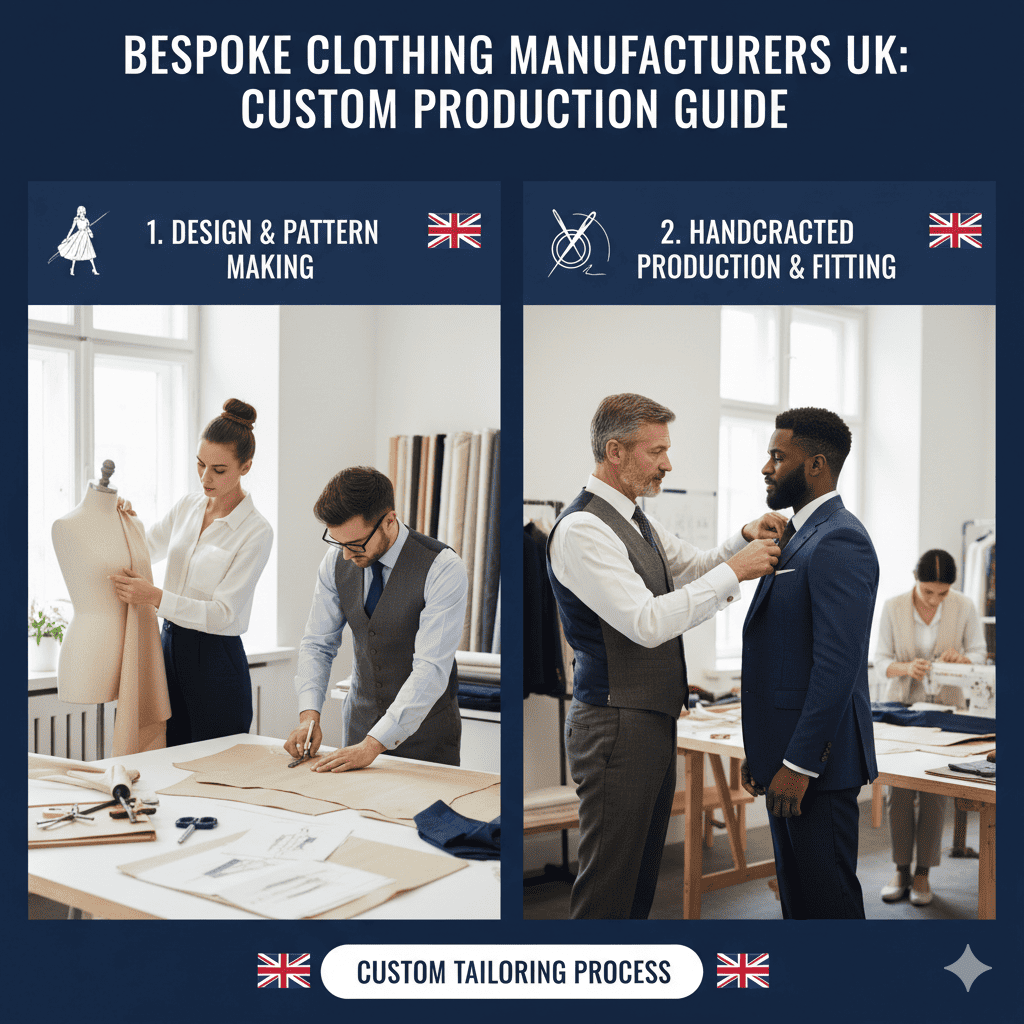
Most brands that think they need bespoke manufacturing do not.
They need custom. The distinction is not semantic — it changes who you approach, what you pay, and how long you wait.
Bespoke is pattern-from-scratch, made-to-individual-specification production. Custom is adaptation of an existing block or template to your requirements. The UK has excellent manufacturers for both. Approaching a bespoke specialist with a custom brief wastes time on both sides. Approaching a custom manufacturer with a genuinely bespoke brief produces a garment that does not exist yet — and a factory floor that is not equipped to make it.
Know which one you actually need before you make contact.
For context on the full range of UK clothing manufacturer types, see the Complete Guide to Clothing Manufacturers in UK.
Post Summary
- Bespoke clothing manufacturing is not the same as custom or made-to-measure — the differences affect cost, timeline, and who you should approach
- UK bespoke manufacturers by product specialism: tailoring, knitwear, uniforms, activewear, and luxury compared
- What a proper bespoke brief looks like — and why most brands get it wrong on the first attempt
- Real cost ranges for bespoke garment production in the UK in 2026
- Lead times for bespoke runs — and the stages where delays are most likely to occur
Contents
- 1. What Is Bespoke Clothing Manufacturing?
- 2. Bespoke vs Custom vs Off-the-Shelf
- 3. UK Bespoke Manufacturers by Specialism
- 4. How to Brief a Bespoke Manufacturer
- 5. Cost of Bespoke Clothing Production UK (2026)
- 6. Lead Times for Bespoke Garments
- 7. Common Mistakes When Commissioning Bespoke Clothing
- 8. Frequently Asked Questions
- 8.1. What Is the Difference Between Bespoke and Made-to-Measure Clothing Manufacturing?
- 8.2. What Is the Minimum Order Quantity for Bespoke Production in the UK?
- 8.3. How Much Should I Budget for Bespoke Clothing Development in the UK?
- 8.4. Can I Use the Bespoke Pattern I Commission for Production Elsewhere?
- 8.5. How Do I Find a Genuine Bespoke Clothing Manufacturer in the UK?
What Is Bespoke Clothing Manufacturing?
Bespoke clothing manufacturing starts with nothing.
No existing block. No adapted template. A pattern cutter works from your specification — measurements, construction details, material requirements — and builds the pattern from scratch.
Every subsequent stage flows from that original pattern. Toile development, fit sessions, correction cycles, final approval. Only then does production begin.
This is the correct process for genuinely original garments: a uniform with construction requirements no existing pattern satisfies, a technical garment with performance specifications that off-the-shelf blocks cannot meet, a luxury product where the construction itself is part of the brand proposition.
It is not the correct process for a t-shirt with a custom print, a hoodie in a non-standard colourway, or a jacket adapted from a manufacturer’s existing silhouette. Those are custom orders. The word “bespoke” does not make them otherwise.
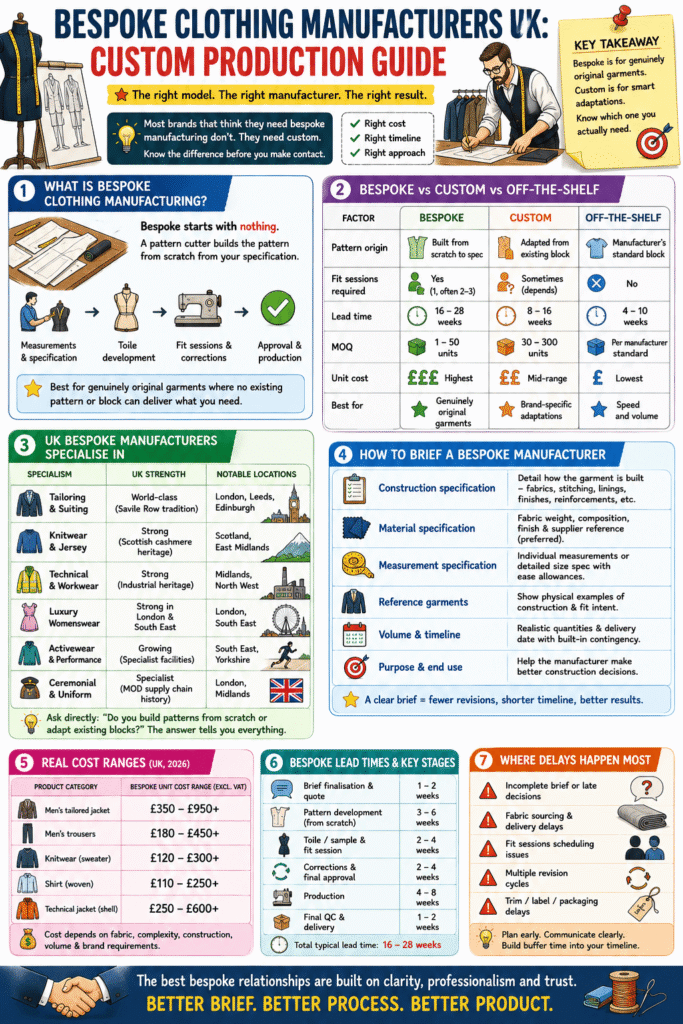
Bespoke vs Custom vs Off-the-Shelf
| Bespoke | Custom | Off-the-Shelf | |
|---|---|---|---|
| Pattern origin | Built from scratch to spec | Adapted from existing block | Manufacturer’s standard block |
| Fit sessions required | Yes — minimum 1, often 2–3 | Sometimes | No |
| Lead time | 16–28 weeks | 8–16 weeks | 4–10 weeks |
| MOQ | 1–50 units typical | 30–300 units typical | Per manufacturer standard |
| Unit cost | Highest | Mid-range | Lowest |
| Best for | Genuinely original garments | Brand-specific adaptations | Speed and volume |
The fit session requirement is the clearest operational distinction. Bespoke production requires at least one fit session on a live model or fit form before pattern approval. Custom production may or may not, depending on how far the adaptation departs from the source block.
If your brief does not require a fit session, you are almost certainly not commissioning bespoke production.
UK Bespoke Manufacturers by Specialism
UK bespoke manufacturing capability is concentrated in specific product categories. The heritage of British manufacturing shapes where genuine bespoke expertise exists.
| Specialism | UK Strength | Notable Locations |
|---|---|---|
| Tailoring and suiting | World-class — Savile Row tradition | London, Leeds, Edinburgh |
| Knitwear and jersey | Strong — Scottish cashmere heritage | Scotland, East Midlands |
| Technical and workwear | Strong — industrial heritage | Midlands, North West |
| Luxury womenswear | Strong in London and South East | London |
| Activewear and performance | Growing — specialist facilities | South East, Yorkshire |
| Ceremonial and uniform | Specialist — MOD supply chain history | London, Midlands |
Not every manufacturer that uses the word “bespoke” in their marketing operates a true bespoke production process. Ask directly: do you build patterns from scratch, or do you adapt existing blocks? The answer tells you immediately which category they fall into.
For performance and technical garments with specific construction requirements, UK manufacturers with a workwear or uniform background often have more relevant capability than those positioned as fashion-led bespoke producers.
How to Brief a Bespoke Manufacturer
A bespoke brief is not a mood board and a fabric reference. It is a technical document.
Arrive with the following before any manufacturer conversation begins:
Construction specification. What the garment must do structurally. For a tailored jacket: chest canvas or fused, shoulder construction, lining specification, pick-stitching requirement. For a technical garment: seam type, bonding or stitching, waterproofing integration points. If you cannot specify construction, you are not ready for a bespoke brief.
Material specification. Fabric weight, composition, finish, and supplier reference where you have a preference. Bespoke manufacturers can source fabric, but arriving with a material direction shortens the development timeline and reduces the number of decisions that can introduce error.
Measurement specification. For made-to-individual bespoke: individual measurements. For a brand producing a bespoke style at small volume: a detailed size specification with ease allowances. Not a generic size chart — a spec written for this garment.
Reference garments. If any existing garment comes close to what you are building, bring it. A physical reference communicates construction intent more precisely than a written description.
Volume and timeline. Realistic quantities and a delivery date with built-in contingency. Bespoke manufacturers working to unrealistic timelines produce rushed patterns. Rushed patterns produce fit problems. Fit problems produce additional sample rounds that destroy the timeline entirely.
“The briefs that produce the best bespoke outcomes share one characteristic — the client knows exactly what problem they are solving. Not what they want it to look like. What it needs to do.” — Silk Routes Manufacturing Team
If you want to discuss a bespoke or custom production requirement with Silk Routes before you finalise your brief, our clothing manufacturing services page covers our process and what we need from a new client.
Cost of Bespoke Clothing Production UK (2026)
Bespoke production costs more than custom or off-the-shelf at every stage. The premium reflects real additional labour at pattern development, toile, fit, and correction stages that custom and standard production do not require.
| Cost Stage | Typical Range (UK, 2026) | Notes |
|---|---|---|
| Pattern development | £300–£1,200 per style | Complexity and fit session count dependent |
| Toile / prototype | £150–£600 per sample | Fabric cost and construction time |
| Fit session (per round) | £100–£400 | Location and specialist rate |
| Production sample | £200–£800 per unit | Pre-bulk sign-off sample |
| Bulk unit cost | £80–£600+ per garment | Category and construction dependent |
These ranges are wide because bespoke spans genuinely different product categories — a bespoke workwear jacket and a bespoke tailored suit require different levels of pattern expertise, different labour inputs, and different material costs.
The stages most brands underbudget are fit sessions and correction cycles. A complex bespoke garment may require two or three fit sessions before the pattern is approved. Each session adds cost and time. Building three fit session rounds into your budget and timeline is safer than assuming one will suffice (Source: British Fashion Council, 2024).
Development costs — pattern, toile, fit sessions — are typically non-refundable regardless of whether bulk production proceeds. Treat them as a cost of the product development process, not a deposit against production.
Lead Times for Bespoke Garments
Bespoke production lead times are longer than any other production model — and less predictable, because fit session outcomes cannot be fully anticipated before the toile stage.
| Stage | Typical Duration | Variable |
|---|---|---|
| Brief to pattern draft | 2–4 weeks | Pattern complexity |
| Pattern to toile | 1–3 weeks | Fabric and cutting schedule |
| Toile to fit session | 1–2 weeks | Client availability |
| Fit to correction and re-toile | 1–3 weeks per round | Number of corrections |
| Pattern approval to production sample | 2–4 weeks | Manufacturer capacity |
| Production sample approval | 1–2 weeks | Client review speed |
| Production | 4–12 weeks | Volume and floor availability |
Total realistic lead time from brief to delivery: 16–28 weeks for a genuinely bespoke garment at small to mid volume.
Brands that need a garment in 10 weeks do not need bespoke production. They need a manufacturer with an existing block that can be adapted quickly. Bespoke cannot be compressed to meet a timeline that the process does not support.
The stage most likely to cause overrun is the fit and correction cycle. One fit session with significant corrections — a common outcome on complex garments — adds 3–5 weeks to the timeline automatically. Build that contingency in before you start.
Common Mistakes When Commissioning Bespoke Clothing
Confusing bespoke with custom and briefing accordingly. A brief that starts “I want this existing garment but with…” is a custom brief. Presenting it to a bespoke manufacturer as a pattern-from-scratch requirement wastes development time and produces a more expensive result than the brief warrants.
Underbudgeting development costs. Pattern development, toile, and fit sessions represent real labour from skilled pattern cutters who cannot be replaced by cheaper alternatives. Brands that negotiate development costs aggressively get pattern cutters who are working against their interests from the first session.
Treating the timeline as flexible. Bespoke production stages are sequential — each depends on the previous one being completed and approved. Compressing any stage produces errors that appear in the next one. Treat the timeline as fixed and build your launch date around it.
Approving a fit without a proper fit session. A sample approved from photographs, without a live fit session on an appropriate model or fit form, will not fit correctly in production. Attend fit sessions in person — this is not optional for bespoke production.
Not specifying construction — only aesthetics. A brief that describes how a garment should look is an aesthetic brief. A bespoke manufacturer needs to know how it should be built. If you cannot specify construction, engage a freelance garment technologist to translate your aesthetic brief into a construction specification before approaching manufacturers.
Assuming bespoke means unlimited revisions. Most UK bespoke manufacturers include one or two fit rounds in their development fee. Additional rounds are charged separately. Clarify the revision structure before work begins.
Frequently Asked Questions
What Is the Difference Between Bespoke and Made-to-Measure Clothing Manufacturing?
Made-to-measure adapts an existing pattern to individual measurements — the block exists, and dimensions are adjusted to fit. Bespoke builds the pattern from scratch to the individual specification, with no existing block as the starting point. Made-to-measure is faster and cheaper. Bespoke is appropriate when no existing block produces the correct result. Most clothing described commercially as “bespoke” is technically made-to-measure.
What Is the Minimum Order Quantity for Bespoke Production in the UK?
True bespoke production can be commissioned at quantities as low as one unit — this is the made-to-individual model of Savile Row tailoring. For brands commissioning a bespoke style for small-volume production, UK manufacturers typically require 10–50 units as a minimum to justify the pattern development investment. Below 10 units, the development cost per unit is rarely commercially viable for a brand producing for resale.
How Much Should I Budget for Bespoke Clothing Development in the UK?
Budget a minimum of £600–£2,000 for pattern development, toile, and one fit session on a garment of moderate complexity. For technically complex garments — structured tailoring, performance outerwear, ceremonial uniform — budget £2,000–£5,000 for the development stage before bulk production begins. These figures exclude fabric costs and bulk production unit costs.
Can I Use the Bespoke Pattern I Commission for Production Elsewhere?
The pattern belongs to you once development costs are paid in full — confirm this in writing before work begins. Some manufacturers include pattern ownership clauses that retain rights until a minimum production volume is reached. Read the development agreement before signing. If no written agreement is offered, request one before any work commences.
How Do I Find a Genuine Bespoke Clothing Manufacturer in the UK?
UKFT membership is the most reliable starting filter — UKFT members are verified UK manufacturers operating to industry standards. For tailoring and suiting, the Savile Row Bespoke Association lists verified bespoke tailors. For other categories, request a factory visit before committing — a manufacturer with genuine bespoke capability will have a pattern room, a toile process, and evidence of previous bespoke development work they can show you.